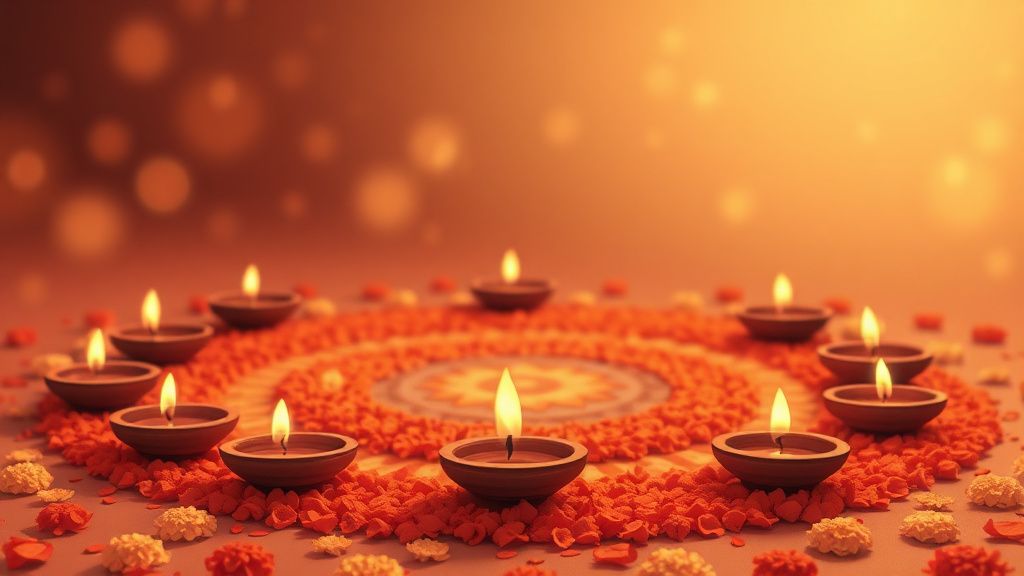
The Diwali house cleaning tradition is anchored to Dhanteras, the Trayodashi of Kartika Krishna Paksha, which in 2026 falls on Friday, 6 November. The classical reasoning is that Lakshmi enters only a cleaned house; the household practice extends backward from Dhanteras into the previous fortnight. Below is the room-by-room sequence most household priests recommend, the items that are traditionally bought new on Dhanteras (broom, vessel, gold token), and the Kuber and Dhanvantari pujas that frame the day.
Why the cleaning ends on Dhanteras, not Diwali
Lakshmi Puja on Diwali (8 November 2026) is the moment Lakshmi is formally invited into the house. The Dhanteras evening (6 November) is the moment the welcome is staged: the new vessel placed at the doorway, the new broom propped behind the door, the gold or silver token in the puja drawer. Cleaning therefore concludes on the morning of Dhanteras, leaving Dhanteras evening and the subsequent two days for ritual rather than physical work.
The classical guidance in the Skanda Purana names the principle that Lakshmi (the goddess of wealth) and Alakshmi (her opposite, the goddess of disorder and decay) cannot share a house. Cleaning literally removes Alakshmi; lamps and rangoli mark the doorway as Lakshmi-only.
Room-by-room sequence
- Puja room or shrine corner (first): the most important. Wipe down all murtis and photos. Clean brass vessels with a brass cleaner or with a paste of lemon, salt and ash. Replace cloth on the chowki. Wash and dry the kalash and any silver puja items.
- Kitchen (second): Lakshmi’s other principal location, since cooking and feeding are central to her domain. Empty cupboards, wipe shelves, discard expired masalas, refile spices. Scrub the stove. Clean the rice and dal storage containers.
- Entryway and doorway (third): the principal threshold for Lakshmi’s arrival. The threshold tile is washed daily during Diwali week. The doorway frame is washed, the new toran (door hanging) is hung on Dhanteras morning, and rangoli is drawn at the threshold.
- Living room (fourth): deep dust, wipe upholstery, vacuum carpets. Replace any cushion covers that have stains. Clean the chandelier or ceiling fan.
- Bedrooms (fifth): strip and wash bedding, dust headboards, clean under the bed, wipe wardrobes.
- Bathrooms (sixth): deep clean, descale taps and showerheads, replace any faded mats. The bathroom is not where Lakshmi is invited but a dirty bathroom signals general household disorder.
- Storage rooms and corridors (last): any space the household has been postponing dealing with. Decluttering is the principal task.
For what it’s worth, working in this order is more rewarding than starting with the storage room. The puja room is small and quickly cleaned; the visible improvement creates momentum for the larger spaces.
The Dhanteras purchases
Dhanteras is treated as the most auspicious day of the year to acquire metal items, with three categories specifically:
- The new broom (jhadu): the most overlooked of the three. The broom is treated as a representation of Lakshmi; sweeping is the act by which she clears poverty. A new broom is bought on Dhanteras morning and used for the first time after a small puja at the home shrine.
- A new vessel (utensil) in copper, brass, silver or steel: the classical “naya bartan.” The vessel is filled with water and placed at the puja chowki on Dhanteras evening. Common choices are a small lota, a thali, or a kalash.
- Gold, silver or copper token: historically a gold or silver coin; in contemporary practice, a small gold token (1 to 8 grams) or a silver Lakshmi coin from the family jeweller.
The broom is symbolic, the vessel is functional, the gold token is the wealth-store. All three are treated as offerings to Lakshmi rather than purchases for the household: this framing is what makes the Dhanteras transaction ritually distinct from any other shopping.
The Dhanteras evening puja
Dhanteras evening sees three pujas overlapping at the same chowki:
- Dhanvantari Puja: Dhanvantari is the physician of the gods, said to have emerged from the Samudra Manthana with the pot of amrita. Health is the first wealth; the day’s name (dhana-trayodashi or dhanvantari-trayodashi) carries both meanings.
- Lakshmi Puja: a smaller version of the Diwali Lakshmi Puja, with the kalash and the new vessel placed before Lakshmi.
- Kuber Puja: Kubera is the treasurer of the gods; the north direction is treated as his. A small lamp is lit facing north on Dhanteras evening.
Some households add Yama Deepam, a clay diya placed outside the front door facing south, for Yama (lord of death). This is the protective layer: Yama receives a lamp so that he does not visit the household during the Diwali week.
Practical considerations
- Start early: a week of one-room-per-day is more achievable than a single weekend marathon. The cleaning effort itself is the offering.
- Hire help where needed: household help in metro cities is heavily booked through Diwali week. Book deep-clean services by mid-October.
- Don’t buy what you do not need: the Dhanteras token purchase is the ritual minimum. Heavy retail spending is not part of the religious frame, despite contemporary marketing.
- Save heavy cooking for after Dhanteras: mithai and the festival meal are prepared from Dhanteras evening onward; the cleaning week is too busy for elaborate kitchen output.
Common questions
What if the household cannot afford a gold purchase?
The classical guidance is that the Dhanteras purchase is symbolic; even a copper coin or a steel ladle is sufficient if bought with sankalpa. The amount is irrelevant to the ritual. Households without budget for gold or silver buy a steel or copper utensil; this is canonically equivalent.
Is the cleaning to be done by the women only?
No. The classical injunction is to the householder, not specifically to the women. Contemporary households share the work across family members. The puja room cleaning is often kept by the elder of the family regardless of gender; kitchen and shrine cleaning are participatory.
Should the old broom be discarded?
Yes, but respectfully. The old broom is taken out of the house after the new broom is installed; in some traditions it is given to a sweeper community member or burned in the Dhanteras evening lamp. Either is canonical; what is avoided is throwing it into the regular trash without acknowledgement.
One limitation worth noting
Specific regional Dhanteras customs (Vasubaras in Maharashtra, the kakad aarti tradition in some Vaishnava households, the Yama Deepam south-facing diya, the south Indian abhyanga snana) vary widely. The sequence above is the north Indian Smarta-Vaishnava form. Adjust for your family’s tradition; the broom-vessel-gold triad is the most universal element.
For background see Wikipedia on Dhanteras and the Drik Panchang 2026 Dhanteras page.