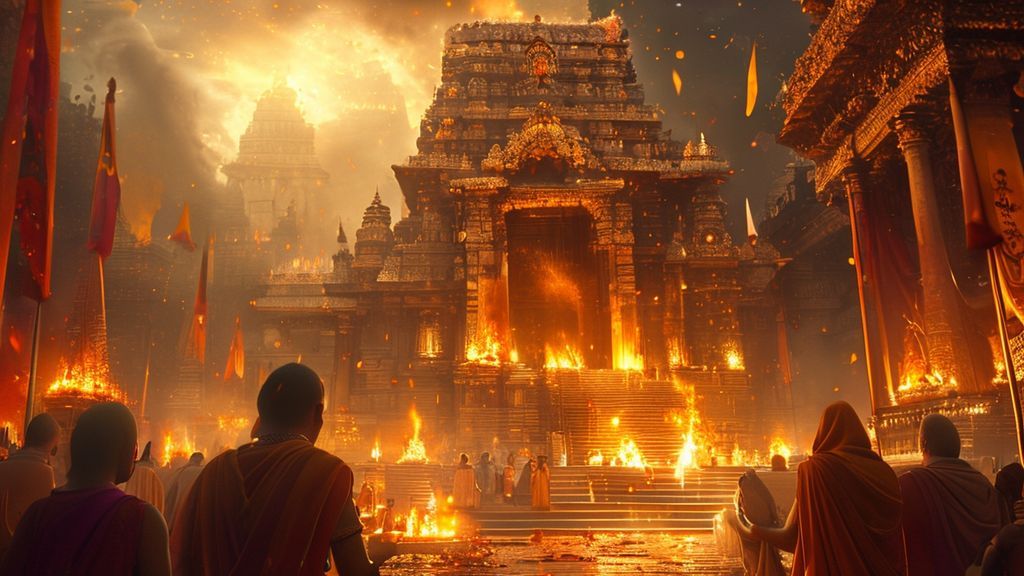
Fire in a dream, from a Sanatana Dharma perspective, is a potent symbol intricately linked to Agni Dev, the divine messenger and purifier. It often signifies transformation, purification, divine presence, sacrifice, and spiritual awakening, reflecting one’s inner state and karmic journey, guiding the seeker towards self-realization and dharma.
| Attribute | Details |
|---|---|
| Deity Represented | Agni Dev (अग्नि देव) |
| Location/Origin | Vedic Pantheon; born from the friction of two Arani (sacred wood) or from the Sun. |
| Key Festivals/Rituals | Agnihotra, Agnistoma, Yajnas, Deepavali, Kartika Purnima. Integral to all Hindu Sanskaras. |
| Primary Scripture Reference | Rig Veda Mandala 1, Sukta 1 (अग्निमीळे पुरोहितं…); Yajur Veda; Atharva Veda. |
| Symbolic Meanings in Dreams | Purification, transformation, destruction of evil, divine knowledge, creation, illumination, sacrifice. |
The Primal Power of Agni: A Gateway to Deeper Understanding
In the vast expanse of Sanatana Dharma, Agni, the sacred fire, holds an unparalleled position. Not merely an element, Agni Dev is a powerful Vedic deity, the divine priest who carries oblations to the Devas, the illuminator of truth, and the purifier of all existence. When this potent force manifests in our dreams, it is never a random occurrence but a profound spiritual message, a glimpse into the cosmic dance of creation, preservation, and dissolution that shapes our individual journeys. Understanding the symbolism of fire in dreams, therefore, becomes a crucial step for any sincere seeker aiming to decode the subtle language of the divine.
Our ancient Rishis, through rigorous Tapasya and profound insight, understood that dreams are not mere neural firings but a conduit to the subconscious and the superconscious realms. They are a medium through which higher intelligence communicates, revealing hidden truths, warning of impending changes, or guiding us towards our Dharmic path. The appearance of fire in this sacred space of dreams necessitates careful, reverent interpretation, anchoring its meaning in the timeless wisdom of the Vedas, Puranas, and Upanishads. For those dedicated to spiritual growth, discerning these symbols is paramount.
Agni Dev in Itihasa and Purana: Legends of the Divine Fire
The reverence for Agni is as ancient as Sanatana Dharma itself. The Rig Veda begins with the hymn “अग्निमीळे पुरोहितं यज्ञस्य देवमृत्विजम्। होतारं रत्नधातमम्॥” (Rig Veda 1.1.1) – “I glorify Agni, the high priest of the sacrifice, the divine, the ministrant, who offers the oblation, the possessor of great wealth.” This verse immediately establishes Agni’s supreme importance as the intermediary between humanity and the celestial realms.
Agni’s birth is recounted in various ways, signifying his omnipresent nature. The Atharva Veda speaks of Agni being born from the waters, while other texts describe him as the son of Dyaus (Heaven) and Prithvi (Earth), or as a manifestation of Brahman itself. He is often depicted with two heads, signifying his power to consume and to grant; seven tongues, representing the seven rays of light and his ability to devour offerings; three legs, symbolizing the three worlds; and four arms, holding a rosary, a spear, a pot of ghee, and a flaming torch.
In the Mahabharata, Agni plays a pivotal role during the Khandava-daha Parva. Suffering from indigestion due to consuming excessive oblations, Agni seeks Arjuna and Krishna’s help to consume the entire Khandava forest, which was protected by Indra. With Krishna’s divine intervention and Arjuna’s celestial weaponry, Agni successfully incinerates the forest, thus regaining his health. This narrative highlights Agni’s power of consumption, transformation, and liberation, even for the Devas themselves.
The Ramayana also features Agni prominently during Sita’s Agni Pariksha. To prove her purity after her abduction by Ravana, Sita enters a blazing pyre. Agni Dev himself rises from the flames, unharmed, carrying Sita and affirming her immaculate virtue. This event underscores Agni’s role as the ultimate purifier and witness to truth. As mentioned in the Skanda Purana, Agni is revered as Vaisvanara, the universal fire dwelling within all beings, responsible for digestion and life itself.
The Sacred Geometry of Agni: Architectural and Scientific Foundations
While “fire in a dream” is an abstract concept, its earthly manifestation is deeply rooted in Vedic architecture and scientific principles. The construction of the Agnikundam (sacred fire pit) or the Vedi (altar) for Yajnas is not arbitrary but follows precise mathematical and geometrical specifications outlined in texts like the Shulba Sutras. These ancient texts are foundational to Indian geometry and demonstrate a profound understanding of sacred spaces.
The dimensions and shapes of the Vedic altars, such as the circular Garhapatya (household fire), the square Ahavaniya (sacrificial fire), and the semi-circular Dakshinagni (southern fire), are meticulously defined. The famous Syena-chit (hawk-shaped altar), described in the Yajur Veda, required an exact area of 7.5 square Purusha, constructed with 10800 bricks of specific dimensions, reflecting advanced knowledge of geometry and astronomy. This precision ensured that the Agni, when invoked, would resonate with cosmic energies, effectively channeling the oblations to the respective deities and ensuring the desired outcomes.
Modern science is only beginning to grasp the subtle energies involved in Agnihotra, the ancient Vedic fire ritual. The specific herbs (Samidhas) offered, the synchronized chanting of Mantras, and the precise timing of the offering create a potent energetic field that purifies the atmosphere, rejuvenates the environment, and promotes physical and mental well-being. This symbiotic relationship between fire, sound, and matter exemplifies the holistic scientific wisdom embedded within Sanatana Dharma, making a visit to Hindutva.online a truly enlightening experience for those seeking to understand these timeless connections.
Interpreting Agni’s Manifestation: Rituals and Puja Vidhi for Dream Clarity
When fire appears in a dream, it demands introspection and sometimes, specific spiritual practices. While there isn’t a “puja for fire in a dream,” understanding the nature of Agni Dev and performing a simple puja can help in deciphering the dream’s message and integrating its wisdom. This helps to establish a clear channel with the divine.
- Purification (Snanam): Begin with a purifying bath, invoking holy rivers like Ganga, Yamuna, Godavari.
- Sankalpa (Intention): Sit in a clean space, facing East. Articulate your intention – to understand the dream’s message, to seek Agni Dev’s guidance, or to purify any negative energies.
- Lighting a Diya: Light a lamp (Diya) with ghee, symbolizing the presence of Agni. Offer a small amount of rice, flowers, or a spoonful of ghee into the flame, while chanting Agni Mantras.
- Dhyana (Meditation): Meditate on Agni Dev, visualizing his purifying light. Reflect on your dream, asking for clarity.
- Purnahuti (Full Offering): Offer a final oblation, mentally or physically, seeking Agni’s blessings for understanding and auspiciousness.
- Pranama (Prostration): Conclude with prostrations, expressing gratitude to Agni Dev and the divine for guidance.
A positive dream of a bright, controlled fire often signifies purification, spiritual progress, or transformation. A destructive, uncontrolled fire might indicate inner turmoil, a need for release, or a warning of impending challenges that require careful handling. Regular connection with Agni through simple rituals fosters intuition and spiritual discernment.
Mantras and Chants for Agni Dev
Chanting Agni Mantras can invoke the deity’s presence and aid in dream interpretation, offering protection and clarity. These potent vibrations resonate with the energy of Agni, purifying the mind and environment.
- Vedic Agni Mantra:
ॐ अग्निमीळे पुरोहितं यज्ञस्य देवमृत्विजम्। होतारं रत्नधातमम्॥
Om Agnimīḷe purohitaṃ yajñasya devamṛtvijam। hotāraṃ ratnadhātamam॥
(Meaning: I glorify Agni, the high priest of the sacrifice, the divine, the ministrant, who offers the oblation, the possessor of great wealth.) - Agni Gayatri Mantra:
ॐ महाज्वालाय विद्महे अग्निदेवाय धीमहि। तन्नो अग्निः प्रचोदयात्॥
Om Mahājvālāya Vidmahe Agni Devāya Dhīmahi। Tanno Agniḥ Prachodayāt॥
(Meaning: Om, let us meditate on the Great Flames, Oh, God of Fire, grant us higher intellect. May Lord Agni illuminate our minds.) - Simple Agni Bija Mantra:
ॐ रं अग्निदेवाय नमः॥
Om Raṁ Agnidevāya Namaḥ॥
Reciting these mantras with devotion before sleep or upon waking can help establish a connection with Agni Dev, seeking his guidance and protection.
Dos and Don’ts When Encountering Fire in Dreams
Understanding the proper etiquette and approach is crucial when interpreting such significant dream symbols within the Dharmic framework.
- Do:
- Reflect deeply on your current life situation, challenges, and aspirations.
- Perform a simple Agni puja or light a lamp as an offering and a plea for clarity.
- Chant Agni mantras to purify your mind and surroundings.
- Seek guidance from a knowledgeable elder or spiritual mentor if the dream is particularly vivid or disturbing.
- Practice self-purification (Tap, Daan, Tirthayatra) to align with positive energies.
- Don’t:
- Dismiss the dream as mere fantasy, especially if it recurs or is intense.
- Panic or fear a destructive fire without seeking deeper meaning; it often signifies transformation.
- Misinterpret the symbolism through a purely materialistic lens.
- Speak negatively about the dream; always seek its auspicious implications.
- Neglect personal hygiene or spiritual practices after such a potent dream.
What does a bright, controlled fire in a dream signify?
A bright, controlled fire typically represents purification, enlightenment, spiritual progress, and transformation. It suggests that positive changes are underway, obstacles are being cleared, and divine blessings are present. It can also signify a strong inner will or a successful completion of tasks.
Is seeing a destructive fire in a dream always a bad omen?
Not necessarily. While a destructive fire can symbolize upheaval, anger, or loss, in a spiritual context, it often signifies the burning away of old patterns, negative karma, or outdated beliefs that no longer serve one’s highest good. It can be a powerful symbol of profound, albeit intense, transformation leading to rebirth and renewal. One must look at the accompanying emotions and specific context within the dream.
How can one discern the specific meaning of Agni’s appearance in a dream?
Discerning the specific meaning requires deep self-reflection, introspection, and an understanding of one’s current life circumstances. Consider the nature of the fire (bright, dim, consuming, creative), the emotions it evokes, and any other symbols present. Meditate on Agni Dev, seek inner guidance, and consult relevant scriptural insights or trusted spiritual guides to unravel the layers of meaning. Connecting with resources like Hindutva.online can also provide valuable context and traditional interpretations.
Agni’s Eternal Flame: Preserving Sanatana Dharma Through Symbolic Understanding
The profound symbolism of Agni Dev manifesting in our dreams is a testament to the living, breathing tradition of Sanatana Dharma. It reminds us that the cosmos is imbued with conscious energy, constantly communicating with us through myriad forms. By attentively interpreting these divine messages, particularly those as primal and powerful as fire, we not only gain insight into our individual spiritual journeys but also reinforce our connection to the ancient wisdom of our Rishis.
To dismiss such dreams as mere subconscious noise is to ignore a rich tapestry of spiritual guidance that has nourished seekers for millennia. Understanding Agni’s role in dreams encourages us to embrace purification, accept transformation, and acknowledge the divine presence in every aspect of our lives. This conscious engagement with sacred symbols preserves the essence of Dharma, ensuring that the eternal flame of knowledge continues to illuminate the path for future generations.