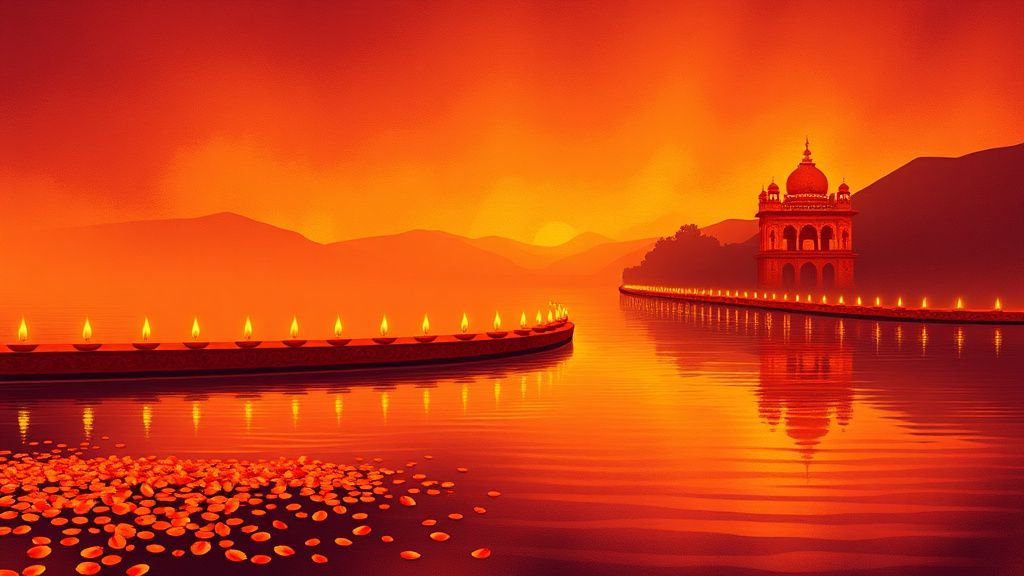
The Nashik-Trimbakeshwar Simhastha is the Kumbh Mela of Maharashtra, held once every twelve years when Jupiter enters the zodiac sign of Leo (Simha). The next full Simhastha runs from October 2026 through July 2028, with the principal shahi snans concentrated in 2027. The mela unfolds across two distinct sacred sites: Ramkund at Panchavati in Nashik on the Godavari, used by the Vaishnava akharas, and Kushavarta Kund at Trimbakeshwar (~38 km from Nashik), used by the Shaiva akharas. Below is the 2027 schedule, the dual-site structure, and what makes Nashik Simhastha distinct from the other three Kumbhs.
The 2026-2028 Simhastha cycle
- Mela opens: October 2026 (with Jupiter’s entry into Leo).
- Principal shahi snans: 2027, on dates set by the mela administration.
- Mela closes: July 2028 (with Jupiter’s exit from Leo).
- Duration: approximately 21 months, the longest of any Kumbh cycle.
- Twin sites: Ramkund (Nashik) for Vaishnava akharas, Kushavarta Kund (Trimbakeshwar) for Shaiva akharas.
Why two sites for one Kumbh
The Nashik-Trimbakeshwar Simhastha is the only Kumbh held across two separate sacred sites simultaneously. The reason is doctrinal: the Vaishnava akharas (which trace their origin to Ramanandacharya and other Bhakti sant lineages) and the Shaiva akharas (which trace to Adi Shankara’s dashanami order) had historically disputed shahi snan precedence at the same ghat in previous Simhasthas, with the 1690 and 1808 melas producing documented violence between the two groups.
The Peshwa administration in the 18th century, and later the British, brokered the split: Vaishnavas to bathe at Ramkund in Nashik, Shaivas at Kushavarta in Trimbakeshwar. This arrangement has held since. The split is the most distinctive structural feature of Nashik Simhastha; the other three Kumbhs see all akharas at a single ghat.
Ramkund at Panchavati
Ramkund is the bathing ghat on the Godavari at Panchavati, the suburb of Nashik where the Ramayana places Rama, Sita and Lakshmana’s forest exile. The Ramayana account (Aranyakanda, Valmiki) names Panchavati as the location of Surpanakha’s encounter with Rama and the subsequent Sita-haran. The kund itself is traditionally read as the spot where Rama bathed and where Lakshmana performed his daily rituals.
The Vaishnava akharas (Digambara, Nirvani, Nirmohi) lead their shahi snans here. The procession from the akhara camp at Tapovan to Ramkund, a march of about 3 km, is the principal Simhastha image of Nashik. Crowd density on shahi snan days exceeds 50 lakh pilgrims at peak.
Kushavarta at Trimbakeshwar
Trimbakeshwar is ~38 km from Nashik, at the source of the Godavari (also called Gautami in classical texts). The Trimbakeshwar Jyotirlinga is one of the twelve Jyotirlingas, with the unique iconography of three faces (Trimbak: Brahma, Vishnu, Shiva) on a single lingam. The Kushavarta Kund, fed by the Godavari source, is where the Shaiva dashanami akharas (Mahanirvani, Niranjani, Juna, Atal, Avahan, Anand, Agni) lead their shahi snans.
The Trimbakeshwar Temple Trust runs the puja and ritual cycle; the Maharashtra government’s Mela Authority runs the security and crowd-control infrastructure. The town of Trimbak is small (population under 15,000 in normal times) and absorbs millions of pilgrims during the shahi snan days; tent cities are erected on the surrounding agricultural land.
The history of the Simhastha
The Nashik-Trimbak Simhastha’s age is uncertain; its association with the Kumbh-amrita myth is relatively recent (consolidated in the 20th century). The Khulasat-ut-Tawarikh (1695) describes a 12-yearly gathering at Trimbakeshwar when Jupiter entered Leo, calling it the most famous gathering in the Berar Subah of the Mughal Empire. The mela has been continuously held since; the modern Indian state has overseen it since 1956.
Previous Simhasthas: 1956, 1968, 1980, 1992, 2003-2004, 2015-2016. The 2015 Simhastha drew an estimated 12 crore visitors across its full cycle. The 2026-2028 cycle is expected to exceed that.
Practical points for visiting
- Nashik base: Nashik city has hotels, the Nashik Road railway station (NK) and Ozar airport (~20 km). The Mela Authority’s tent city in 2015 was at Tapovan, north of the river; a similar arrangement is planned for 2027.
- Trimbakeshwar accommodation: very limited; most visitors stay in Nashik and commute. The Mela Authority publishes shuttle bus timings on shahi snan days.
- Travel between sites: Nashik to Trimbakeshwar is ~38 km by road, 1 to 2 hours depending on traffic; shahi snan days see severe congestion.
- Documents: Aadhaar or other government ID, mela registration via the official portal once it opens.
- Climate: the Simhastha cycle spans winter to early summer in 2027; the August-September monsoon edges are avoided for shahi snans, which fall in the cooler months.
For what it’s worth, the most rewarding visit pairs both sites: one day at Trimbakeshwar for the Shaiva atmosphere and the Jyotirlinga darshan, one day at Ramkund for the Vaishnava procession. Doing only one of the two misses the structural distinctiveness of the Nashik Simhastha.
Common questions
Why is the Godavari called the Ganga of the South?
The Godavari rises at Trimbakeshwar in the Western Ghats and flows ~1,465 km to the Bay of Bengal. The classical Sanskrit name Gautami links it to the sage Gautama, whose tapas is said to have brought the river to earth. The “Ganga of the South” phrase reflects the parallel ritual status: bathing in the Godavari is treated as equivalent to the Ganga in Maharashtrian and Telugu tradition.
Can both Ramkund and Kushavarta be visited on the same day?
Yes, if planned. Leave Nashik by 5 AM, reach Trimbakeshwar by 6:30 AM, complete Jyotirlinga darshan and Kushavarta bath by 9 AM, return to Nashik for Ramkund by 11 AM. On shahi snan days, road closures make the same-day plan impossible; on non-shahi-snan days, it is realistic.
What is the Tapovan camp?
The Tapovan area north of the Godavari at Nashik hosts the akhara camps and the Mela Authority’s tent city. Public access during the mela is permitted at scheduled hours; the camps are working religious settlements rather than tourist sites. Many pilgrims do a parikrama (circumambulation) of the camp area before bathing.
One limitation worth noting
Specific shahi snan dates, akhara processional order and infrastructure availability are announced by the Maharashtra government’s Mela Authority a few months before the principal 2027 bathing days. The dates above describe the cycle envelope; for booking and travel decisions, the Mela Authority portal closer to the date is the authoritative source.
For background see Wikipedia on the Nashik-Trimbakeshwar Simhastha and the Wikipedia entry on Trimbakeshwar Shiva Temple.
