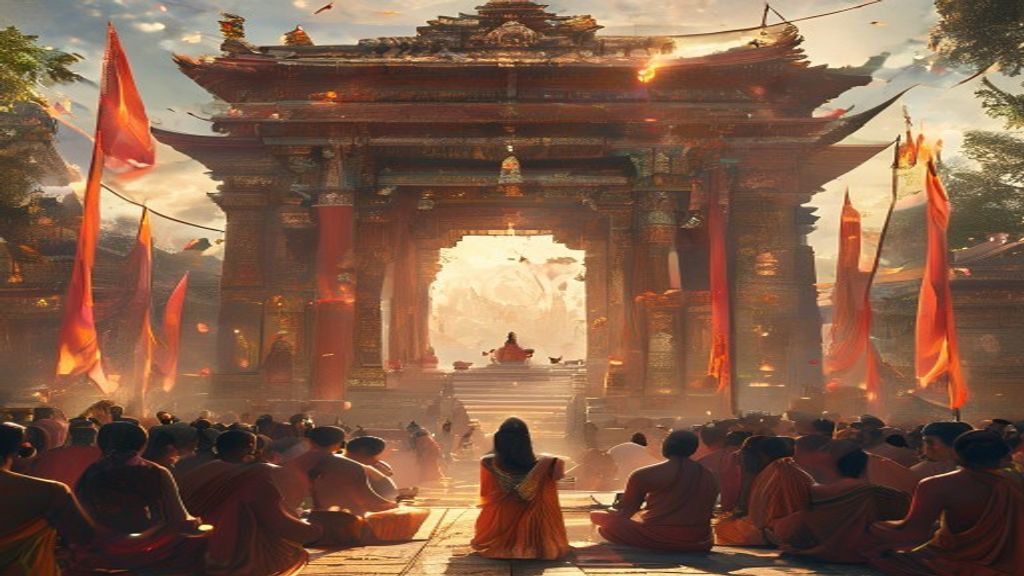
Hindu-Buddhist relations are deeply intertwined, rooted in a shared spiritual and philosophical heritage originating on the sacred land of Bharatavarsha. Hinduism reveres Buddha as the ninth Avatar of Vishnu, signifying an unbroken spiritual lineage. Both traditions emphasize Dharma, Karma, Ahimsa, and the pursuit of liberation (Moksha or Nirvana), making them profound expressions of Sanatan Dharma’s expansive wisdom.
| Attribute | Details |
|---|---|
| Shared Philosophical Roots | Dharma (cosmic law, righteous conduct), Karma (action and consequence), Samsara (cycle of rebirth), Tapas (asceticism), Dhyana (meditation), Ahimsa (non-violence). |
| Key Figures & Lineage | Lord Buddha (Siddhartha Gautama), revered in Hinduism as the ninth Avatar of Bhagavan Vishnu. |
| Core Tenets | Suffering as inherent to existence, the importance of ethical conduct, the path to liberation from suffering, and the recognition of impermanence. |
| Scripture References | Hindu: Bhagavata Purana, Varaha Purana, Agni Purana, Upanishads. Buddhist: Tripitaka (Sutta Pitaka, Vinaya Pitaka, Abhidhamma Pitaka). |
| Architectural & Artistic Overlap | Cave complexes (Ajanta, Ellora, Bagh), Stupas (dome-shaped mounds), Chaityas (prayer halls), Vimanas (temple towers), shared iconography of celestial beings (Yakshas, Yakshinis). |
The Unbroken Thread: Sanatan Dharma and Buddhism
The spiritual landscape of Bharat has been graced by a multitude of profound paths, each a unique ascent towards the Absolute Truth. Among these, Hinduism and Buddhism stand as two monumental traditions, not as disparate entities, but as expressions of a shared spiritual quest. Their relationship is one of continuous dialogue, mutual influence, and deep reverence, fundamentally shaping the civilization of India and beyond. From the foundational concepts of Dharma and Karma to the ultimate goal of liberation from suffering, the philosophical currents that nourished both traditions flowed from the same ancient spring of Sanatan Dharma.
This guide illuminates the intricate tapestries woven between these two great faiths, exploring their shared heritage, their Puranic narratives, their architectural synchronicity, and the enduring lessons they offer for every sincere seeker. We shall uncover how, far from being rivals, they represent distinct yet complementary facets of a grand spiritual continuum.
Lord Buddha: An Avatar of Vishnu in Hindu Puranas
The most compelling testament to the intimate connection between Hinduism and Buddhism lies in the Hindu Puranic tradition, which explicitly recognizes Siddhartha Gautama, the Buddha, as an incarnation of Lord Vishnu. This unique “Information Gain” is central to understanding the Hindu perspective on Buddhism.
As detailed in the Bhagavata Purana (1.3.24), it is stated: “Then, in the beginning of Kali-yuga, the Lord will appear as Lord Buddha, the son of Anjana, in Gaya, for the purpose of deluding those who are envious of the faithful theists.” Similar mentions are found in the Agni Purana (16.1-2), Varaha Purana (49.22), and the Matsya Purana (47.247). These scriptures posit that Lord Vishnu incarnated as Buddha for a specific divine purpose: to preach Ahimsa (non-violence), particularly to those who misused Vedic injunctions to justify indiscriminate animal sacrifices. He also appeared to lead astray those who had become excessively materialistic and atheistic, guiding them towards a path of ethical conduct and self-realization, albeit through a seemingly non-Vedic framework initially. The Garuda Purana (I.206.1-6) even lists ten avatars including Buddha. This Puranic interpretation frames Buddha’s mission as a corrective measure, a compassionate intervention by the Divine to guide humanity back to righteousness and to emphasize the profound ethical core inherent in all Dharma.
Architectural & Scientific Marvels: A Confluence of Devotion
The shared heritage of Hinduism and Buddhism is not merely philosophical but is magnificently etched in stone across Bharat. Many ancient sites demonstrate a seamless fusion or co-existence of both traditions, reflecting centuries of shared patronage and artistic exchange. The renowned cave complexes of Ajanta and Ellora in Maharashtra stand as prime examples. While Ajanta is predominantly Buddhist, Ellora hosts a breathtaking array of Buddhist, Hindu, and Jain cave temples carved side-by-side, showcasing similar architectural techniques and iconographic styles. The Kailasa Temple at Ellora (Cave 16), a monolithic Hindu marvel, demonstrates the same intricate carving and engineering prowess seen in the Buddhist Chaityas and Viharas.
The concept of the Stupa, a dome-shaped sacred mound, predates Buddhism, having roots in ancient Indian burial practices and Vedic fire altars. However, it was within Buddhism that the Stupa evolved into a profound symbol of the Buddha’s presence and enlightenment. Similarly, the structural elements found in early Buddhist architecture, such as the Torana (ornamental gateway) and the Vedika (railing), find parallels in Vedic and later Hindu temple architecture. The depiction of Yakshas and Yakshinis, celestial beings, is common to both Hindu and early Buddhist art, signifying a shared mythological substratum. This symbiotic relationship in art and architecture is a powerful testament to the underlying unity of spiritual expression on the Indian subcontinent, as further explored on Hindutva.online.
Shared Practices and Paths: The Puja Vidhi of Dharma
While specific rituals may differ, the fundamental spiritual practices that lead to inner transformation are profoundly shared. For both Hindu and Buddhist devotees, the path involves:
- Dhyana (Meditation): Central to both traditions, whether it is Vipassana or Shamatha in Buddhism, or various forms of Yoga and Dhyana in Hinduism. Both aim to quiet the mind, attain insight, and experience deeper states of consciousness.
- Mantra Japa (Chanting): The repetitive chanting of sacred sounds or names to purify the mind and invoke divine energies. While specific mantras differ, the power and purpose of sound vibration are universally acknowledged.
- Tirtha Yatra (Pilgrimage): Visiting sacred sites is a revered practice in both faiths. Hindus often visit Buddhist pilgrimage sites like Bodh Gaya, recognizing the profound spiritual energy associated with such places, and vice-versa.
- Dana (Generosity) and Seva (Selfless Service): Both traditions emphasize the importance of giving and serving others as a means of accumulating merit and purifying the heart.
- Ahimsa (Non-Violence): Perhaps the most significant shared ethical principle, Ahimsa is foundational to both Hindu Dharma and Buddhist teachings, extending to all sentient beings.
These shared vidhis underscore that the ultimate goal of both paths is the alleviation of suffering and the realization of ultimate truth, irrespective of the specific terminology used.
Mantras & Chants: Echoes of Enlightenment
While Buddhism has its specific protective mantras, the spirit of devotion and the invocation of peace resonate deeply with Vedic chants. A universal mantra of peace, relevant to all Dharmic traditions, is:
ॐ शान्तिः शान्तिः शान्तिः |
Om Shantih Shantih Shantih
(Om Peace, Peace, Peace.)
This embodies the universal aspiration for inner and outer tranquility, a goal common to both Hindu and Buddhist practitioners. Furthermore, the essence of Lord Buddha’s teachings on compassion finds resonance in ancient Hindu texts. For example, the Bhagavad Gita (12.13-14) describes the ideal devotee as one who is “अद्वेष्टा सर्वभूतानां मैत्रः करुण एव च” (adveṣṭā sarvabhūtānāṁ maitraḥ karuṇa eva ca) – “one who is not envious of any being, who is a friendly and compassionate friend.” This perfectly encapsulates the Bodhisattva ideal of Mahakaruna (great compassion).
Dos and Don’ts for Fostering Shared Heritage
- Do Practice Mutual Respect: Acknowledge and honor the distinct yet interconnected paths. Understand that diverse expressions lead to the same spiritual goal.
- Do Study Both Traditions: Engage with the scriptures and teachings of both Hinduism and Buddhism to appreciate their depth and shared wisdom.
- Do Visit Shared Sacred Sites: Experience the spiritual energy of places like Ellora, Ajanta, or Bodh Gaya, recognizing their significance for both communities.
- Don’t Engage in Sectarianism: Avoid rhetoric that creates division or denigrates one tradition in favor of another. Sanatan Dharma embraces diversity.
- Don’t Misrepresent Teachings: Be diligent in understanding the core tenets of each faith rather than relying on superficial interpretations.
- Do Uphold Ahimsa: Live by the principle of non-violence in thought, word, and deed, as it is a foundational pillar for both spiritual paths.
Is Lord Buddha a part of the Hindu pantheon?
Yes, in mainstream Hindu traditions, Lord Buddha is revered as the ninth Avatar of Bhagavan Vishnu. This integration reflects Hinduism’s inclusive nature and its capacity to incorporate diverse spiritual figures within its expansive framework, recognizing their contributions to Dharma. This perspective is rooted in several Puranic texts, as discussed above.
What are the fundamental differences between Hinduism and Buddhism?
While sharing a common cultural and philosophical substratum, some key differences include Buddhism’s emphasis on “Anatta” (non-self) in contrast to the Hindu concept of “Atman” (eternal soul) and “Brahman” (ultimate reality). Additionally, early Buddhism did not emphasize the existence of a Creator God in the same way as some Hindu schools. However, both traditions ultimately seek liberation from the cycle of Samsara through ethical conduct, meditation, and wisdom.
Are there shared sacred sites that Hindus and Buddhists visit together?
Absolutely. Many sites are revered by both. The cave complexes of Ajanta and Ellora, for instance, showcase centuries of shared artistic and spiritual endeavors. Bodh Gaya, where Lord Buddha attained enlightenment, is a primary Buddhist pilgrimage site but is also respected and visited by Hindus, particularly given Buddha’s status as a Vishnu Avatar. Varanasi, a sacred Hindu city, also has significant Buddhist sites like Sarnath nearby.
The Dharmic Significance: Unity in Diversity
The profound relationship between Hinduism and Buddhism stands as an eternal testament to the expansive and accommodating nature of Sanatan Dharma. It illustrates that spiritual truths can be expressed through manifold paths, each valid and leading towards the ultimate reality. The recognition of Buddha as a Vishnu Avatar is not merely a historical or theological footnote but a living example of how the Vedic tradition embraces new insights and societal needs, perpetually renewing itself while retaining its core principles. This shared heritage strengthens the spiritual fabric of Bharat and indeed, the world, emphasizing compassion, wisdom, and the enduring quest for liberation. It is a powerful reminder that while forms may vary, the essence of Dharma remains one, guiding all beings towards light and truth, a principle central to our mission at Hindutva.online.
