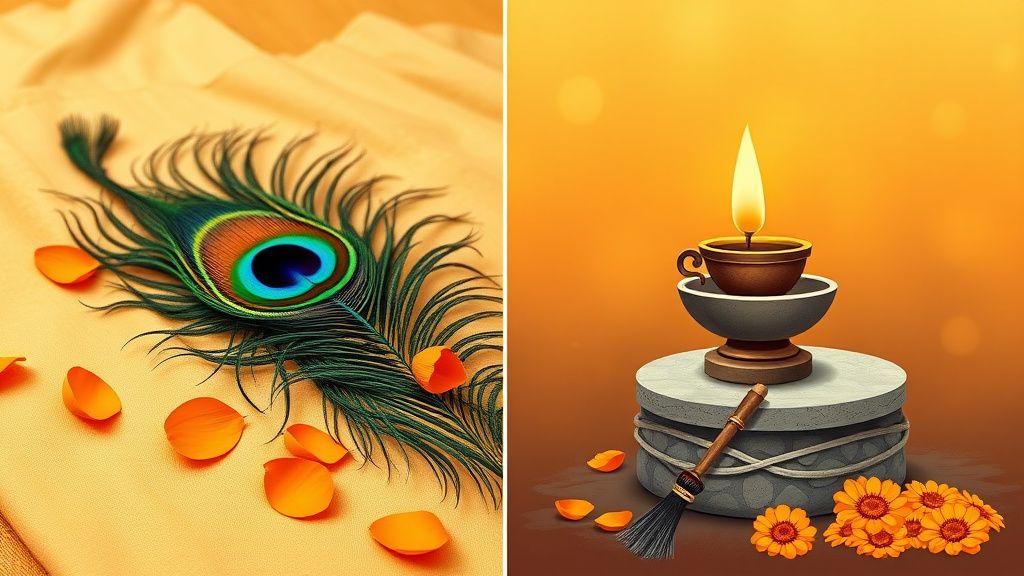
The Janmashtami jhula (palna) is the small decorative swing in which the Laddu Gopal or Bal Krishna idol is placed and rocked on the festival night marking Krishna’s birth. The basic setup is a wooden, brass, or fabric-suspended cradle 6 to 12 inches wide, hung from a small bamboo or metal frame on the home altar, decorated with marigold and rose garlands, fairy lights or small diyas, peacock feathers, and dressed with a small yellow or red cloth bedding. After the midnight abhishekam, the family gently rocks the swing while singing Krishna bhajans. This article covers the parts of the jhula, the decoration sequence, the symbolism, and the practical points couples and home-puja organisers ask.
The jhula frame: choosing material
The jhula has two parts: the frame (the stand from which the cradle hangs) and the cradle itself (the small swing-bed where the idol sits). The standard materials:
- Wooden jhula: the classical option, often in sheesham or rosewood, with hand-carved arches and turned pillars. Sizes range from a 6-inch tabletop jhula for a Laddu Gopal up to a 18-inch one for a larger Bal Krishna. Folding wooden jhulas are sold seasonally in the weeks before Janmashtami in temple bazaars across North India.
- Brass jhula: a smaller, heavier option, suited to a permanent place on the household altar. The brass version is reused year after year and is often inherited from grandparents.
- Cloth and bamboo: the home-DIY version. A square of red or yellow cloth is tied at four corners to a bamboo frame, making a simple hammock-style cradle.
- Cardboard or paper: for school crafts and children’s home setups; covered in coloured paper, glitter, and string.
The frame is placed on the puja chowki (low wooden platform) facing east or north, with the rest of the household altar arranged around it.
Dressing the cradle
The cradle holds the idol on a layered bed:
- A small mattress of soft cotton wool or quilt, about an inch thick.
- A red, yellow, or peacock-blue cloth covering the mattress.
- A tiny pillow at the head end, often embroidered.
- A small odhna (cover blanket) draped lightly over the idol after the midnight rock.
- The Laddu Gopal or Bal Krishna idol placed in the centre, with the head facing east.
The idol itself is bathed (abhishekam) at midnight with milk, curd, ghee, honey, and sugar (the panchamrit), then dressed in fresh clothes — a yellow dhoti, a red or peacock-blue chola, a small crown with a peacock feather, and miniature jewellery. After dressing, the idol is placed in the cradle and the swing is gently rocked.
Floral and decorative elements
The standard decoration around the jhula:
- Floral garlands: marigold for the frame arches, rose petals scattered on the cradle, jasmine garlands hung from the side pillars. Mogra (Arabian jasmine) is the preferred fragrant flower for Krishna.
- Peacock feathers: two or four small peacock feathers tied to the corners of the frame or arranged in a small vase beside the jhula. The peacock feather is Krishna’s defining ornament.
- Fairy lights: soft yellow LED strings wrapped around the frame, giving a glow without overheating the cloth or paper elements.
- Diyas: small clay diyas placed at the four corners of the chowki, lit during the puja and aarti.
- Banana plant or bamboo stems: in older households, two small banana stems are placed on either side of the chowki as ritual markers; in apartments, bamboo poles wrapped with mango leaves serve the same purpose.
- Toy cows and butter pot (matki): small clay or wooden cow figurines, and a tiny matki tied with red thread, placed near the jhula to evoke the Gokul setting of Krishna’s childhood.
The symbolism
The jhula carries direct narrative meaning. The Bhagavata Purana (Book 10) describes Krishna’s birth at midnight in the prison of Mathura and his transfer to Nanda and Yashoda’s home in Gokul, where he was cradled and nursed. The home jhula ritual is the family taking on the role of Yashoda and Nanda, welcoming the newborn deity and rocking him to sleep.
The swing also evokes the later kunj-jhulan tradition: the swings hung in the kadamba groves of Vrindavan, in which Radha and Krishna are depicted swinging together during the monsoon month of Shravan. Some households extend the swing ritual through Hariyali Teej (Shravan), Jhulan Yatra in Puri (Ekadashi to Purnima in Shravan), and into Janmashtami itself, treating the whole month as a swinging season for the deities.
The midnight ritual sequence
The home Janmashtami sequence with the jhula:
- Evening setup (around sunset): the chowki, jhula frame, and idols are arranged. The fast has been observed through the day.
- Evening puja (around 9 p.m.): a preliminary aarti is performed, with the idol still on the main puja platform (not yet in the jhula).
- Midnight abhishekam (around 11:45 p.m. to 12:30 a.m.): at the exact midnight muhurta of Krishna’s birth (Nishita Kal), the idol is bathed with panchamrit, dressed in fresh clothes, and placed in the jhula.
- Rocking the cradle: the swing is rocked gently while the family sings bhajans (Govind Bolo Hari Gopal Bolo, Sri Krishna Govinda Hare Murare, the Krishnashtakam).
- Aarti and bhog: the midnight aarti is offered, with bhog of dhaniya panjiri, makhan-mishri (butter and rock sugar), and panchamrit distributed as prasad. The fast is broken with the prasad.
For what it’s worth, the rocking is meant to be gentle and rhythmic, not vigorous; the cradle is treated as if a real infant lies in it. Children in the household are usually given the first turn at the rocking.
DIY jhula in five steps
For a household without a wooden or brass jhula, a working home version takes about an hour:
- Take four lengths of bamboo or thick wooden dowels, about 12 inches long, and tie them together at the top to form a tripod or four-leg frame.
- Cut a 10-inch square of red or yellow soft cotton cloth. Tie strong cotton thread or ribbon at each corner.
- Attach the four threads to a single hook at the top of the frame. The cloth now hangs as a hammock cradle.
- Lay a small folded cotton mat inside the cradle. Place a tiny pillow at one end.
- Decorate the frame with marigold garlands, peacock feathers, and fairy lights.
Common questions
When exactly is the swing rocked?
At the Nishita Kal — the midnight muhurta on the eighth lunar day of Krishna paksha in Bhadrapada (the festival day). The Nishita Kal is roughly 24 minutes spanning midnight; the exact local window is published each year in the panchang. The idol is placed in the jhula at this moment, and the rocking and aarti follow immediately. The jhula is then kept set up overnight, with the idol back on the main altar by the next morning.
Should the swing be left rocking all night?
No; the rocking is part of the ceremony, not a continuous overnight motion. After the midnight aarti, the cradle is allowed to settle, the odhna is draped lightly over the idol, and the family continues with bhajans and prasad distribution. By 1 or 1:30 a.m. the active ritual is complete; the decoration is left in place through the next day for visitors.
Which idol size suits which jhula?
A Laddu Gopal of 2 to 4 inches fits a small 6-inch wooden or brass jhula meant for a household altar. A larger 6 to 8 inch Bal Krishna needs a 10 to 12 inch jhula. Excessively large idols look out of scale with a home jhula and are better placed on a chowki next to the empty jhula, which holds a symbolic flower or a smaller travel-Krishna. The frame should be at least one and a half times the height of the idol to allow the swinging clearance.
A limitation worth noting
The Janmashtami jhula tradition described here is primarily North Indian (Vraj-Mathura, Punjab, Rajasthan, UP, MP). South Indian Sri Krishna Jayanthi observances (mainly in Tamil Nadu, Karnataka and Kerala) use a different setup, with the Krishna footprint pattern (small footprints drawn in rice flour leading into the house) being the central decorative element rather than the swing. For South Indian Krishna Jayanthi rituals, the local Iyengar or Madhva household practice, or a community priest, is the better source.
For background, see the Krishna Janmashtami entry on Wikipedia and the entry on Jhulan Yatra.
