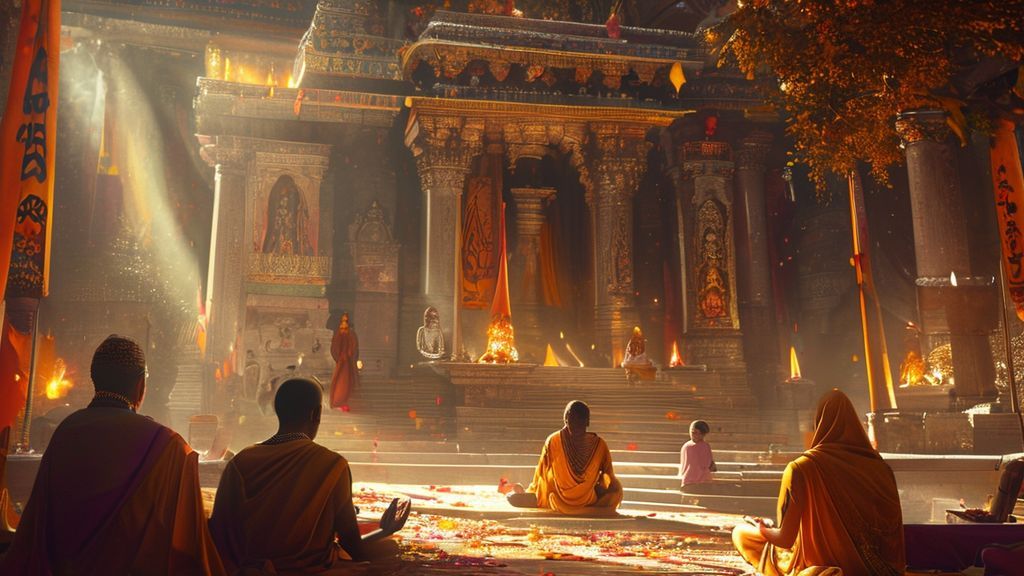
ADHD and meditation find profound synergy in Sanatan Dharma’s ancient wisdom, where techniques for cultivating single-pointed focus (एकग्रता – *Ekagrata*) directly address the challenges of a restless mind. Hindu focus techniques, rooted in the Vedas and Yoga Shastras, offer structured paths like Dharana and Dhyana to calm mental fluctuations (*Chitta Vritti Nirodha*), enhance concentration, and promote inner peace, transforming the experience of an unsteady mind into an opportunity for spiritual growth.
| Attribute | Details |
|---|---|
| Hindu Concept of Mind Restlessness | चञ्चल मनस् (*Chañchala Manas*), विक्षेप (*Vikshepa*) – distraction, agitation |
| Core Solution Pathways | धारणा (*Dharana*) – Concentration, ध्यान (*Dhyana*) – Meditation, प्राणायाम (*Pranayama*) – Breath Control, भक्ति योग (*Bhakti Yoga*) – Devotion |
| Key Scripture References | भगवद् गीता (*Bhagavad Gita*), योग सूत्र (*Yoga Sutras of Patanjali*), उपनिषद् (*Upanishads*) |
| Primary Aim | एकग्रता (*Ekagrata*) – single-pointed focus, चित्त वृत्ति निरोध (*Chitta Vritti Nirodha*) – cessation of mental fluctuations |
Introduction: Calming the Chanchala Manas for Spiritual Ascendance
In the vast ocean of Sanatan Dharma, the human mind (मनस् – *manas*) is understood as both a powerful instrument for liberation and a potential source of bondage. For those who experience what modern parlance terms “ADHD” – a mind characterized by restlessness, fleeting attention, and difficulty in sustaining focus – our ancient Rishis and Yogis offered not just remedies, but transformative pathways. The concept of the चञ्चल मनस् (*chañchala manas*), or the restless mind, is deeply acknowledged in our scriptures, notably in the Bhagavad Gita where Arjuna himself laments its tempestuous nature. Lord Krishna, in His divine discourse, assures that while difficult, control of the mind is indeed achievable through persistent practice (अभ्यास – *abhyasa*) and dispassion (वैराग्य – *vairagya*). Hindu focus techniques are not merely about managing symptoms; they are profound spiritual practices designed to purify the mind, harness its immense potential, and ultimately guide the individual towards inner tranquility and Self-realization.
Puranic History & Yogic Lineage of Concentration
The quest for controlling the mind and achieving unwavering focus has been central to the spiritual journeys of countless sages and deities throughout Itihasa and the Puranas. The very foundation of Yogic philosophy, codified by Maharishi Patanjali in his Yoga Sutras, defines Yoga as “योगश्चित्तवृत्तिनिरोधः” (*Yogaś Citta Vṛtti Nirodhaḥ*) – the cessation of the fluctuations of the mind. This single statement encapsulates the profound understanding that true liberation stems from mastering the inner landscape.
Numerous narratives illustrate this principle. Sage Vishwamitra, despite his initial struggles and distractions, performed millennia of intense tapasya (austerities) and dharana (concentration) to achieve the status of a Brahmarishi, a feat requiring unparalleled mental discipline, as recounted in the Valmiki Ramayana. Even Lord Shiva, revered as Yogeshwara, the Lord of Yoga, exemplifies perfect समाधि (*Samadhi*), a state of profound meditative absorption where the mind is completely still. His iconography often depicts Him in deep meditation, radiating absolute tranquility, a testament to the power of divine concentration. The stories of Dhruva Maharaja’s unwavering devotion and focus on Lord Vishnu, mentioned in the Vishnu Purana, illustrate how single-pointed concentration, even from a young age, can lead to direct divine vision and boons. These ancient accounts serve not as mere legends, but as practical blueprints for training the mind, demonstrating that even the most restless or distracted mind can be brought to a state of profound stillness through dedicated practice.
The Architecture of Consciousness: Yogic Science of Focus
Sanatan Dharma’s approach to the mind is akin to a sophisticated science of consciousness. It maps the inner architecture with precision, offering tools to not just manage but transform the mind’s operational framework. The mind is not seen as a monolithic entity but as having various layers and functions. The concept of एकाग्रता (*Ekagrata*), or one-pointedness, is the cornerstone. This isn’t about suppressing thoughts but rather directing the entire mental faculty towards a single object, idea, or mantra. The Yoga Sutras of Patanjali systematically outline the eight limbs of Yoga, with धारणा (*Dharana* – concentration) and ध्यान (*Dhyana* – meditation) being the sixth and seventh limbs, sequentially leading to समाधि (*Samadhi* – absorption).
Dharana is the initial stage where the mind learns to hold its focus on one point, be it the breath, a mantra, a deity’s image, or a specific chakra. This practice builds mental stamina, much like physical exercise builds muscle. Dhyana is the sustained flow of concentration, where the meditator becomes one with the object of meditation, transcending the feeling of separation. The scientific precision lies in understanding the subtle interplay of प्राण (*Prana*) – the life force – and the mind. Through प्राणायाम (*Pranayama*), breath control techniques, the practitioner directly influences the nervous system and calms mental agitation. As described in the Hatha Yoga Pradipika, “When the breath is unsteady, the mind is unsteady. When the breath is still, the mind is still.” This ancient physiological understanding is remarkably consistent with modern scientific findings on the vagus nerve and its role in regulating stress and attention. The careful structuring of these practices provides a robust “architecture” for re-engineering a restless mind towards profound stability and insight.
Rituals & Puja Vidhi for Cultivating Focus
While the term “ritual” might suggest external actions, in the context of mind training, it refers to structured, repetitive practices that internalize focus. For individuals seeking to manage a restless mind, the following practices, often considered elements of Puja or Sadhana, are highly effective:
- आसन (*Asana*) & प्रारंभिक प्राणायाम (*Prarambhika Pranayama*): Begin with a comfortable, steady posture (e.g., Sukhasana or Padmasana). Practice simple breath awareness – observing the natural flow of breath. Then, engage in Nadi Shodhana (Alternate Nostril Breathing) for 5-10 minutes. This purifies the energy channels and calms the nervous system, preparing the mind for deeper focus.
- संकल्प (*Sankalpa*): Before commencing, set a clear intention. Affirm your commitment to cultivate focus and inner peace. This internal resolve strengthens your practice.
- धारणा (*Dharana*) Practice:
- त्राटक (*Trataka*): Gaze steadily at a candle flame or a Yantra (geometrical diagram) without blinking. When tears come, close your eyes and visualize the image internally. This practice is exceptional for eye muscles and training the mind to hold a single image.
- मन्त्र जप (*Mantra Japa*): Choose a simple, powerful mantra like ॐ (*Om*) or गायत्री मन्त्र (*Gayatri Mantra*). Chant it audibly, then softly, then mentally. The rhythmic vibration and sound give the restless mind a positive anchor. Utilize a Mala (rosary) for counting repetitions to sustain focus.
- श्वास ध्यान (*Shvas Dhyana*): Focus solely on the sensation of your breath at the nostrils or solar plexus. Every time the mind wanders, gently bring it back to the breath, without judgment.
- लघु ध्यान (*Laghu Dhyana*): After Dharana, allow the focus to deepen into Dhyana. Sit with the chosen object of concentration (mantra, breath, deity form) and simply be present with it, allowing thoughts to pass without engaging.
- प्रतिभावन (*Pratibhavana*): Conclude with a few moments of gratitude and offer the fruits of your practice to the Divine.
Consistency is paramount. Even 10-15 minutes daily can bring profound changes to the restless mind, anchoring it in the present moment. More resources on structured meditation practices can be found at Hindutva.online.
Mantras & Chants for Enhanced Concentration
Mantras are not mere sounds; they are vibrational keys to unlocking specific states of consciousness. Chanting them regularly helps quiet the mental chatter and direct the mind’s energy constructively. For those seeking to enhance concentration and calm a restless mind, specific mantras are particularly potent:
- ॐ (*Om*): The primordial sound, the essence of all existence. Chanting Om vibrates through the body, centering the mind and opening channels of awareness. It is excellent for beginning any meditation practice.
- गायत्री मन्त्र (*Gayatri Mantra*):
ॐ भूर्भुवः स्वः। तत्सवितुर्वरेण्यं। भर्गो देवस्य धीमहि। धियो यो नः प्रचोदयात्॥
Om Bhur Bhuvah Svah Tat Savitur Varenyam Bhargo Devasya Dhimahi Dhiyo Yo Nah Prachodayat.This powerful Vedic mantra invokes the brilliance of the divine light to illuminate our intellect and guide our understanding. It is a potent tool for sharpening focus and mental clarity, as it directly prays for the awakening of higher intelligence. As mentioned in the Rig Veda (Mandala 3, Hymn 62, Verse 10), it is a prayer for inspiration.
- महामृत्युञ्जय मन्त्र (*Mahamrityunjaya Mantra*):
ॐ त्र्यम्बकं यजामहे सुगन्धिं पुष्टिवर्धनम्। उर्वारुकमिव बन्धनान् मृत्योर्मुक्षीय माऽमृतात्॥
Om Tryambakam Yajamahe Sugandhim Pushtivardhanam. Urvarukamiva Bandhanan Mrityor Mukshiya Maamritat.While primarily a healing and liberation mantra, its chanting brings immense peace and stability to the mind, reducing anxiety and restlessness. It invokes Lord Shiva for protection and inner strength, which are vital for sustained focus.
- गणेश मन्त्र (*Ganesha Mantra*):
ॐ गं गणपतये नमः।
Om Gam Ganapataye Namaha.Lord Ganesha is the remover of obstacles. Chanting His mantra helps clear mental blocks, enhance memory, and facilitate concentration, making it easier to embark on and sustain any new endeavor, including meditation.
The consistent recitation of these mantras, particularly with attention to pronunciation and meaning, helps anchor the *chañchala manas*, transforming its erratic energy into focused spiritual power.
Dos and Don’ts for Effective Hindu Focus Techniques
- DO establish a regular time and place for practice. Consistency is more important than duration.
- DO sit in a comfortable, stable posture (asana) with a straight spine to allow energy to flow freely.
- DO practice Pranayama (breath control) before meditation to calm the nervous system.
- DO start with shorter durations and gradually increase as your focus improves.
- DO bring your mind back gently when it wanders, without self-criticism. This act of returning is the meditation itself.
- DO practice Aparigraha (non-possessiveness) towards thoughts – observe them without attachment or aversion.
- DON’T expect immediate profound experiences. Patience and persistence are key (अभ्यास – *abhyasa*).
- DON’T meditate directly after heavy meals; allow some time for digestion.
- DON’T force concentration. Effort without strain is the ideal.
- DON’T neglect the ethical foundations of Yoga (Yamas and Niyamas), which create a fertile ground for meditation.
Frequently Asked Questions on Hindu Focus Techniques
Can these techniques help with modern challenges like information overload?
Absolutely. The principles of Dharana and Dhyana are designed precisely to train the mind to sift through mental noise, whether internal thoughts or external stimuli. By cultivating single-pointed focus, one can approach information with greater discernment, process it efficiently, and reduce mental fatigue caused by constant distraction.
Is it necessary to be Hindu to practice these techniques?
No. While these techniques are deeply rooted in Sanatan Dharma, their application is universal. The scientific approach to understanding the mind and breath transcends religious boundaries. Many practitioners globally benefit from Hindu Yogic and meditative practices, recognizing their efficacy for mental clarity and well-being, irrespective of their personal faith.
How long does it take to see results in calming a restless mind?
The timeline varies for each individual, but consistency is the primary factor. With dedicated daily practice, even for 10-15 minutes, many individuals report noticing improvements in their attention span, emotional regulation, and overall sense of calm within a few weeks or months. Deeper changes unfold over longer periods of sustained practice (दीर्घकाल नैरंतर्य सत्कारसेवितो दृढभूमिः – *dirgha kala nairantarya satkara sevito dridhabhumih* – Patanjali Yoga Sutra 1.14).
Why This Matters for Every Hindu: Upholding Sanatan Dharma Through Focus
The ability to focus is not merely a mental skill; it is a fundamental pillar for spiritual growth and the preservation of Sanatan Dharma. A mind disciplined through Dharana and Dhyana can better grasp the profound truths of the Vedas, absorb the wisdom of the Upanishads, and engage in meaningful Bhakti. Without concentration, scripture study becomes superficial, prayer becomes rote, and devotion lacks depth. The very act of worship, of connecting with the Divine, demands an undivided mind. Furthermore, in an increasingly distracted world, the ancient Hindu focus techniques offer a timeless antidote to the fragmentation of attention and spirit. By mastering our inner landscape, we not only achieve personal liberation but also embody the wisdom of our ancestors, becoming living testaments to the power of Sanatan Dharma. Let us embrace these sacred practices to cultivate a mind that is not *chañchala*, but clear, calm, and conducive to spiritual illumination, strengthening our connection to the divine at Hindutva.online and beyond.
