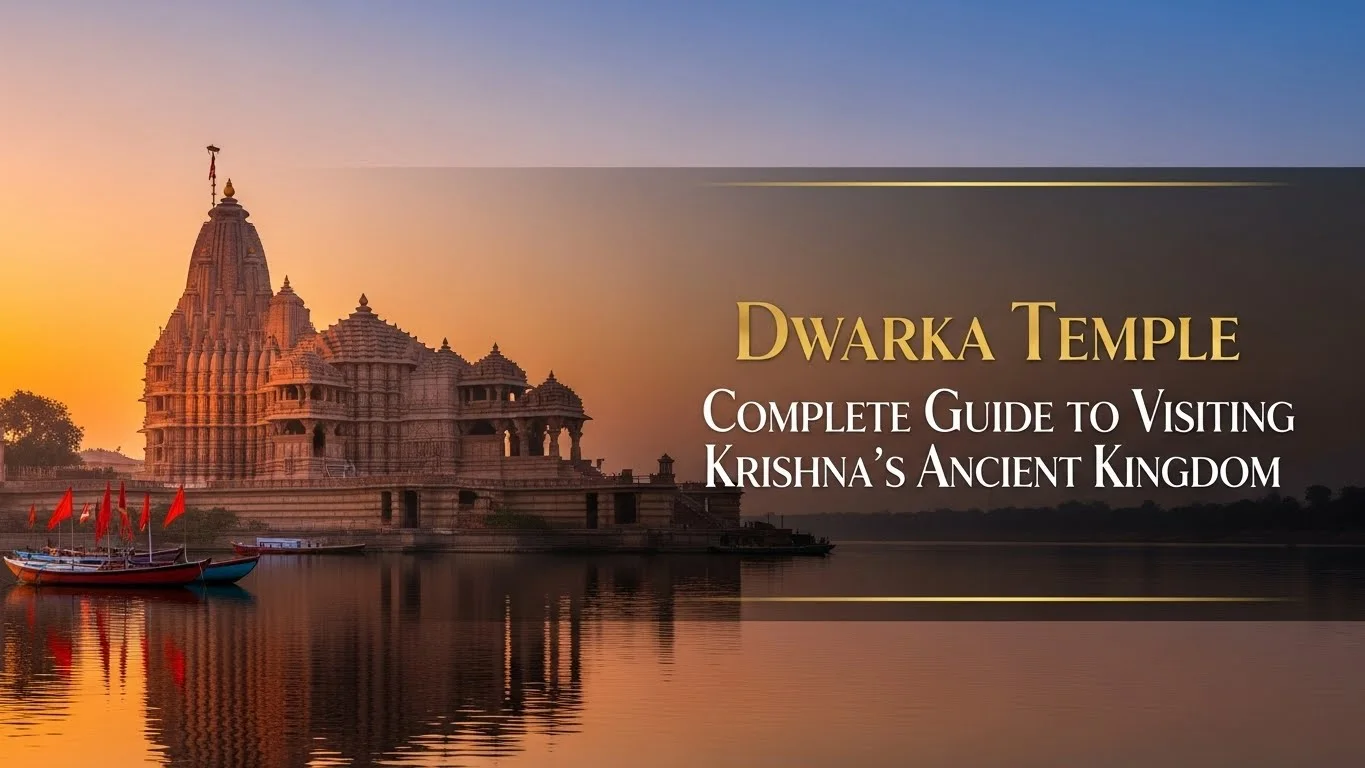
The sacred Dwarka Temple stands as a living testament to Lord Krishna’s earthly kingdom, where the divine ruler established his legendary capital over 3,500 years ago before it was submerged beneath the Arabian Sea. Located on Gujarat’s western coast, this magnificent five-story structure rises 78 meters (256 feet) and attracts millions of devotees annually who seek darshan of Lord Dwarkadhish—the “King of Dwarka”—enshrined within its sanctum. The temple opens daily from 6:30 AM to 9:30 PM with multiple darshan sessions interspersed with elaborate rituals that honor Krishna with royal reverence befitting the divine monarch who once ruled this sacred land.

As one of the four sacred Char Dham pilgrimage sites representing Dwapara Yuga (the age of Krishna), Dwarka holds unparalleled significance in Hindu spiritual geography. Archaeological discoveries of submerged structures off Dwarka’s coast by marine archaeologist Dr. S.R. Rao have provided compelling evidence supporting the Mahabharata’s accounts of Krishna’s magnificent capital city, bridging ancient scripture with modern scientific investigation. This comprehensive guide provides essential information for pilgrims and spiritual seekers planning to visit this extraordinary confluence of history, archaeology, devotion, and divine presence in 2026.
Historical Significance: Krishna’s Legendary Capital
The ancient city of Dwarka (meaning “Gateway to Moksha”) served as Lord Krishna’s capital after he migrated from Mathura to escape the persistent threats of King Jarasandha. According to the Mahabharata, Bhagavata Purana, and other Puranic texts, Krishna established this magnificent coastal kingdom characterized by elaborate palaces, organized governance, and unprecedented prosperity. The city became the seat of Krishna’s administration where he balanced divine wisdom with practical statecraft, demonstrating that spiritual enlightenment need not require worldly renunciation.
Puranic accounts describe Dwarka’s glory in extraordinary detail—a well-planned city with wide streets, beautiful gardens, magnificent mansions, and a harbor accommodating vessels from distant lands. The city featured 900,000 palatial residences built with precious metals and gems, protected by fortifications and surrounded by flowering groves. Krishna’s own palace, Sudharma, served as the administrative and spiritual center where he received visitors, dispensed justice, and engaged in philosophical discourse with sages and devotees. This integration of material prosperity with spiritual values established Dwarka as a model of dharmic governance.
The present-day temple was originally constructed approximately 2,500 years ago, though tradition attributes the first shrine to Vajranabha, Krishna’s great-grandson, who built it directly over Krishna’s residential palace. This original structure was destroyed by Mahmud Begada in the early 16th century and subsequently rebuilt by devotees determined to preserve this sacred site. The current five-story structure showcases the distinctive Chalukya (Solanki) architectural style known as Maru-Gurjara, featuring intricate stone carvings, elaborate pillars, and the characteristic curvilinear shikhara of Nagara temple architecture.
The submergence of the ancient city occurred, according to tradition, immediately upon Krishna’s departure from the earthly realm at the end of Dwapara Yuga. The Bhagavata Purana describes how the sea swallowed the entire city as Krishna left his mortal form, with only the temple site remaining above water. This dramatic event marked the transition from Dwapara Yuga to Kali Yuga (the current age), symbolizing the shift from direct divine presence to the age requiring faith and devotion to experience the divine. Modern Dwarka, considered the seventh incarnation of the city, rises above the submerged ancient settlements.
Archaeological Discoveries: Validating Ancient Texts
The groundbreaking underwater archaeological work of Dr. S.R. Rao between 1983-1990 provided remarkable scientific evidence supporting the historical existence of Krishna’s Dwarka. Leading the Marine Archaeology Unit of the National Institute of Oceanography, Rao conducted twelve underwater expeditions that discovered two distinct submerged settlements—one near present-day Dwarka and another at Bet Dwarka island. These discoveries earned Rao the prestigious World Ship Trust Award for Individual Achievement, recognizing his pioneering contributions to marine archaeology.
Key archaeological findings that corroborate ancient textual accounts include:
- Massive stone structures including a 560-meter-long wall visible at Bet Dwarka, suggesting sophisticated fortification systems
- Thermoluminescence dating of pottery artifacts established dates of approximately 1528 BCE and 3,528 years ago, aligning with traditional chronologies of Krishna’s era
- Inscriptions in Vedic Sanskrit found on utensils recovered from the seabed, providing linguistic evidence of the civilization’s character
- Anchor stones and marine artifacts indicating a thriving port city engaged in maritime trade
- Settlement evidence showing the ancient city was established when sea levels were 10 meters lower than present, explaining subsequent submergence
Rao’s analysis concluded that Krishna’s Dwarka existed around 1700 BCE at the far end of the Harappan era, based on pottery styles and architectural features matching those found at other Harappan sites like Lothal, Dholavira, and Sur Kotada. This dating challenges earlier assumptions placing Krishna at 3100 BCE, instead situating him at approximately 3,500 years ago—a timeframe supported by multiple lines of archaeological evidence. The discovery of lustrous redware pottery identical to that found at other Harappan sites establishes Dwarka’s cultural connections with the broader Indus Valley civilization.
The ongoing archaeological significance of submerged Dwarka continues to attract researchers interested in understanding ancient Indian maritime capabilities, urban planning, and the historical basis of epic literature. Professor Rao noted that deeper excavation beyond the current 5-meter depth might reveal even earlier settlement layers directly connected to Krishna’s original city. These discoveries demonstrate how Hindu philosophy and historical texts contain valuable historical information that, when approached scientifically, can illuminate India’s ancient past and validate cultural memory preserved through millennia.
Temple Architecture and Sacred Features
The Dwarkadhish Temple exemplifies Nagara-style architecture with its distinctive five-story structure rising to 78 meters, supported by 72 intricately carved pillars. The temple’s construction employs the traditional ‘skandha’ method where horizontal layers of locally sourced sandstone gradually reduce in size as they ascend, creating the characteristic curvilinear shikhara profile while effectively distributing structural weight. This engineering technique, perfected during the Chalukya period, allows for elaborate carvings on each layer, transforming the entire shikhara into a three-dimensional narrative of Krishna’s divine pastimes and mythological scenes.
Architectural highlights of the temple complex include:
- Main Sanctum (Garbhagriha): Houses the four-armed black stone idol of Lord Dwarkadhish in a standing posture, holding conch (shankha), discus (chakra), mace (gada), and lotus (padma)
- Jagat Mandir: The temple’s designation as “Temple of the World,” reflecting its universal spiritual significance
- Elaborate Pillars: 72 pillars featuring intricate carvings depicting scenes from Krishna’s life, gopis (cowherd maidens), celestial beings, and geometric patterns
- Swarg Dwar: The northern entrance where pilgrims perform final rites for deceased ancestors
- Gomti Ghat: Sacred bathing steps along the Gomti River where devotees ritually purify themselves before temple entry
The temple’s detailed stone carvings showcase exceptional Solanki craftsmanship with depictions of Krishna lifting Govardhan mountain, dancing with gopis, defeating demons like Putana and Bakasura, and engaging in childhood pastimes in Vrindavan and Gokul. The exterior walls feature ornate bands of sculptures including dancers, musicians, elephants, horses, and floral motifs that create visual narratives accessible to devotees regardless of literacy. The use of locally available sandstone connects the structure organically to its geographical context while demonstrating medieval India’s sophisticated quarrying and stone-working capabilities.
The temple’s soaring shikhara dominates Dwarka’s skyline, visible from considerable distances and serving as a beacon guiding pilgrims to Krishna’s sacred abode. The spire’s curvilinear form represents Mount Meru, the cosmic mountain at the universe’s center in Hindu cosmology, symbolizing the temple as an axis mundi connecting earthly and divine realms. Gold-plated kalashas (pinnacles) crown the shikhara, catching sunlight and creating a radiant appearance that devotees interpret as manifestation of Krishna’s divine radiance.
Daily Rituals and Darshan Timings
The Dwarkadhish Temple follows an elaborate daily ritual schedule called Nitya Seva, treating the deity with royal reverence befitting Krishna’s status as divine monarch. The temple opens at 6:30 AM and closes at 9:30 PM, with darshan periods interspersed throughout the day between ceremonial worship sessions when the sanctum closes to allow priests to perform specific rituals. These ceremonies recreate the daily routine of a king—awakening, bathing, dressing, dining, holding court, and retiring—demonstrating how Hindu temple practices across India adapt universal devotional principles to each deity’s specific character and mythology.
Detailed Daily Schedule:
| Time | Ritual/Activity | Darshan Status |
|---|---|---|
| 6:30-7:00 AM | Mangal Aarti (Morning worship) | Open for Aarti |
| 7:00-8:00 AM | Mangal Darshan (First darshan) | Open |
| 8:00-9:00 AM | Snan Vidhi/Abhishek (Ritual bathing) | Closed |
| 9:00-9:30 AM | Sringar Darshan (Viewing after decoration) | Open |
| 9:30-9:45 AM | Snan Bhog (Breakfast offering) | Closed |
| 9:45-10:15 AM | Sringar Darshan | Open |
| 10:15-10:30 AM | Sringar Bhog (Mid-morning offering) | Closed |
| 10:30-10:45 AM | Sringar Aarti | Open for Aarti |
| 11:05-11:20 AM | Gwal Bhog (Cowherd’s meal offering) | Closed |
| 11:20 AM-12:00 PM | Darshan | Open |
| 12:00-12:20 PM | Raj Bhog (Royal lunch offering) | Closed |
| 12:20-1:00 PM | Darshan | Open |
| 1:00-5:00 PM | Anosar (Afternoon rest) | Closed |
| 5:00 PM | Uthappan (Evening awakening) | Open |
| 5:30-5:45 PM | Uthappan Bhog (Evening snack) | Closed |
| 5:45-7:15 PM | Darshan | Open |
| 7:15-7:30 PM | Sandhya Bhog (Evening meal) | Closed |
| 7:30-7:45 PM | Sandhya Aarti (Evening worship) | Open for Aarti |
| 8:00-8:10 PM | Shayan Bhog (Dinner offering) | Closed |
| 8:10-8:30 PM | Darshan | Open |
| 8:30-8:35 PM | Shayan Aarti (Bedtime worship) | Open for Aarti |
| 8:35-9:00 PM | Darshan | Open |
| 9:00-9:20 PM | Banta Bhog & Shayan (Final offering & sleep preparation) | Closed |
| 9:20-9:30 PM | Final Darshan | Open |
| 9:30 PM | Temple Closure | Closed |
The five daily aartis constitute particularly auspicious moments when devotees witness elaborate ceremonies involving oil lamps, bells, conch shells, and devotional singing. Mangal Aarti (6:30-7:00 AM) awakens the deity with hymns praising Krishna’s beauty and divine attributes. Sandhya Aarti (7:30-7:45 PM) represents the day’s spiritual culmination when hundreds of devotees gather to participate in collective worship, creating an atmosphere of intense devotion. The temple’s priests, many from hereditary families serving for generations, conduct these rituals following precise Vedic prescriptions that have remained unchanged for centuries.
Special darshan opportunities occur during festivals when extended hours and additional ceremonies accommodate increased pilgrim numbers. The temple administers crowd management through queue systems during peak periods, with separate lines for general devotees and those who have booked special darshan tickets. Photography inside the sanctum is prohibited to maintain the sacred atmosphere, though visitors may photograph the temple’s exterior architecture and courtyard areas.
Sacred Sites Near Dwarkadhish Temple
Bet Dwarka (Beyt Dwarka), an island located 30 kilometers north of Dwarka, holds immense archaeological and religious significance. Accessible by a 20-minute boat ride from Okha port, this island is believed to be Krishna’s original residence where he lived with the Yadava community before establishing the main city of Dwarka. The island features ancient temples dedicated to Vishnu’s Matsya Avatar (fish incarnation) and other deities, along with the 560-meter-long stone wall discovered by Dr. S.R. Rao that provides tangible evidence of the site’s ancient settlement. Pilgrims consider the Dwarka yatra incomplete without visiting Bet Dwarka, where Krishna is believed to have spent considerable time engaged in divine pastimes.
Nageshwar Jyotirlinga, located approximately 18 kilometers from Dwarka, represents one of the twelve sacred Jyotirlingas (self-manifested Shiva lingams) in India. This temple holds the unique distinction of being considered the first among the twelve Jyotirlingas, making it exceptionally sacred for Shaivite devotees. The red temple structure houses the main sanctum with the Shivalinga, and the complex features a massive 25-meter-tall statue of Lord Shiva visible from considerable distance. The temple operates from 6:00 AM to 6:00 PM daily, and its proximity to Dwarka allows pilgrims to seek blessings from both Krishna (Vishnu) and Shiva, honoring the complementary aspects of divinity within Sanatana Dharma.
Rukmini Devi Temple, situated approximately 2 kilometers from the main Dwarkadhish Temple, honors Krishna’s principal consort Rukmini. Built in the Nagara architectural style with intricate stone carvings and tiered shikhara, the temple showcases exquisite craftsmanship depicting scenes from Krishna and Rukmini’s divine relationship. According to popular legend, Sage Durvasa cursed Rukmini to live separately from Krishna after she committed a protocol breach, explaining why her temple stands outside the main town rather than adjacent to the Dwarkadhish Temple. The temple’s colorful frescoes, detailed sculptures, and peaceful atmosphere provide contemplative counterpoint to the main temple’s crowds. Dwarka pilgrimage is traditionally considered incomplete without paying respects to Rukmini Devi, acknowledging the inseparable nature of divine consort pairs in Hindu theology.
Additional significant sites enriching the Dwarka pilgrimage experience include:
- Gomti Ghat: Sacred bathing steps along the Gomti River where ritual purification occurs before temple entry
- Gopi Talav Tirth: A lake near Nageshwar Jyotirlinga connected to legends of gopis (cowherd maidens) merging with the soil while seeking Krishna
- Bhadkeshwar Mahadev Temple: A Shiva temple situated on a rocky outcrop surrounded by sea, offering spectacular sunset views
- Sudama Setu: A bridge commemorating the friendship between Krishna and the poor Brahmin Sudama, whose story exemplifies true devotion transcending material circumstances
These complementary pilgrimage sites create a comprehensive spiritual geography where devotees experience diverse aspects of Krishna’s divine character—as king at Dwarkadhish Temple, as friend and companion at Bet Dwarka, as cosmic principle alongside Shiva worship at Nageshwar, and as devoted husband at Rukmini Temple.
Travel Guide: How to Reach Dwarka
By Air: The nearest airport to Dwarka is Jamnagar Airport, located approximately 137 kilometers away with flight connections to major Indian cities including Delhi, Mumbai, and Ahmedabad. From Jamnagar Airport, pilgrims can hire private taxis (approximately 2.5-3 hours journey) or board Gujarat State Road Transport Corporation (GSRTC) buses to Dwarka. For international travelers or those from distant Indian cities, flying to Ahmedabad’s Sardar Vallabhbhai Patel International Airport (approximately 440 kilometers from Dwarka) provides more flight options, followed by train, bus, or taxi to Dwarka.
By Train: Dwarka Railway Station (station code: DWK) enjoys excellent connectivity with direct trains from major cities across India. The station lies just 2-3 kilometers from Dwarkadhish Temple, easily accessible via auto-rickshaws, taxis, or local buses. Popular trains serving Dwarka include:
- Delhi-Okha Express: Direct service from Delhi (approximately 22-24 hours journey time)
- Somnath Express: Connects via Ahmedabad with onward journey to Dwarka
- Yoga Express: Provides connectivity from eastern Indian cities
- Hapa-Okha Passenger: Local train service connecting nearby towns
The railway station offers basic facilities including waiting rooms, refreshment stalls, and tourist information. Advance booking is strongly recommended during festival periods, especially around Janmashtami when pilgrim influx increases dramatically.
By Road: Dwarka’s robust road network connects it to all major Gujarat cities and neighboring states. GSRTC operates regular bus services including Volvo AC coaches and sleeper buses from Ahmedabad (440 km, 7-8 hours), Rajkot (220 km), Jamnagar (137 km), and other cities. Private tour operators offer comfortable AC coaches with organized pilgrimage packages covering Dwarka along with Somnath, Gir National Park, and Diu. For self-driving enthusiasts, the journey offers scenic coastal and rural Gujarat landscapes, though hiring experienced local drivers familiar with regional roads is recommended over navigating independently.
Distance from Major Cities:
- Ahmedabad to Dwarka: 440 kilometers (7-8 hours)
- Mumbai to Dwarka: 950 kilometers (14-16 hours)
- Rajkot to Dwarka: 220 kilometers (4-5 hours)
- Jamnagar to Dwarka: 137 kilometers (2.5-3 hours)
- Somnath to Dwarka: 230 kilometers (5-6 hours)
Local Transportation: Within Dwarka, auto-rickshaws, e-rickshaws, cycle-rickshaws, and taxis provide convenient transport between the temple, accommodation, and nearby attractions. Most hotels and dharamshalas are located within walking distance of Dwarkadhish Temple, particularly around Teen Bati Chowk and Bhadrakali Chowk areas. Boat services to Bet Dwarka operate from Okha port (30 km from Dwarka), with regular ferry schedules accommodating day-trip pilgrims.
Accommodation and Best Time to Visit
Accommodation options in Dwarka range from economical dharamshalas (pilgrim guesthouses) to comfortable mid-range hotels catering to diverse budget requirements. The town offers numerous lodging choices concentrated near the temple in areas like Teen Bati Chowk, Bhadrakali Chowk, and along the highway. Popular options include:
- Dharamshalas: Dwarkadhish Dharamshala and other trust-operated facilities provide basic, affordable accommodation specifically for pilgrims, often with dormitory-style rooms and minimal amenities
- Budget Hotels: Numerous family-run hotels offer clean rooms with essential facilities at economical rates
- Mid-range Hotels: Hotel Gomti, VITS Devbhumi Hotel, and similar establishments provide air-conditioned rooms, attached bathrooms, and restaurant facilities
- Guesthouses: Government-operated and private guesthouses offer comfortable stays with moderate pricing
Advance booking is essential during peak pilgrimage seasons and major festivals when accommodation becomes extremely scarce. Most accommodations are located within walking distance of Dwarkadhish Temple, eliminating transportation concerns for darshan visits. Hotels typically offer vegetarian meals respecting the town’s religious character, with numerous restaurants serving traditional Gujarati cuisine including dhokla, thepla, undhiyu, and other regional specialties.
Best Time to Visit Dwarka depends on weather preferences and festival interests:
October to March (Ideal Period):
- Pleasant weather with temperatures ranging 15-30°C
- Comfortable for temple visits and sightseeing
- Clear skies ideal for coastal exploration and photography
- Peak tourist season with higher accommodation rates
Janmashtami (August/September):
- Most spiritually significant period celebrating Krishna’s birth
- Massive devotee gatherings (80,000-100,000 pilgrims) creating vibrant atmosphere
- Midnight Janm-Utsav marking Krishna’s birth moment
- Temple beautifully decorated with lights and flowers
- Continuous bhajans, Garba dances, Makhan Handi events
- Dwarka Utsav fair along Gomti riverbank
- Requires very early accommodation booking
April to June (Summer):
- Hot weather with temperatures exceeding 38°C
- Fewer crowds and lower accommodation costs
- Early morning and evening temple visits recommended
- Less comfortable for extensive outdoor exploration
July to September (Monsoon):
- Moderate rainfall refreshing the landscape
- Fewer tourists providing peaceful pilgrimage experience
- Potential travel disruptions during heavy rains
- Lower accommodation rates
Other Significant Festivals: Kartik Purnima, Shivratri, Holi, Ram Navami, and Diwali also draw considerable devotee participation with special temple ceremonies and extended darshan hours.
Spiritual Significance in the Char Dham Circuit
Dwarka holds unique theological importance as one of the four Char Dham pilgrimage sites representing the four cardinal directions of India—Badrinath (north), Rameshwaram (south), Dwarka (west), and Puri (east). Established by Adi Shankaracharya in the 8th century to unify India spiritually, this sacred circuit enables devotees to traverse the subcontinent while seeking liberation (moksha) through pilgrimage to these supremely holy sites. Each dham represents a specific yuga (cosmic age), with Dwarka symbolizing Dwapara Yuga, the age when Krishna incarnated and established dharma through divine play (leela) and philosophical teachings.
Dwarka’s distinctive spiritual character derives from its direct connection to Krishna’s physical presence on earth. Unlike other pilgrimage sites built to honor deities through representational worship, Dwarka occupies the actual land where Krishna lived, ruled, and established his kingdom. This historical authenticity creates unique spiritual potency—devotees believe they walk the same ground Krishna traversed, bathe in waters he blessed, and worship at the location of his royal palace. The temple’s designation as “Jagat Mandir” (Temple of the World) reflects Krishna’s universal message transcending sectarian boundaries.
The philosophical teachings associated with Dwarka center on Krishna’s demonstration that worldly engagement need not contradict spiritual realization. While Badrinath represents meditation and renunciation, Dwarka embodies engaged spirituality—performing duties, governing justly, maintaining relationships, and participating fully in worldly life while remaining internally detached and God-conscious. This balanced approach, elaborated extensively in the Bhagavad Gita, provides an accessible spiritual path for householders unable to adopt complete renunciation. Krishna’s example at Dwarka proves that one can achieve liberation while fulfilling social responsibilities and enjoying legitimate pleasures.
Completing the Char Dham pilgrimage circuit is believed to wash accumulated sins, break the cycle of rebirth, and grant moksha. Many Hindus aspire to undertake this journey at least once in their lifetime, viewing it as the spiritual culmination of their devotional practice. The circuit’s geographical expanse—covering India from Himalayan heights to southern coasts—creates a transformative journey where physical challenges mirror internal spiritual work. Pilgrims often report profound psychological shifts, renewed faith, and deeper philosophical understanding following their completion of the Char Dham yatra.
Dwarka Temple Frequently Asked Questions
What are the daily darshan timings at Dwarkadhish Temple?
The temple opens at 6:30 AM and closes at 9:30 PM daily, with darshan available during multiple sessions throughout the day interspersed with ritual worship periods. Morning darshan begins at 7:00 AM (after Mangal Aarti), while evening darshan extends from 5:00 PM to 9:30 PM with breaks for various bhog offerings and aartis. Timings may vary slightly during festivals, and devotees should verify current schedules upon arrival.
How do I reach Dwarka from major cities?
Dwarka is accessible by air (via Jamnagar Airport 137 km away), train (direct Dwarka Railway Station), and road (well-connected highways). From Delhi, the Delhi-Okha Express provides direct rail service (22-24 hours), while flights to Jamnagar or Ahmedabad with onward surface transport offer faster alternatives. GSRTC buses operate regularly from Ahmedabad (440 km, 7-8 hours), Rajkot (220 km), and other Gujarat cities.
What is the best time to visit Dwarka?
October to March offers ideal weather conditions with pleasant temperatures (15-30°C) comfortable for temple visits and sightseeing. Janmashtami (August/September) provides the most spiritually significant experience with elaborate celebrations and massive devotee gatherings, though it requires early accommodation booking and tolerance for large crowds. Avoid peak summer (April-June) when temperatures exceed 38°C.
What are the must-visit places near Dwarkadhish Temple?
Essential pilgrimage sites include Bet Dwarka (island with Krishna’s original residence, 30 km), Nageshwar Jyotirlinga (one of twelve sacred Shiva temples, 18 km), Rukmini Devi Temple (honoring Krishna’s consort, 2 km), Gomti Ghat (sacred bathing steps), and Bhadkeshwar Mahadev Temple (coastal Shiva shrine). Most pilgrims allocate 2-3 days to visit these complementary sites while based in Dwarka.
What archaeological evidence supports Krishna’s historical existence?
Dr. S.R. Rao’s underwater archaeological expeditions (1983-1990) discovered submerged settlements, a 560-meter stone wall, pottery with Vedic Sanskrit inscriptions, and artifacts dated to approximately 1528-1700 BCE through thermoluminescence testing. These findings align with Mahabharata accounts of Dwarka’s submergence after Krishna’s departure, providing scientific validation for textual traditions and demonstrating the city’s connection to the broader Harappan civilization.
Where should I stay in Dwarka?
Accommodation clusters around the temple in Teen Bati Chowk and Bhadrakali Chowk areas, ranging from basic dharamshalas (pilgrim guesthouses) to mid-range hotels like VITS Devbhumi and Hotel Gomti. Most lodging is within walking distance of Dwarkadhish Temple. Book well in advance during Janmashtami and peak season (October-March) when availability becomes limited. Dharamshalas offer economical options specifically for pilgrims.
What is the significance of Dwarka in the Char Dham pilgrimage?
Dwarka represents the western point of the Char Dham circuit and symbolizes Dwapara Yuga when Lord Krishna incarnated. Unlike other dhams, Dwarka’s unique significance stems from being Krishna’s actual earthly kingdom where he physically lived and ruled, making it a site of both historical and theological importance. The pilgrimage demonstrates how worldly engagement and spiritual realization can coexist, reflecting Krishna’s balanced teachings in the Bhagavad Gita.
Are there any dress code requirements for temple entry?
While not strictly enforced, modest dress covering shoulders and legs is recommended respecting the temple’s sacred character. Devotees must remove shoes before entering temple premises, with shoe-storage facilities available at the entrance. Photography is prohibited inside the sanctum sanctorum to maintain the devotional atmosphere, though exterior architectural photography is permitted. Leather items (belts, bags) are generally discouraged within the temple.
Conclusion
The Dwarkadhish Temple pilgrimage offers contemporary seekers an extraordinary opportunity to connect with Krishna’s historical kingdom while engaging profound philosophical teachings that remain timelessly relevant. The convergence of archaeological evidence, scriptural traditions, architectural magnificence, and vibrant devotional practice creates a uniquely comprehensive spiritual experience. Dr. S.R. Rao’s underwater discoveries bridge ancient texts with modern scientific methodology, demonstrating that India’s epic literature contains valuable historical information validated through rigorous investigation.
The temple’s elaborate daily ritual schedule—treating the deity with royal reverence through multiple bhog offerings, aartis, and darshan sessions—allows devotees to participate in centuries-old traditions maintained with precision by hereditary priests. Complementary sites including Bet Dwarka, Nageshwar Jyotirlinga, and Rukmini Temple create a sacred geography where pilgrims experience diverse facets of Krishna’s multidimensional divinity. The city’s position within the prestigious Char Dham circuit establishes its theological importance for Hindus seeking liberation through comprehensive pilgrimage across India’s sacred landscape.
As we navigate the complexities of modern existence in 2026, Dwarka’s spiritual message grows increasingly relevant—demonstrating that authentic spirituality need not require worldly withdrawal but can flourish through engaged, conscious participation in life’s full spectrum. Krishna’s example at Dwarka proves that one can govern kingdoms, maintain relationships, fulfill social responsibilities, and experience pleasure while remaining internally established in divine consciousness. This balanced integration of material engagement with spiritual awareness offers practical guidance for householders seeking meaningful lives aligned with dharmic principles.
Planning your Dwarka pilgrimage with awareness of darshan timings, travel logistics, accommodation options, and nearby sacred sites ensures a fulfilling spiritual journey. Whether undertaken as part of the complete Char Dham circuit or as a focused visit to Krishna’s kingdom, the experience promises transformation through divine grace, historical connection, and participation in living traditions extending across millennia.
About the Author
Sandeep Vohra – Vedantic Scholar & Hindu Philosophy Expert
Sandeep Vohra is a distinguished scholar specializing in Hindu philosophy, Vedantic studies, and scriptural interpretation. With a Master’s degree in Sanskrit and Comparative Philosophy from Banaras Hindu University, he has translated numerous Sanskrit texts and authored comprehensive commentaries on the Bhagavad Gita, Upanishads, and Brahma Sutras. His work focuses on making ancient philosophical wisdom accessible to contemporary seekers while preserving doctrinal accuracy and spiritual depth.