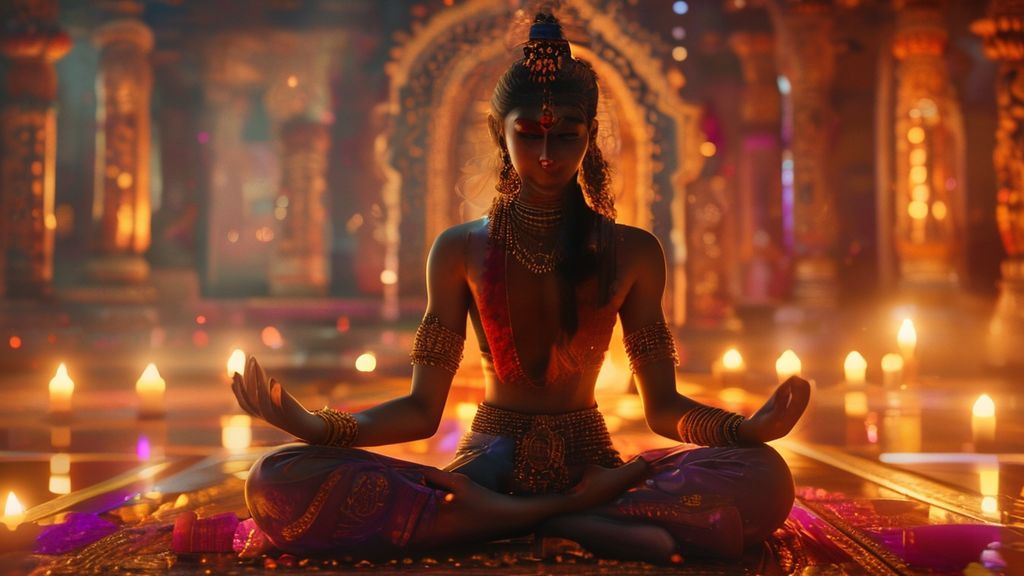
The Gayatri Mantra is a profound Vedic hymn, a prayer for divine light to awaken and illuminate the intellect. Its line-by-line meaning unfolds as an invocation to Savitr, the Sun-God, representing the supreme source of all existence and consciousness, guiding us towards spiritual wisdom and truth.
| Feature | Details |
|---|---|
| Mantra Type | Vedic Mahamantra |
| Primary Deity Addressed | Savitr (Divine Illuminator, aspect of the Sun) |
| Vedic Reference | Rig Veda, Mandala 3, Hymn 62, Verse 10 |
| Core Purpose | Enlightenment, Purification of Intellect, Wisdom |
| Traditional Chanting Times | Dawn, Noon, Dusk (Trikala Sandhya) |
| Attributed Rishi | Vishwamitra |
Introduction: The Universal Prayer for Enlightenment
The Gayatri Mantra stands as a jewel in the crown of Sanatan Dharma, revered across centuries as one of the most potent and universally applicable Vedic hymns. It is not merely a sequence of words but a profound invocation to the ultimate source of existence, light, and consciousness. This sacred mantra is a prayer for the purification and illumination of the intellect, guiding seekers towards supreme truth and wisdom. Its timeless wisdom resonates with anyone striving for spiritual clarity, regardless of their path. Understanding its intricate line-by-line meaning unveils a deeper appreciation for its transformative power.
Historical Context: Roots in Ancient Wisdom
The origins of the Gayatri Mantra are deeply embedded in the ancient Vedic tradition. Its first appearance is found in the Rig Veda, specifically in Mandala 3, Hymn 62, Verse 10, where it is attributed to the revered Rishi Vishwamitra. Within the Vedic corpus, Savitr, the solar deity to whom the mantra is addressed, is celebrated not merely as the physical sun but as the divine impulse, the vivifying energy that animates the entire universe. The mantra was a central component of ancient spiritual practices, particularly the ‘Sandhyavandanam’, a daily ritual performed at dawn, noon, and dusk, signifying the alignment of the individual consciousness with cosmic rhythms. Its profound significance transcended the Vedas, finding mention and elaboration in various Upanishads and Puranas, which further expounded on its spiritual efficacy and philosophical depth, cementing its status as a foundational pillar of Hindu spiritual practice and thought.
Detailed Guide: Gayatri Mantra Line by Line Meaning
To truly grasp the essence of the Gayatri Mantra, it is imperative to delve into its precise Sanskrit phrasing and uncover the layers of meaning embedded in each line. This mantra is a direct prayer for enlightenment, invoking the divine light to guide our intellect.
Om (ॐ)
Meaning: This is the primordial sound, the universal syllable, and the highest sacred symbol in Sanatan Dharma. It represents the Brahman, the Absolute Reality, encompassing creation, preservation, and dissolution. Chanting Om prepares the mind for meditation, connecting individual consciousness with cosmic consciousness.
Bhur Bhuvaḥ Swaḥ (भूर् भुवः स्वः)
Meaning: These are the “Vyāhṛtis,” mystical utterances signifying the three realms of existence:
- Bhūh (भूः): The Earth, representing the physical realm, the gross material world.
- Bhuvaḥ (भुवः): The Atmosphere or Mid-region, representing the subtle realm of emotions and vital energy (Prana).
- Swaḥ (स्वः): Heaven, representing the causal realm, the celestial planes, and the realm of pure mind and intellect.
Together, they invoke the divine presence permeating all three planes of existence, reminding us of the omnipresence of the Supreme Being.
Tat Savitur Vareṇyaṃ (तत् सवितुर् वरेण्यं)
Meaning: This phrase directs our attention to the divine source.
- Tat (तत्): “That” – Refers to the Supreme, Transcendent Reality, beyond name and form.
- Savitur (सवितुर्): “Of Savitr” – Savitr is the Sun-God, not just the physical sun, but the divine impulse, the source of all light, life, and creative energy. He represents the divine illuminator who inspires wisdom.
- Vareṇyaṃ (वरेण्यं): “Worthy of Adoration” or “Most Excellent” – Describing the glorious nature of Savitr, emphasizing that this divine light is the most desirable and revered aspect of existence.
Thus, “Tat Savitur Vareṇyaṃ” means “Let us meditate on that adorable and most excellent effulgence of the Divine Illuminator, Savitr.”
Bhargo Devasya Dhīmahi (भर्गो देवस्य धीमहि)
Meaning: This is the core invocation for meditation.
- Bhargo (भर्गो): “Spiritual Effulgence” or “Radiance” – Refers to the divine light that purifies and destroys ignorance and sin. It is the illuminating power of the Supreme.
- Devasya (देवस्य): “Of the Divine Being” or “Of the God” – Further qualifying the divine nature of the light.
- Dhīmahi (धीमहि): “We Meditate” or “May We Meditate” – This is a direct expression of the devotee’s intent to absorb and reflect upon this divine light.
So, “Bhargo Devasya Dhīmahi” translates to “We meditate upon the spiritual effulgence of that Divine Reality.” This is a crucial step towards spiritual assimilation, as explained on Hindutva.online.
Dhīyo Yo Naḥ Prachodayāt (धियो यो नः प्रचोदयात्)
Meaning: This is the ultimate prayer for divine guidance.
- Dhīyo (धियो): “Our Intellects” or “Our Minds” – Refers to our discriminatory faculty, our capacity for understanding and wisdom.
- Yo (यो): “Who” or “Which” – Refers back to the divine effulgence (Bhargo Devasya).
- Naḥ (नः): “Our” or “Us” – Acknowledging the personal plea for guidance.
- Prachodayāt (प्रचोदयात्): “May He Inspire” or “May He Enlighten” – The earnest request for the divine light to awaken and stimulate our intelligence.
The full translation of this final line is “May He (the Divine Effulgence) enlighten our intellects.” This encapsulates the mantra’s primary purpose: to seek divine illumination for clarity, wisdom, and righteous action.
Rituals & Significance: Dos and Don’ts of Chanting
The power of the Gayatri Mantra is amplified by understanding and adhering to certain ritualistic and devotional guidelines. It is not just about utterance, but about intent and reverence.
Dos: Enhancing Your Practice
- Purity: Chanting should ideally be done after bathing and in a clean, serene environment.
- Pronunciation: Pay close attention to the correct pronunciation (shuddhi) of each syllable to unlock its full vibratory potential.
- Devotion (Bhava): Chant with genuine faith, reverence, and a deep understanding of its meaning, visualizing the divine light.
- Regularity: Consistent practice, especially during the traditional Sandhya times (dawn, noon, and dusk), yields the most profound benefits.
- Mindfulness: Focus your attention entirely on the mantra, letting go of distractions.
- Japa: Repetition (japa) using a mala (rosary) can help maintain focus and count repetitions, typically in multiples of 108.
Don’ts: Practices to Avoid
- Chanting Without Belief: Reciting mechanically without faith or understanding diminishes its spiritual impact.
- Impure State: Avoid chanting in a state of anger, extreme sadness, or physical impurity if possible.
- Disrespect: Do not treat the mantra casually or disrespectfully.
- Inattentiveness: Avoid chanting while distracted or multitasking, as it negates the meditative aspect.
- Public Display: While it can be chanted aloud, deep meditative chanting is often performed in a personal, quiet space.
Adhering to these guidelines helps align the individual with the mantra’s inherent spiritual energy, fostering a deeper connection and maximizing its transformative potential. For more insights into such practices, visit Hindutva.online.
FAQs About the Gayatri Mantra
What is the best time to chant the Gayatri Mantra?
Traditionally, the Gayatri Mantra is chanted during “Trikala Sandhya” – at dawn (Brahma Muhurta, before sunrise), at noon, and at dusk (just before or during sunset). These transition times are considered auspicious for spiritual practices, as the atmosphere is believed to be most conducive to meditation and spiritual absorption.
Who can chant the Gayatri Mantra?
Historically, its chanting was restricted, but in modern Sanatan Dharma, the understanding has evolved to be inclusive. Anyone with sincerity, faith, and purity of intention can chant the Gayatri Mantra. It is a universal prayer for enlightenment, and its benefits are accessible to all who approach it with devotion.
What are the benefits of chanting the Gayatri Mantra?
Chanting the Gayatri Mantra regularly is believed to bring numerous benefits, including purification of the mind, enhancement of intellect and wisdom, inner peace, improved concentration, spiritual growth, protection from negative influences, and overall well-being. It is said to awaken the divine consciousness within.
Is Gayatri Mantra for a specific deity?
While the mantra directly addresses Savitr, the Sun-God, Savitr is understood not merely as a physical deity but as the embodiment of the supreme, all-pervading consciousness and the divine illuminator of the intellect. Therefore, it is considered a prayer to the universal Supreme Being, transcending sectarian distinctions.
Conclusion
The Gayatri Mantra is far more than a simple prayer; it is a profound spiritual tool, a concise yet comprehensive invocation for divine wisdom and enlightenment. Its line-by-line meaning reveals a meticulous plea to the universal source of light, Savitr, to purify and awaken our intellects, guiding us from ignorance to knowledge, from darkness to light. By understanding each sacred syllable and embracing the devotion it embodies, practitioners can unlock a profound path to inner transformation, clarity, and spiritual illumination, aligning their individual consciousness with the omnipresent divine truth that governs all existence.