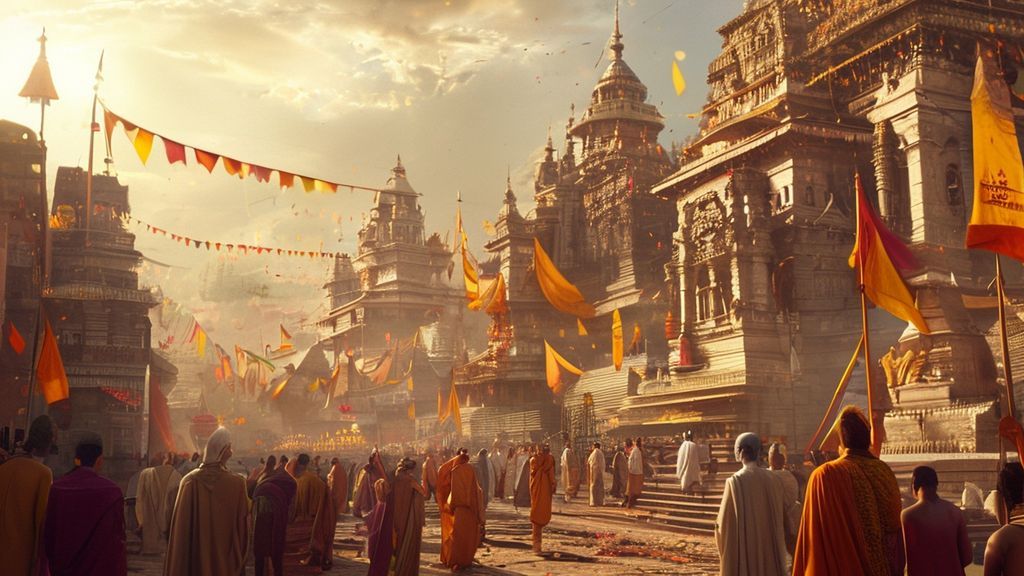
The Haridwar Kumbh Mela, the world’s largest spiritual gathering, is a sacred pilgrimage held every twelve years at Haridwar, Uttarakhand, where millions of devotees converge to bathe in the holy Ganga River. This auspicious event, rooted in ancient Puranic legends, offers profound spiritual purification and liberation from the cycle of birth and death.
| Attribute | Details |
|---|---|
| Event Name | Haridwar Kumbh Mela (हरिद्वार कुम्भ मेला) |
| Significance | Mass pilgrimage for spiritual purification and moksha. |
| Location | Haridwar, Uttarakhand, India (banks of Ganga River). |
| Frequency | Every 12 years (Purna Kumbh), with Ardh Kumbh every 6 years. |
| Next Occurrence | Anticipated 2038 (exact dates determined astrologically). |
| Scripture Reference | Bhagavata Purana, Vishnu Purana, Skanda Purana. |
| Key Rituals | Shahi Snan (royal bath), Ganga Aarti, Sadhu Darshan, devotional chanting. |
The Confluence of Faith: Understanding the Haridwar Kumbh Mela
Haridwar, the ancient city nestled at the foothills of the Himalayas, holds a paramount position in Sanatan Dharma. It is here, at the “Gateway to Hari” (हरिद्वार), where the sacred Ganga River descends from the mountains to the plains, that the most colossal human gathering for spiritual purpose unfolds: the Kumbh Mela. More than a festival, it is a temporal and spatial convergence of celestial energies, an opportunity for millions to cleanse karmic impurities, attain merit, and strive for ultimate liberation. This pilgrimage is a vibrant manifestation of India’s spiritual heart, a testament to the enduring faith and rich traditions that define our ancient civilization. The Mela is a living scripture, performed by humanity itself, seeking communion with the divine.
The Amrita Kalasha and the Cosmic Struggle: Origins in the Puranas
The genesis of the Kumbh Mela is exquisitely detailed in our venerable Itihasas and Puranas, primarily the Bhagavata Purana (Srimad Bhagavatam) and the Vishnu Purana. The legend speaks of the monumental Samudra Manthan (समुद्र मन्थन), the churning of the cosmic ocean by the Devas (gods) and Asuras (demons) to obtain the celestial nectar of immortality, the Amrita (अमृत).
After a thousand years of arduous churning, Dhanvantari, the divine physician, emerged from the ocean holding the golden pitcher (Kumbh) filled with Amrita. A ferocious battle ensued. During the twelve celestial days—equivalent to twelve human years—the celestial bird Garuda, carrying the Kumbh, momentarily rested at four earthly locations. Drops of Amrita are believed to have fallen here:
- Haridwar, on the banks of the Ganga.
- Prayagraj (Allahabad), at the confluence of Ganga, Yamuna, and Saraswati.
- Nashik, on the banks of the Godavari.
- Ujjain, on the banks of the Shipra.
These divine drops imbued these lands with unparalleled sanctity. The twelve-year cycle of the Kumbh Mela corresponds to the celestial battle, specifically when Jupiter (Brihaspati) and the Sun are in particular zodiacal positions, marking the auspicious time.
The Ephemeral City: A Masterpiece of Spiritual Logistics
While the Kumbh Mela does not involve permanent temple architecture, the temporary city that rises on the banks of the Ganga in Haridwar every twelve years is an unparalleled marvel of human organization and civic engineering. This transient metropolis, often larger than many permanent cities, is meticulously planned and constructed months in advance to accommodate tens of millions of pilgrims and ascetics.
The layout considers sacred geometry, ensuring optimal flow for processions, especially the crucial Shahi Snans (शाही स्नान) – the royal bathing rituals of the various Akharas. Engineers construct temporary pontoon bridges over the Ganga, erect vast tent cities, establish intricate water and sanitation systems, and deploy comprehensive security and medical infrastructure. This feat, repeated over millennia, demonstrates a profound understanding of crowd dynamics and resource management, all while respecting the ecological sanctity of the river. The very act of creating and dismantling this sacred city reflects the transient nature of material existence and the eternal pursuit of the divine.
The Path to Purity: Key Rituals and Worship at Kumbh Mela
Participation in the Haridwar Kumbh Mela is a profound spiritual journey marked by specific rituals designed to purify the body, mind, and soul. The central ritual is the holy bath, or Snan, in the Ganga River at specific auspicious timings, determined by planetary positions.
- Sankalp (Intention Setting): Before entering the sacred waters, devotees traditionally make a Sankalp, vowing to cleanse their sins and seek divine blessings for themselves and their ancestors.
- The Holy Dip (Snan): Pilgrims immerse themselves in the Ganga, particularly at Har Ki Pauri, chanting mantras and offering prayers. The belief is that bathing during the Kumbh period, especially on Purnima, Amavasya, and Makar Sankranti, and during the Shahi Snans, liberates one from the cycle of birth and death (Moksha).
- Shahi Snan (Royal Bath): These are the most significant bathing days, when various Akharas of Naga Sadhus, Urdhwavahurs, Parivrajakas, and other ascetic orders proceed in grand processions to the river for their ritual bath. Witnessing these processions and bathing immediately after them is considered immensely meritorious.
- Ganga Aarti: Attending the evening Ganga Aarti at Har Ki Pauri is an essential part of the Haridwar experience. The synchronized chanting, the flickering lamps, and the devotion create an ethereal atmosphere.
- Sadhu Darshan: Meeting and seeking blessings from the myriad Sadhus, Mahatmas, and spiritual masters who gather at the Mela is highly revered. Their wisdom and asceticism are a source of inspiration.
- Pind Daan and Tarpan: Many pilgrims perform rituals for their ancestors, offering Pind Daan (oblations of rice balls) and Tarpan (water offerings) to ensure their ancestors’ liberation and peace.
- Hawan and Yajna: Fire rituals are performed by various spiritual organizations and individuals to invoke deities, purify the environment, and seek universal welfare.
These rituals collectively represent a holistic approach to spiritual elevation, encompassing purification, devotion, ancestral veneration, and communal harmony.
Invoking the Divine: Mantras for the Kumbh Mela
Chanting during the Kumbh Mela enhances the spiritual experience and reinforces the connection with the divine. When taking a holy dip in the Ganga, the following mantra is often recited:
ॐ गंगे च यमुने चैव गोदावरी सरस्वती। नर्मदे सिन्धु कावेरी जलेऽस्मिन् सन्निधिं कुरु॥
Om Gange Cha Yamune Chaiva Godavari Saraswati | Narmade Sindhu Kaveri Jale Asmin Sannidhim Kuru ||
Meaning: “O Ganga, Yamuna, Godavari, Saraswati, Narmada, Sindhu, Kaveri, may your waters be present in this water.” This mantra invokes the presence of all seven sacred rivers, making the bath universally purifying.
Beyond this, devotees engage in continuous chanting of various divine names and Mahamantras such as “Om Namah Shivaya” (ॐ नमः शिवाय), “Hare Krishna Hare Krishna, Krishna Krishna Hare Hare | Hare Rama Hare Rama, Rama Rama Hare Hare” (हरे कृष्ण हरे कृष्ण, कृष्ण कृष्ण हरे हरे | हरे राम हरे राम, राम राम हरे हरे), or “Om Namo Bhagavate Vasudevaya” (ॐ नमो भगवते वासुदेवाय). The air during the Mela resonates with these sacred vibrations, fostering a collective spiritual consciousness.
Navigating the Sacred Space: Etiquette at Kumbh Mela
To ensure a respectful and spiritually enriching experience at the Haridwar Kumbh Mela, it is essential to observe certain cultural and spiritual etiquettes:
- Do maintain reverence for the Sadhus and holy persons. Seek their blessings respectfully.
- Do keep the Mela grounds clean. Dispose of waste responsibly.
- Do dress modestly, covering shoulders and knees, especially when visiting temples or participating in rituals.
- Do be patient and considerate of fellow pilgrims, especially during crowded bathing times.
- Do participate in the Ganga Aarti and other devotional activities.
- Don’t consume alcohol, non-vegetarian food, or tobacco products. The Mela is a sattvic (pure) environment.
- Don’t engage in loud or disruptive behavior. Maintain a contemplative and peaceful demeanor.
- Don’t photograph Sadhus without their explicit permission, and never disturb their meditation or rituals.
- Don’t argue or create discord. The spirit of the Mela is harmony and devotion.
- Don’t litter in the Ganga River or on its banks.
What is the astrological significance of Kumbh Mela?
The timing of the Kumbh Mela is determined by specific astrological configurations of the Sun, Moon, and Jupiter (Brihaspati). For Haridwar, the Mela occurs when Jupiter is in Aquarius (Kumbh Rashi) and the Sun is in Aries (Mesha Rashi). These specific planetary alignments are believed to open a celestial window, amplifying the spiritual benefits of bathing in the sacred rivers and performing austerities, making the period exceptionally potent for spiritual growth and liberation.
Why do Akharas participate in the Shahi Snan?
The Akharas, ancient monastic orders of renunciates, play a central role in the Kumbh Mela. Their participation in the Shahi Snans is not merely ceremonial; it signifies the spiritual authority and unbroken lineage of ascetic traditions. The Naga Sadhus, in particular, are iconic, emerging from their secluded hermitages for this auspicious event. Their royal procession and collective bathing are believed to infuse the waters with their accumulated spiritual power, benefiting all who follow. It is a powerful display of Dharmic strength and spiritual devotion.
How does the Kumbh Mela relate to Sanatan Dharma’s principles?
The Kumbh Mela embodies several core principles of Sanatan Dharma: the belief in ritual purification (Shuddhi), the concept of pilgrimage (Tirtha Yatra) as a path to spiritual merit, the reverence for sacred rivers (like Ganga Devi), the importance of community (Satsang), and the pursuit of liberation (Moksha). It demonstrates the living, evolving nature of our faith, where ancient traditions are kept vibrant through active participation. It’s a reminder of humanity’s eternal quest for the divine, an affirmation of collective faith that you can explore further on Hindutva.online.
Preserving Sanatan Dharma: The Enduring Legacy of Kumbh Mela
The Haridwar Kumbh Mela is far more than a historical event or a massive gathering; it is a profound living tradition that meticulously preserves the essence of Sanatan Dharma. It serves as an unparalleled platform for the transmission of ancient wisdom, where spiritual masters interact with millions, and devotees collectively reinforce their faith. The Mela is a powerful assertion of our cultural identity, a vibrant demonstration of devotion, and a testament to the timeless spiritual truths that have guided humanity for millennia. It is a spiritual crucible where individual souls are refined and the collective consciousness of Bharatavarsha is renewed. By participating, witnessing, and understanding its deep roots, every Hindu contributes to the perpetuation of this sacred legacy for future generations. The Mela is a beacon of hope and a profound reminder of the spiritual wealth our Dharma offers to the world. For deeper insights into such timeless traditions, visit Hindutva.online.
