The concept of Infinity in Hindu mathematical philosophy, known as Ananta or Purna, transcends mere numerical vastness, deeply interwoven with the very fabric of Sanatan Dharma. It signifies the boundless nature of Brahman, the endless cycles of creation and dissolution, and the profound understanding of quantities that extend beyond any finite measure, laying foundational principles for advanced mathematics and spiritual realization.
| Attribute | Details |
|---|---|
| Concept Name (Sanskrit) | Ananta (Endless), Purna (Full/Complete), Brahman (Ultimate Reality) |
| Philosophical Schools | Vedanta (especially Advaita), Samkhya, Nyaya, Vaisheshika |
| Key Mathematical Contributions | Invention of Zero (Shunya), Decimal Place-Value System, handling of indeterminate forms, understanding of infinitesimals. |
| Core Scripture References | Vedas, Upanishads (e.g., Isha, Brihadaranyaka), Brahma Sutras, Bhagavad Gita, Surya Siddhanta, Lilavati. |
| Divine Manifestations | Ananta Shesha (Cosmic Serpent), Virat Purusha (Cosmic Form of Vishnu/Krishna), Kalachakra (Wheel of Time). |
The Boundless Horizon of Sanatan Dharma: Understanding Infinity
In Sanatan Dharma, the concept of infinity is not merely a mathematical abstraction but a living truth that permeates cosmology, theology, and the very quest for liberation. From the immeasurable vastness of the cosmos to the subtle omnipresence of Brahman, the infinite is the ultimate reality that Hindu thought strives to comprehend and experience. This profound understanding did not remain confined to philosophical discourse; it catalyzed groundbreaking mathematical discoveries that reshaped global scientific understanding, particularly the invention of zero and the decimal system, which are indispensable for conceptualizing and calculating with infinite quantities. The vision of an unbounded reality encourages the devotee to transcend finite limitations and realize their intrinsic connection to the eternal and the absolute.
Puranic History & Cosmic Legends of the Infinite
The Puranas, our sacred narratives, are replete with depictions of the infinite, weaving it into the very fabric of creation and divine play. A prime example is Lord Vishnu reclining upon Ananta Shesha (अनन्त शेष), the multi-headed cosmic serpent whose name itself means “the endless one.” As described in the Vishnu Purana (Book II, Chapter VII), Ananta upholds all the planets of the universe on his hoods, constantly chanting the glories of Vishnu with his thousands of mouths, symbolizing the infinite expanse of creation and the eternal aspect of preservation. The coils of Ananta represent the boundless time and space, upon which the divine drama unfolds.
The cycles of creation and dissolution, known as Kalpas (कल्प) and Yugas (युग), are themselves expressions of infinity. One day of Brahma, as detailed in the Brahma Vaivarta Purana, comprises a thousand Mahayugas, and his lifespan extends for a hundred such years – a period so vast it borders on the incomprehensible, illustrating the infinite scale of cosmic time. This cyclical nature, without a true beginning or end, reflects the concept of eternal recurrence, where existence is an endless flow. Furthermore, the concept of Virat Purusha (विराट पुरुष), the cosmic form of the Divine, as glimpsed by Arjuna in the Bhagavad Gita (Chapter 11), reveals a being with infinite arms, mouths, eyes, and forms, containing all universes within Himself—a powerful visual metaphor for the boundless and all-encompassing nature of God.
Architectural & Scientific Marvels Reflecting Infinity
Ancient Hindu civilization profoundly understood infinity, not just philosophically but also mathematically and scientifically. The most significant contribution was the invention of Shunya (शून्य), the concept of zero. As detailed in texts like the Brahmasphuta-siddhanta by Brahmagupta (7th century CE), zero was not merely a placeholder but a number with its own arithmetic rules. This revolutionary concept, often translated as “emptiness” or “void,” paradoxically enabled the comprehension and manipulation of infinite quantities. Without zero and the decimal place-value system (which originated in India), advanced mathematics, including calculus and the precise calculation of astronomical distances, would have been impossible.
Mathematicians like Aryabhata (5th century CE) and Bhaskara II (12th century CE) explored properties akin to modern calculus. Bhaskara’s treatise, Lilavati and Bijaganita, specifically discusses ‘kha-hara’ (division by zero), stating that the result is an “infinite quantity” or ‘ananta-rāśi’ (अनन्त राशि), which remains unchanged even when added to or subtracted from. This demonstrates an intuitive grasp of the properties of infinity long before Western mathematicians formally addressed it. The use of vast numerical scales for astronomical periods and distances, as found in the Surya Siddhanta, points to an implicit engagement with the concept of the extremely large, pushing the boundaries of finite numbers.
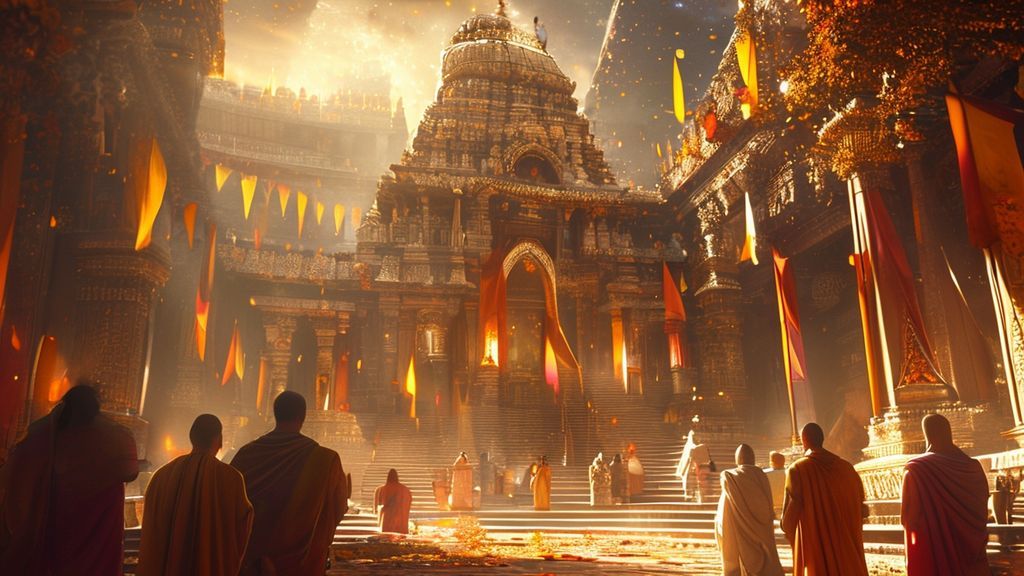
In temple architecture, while not explicitly designed to represent mathematical infinity, the intricate and repetitive patterns, the fractal-like embellishments on gopurams and vimanas, and the multi-layered mandalas often evoke a sense of the boundless. The recursive nature of these designs, where smaller forms replicate larger ones, can be seen as a visual metaphor for the cosmic order that unfolds infinitely. The central sanctum, often dark and empty yet representing the ultimate fullness (Purna) of the Divine, also echoes the concept of zero as the source of all numbers and creation. These architectural marvels serve as a meditative aid, guiding the devotee’s mind from the finite details to the infinite expanse of the sacred, encouraging a deeper dive into spiritual truths available at Hindutva.online.
Rituals & Puja Vidhi: Experiencing the Boundless
Engaging with the infinite is a core aspect of spiritual practice in Sanatan Dharma, moving beyond intellectual understanding to direct experience. The most profound way is through meditation and philosophical inquiry:
- Chanting the Om Purnamadah Purnamidam Mantra: This powerful Shanti Mantra from the Isha Upanishad and Brihadaranyaka Upanishad directly addresses the concept of fullness (Purna) or infinity.
पूर्णमदः पूर्णमिदं पूर्णात् पूर्णमुदच्यते ।
पूर्णस्य पूर्णमादाय पूर्णमेवावशिष्यते ॥
Om Purnamadah Purnamidam Purnat Purnamudachyate |
Purnasya Purnamadaya Purnamevavashishyate ||
It means: “That is whole, this is whole; from the whole, the whole emerges. If you take the whole from the whole, the whole alone remains.” This beautifully illustrates how infinity, when subtracted from infinity, still remains infinite.
- Neti-Neti (नेति नेति) Meditation: A profound Vedantic practice, meaning “not this, not this.” By systematically negating all finite attributes and identifications (body, mind, emotions, roles), the seeker gradually transcends limitations to realize the infinite, attributeless Brahman, their true Self.
- Visualizing Cosmic Forms: Meditating on the vastness of the cosmos, the innumerable stars, and the divine forms like Virat Purusha, helps expand the mind’s capacity to conceive of the infinite.
- Japa of Ananta’s Name: Chanting names of deities associated with infinity, such as “Om Anantaya Namaha” (ॐ अनन्ताय नमः) for Lord Vishnu, helps cultivate a consciousness attuned to the boundless.
Mantras & Chants for the Infinite
Beyond the Purnamadah mantra, several chants evoke the infinite:
Gayatri Mantra: While not explicitly about mathematical infinity, its invocation of the ultimate divine light (Dhimahi) for spiritual wisdom implicitly points to the boundless source of all knowledge and existence.
ॐ भूर्भुवः स्वः तत्सवितुर्वरेण्यं भर्गो देवस्य धीमहि धियो यो नः प्रचोदयात् ॥
Om Bhur Bhuvah Svah Tat Savitur Varenyam Bhargo Devasya Dhimahi Dhiyo Yo Nah Prachodayat ||
Om Namo Bhagavate Vasudevaya: This Dvadasakshari Mantra dedicated to Vishnu, the preserver, acknowledges His omnipresence and infinite attributes.
Maha Mrityunjaya Mantra: Invoking Lord Shiva, it seeks immortality and liberation from the cycle of birth and death, essentially seeking union with the eternal, infinite Self.
Dos and Don’ts in Contemplating the Infinite
- Do approach the concept of infinity with reverence, understanding it as a manifestation of the Divine.
- Do engage in philosophical study of the Upanishads and other Vedantic texts that explore Brahman’s infinite nature.
- Do practice meditation techniques like Neti-Neti to experientially understand the boundless Self.
- Do recognize the interconnectedness of mathematics and spirituality in Hindu thought; they are not separate domains.
- Don’t limit the understanding of the Divine to finite, anthropomorphic forms alone; always remember the transcendental, infinite aspect.
- Don’t dismiss the mathematical contributions of ancient India as mere intellectual exercises; they were deeply rooted in spiritual insights.
- Don’t confuse the infinite with mere “very large numbers”; true infinity transcends quantification.
Frequently Asked Questions
What is the Sanskrit term for infinity in Hindu philosophy?
The primary Sanskrit terms for infinity are Ananta (endless, boundless) and Purna (full, complete, whole). While Ananta often refers to spatial or temporal endlessness, Purna denotes an ultimate fullness that cannot be diminished, even with subtraction, as described in the Upanishads, signifying absolute wholeness or Brahman.
How is the concept of zero (Shunya) related to infinity in Hindu mathematical thought?
The invention of Shunya (zero) in India was foundational to understanding infinity. It enabled the decimal place-value system, allowing for the representation and calculation of extremely large numbers, pushing towards the concept of infinity. Mathematically, ancient Indian texts like Bhaskara II’s Lilavati also explored “division by zero” (kha-hara), identifying the result as ‘ananta-rāśi’ (infinite quantity), demonstrating a clear link between zero and infinity.
Is Brahman synonymous with infinity?
Yes, Brahman, the ultimate reality in Hindu philosophy, is often described in terms of infinity. It is without beginning, middle, or end (anadi, ananta), omnipresent, omniscient, and omnipotent. The attributes of Brahman—being eternal, unconditioned, and boundless—directly correspond to the spiritual understanding of infinity, making Brahman the ultimate infinite consciousness and existence.
How did ancient Indians mathematically express infinity?
Ancient Indians mathematically expressed infinity through their sophisticated decimal system, the conceptualization of zero, and explicit discussions on indeterminate forms. Texts like Bhaskara II’s work provided methods for dealing with “infinity” resulting from division by zero. While not having the modern formal limit concept, their calculations of vast cosmic periods and the manipulation of numbers that transcended finite bounds showcased a profound engagement with the properties of the infinite, as explored further on Hindutva.online.
Dharmic Significance: The Endless Pursuit of Truth
The concept of infinity is not an abstract intellectual exercise in Sanatan Dharma; it is the very essence of spiritual liberation. Understanding Ananta and Purna liberates the devotee from the illusion of finite existence, guiding them towards the realization of their own boundless nature (Atman) and its non-duality with the ultimate, infinite reality (Brahman). It underscores the cyclical, eternal nature of the cosmos, the endless possibilities of karma, and the ultimate goal of moksha—a state of infinite bliss and freedom. This profound philosophical and mathematical legacy reinforces Sanatan Dharma’s position as a holistic system of knowledge that embraces both the empirical and the transcendental, continually inspiring seekers to look beyond the immediate and embrace the eternal, boundless truth.