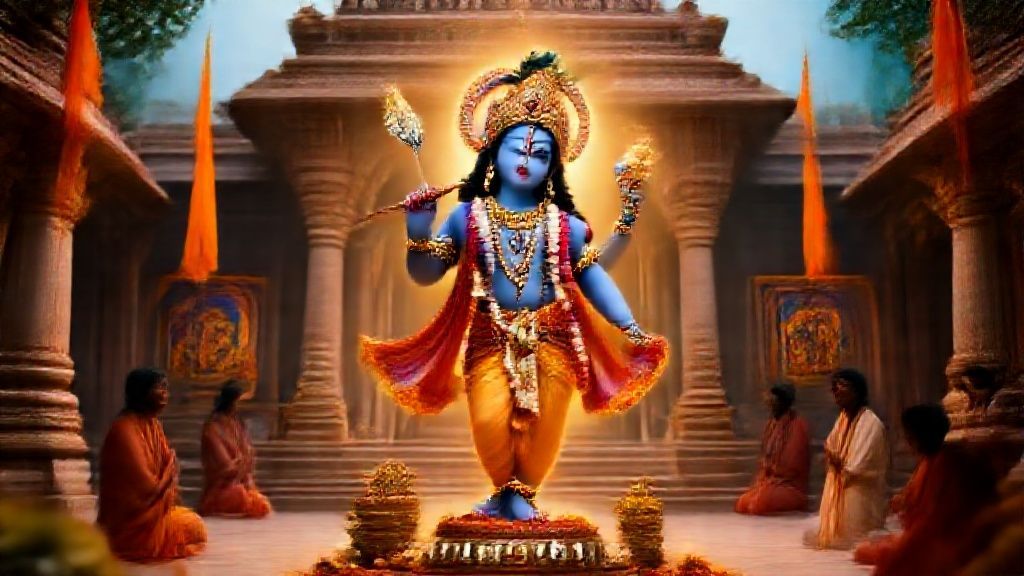
Janmashtami 2026, the divine appearance day of Bhagavan Shri Krishna, is predominantly observed on Sunday, August 16, 2026. This sacred festival commemorates the midnight birth of Lord Krishna, the eighth incarnation of Lord Vishnu, during the Krishna Paksha Ashtami (eighth day of the dark fortnight) of the Bhadrapada month, under the auspicious Rohini Nakshatra.
| Attribute | Details |
|---|---|
| Deity Celebrated | Bhagavan Shri Krishna (Lord Vishnu’s eighth avatar) |
| Key Date (2026) | Sunday, August 16, 2026 (Nishita Kaal aligns) |
| Traditional Date Calculation | Krishna Paksha Ashtami (8th Tithi of dark fortnight) of Bhadrapada Month, with Rohini Nakshatra at midnight. |
| Place of Birth | Mathura, Uttar Pradesh, Bharat |
| Key Observances | Fasting, midnight puja, abhishekam, singing bhajans, cradle ceremony (Jhulanotsav), Dahi Handi. |
| Scripture Reference | Bhagavata Purana (Skanda X), Vishnu Purana, Harivamsa |
The Auspicious Advent of the Dharma Rakshaka
Janmashtami is not merely a festival; it is a profound spiritual experience, an annual celebration that pulsates with the love, joy, and devotion of billions worldwide. It marks the descent of Bhagavan Shri Krishna, the Purna Purushottam, from His eternal abode to the earthly realm. His advent, approximately 5,200 years ago, was a watershed moment in cosmic history, signifying the re-establishment of Dharma (righteousness) and the annihilation of Adharma (unrighteousness).
The very mention of Krishna evokes a sense of wonder—His enchanting smile, His divine flute, His unparalleled wisdom in the Bhagavad Gita, and His playful leelas. Janmashtami is a day when devotees immerse themselves in these transcendental pastimes, fasting, chanting, and decorating their homes and temples to welcome their beloved Lord. It is a reminder that whenever unrighteousness prevails, the Divine intervenes to protect the virtuous and punish the wicked, as promised in the Gita: “यदा यदा हि धर्मस्य ग्लानिर्भवति भारत। अभ्युत्थानमधर्मस्य तदात्मानं सृजाम्यहम्।” (Whenever righteousness declines and unrighteousness prevails, O descendant of Bharata, then I manifest Myself.) This promise is the bedrock of hope for every follower of Sanatan Dharma.
Puranic History: The Divine Birth in Kamsa’s Prison
The captivating narrative of Shri Krishna’s birth is vividly chronicled in the sacred texts, primarily the Bhagavata Purana (Skanda X) and the Vishnu Purana. The story begins in the city of Mathura, ruled by the tyrannical King Kamsa, brother of Devaki.
A celestial voice, an Akashvani (अकशवणि), prophesied that Kamsa would be slain by the eighth child of Devaki. Terrified, Kamsa imprisoned Devaki and her husband, Vasudeva, and ruthlessly murdered their first six children immediately after birth. When Devaki conceived her seventh child, Balarama, He was miraculously transferred to the womb of Rohini, Vasudeva’s other wife, escaping Kamsa’s wrath.
Then came the eighth conception. The scriptures describe this moment as supremely auspicious. On a dark, stormy night, the Ashtami tithi of Krishna Paksha in the Bhadrapada month, with the Rohini Nakshatra ascending, Bhagavan Shri Krishna manifested in His four-armed form (Chaturbhuj रूप) before His parents, bearing the conch, discus, mace, and lotus. This vision filled Devaki and Vasudeva with divine bliss and awe. Immediately, He transformed into an infant boy.
A divine command instructed Vasudeva to take the newborn Krishna across the Yamuna River to Gokul, exchanging Him with the infant daughter of Yashoda and Nanda Baba. Miraculously, the prison gates opened, the guards fell into a deep slumber, and the raging Yamuna parted its waters, allowing Vasudeva to cross with the infant sheltered by the serpent Sheshnaga. In Gokul, Vasudeva exchanged Krishna with baby Yogamaya, Nanda and Yashoda’s daughter, returning to Mathura before dawn. When Kamsa attempted to kill the eighth child, Yogamaya revealed her true divine form and warned him of his impending doom before vanishing. Thus, the stage was set for Krishna’s childhood leelas in Vrindavan and His eventual triumph over Kamsa, fulfilling the prophecy and restoring Dharma.
Astronomical Significance & Calendar Calculation of Janmashtami 2026
The precise dating of Janmashtami embodies the profound astronomical wisdom embedded within Sanatan Dharma. Unlike festivals determined solely by the solar calendar, Janmashtami relies on a complex interplay of lunar tithi, nakshatra (lunar mansion), and time of day (specifically midnight, known as Nishita Kaal). For Janmashtami 2026, these celestial parameters align to designate August 16th as the primary day of celebration for most traditions.
According to the traditional Panchang (Hindu almanac) calculations for Bharat, the Krishna Ashtami Tithi (eighth day of the dark fortnight) of the Bhadrapada month begins at 08:31 AM IST on August 16, 2026, and concludes at 08:08 AM IST on August 17, 2026. The key astronomical alignment for Janmashtami is the presence of Rohini Nakshatra (the star Aldebaran) during the Nishita Kaal. In 2026, Rohini Nakshatra is prominent during the midnight hours on the night of August 16th into August 17th, thereby confirming August 16th as the auspicious day for observing Janmashtami.
The adherence to these specific astrological conditions, where the birth occurred under the confluence of Ashtami Tithi, Rohini Nakshatra, and at midnight, is paramount. Different regional traditions, particularly Smarta (who prioritize the Tithi) and Vaishnava (who emphasize the Rohini Nakshatra and Nishita Kaal), sometimes observe Janmashtami on slightly different days if these elements do not perfectly converge. However, for 2026, the alignment ensures a unified celebration on August 16th for the majority of devotees across the globe, ensuring the puja for Hindutva.online readers can be performed with traditional accuracy.
Rituals & Puja Vidhi for Janmashtami
Observing Janmashtami involves a series of devotional acts, culminating in the midnight celebration of Krishna’s birth. Here is a step-by-step guide:
- Sankalpa and Fasting: Begin the day by taking a Vrata Sankalpa (vow) to observe a full day’s fast. Many devotees observe a Nirjala (waterless) fast, while others opt for a Phalahari (fruit-based) fast. The fast is typically broken after the midnight puja.
- Preparation and Decoration: Clean and decorate your home or puja area. A special cradle (Jhula or Palana) is prepared for the infant Krishna idol. Adorn the idol with new clothes, ornaments, and flowers.
- Midnight Puja Preparations: Gather all puja items: Panchamrita (mixture of milk, curd, ghee, honey, and sugar), Gangajal, fruits, sweets (especially Makhan Mishri – butter and rock sugar, Krishna’s favorite), incense, lamps, sandalwood paste, tulsi leaves, and arati thali.
- Abhishekam (Sacred Bath): Precisely at midnight, place the Krishna idol (often a small Bala Krishna or Laddu Gopal) in a clean vessel. Perform an elaborate Abhishekam, first with Gangajal, then with Panchamrita, followed by fragrant water, and finally with pure water. Gently wipe the idol dry.
- Shringar (Adornment): Dress the idol in new clothes, apply sandalwood paste (Chandan) and vermilion (Kumkum), decorate with flowers and garlands, and adorn with ornaments.
- Offerings and Aarti: Place the idol in the decorated cradle. Offer the prepared Bhog (food offerings) which includes Makhan Mishri, various fruits, and other sweets. Light incense and lamps. Perform Aarti, circling the lamp around the idol while singing devotional hymns (bhajans). Offer prayers, seek blessings, and swing the cradle gently.
- Breaking the Fast (Parana): After the midnight puja and offering of Bhog, devotees consume the Mahaprasad (sanctified food) and break their fast.
Mantras & Chants for Divine Connection
Chanting during Janmashtami deepens one’s spiritual experience, connecting the devotee directly with the divine vibrations of Lord Krishna. These sacred sounds purify the mind and invoke divine grace:
- Maha Mantra: The most widely chanted mantra, especially by Vaishnavites: “हरे कृष्ण हरे कृष्ण, कृष्ण कृष्ण हरे हरे / हरे राम हरे राम, राम राम हरे हरे” (Hare Krishna Hare Krishna, Krishna Krishna Hare Hare / Hare Rama Hare Rama, Rama Rama Hare Hare).
- Dwadakshari Mantra: The twelve-syllable mantra dedicated to Lord Krishna: “ॐ नमो भगवते वासुदेवाय” (Om Namo Bhagavate Vasudevaya). This mantra invokes Vasudeva, the son of Vasudeva, identifying Krishna with the supreme reality.
- Gopala Mantra: A simple yet powerful mantra for Bala Krishna: “ॐ क्लीं कृष्णाय नमः” (Om Klim Krishnaya Namah).
- Recitation of Vishnu Sahasranamam or Gopal Sahasranam (thousand names of Vishnu/Gopala) is also highly meritorious on this day.
Dos and Don’ts on Janmashtami
To observe Janmashtami with utmost reverence and derive maximum spiritual benefit, certain practices are upheld:
- Dos:
- Observe a complete fast (Nirjala or Phalahari) with devotion.
- Decorate your puja altar and home beautifully.
- Chant Hare Krishna Maha Mantra or other Krishna mantras throughout the day.
- Meditate on the divine leelas of Lord Krishna.
- Offer fresh fruits, milk products, and especially Makhan Mishri to the Lord.
- Visit local temples to partake in communal celebrations and Darshan.
- Donate to the needy and perform acts of charity.
- Don’ts:
- Consume any non-vegetarian food or alcohol.
- Engage in negative thoughts, gossip, or arguments.
- Perform any disrespectful acts towards elders or fellow beings.
- Eat grains or common salt if observing a strict fast.
- Sleep during the Nishita Kaal (midnight puja time).
Frequently Asked Questions About Janmashtami
Why is Janmashtami celebrated at midnight?
Shri Krishna’s birth occurred at the precise moment of midnight, in the secrecy of Kamsa’s prison, while the entire city slept. This timing symbolizes the manifestation of divine light amidst the deepest darkness and the overcoming of evil. Hence, the main rituals and puja are performed during the Nishita Kaal.
What is the significance of fasting on Janmashtami?
Fasting on Janmashtami is an act of purification and devotion. It signifies austerity (Tapasya) and dedication, helping devotees focus their minds on the Lord, cleansing the body and spirit. It is believed that observing this fast with sincerity can absolve one of sins and lead to spiritual liberation.
Are there different dates for Janmashtami?
Occasionally, there can be two consecutive days for Janmashtami celebrations. This often arises due to differences in astronomical calculations, specifically regarding the precise alignment of Ashtami Tithi and Rohini Nakshatra with the Nishita Kaal. Smarta traditions primarily focus on the Ashtami Tithi, while Vaishnava traditions give prominence to the presence of Rohini Nakshatra at midnight. For 2026, August 16th is widely accepted, harmonizing both aspects for most.
What is the meaning of Dahi Handi?
Dahi Handi is a popular Janmashtami tradition, especially in Maharashtra, commemorating Krishna’s playful childhood pastime (leela) of stealing butter (makhan) with His friends. Young men form human pyramids to reach a high-hung pot filled with Dahi (curd) or butter, breaking it to signify Krishna’s butter-stealing antics, reminding us of His divine mischief and love for His devotees.
Dharmic Significance: Embracing Krishna’s Eternal Message
The annual celebration of Janmashtami transcends mere ritual; it is a profound reaffirmation of faith, a joyous remembrance of the divine intervention that upholds the cosmic order. Lord Krishna’s life, from His miraculous birth to His teachings in the Bhagavad Gita, serves as an eternal beacon for humanity. He taught us the principles of Dharma, Karma, Bhakti, and Jnana—the paths to righteousness, action, devotion, and wisdom. His advent reminds us that the Supreme Being is always accessible to His devotees, ever ready to guide, protect, and uplift. By observing Janmashtami, we not only honor His divine play but also internalize His message of selflessness, courage, and unconditional love. This sacred festival reinvigorates our commitment to Sanatan Dharma, fostering spiritual growth and ensuring the continuity of our rich cultural heritage for future generations, as we continue our mission at Hindutva.online.
