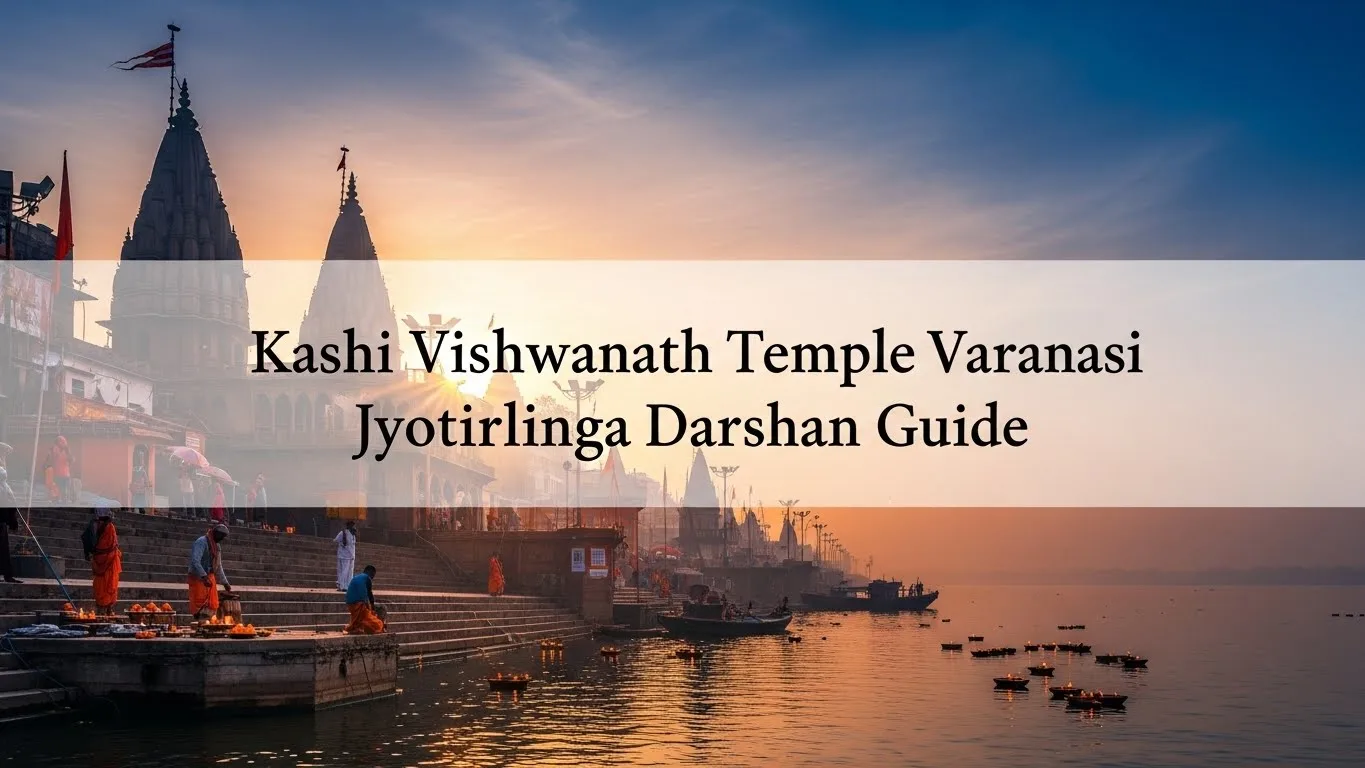
Kashi Vishwanath Temple in Varanasi—the ninth and holiest among all twelve Jyotirlingas, popularly known as the “Golden Temple” due to Maharaja Ranjit Singh’s 1835 donation of 1 tonne gold plating its three domes and spire—represents Hinduism’s supreme pilgrimage destination where death itself grants liberation, with Wikipedia’s authoritative documentation confirming that Varanasi is the first Jyotirlinga to manifest when Lord Shiva appeared as an infinite column of light (jyoti) settling the Brahma-Vishnu supremacy dispute, making it the only city where Shiva himself whispers the Taraka mantra (mantra of salvation) into dying persons’ ears granting instant moksha, thus establishing Varanasi as one of seven Sapta Moksha Puris where death breaks all karmic bonds [web:827][web:843][web:846].
According to the legend documented in Skanda Purana’s Kashi Khanda, when Brahma and Vishnu argued over supremacy, Shiva manifested as an endless pillar of blazing light piercing all three worlds—Vishnu took boar form diving deep to find its base while Brahma assumed swan form flying high to locate its peak, but neither could find the column’s beginning or end—yet Brahma falsely claimed success prompting Shiva to curse him that he would never receive worship while truthful Vishnu would be equally venerated alongside Shiva forever, thus establishing Vishwanath (“Lord of the Universe”) as king over all deities and Varanasi inhabitants [web:827][web:828][web:846].
The extraordinary spiritual and historical convergence validates profound significance: Trawell’s comprehensive 2025 temple guide explains that Kashi Vishwanath endures as testament to undying Hindu faith through multiple destructions—1194 CE by Ghurids’ Mohammad ibn Sam, 1230s by Iltutmish, 1447-1517 by Hussain Shah Sharqi or Sikandar Lodi, and most devastatingly 1669 by Aurangzeb who demolished the Akbar-era Man Singh-Todar Mal reconstruction to build Gyanvapi Mosque (whose foundation, columns, and rear still show Hindu temple remains)—yet 1780 saw Maratha queen Ahilyabai Holkar build the present adjacent structure housing the 60 cm tall, 90 cm circumference Shiva lingam in silver altar, with the sacred Jnana Vapi well where the main priest jumped with the original linga during Mughal invasion to protect it [web:827][web:828][web:831][web:842].
The transformative 2021 Kashi Vishwanath Corridor Project inaugurated by Prime Minister Modi represents modern India’s civilizational revival—the ₹339 crore phase 1 expansion from cramped 3,000 sq ft to magnificent 5 lakh sq ft complex with 23 buildings including Yatri Suvidha Kendras, Tourist Facilitation Centre, Vedic Kendra, City Museum, Food Court, direct sandstone pathway connecting Ganga River to temple replacing congested medieval lanes, discovery and restoration of 40 ancient ruined temples during demolition, amicable rehabilitation of 1,400 properties without single litigation, escalators and ramps for elderly/disabled, and transformation making 50,000-75,000 daily visitors possible—completed during COVID pandemic in less than 3 years as planned [web:837][web:838][web:839][web:840][web:844].
As millions undertake pilgrimage to experience Varanasi’s promised moksha—with modern infrastructure including online darshan booking through shrikashivishwanath.org (₹250 Sugam Darshan 6 AM-6 PM, ₹500 Mangla Aarti 3-4 AM, ₹300 aartis), temple operating 3 AM-11 PM daily, Lal Bahadur Shastri Airport 25 km away, Varanasi Junction railway station 5 km distance, and the transformative Corridor experience combining Ganga dip at Lalita Ghat with escalator-assisted temple access—understanding the complete infinite light legend, destruction-resurrection history,
Golden Temple significance, Corridor features, and practical darshan guide becomes essential for meaningful Hindu pilgrimage [web:827][web:832][web:833][web:835]https://hindutva.online. This comprehensive article presents Kashi Vishwanath’s sacred Brahma-Vishnu light pillar story, ninth Jyotirlinga and Moksha city significance, destruction-reconstruction history from 1194 to 1780, 2021 Corridor transformation, complete darshan timings and aarti schedule, online booking procedure, how to reach from major cities, and pilgrimage preparation tips.
The Legend: Infinite Column of Light
Brahma and Vishnu’s Supremacy Dispute
The cosmic debate [web:827][web:828]:
- Brahma (Hindu god of creation) and Vishnu (Hindu god of preservation) disputed who was supreme
- Neither could agree on superiority
- Their argument threatened cosmic balance
Shiva’s Infinite Light Manifestation
The divine intervention [web:827][web:828]:
- Shiva manifested as endless pillar of blazing light
- The column pierced all three worlds (heaven, earth, underworld)
- It was infinite—with no beginning or end
- Radiated supreme divine energy
The Search for Origin
The cosmic test [web:827][web:828]:
- Vishnu as boar (Varaha): Dived deep into earth to find the base
- Brahma as swan (Hamsa): Flew high to locate the apex
- Both searched for eons
- Neither could discover the beginning or end of the luminous column
Brahma’s Deceit and Curse
Shiva’s judgment [web:827][web:828]:
- Vishnu remained truthful: Humbly admitted failure
- Brahma lied: Falsely claimed he found the top
- Brahma even brought Ketaki flower as false witness
The curse [web:827][web:828]:
- Due to Brahma’s deceit, Shiva cut off his fifth head
- Cursed Brahma: Would no longer receive worship (why few Brahma temples exist)
- Blessed truthful Vishnu: Would be equally venerated alongside Shiva with dedicated temples forever
Vishwanath as Lord of Universe
Vishwanath’s meaning [web:827]:
- “Vishwanath” = Lord of the Universe
- Also called Vishweshwara (Lord of All)
- Shiva as king over all deities and inhabitants
- Rules over Panchkoshi (50-mile sacred circuit of Varanasi)
Varanasi: The Moksha City
Avimukta Kshetra—Never Forsaken by Shiva
Eternal divine presence:
- Varanasi called “Anandavana” (forest of bliss)
- Shiva never leaves this sacred spot
- Permanent residence alongside Mount Kailash
Mahasamshan—The Great Cremation Ground
Liberation at death [web:843][web:846]:
- Shiva whispers Taraka mantra (mantra of salvation) at death
- Instant moksha (liberation from cycle of rebirth)
- Death in Kashi breaks all karmic bonds
- Part of Sapta Moksha Puris (seven cities of liberation)
Pilgrimage to Liberation
Sacred tradition:
- Bath in Ganga River
- Darshan at Kashi Vishwanath
- Carry Ganga water to Rameshwaram (South India)
- Bring back sand from Rameshwaram to complete pilgrimage
The Golden Temple: History and Destruction
Ancient Origins
Historical references:
- Skanda Purana’s “Kashi Khanda”: Describes 1,099 temples (513 for Shiva)
- Brahmavaivarta Purana’s “Kashi Rahasya”: Dedicated to Varanasi
- Temple formerly called “Moksha Lakshmi Vilas”
First Destruction (1194 CE)
Subsequent Destructions
1230: Temple was rebuilt away from main site during reign of Delhi’s Sultan Iltutmish (1211–1266). It was demolished again during the rule of either Hussain Shah Sharqi (1447–1458) or Sikandar Lodi (1489–1517) [web:827][web:842].
Akbar-Era Reconstruction (1585)
Raja Man Singh started rebuilding the temple during Akbar’s reign. Raja Todar Mal furthered the reconstruction of the temple in 1585 [web:827][web:831].
Mughal tolerance period:
- Emperor Akbar sanctioned reconstruction
- Built by Raja Man Singh I and Todar Mal
- Large-scale beautiful temple
Aurangzeb’s Destruction and Gyanvapi Mosque (1669)
In 1669, Mughal Emperor Aurangzeb ordered the demolition of the Hindu temple in 1669. Subsequently, in 1678, the Gyanvapi Mosque was built on its site [web:827][web:831][web:842].
The devastation [web:842][web:845]:
- April 9, 1669: Aurangzeb issued farman decree
- Ordered “demolition of schools and temples of infidels”
- Temple completely destroyed
- Gyanvapi Mosque built using temple debris (1678)
- Temple remains visible: Foundation, columns, rear part of mosque
Ahilyabai Holkar’s Reconstruction (1780)
The present temple was built in 1780 CE by Rani Ahilyabai Holkar of Indore after Mughal emperor Aurangzeb destroyed the previous temple and built a mosque at the site [web:828][web:831].
Maratha revival [web:827][web:831]:
- 1780: Ahilyabai Holkar built present structure
- Located adjacent to Gyanvapi Mosque
- Current temple where devotees worship today
The Golden Domes (1835)
In 1835, Maharaja Ranjit Singh of the Sikh Empire, at the behest of his wife, Maharani Datar Kaur, donated 1 tonne of gold for plating the temple’s dome [web:827][web:834].
Golden Temple features [web:827][web:834]:
- 1 tonne gold donated by Ranjit Singh
- Three pure gold domes plated
- Golden spire (shikhara)
- 15.5-meter-high spire on temple
- Hence the name “Golden Temple”
Kashi Vishwanath Corridor (2021)
PM Modi’s Vision
Foundation and inauguration [web:837][web:838][web:840][web:844]:
- Foundation stone: March 8, 2019
- Inauguration: December 13, 2021
- Cost: ₹339 crore (Phase 1); Total project ₹800-900 crore
- Completion: Less than 3 years despite COVID pandemic
Transformation: 3,000 sq ft to 5 Lakh sq ft
The project is now spread over a massive area of about 5 lakh square feet, whereas earlier premises was limited to just around 3,000 square feet [web:840][web:844].
Scale of expansion [web:839][web:840]:
- Earlier: Cramped 3,000 sq ft
- Now: Magnificent 5 lakh sq ft complex (over 165 times larger)
- Direct access from Ganga River to temple
- Wide sandstone pathways replacing congested medieval lanes
23 Buildings and Facilities
A total of 23 buildings were inaugurated in the phase 1 of the project. They provide a variety of facilities to the pilgrims [web:840][web:841][web:844]:
Modern amenities:
- Yatri Suvidha Kendras (Pilgrim Facilitation Centers)
- Tourist Facilitation Centre
- Vedic Kendra (Vedic learning center)
- Mumukshu Bhavan (Seeker’s residence)
- Bhogshala (Community kitchen)
- City Museum (showcasing Varanasi’s heritage)
- Viewing Gallery (panoramic views)
- Food Court (vegetarian meals)
- Escalators and ramps for elderly/disabled
- Ghats and jetty for boat access from Ganga
40 Ancient Temples Restored
During the process of destruction of the old properties, more than 40 ancient temples were rediscovered. These temples have been restored and beautified, while ensuring that there is no change in the original structure [web:827][web:840][web:841]:
Rediscovered shrines:
- Gangeshwar Mahadev temple
- Manokameshwar Mahadev temple
- Jauvinayak temple
- Shri Kumbha Mahadev temple
- 40+ other ancient temples
Amicable Rehabilitation
Achievement: No litigation pending in any court regarding acquisitions or rehabilitation [web:840]
Temple Architecture
Nagara Style Structure
Architectural features [web:827][web:828]:
- Quadrangular main shrine
- Golden spire (shikhara): 15.5 meters high
- Three golden domes: Pure gold plating
- Sabha Griha: Congregation hall
- Garbha Griha: Inner sanctum sanctorum
The Sacred Shiva Lingam
Lingam specifications [web:827][web:828]:
- Height: 60 centimeters (24 inches)
- Circumference: 90 centimeters (35 inches)
- Altar: Silver platform
- Represents infinite nature of Shiva
Jnana Vapi—The Wisdom Well
There is a small well in the temple called the Jnana Vapi, also spelled Gyan Vapi (the wisdom well) [web:827].
Historical significance [web:827]:
- Located north of main temple
- During Mughal invasion, jyotirlinga was hidden in well
- Main priest jumped in with lingam to protect from invaders
- Sacred site of immense reverence
Temple Timings and Darshan
Daily Temple Timings
Temple Timing: 03:00 AM to 11:00 PM [web:832]:
| Days | Opening Time | Closing Time |
|---|---|---|
| All Days | 3:00 AM | 11:00 PM |
Aarti and Pooja Schedule
Complete Aarti Schedule [web:832]:
| Aarti/Pooja | Timings | Cost (₹) |
|---|---|---|
| Mangla Aarti | 3:00 AM – 4:00 AM | 500 (Normal days) |
| Bhog Aarti | 11:15 AM – 12:20 PM | 300 |
| Saptirishi Aarti | 7:00 PM – 8:15 PM | 300 |
| Night Shringar/Bhog Aarti | 9:00 PM – 10:15 PM | 300 |
| Night Shayan Aarti | 10:30 PM – 11:00 PM | FREE |
Darshan Options and Booking
Darshan Booking [web:832][web:835]:
| Type | Timings | Cost (₹) |
|---|---|---|
| Sugam Darshan | 6:00 AM – 6:00 PM | 250 |
| Rudrabhishek (1 Shastri) | 4:00 AM – 6:00 PM | 450 |
| Sparsh Darshan | Various slots | Book online |
| Live Darshan | Online streaming | Free |
Official booking: https://shrikashivishwanath.org [web:829][web:832]
Note: At time of aarti and special days, Sugam Darshan not allowed [web:835]
How to Reach Kashi Vishwanath Temple
By Air
Lal Bahadur Shastri International Airport (VNS), Varanasi [web:833][web:835][web:836]:
- Distance: 25 km from temple
- Travel time: 45 minutes to 1 hour
- Daily flights: Delhi, Mumbai, Kolkata, Lucknow, Chennai, Hyderabad, Ahmedabad, Bhubaneswar
- Transport: Prepaid taxi, Ola/Uber, airport bus
By Train
Varanasi Junction (BSB) / Varanasi Cantt [web:833][web:835][web:836]:
- Distance: 4-5 km from temple
- Travel time: 15-20 minutes by taxi
- Major rail junction with trains from all metros
- Well-connected to Delhi, Mumbai, Kolkata, Chennai, Lucknow, Allahabad
By Road
- Bus terminals: Cantonment and Kashi Depot (Golgadda)
- Local transport: Auto-rickshaws, cycle rickshaws, e-rickshaws, taxis
- Kashi Darshan Bus Seva: Stops at temple area
Last Mile to Temple
- Get dropped at Godowlia Chowk or Dashashwamedh Ghat
- Walk through Vishwanath Gali (10-15 minutes)
- Or use Corridor entrance from Ganga side
Pilgrimage Tips
Essential Tips
- Book darshan online in advance (especially Mondays, festivals)
- Visit early morning (4-7 AM) for peaceful darshan
- Take Ganga bath before temple visit (traditional custom)
- Use Corridor facilities: Escalators, ramps for elderly
- Dress modestly: Traditional attire recommended
- Carry ID proof: For verification
- No mobile phones/cameras inside sanctum
- Remove leather items: Belts, wallets, shoes
Best Time to Visit
- October to March: Pleasant weather
- Maha Shivaratri: Most auspicious but extremely crowded
- Shravan month (July-August): Sacred for Shiva worship
- Monday: Weekly Shiva day (crowded)
What to Experience
- Ganga Aarti: Evening at Dashashwamedh Ghat
- Boat ride: Sunrise on Ganga
- Kashi Vishwanath Corridor: Architectural marvel
- Annapurna Temple: Adjacent to Vishwanath
- Kaal Bhairav Temple: Guardian deity of Varanasi
- Ancient ghats: Manikarnika (cremation), Assi, Panchganga
Frequently Asked Questions
Why is Kashi Vishwanath the holiest Jyotirlinga?
What is the legend of Kashi Vishwanath Temple?
When was the temple destroyed and rebuilt?
Originally destroyed 1194 CE by Ghurids, rebuilt 1585 by Man Singh-Todar Mal, destroyed 1669 by Aurangzeb who built Gyanvapi Mosque, present structure built 1780 by Ahilyabai Holkar [web:827][web:831][web:842].
Why is it called the Golden Temple?
Maharaja Ranjit Singh donated 1 tonne gold in 1835 for plating three domes and spire, hence the name “Golden Temple” [web:827][web:828][web:834].
What is Kashi Vishwanath Corridor?
PM Modi’s ₹339 crore project inaugurated December 13, 2021, expanding temple from 3,000 sq ft to 5 lakh sq ft with 23 buildings, direct Ganga-temple pathway, 40 restored ancient temples [web:827][web:840][web:844].
What are the temple timings?
Temple opens 3:00 AM (Mangla Aarti) and closes 11:00 PM daily; Sugam Darshan 6 AM-6 PM costs ₹250 [web:832].
How to reach the temple?
Lal Bahadur Shastri Airport 25 km; Varanasi Junction railway station 4-5 km; temple in Vishwanath Gali (pedestrian lanes) accessed via Godowlia Chowk or Corridor [web:833][web:836].
What is Jnana Vapi well?
Conclusion
Kashi Vishwanath Temple in Varanasi—the sacred ninth and holiest among all twelve Jyotirlingas where Lord Shiva first manifested as an infinite column of blazing light settling the Brahma-Vishnu supremacy dispute and cursing deceitful Brahma to never receive worship while blessing truthful Vishnu with eternal veneration, establishing Vishwanath as “Lord of the Universe” ruling over all deities—represents Hinduism‘s supreme pilgrimage destination where death itself grants liberation through Shiva’s whispered Taraka mantra, with Wikipedia’s documentation confirming extraordinary resilience through five major destructions (1194 Ghurids,
1669 Aurangzeb’s Gyanvapi Mosque built from temple debris) yet Phoenix-like resurrection culminating in 1780 Ahilyabai Holkar reconstruction, 1835 Maharaja Ranjit Singh’s 1 tonne gold donation creating the “Golden Temple,” and 2021 PM Modi’s transformative ₹339 crore Corridor expanding cramped 3,000 sq ft to magnificent 5 lakh sq ft complex with 23 buildings, direct Ganga-temple sandstone pathway, 40 restored ancient temples, and amicable rehabilitation of 1,400 properties without single litigation [web:827][web:840]https://hindutva.online.
What distinguishes Kashi Vishwanath’s extraordinary significance is its convergence of legendary supremacy (first Jyotirlinga manifestation with infinite light pillar demonstrating Shiva’s ultimate authority), spiritual promise (Varanasi as Avimukta Kshetra never forsaken by Shiva, Mahasamshan great cremation ground where death breaks all karmic bonds, one of Sapta Moksha Puris, Taraka mantra whispered at death), architectural magnificence (60 cm tall lingam in silver altar, 15.5-meter golden spire, three pure gold domes, Nagara style with intricate carvings, sacred Jnana Vapi wisdom well),
historical resilience (testament to undying Hindu faith surviving five destructions yet eternally resurrecting), and modern transformation (Corridor’s escalators and ramps for 50,000-75,000 daily pilgrims, online booking at shrikashivishwanath.org for ₹250 Sugam Darshan 6 AM-6 PM, ₹500 Mangla Aarti 3-4 AM, complete facilities from Vedic Kendra to City Museum) [web:827][web:828][web:832][web:840][web:846].
By understanding this eternal spiritual capital—accessed from Lal Bahadur Shastri Airport (25 km) or Varanasi Junction (5 km), combining Ganga dawn boat ride and Dashashwamedh evening aarti with temple darshan (3 AM-11 PM), experiencing Corridor’s architectural marvel connecting river to shrine, visiting adjacent Annapurna and Kaal Bhairav temples—devotees access the transformative pilgrimage that ancient Hindu wisdom established as Lord Shiva’s most sacred abode where the very act of death grants instant moksha [web:827][web:833][web:843]https://hindutva.online.
About the Author
Priya Sharma – Certified Yoga Therapist & Spiritual Wellness Expert
Priya Sharma is a certified yoga therapist with over 18 years of experience specializing in Hatha Yoga, pranayama, meditation, and traditional shatkarma purification practices. He holds advanced certifications in yoga therapy and has trained extensively in classical yogic texts including the Hatha Yoga Pradipika and Gheranda Samhita. Priya Sharma integrates ancient yogic wisdom with Ayurvedic principles to help students achieve optimal physical health and spiritual growth through authentic practices. His teaching focuses on making traditional techniques accessible to modern practitioners while maintaining the depth and transformative power of the original methods. He has guided thousands of students through systematic yoga sadhana at leading institutions and retreat centers across India and internationally.