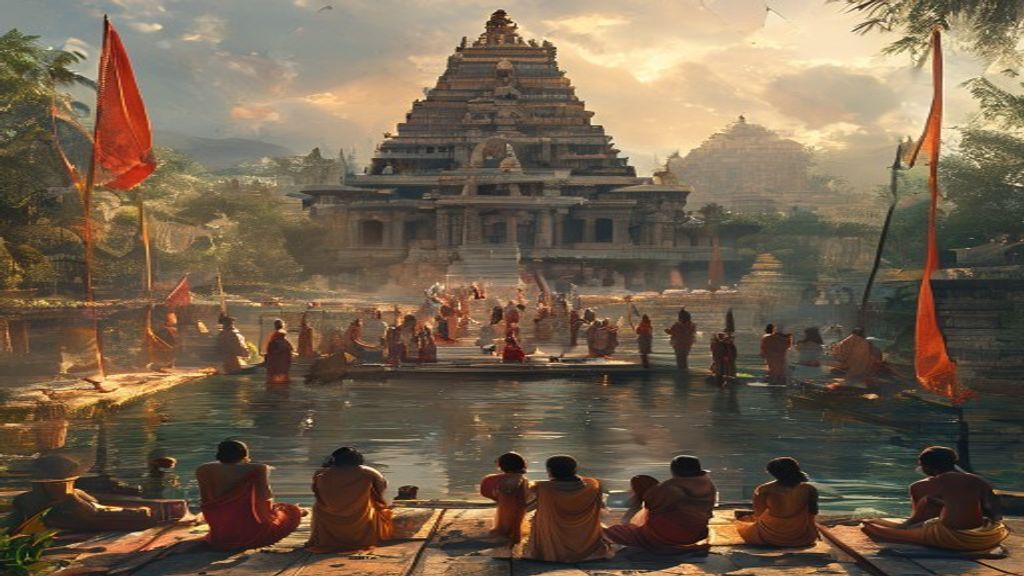
The Kaveri River, reverentially known as Dakshina Ganga (Ganga of the South), is a sacred lifeline originating in the Brahmagiri Hills of Kodagu, Karnataka. This divine river embodies the Mother Goddess, bestowing prosperity, spiritual purification, and sustenance across the South Indian plains, playing an indispensable role in the cultural and religious fabric of Sanatan Dharma.
| Attribute | Details |
|---|---|
| Deity | Kaveri Devi, Mother Goddess, identified with Lopamudra |
| Location/Origin | Talakaveri, Brahmagiri Hills, Kodagu (Coorg District), Karnataka, Bharat |
| Key Festivals | Kaveri Sankramana (Tula Sankramana), Kaveri Pushkaram (every 12 years) |
| Scripture Reference | Skanda Purana (Kaveri Mahatmya), Agni Purana, Brahma Purana |
Introduction: The Lifeblood of Dharma in South India
The Kaveri River, affectionately called “Ponni” (the Golden Girl) in Tamil, is far more than a geographical entity; she is a living deity, a benevolent mother who has nurtured civilizations, spiritual traditions, and agricultural abundance for millennia. Her sacred waters are considered as purifying as those of the Ganga, making her an essential pilgrimage destination for Hindus seeking liberation from sins and spiritual merit. Flowing gracefully through the fertile lands of Karnataka and Tamil Nadu, Kaveri has shaped the history, art, and philosophy of the region, becoming an inseparable part of Sanatan Dharma’s vibrant tapestry.
Her divine flow sustains countless temples, paddy fields, and human habitations, symbolizing the eternal cycle of creation and sustenance. Devotees believe that a dip in her waters cleanses the soul, and offerings made on her banks reach the ancestors, ensuring their peace and prosperity. The Kaveri is not merely a river; she is a testament to the profound reverence Hindus hold for nature, recognizing the divine in every element that sustains life.
Puranic History & Legend: The Descent of Devi Kaveri
The origin of Kaveri is enshrined in several Puranas, most notably the Skanda Purana (particularly the Kaveri Mahatmya section) and the Agni Purana, narrating her divine descent to the earthly realm. The most widely revered legend centers around the great sage Agastya Muni and the cosmic interplay of divine wills.
According to the sacred texts, Kaveri was originally Lopamudra, the daughter of Lord Brahma, or in some accounts, the daughter of Surya Dev. She was endowed with extraordinary beauty and virtues. Through a divine scheme, she was adopted by Agastya Muni, one of the Saptarishis, renowned for his profound austerities and wisdom. Lopamudra, however, harbored a fervent desire to alleviate the suffering of humanity in the southern lands, which were parched and devoid of a life-giving river equivalent to the Ganga in the North.
Agastya Muni, recognizing her divine purpose, assented to her wish. He took her in his kamandalu (water pot), which contained the sacred waters he had collected from various holy rivers. During a moment of deep meditation by Agastya Muni at Brahmagiri Hills, near the present-day Talakaveri, Lord Ganesha, disguised as a crow, mischievously tipped the kamandalu, releasing Lopamudra in her watery form. This act, although seemingly accidental, was orchestrated by the Devas to fulfill Lopamudra’s divine resolve to become a river.
Upon her release, Lopamudra transformed into the mighty Kaveri River, gushing forth from the peak of Brahmagiri. Agastya Muni, initially startled, soon realized the divine intent behind the event and blessed her, declaring her to be the purifier of sins and the bringer of prosperity. Thus, Kaveri began her westward journey, eventually turning southeastward, carving a path through the Deccan Plateau to embrace the Bay of Bengal, fulfilling her mission as the perennial source of life and spirituality for South India. This divine narrative underscores the river’s sanctity and its deep connection to the celestial realm.
Architectural & Scientific Marvels along Kaveri’s Banks
The Kaveri River has been a cradle of profound architectural and engineering ingenuity, inspiring magnificent temples and sustaining ancient hydraulic systems. Her banks are dotted with pilgrimage sites, each a marvel of Dravidian architecture and a testament to unwavering faith.
At her very source, Talakaveri, a small shrine marks the spot where the river emerges. Further downstream, the islands formed by her meandering course host some of the most revered Vishnu and Shiva temples. The three sacred islands of Srirangapatna (Karnataka), Srirangam, and Shivanasamudra (both in Tamil Nadu) are particularly significant. Srirangam Ranganathaswamy Temple, dedicated to Lord Vishnu, is the largest functioning Hindu temple in the world and a prime example of Dravidian temple architecture, with its towering gopurams and intricate carvings. Nearby, Jambukeswarar Temple (Thiruvanaikaval) is one of the Pancha Bhuta Sthalams, representing the element of water (Ap). The town of Kumbakonam, nestled between Kaveri and Arasalar rivers, is renowned for its multitude of ancient temples, including the Adi Kumbeswarar Temple, symbolizing the rich spiritual heritage nurtured by the river.
Beyond spiritual architecture, Kaveri also boasts ancient engineering marvels. The Kallanai Dam, also known as the Grand Anicut, near Tiruchirappalli, stands as a testament to the advanced hydraulic engineering of the ancient Chola dynasty. Built in the 2nd century CE by Karikala Chola, this dam is one of the oldest water-diversion structures in the world still in use. Its design, utilizing local stones and a unique structure to control the river’s flow and irrigate vast tracts of land, demonstrates an incredible understanding of hydrodynamics and structural integrity, an unparalleled feat of its time.
Rituals & Puja Vidhi: Honoring Mother Kaveri
Devotion to Kaveri Devi manifests in various sacred rituals performed by pilgrims and residents alike, aimed at purification, ancestral worship, and seeking blessings. These practices are an integral part of Sanatan Dharma in the Kaveri basin.
- Snana (Holy Dip): The most fundamental act of devotion is taking a holy dip in the Kaveri. It is believed that a purifying bath in her waters, especially during auspicious times like Tula Sankramana or Amavasya, cleanses one of accumulated sins and bestows spiritual merit. Devotees often recite mantras like “Gange ca Yamune caiva Godavari Sarasvati, Narmade Sindhu Kaveri jalesmin sannidhim kuru” (May the presence of Ganga, Yamuna, Godavari, Saraswati, Narmada, Sindhu, and Kaveri be in this water).
- Pind Daan and Tarpana: Kaveri’s banks, particularly at Talakaveri, Srirangapatna, and Mayiladuthurai, are revered sites for performing Pind Daan (offering rice balls) and Tarpana (water offerings) to ancestors. These rituals are crucial for ensuring the peace and liberation of the departed souls, a profound act of filial piety.
- Kaveri Pushkaram: Celebrated once every 12 years when Jupiter (Guru) enters the Tula Rashi (Libra), the Kaveri Pushkaram is a grand festival of immense spiritual significance. Millions of devotees gather to take holy dips, perform pujas, and offer prayers for twelve days, believing that the river gains extraordinary purifying powers during this period.
- Daily Offerings: Locals regularly offer flowers, incense, and lamps (deepam) to the river, expressing gratitude for her life-sustaining waters. Small shrines dedicated to Kaveri Devi are common along her course, where devotees perform daily archana.
Mantras & Chants for Kaveri Devi
Chanting sacred mantras connects the devotee to the divine energy of Kaveri, invoking her blessings for purity, prosperity, and peace.
A simple yet potent mantra for Kaveri Devi is:
ॐ श्री कावेर्यै नमः॥
Om Sri Kaveryai Namah॥
(Salutations to the revered Kaveri)
Devotees often recite the following sloka, which includes Kaveri among the seven sacred rivers of Bharat:
गंगे च यमुने चैव गोदावरि सरस्वती।
नर्मदे सिन्धु कावेरि जलेऽस्मिन् सन्निधिं कुरु॥
Gange ca Yamune caiva Godavari Sarasvati।
Narmade Sindhu Kaveri jalesmin sannidhim kuru॥
(O Ganga, Yamuna, Godavari, Sarasvati, Narmada, Sindhu, Kaveri, may your presence be in these waters.)
This sloka is typically recited before taking a holy bath, invoking the collective purifying power of all sacred rivers.
Dos and Don’ts: Respectful Conduct at Sacred Kaveri
- Do approach the river with reverence and humility.
- Do maintain cleanliness and ensure you do not litter or pollute the river’s banks or waters.
- Do dress modestly, especially when visiting temples or performing rituals.
- Do offer prayers and participate in rituals with devotion.
- Do seek permission before photographing individuals or sensitive areas.
- Don’t throw non-biodegradable waste, plastic, or harmful chemicals into the river.
- Don’t engage in loud or disrespectful behavior.
- Don’t consume alcohol or non-vegetarian food in the immediate vicinity of sacred bathing ghats or temples.
- Don’t disrupt rituals or disturb other devotees.
Why is Kaveri called Dakshina Ganga?
Kaveri is revered as Dakshina Ganga (Ganga of the South) because of her immense spiritual significance and life-sustaining role in South India, akin to how the Ganga nourishes North India. Her waters are considered equally purifying, and she is central to the religious and cultural life of millions, fulfilling the same spiritual aspirations as the sacred Ganga.
What is the significance of Talakaveri?
Talakaveri is the sacred source of the Kaveri River, located in the Brahmagiri Hills of Kodagu, Karnataka. It is a prime pilgrimage site where devotees believe the river emerged from Agastya Muni’s kamandalu. A small spring and temple mark the spot, making it profoundly significant for ancestral rituals (Pind Daan) and seeking the river goddess’s blessings.
Which major temples are located on Kaveri’s banks?
The Kaveri River nurtures several iconic temples, including the Ranganathaswamy Temple at Srirangam (a grand Vaishnava shrine), Jambukeswarar Temple at Thiruvanaikaval (a Pancha Bhuta Sthalam for water), and the numerous ancient temples of Kumbakonam. The shrines at Talakaveri and Srirangapatna also hold immense religious importance.
Dharmic Significance: Preserving the Eternal Flow of Sanatan Dharma
The Kaveri River is not merely a geographic feature; she is an embodiment of Sanatan Dharma itself – eternal, nurturing, and ever-flowing. Her journey from the Brahmagiri hills to the Bay of Bengal mirrors the continuous flow of spiritual wisdom and cultural heritage that defines Hindu civilization. The reverence for Kaveri underscores the profound ecological wisdom inherent in Sanatan Dharma, where rivers are worshipped as mothers, not just resources. This perspective fosters a deep sense of responsibility towards nature, encouraging harmony and sustainable living. The rituals performed, the temples built, and the legends recounted along her banks all serve to reinforce the principles of dharma: piety, duty, sacrifice, and the pursuit of liberation. By honoring Kaveri, we honor the unbroken chain of tradition, the spiritual sustenance of our ancestors, and the promise of a dharmic future for generations to come. Her existence is a constant reminder of the divine presence in the natural world, urging every devotee to live a life aligned with righteousness and ecological consciousness, a core tenet we uphold at Hindutva.online.