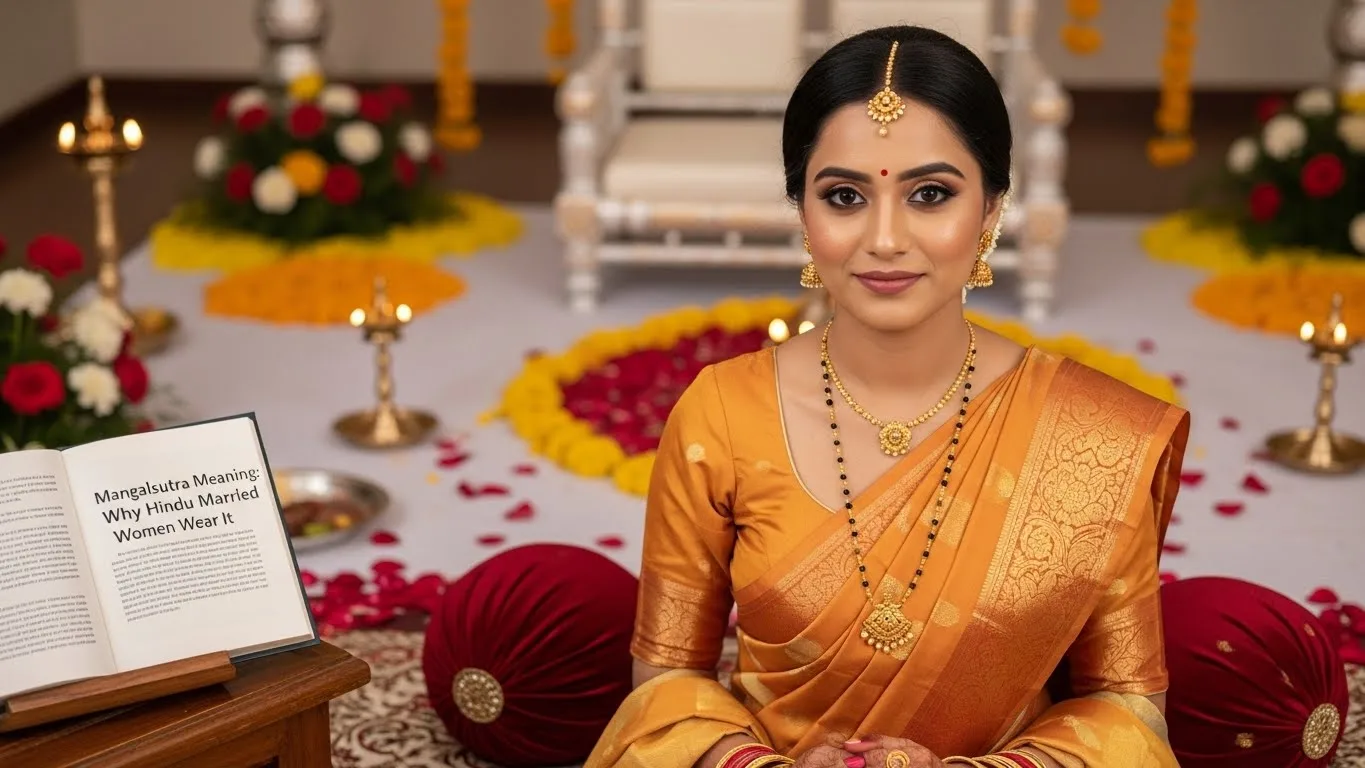
The practice of wearing mangalsutra meaning – sacred marriage necklace from Sanskrit [translate:मङ्गलसूत्र] meaning “auspicious thread” where [translate:मङ्गल] (mangal) means “holy/auspicious” and [translate:सूत्र] (sutra) means “thread” – represents one of Hinduism’s most visually distinctive, emotionally resonant, and spiritually significant symbols of married status where Hindu wives wear this specially designed necklace combining black beads with gold pendants tied around their necks by grooms during wedding ceremonies ([translate:Mangalsutra Dharana]) creating permanent visible reminder of sacred marital bond that simultaneously announces.

woman’s married status to society, protects couple from negative energies and evil eye through black beads’ mystical absorption properties, honors divine feminine [translate:Shakti] power manifest in married woman’s pivotal household role, and maintains ancient traditions connecting contemporary brides with countless generations of wives who wore identical sacred necklaces as badges of honor, devotion, and commitment.
Unlike mere decorative jewelry or fashion accessory, mangalsutra carries profound multi-dimensional significance encompassing spiritual belief that black beads specifically chosen for protective qualities ward off malevolent forces ([translate:drishti]/evil eye) while gold components represent prosperity, purity, and marital longevity ensuring couple’s wellbeing through combination of sacred materials, astrological connection where traditional nine black beads correspond to [translate:Navagraha] (nine celestial bodies) bringing cosmic balance and harmony to marriage, psychological dimension where daily wearing ritual reinforces marital commitment maintaining consciousness of sacred vows beyond romantic feelings’ natural fluctuations, and social function immediately communicating woman’s unavailable status preventing unwanted advances while claiming protection and respect due to married
women in traditional society. The complete mangalsutra tradition encompasses understanding historical evolution from simple turmeric-smeared yellow thread in ancient Dravidian civilization through medieval period’s introduction of black beads inspired by Arab merchants’ protective talismans to contemporary elaborate gold-and-diamond designs balancing tradition with modern aesthetics, regional variations creating distinctive styles from Maharashtra’s dual-row black bead patterns through South India’s Thaali/Thali temple-motif pendants to Bengal’s conch-shell influenced designs each reflecting local cultural heritage, wedding ceremony’s sacred moment when groom ties three knots ([translate:Granthi Bandhan]) with specific mantras binding couple for lifetime creating ceremonial beginning of wife’s mangalsutra-wearing practice, contemporary debates surrounding choice versus compulsion as progressive
women question traditions marking only wives while exempting husbands from equivalent symbols yet others defend practice as empowering expression of Shakti and marital pride, and modern design innovations creating office-appropriate minimalist styles, convertible pieces functioning as regular necklaces, and personalized pendants incorporating initials or meaningful symbols allowing contemporary women to honor tradition while expressing individual taste. For women in 2025 whether newly married brides selecting first mangalsutra balancing family expectations with personal style preferences, experienced wives treasuring cherished pieces connecting daily routine to spiritual heritage, young professionals seeking workplace-appropriate designs maintaining tradition without compromising contemporary aesthetics, or simply curious individuals wanting to understand ubiquitous black-and-gold necklace’s
significance beyond surface appearance, recognizing mangalsutra as complex cultural-spiritual practice rather than simple ornament or outdated custom enables approaching this tradition with nuanced appreciation acknowledging both profound devotional beauty in wives’ loving dedication symbolized through sacred necklace and legitimate modern perspectives about personal choice, gender equity, and individual expression ultimately allowing each woman to make informed conscious decision about participation based on understanding complete significance rather than either unthinking tradition-following or dismissive rejection without comprehension.
The Meaning and Spiritual Significance
Understanding profound layers of meaning reveals mangalsutra as far more than jewelry.
The Etymology: Auspicious Thread
[translate:मङ्गलसूत्र (Mangalsutra)]
Breaking Down the Word Mangalsutra Meaning:
- मङ्गल (Mangal): Holy, auspicious, sacred, blessed
- सूत्र (Sutra): Thread, string, cord
Combined Meaning: “Sacred thread” or “Auspicious thread”
Why This Name?
Historical Origin:
Originally, mangalsutra was literally a sacred thread – simple yellow cord smeared with turmeric tied around bride’s neck.
Evolution:
Over centuries, simple thread transformed into:
- Thread strung with protective black beads
- Gold pendants added for prosperity
- Elaborate designs reflecting regional artistry
Yet name remained: Even modern diamond-studded gold mangalsutra still called “thread” honoring ancient origins.
The Sacred Thread Tradition:
Parallels other Hindu sacred thread customs:
- Yajnopavita (sacred thread ceremony for men)
- Rakhi (protective thread sisters tie on brothers)
Thread = Bond: Symbolizes connection, tie, binding relationship
Unity and Eternal Bond
Core Symbolism:
Mangalsutra represents “unity and togetherness – it signifies the union of two souls, intended to remain bonded for life.”
The Sacred Knot:
During wedding, groom ties three knots ([translate:Granthi Bandhan]):
- First knot: Groom ties, establishing marriage
- Second & Third knots: Traditionally tied by groom’s sister or mother (varies by region)
Three Knots Represent:
Multiple Interpretations:
1. Triple Commitment:
- Physical unity
- Mental harmony
- Spiritual connection
2. Three Life Stages:
- Past lives together
- Present marriage
- Future rebirths (belief in eternal souls’ reunion)
3. Three Divine Aspects:
- Brahma (Creation) – creating new family
- Vishnu (Preservation) – maintaining marriage
- Shiva (Transformation) – evolving through life together
The Permanence:
Once tied during wedding, mangalsutra worn for lifetime (traditionally) – never removed, symbolizing unbreakable bond.
Protection from Negative Energies and Evil Eye
The Black Beads’ Primary Function:
According to tradition, “black beads are not merely ornamental but serve multiple symbolic and practical purposes.”
Protection Mechanism:
1. Absorbing Negative Energy:
“Scientifically, the black color is believed to absorb negative vibrations before they can affect the couple.”
The Belief:
- Black absorbs rather than reflects
- Captures ill-will, jealousy, evil eye directed at couple
- Prevents negative energy from harming marriage
2. Evil Eye Protection (Drishti):
The Concept:
[translate:दृष्टि (Drishti)] = Evil eye, malevolent gaze
Traditional Belief:
- Others’ jealousy, envy can harm
- Newlyweds especially vulnerable (happiness attracts negative attention)
- Black beads ward off drishti protecting couple’s joy
Historical Context:
“These beads, particularly the black beads, began to be interwoven into the fabric of the mangalsutra, each bead believed to carry protective powers against malign energies.”
Cultural Precedent:
Similar protective black bead use across cultures:
- Mediterranean “evil eye” amulets
- Middle Eastern black kohl (kajal) for babies
- African protective bead necklaces
Universal Recognition: Black’s protective properties transcend Hinduism
3. Preventing Marital Discord:
“It’s believed that the beads keep the relationship strong and free from conflict.”
The Teaching:
External protection (from evil eye) combined with internal strength (marital harmony) creates comprehensive shield around marriage.
Symbol of Shakti (Divine Feminine Power)
The Deeper Meaning:
“They are a symbol of the wife’s strength and power within the marriage.”
Shakti Significance:
[translate:शक्ति (Shakti)] = Divine feminine energy, cosmic power, creative force
Married Woman as Shakti:
“Every Hindu wife represents Shakti or Sati” – embodying divine feminine’s protective, nurturing, creative aspects.
Mangalsutra as Shakti Symbol:
Black beads specifically represent this power:
- Not passive decoration
- Active protective force
- Wife as household’s spiritual guardian
Empowerment Interpretation:
Modern perspective: Mangalsutra isn’t subjugation symbol but empowerment emblem – married woman channels Shakti protecting family.
Gold: Prosperity and Purity
Why Gold Component Essential?
“Gold symbolizes prosperity and longevity in the relationship.”
Gold’s Significance:
1. Purity:
- Incorruptible metal (doesn’t tarnish)
- Represents marriage’s purity
- Sacred metal for divine worship
2. Prosperity:
- Wealth and abundance
- Auspiciousness
- Marital success and wellbeing
3. Longevity:
- Durable, lasting
- Symbolizes enduring marriage
- “Till death do us part” commitment
The Combination:
Black + Gold = Perfect Balance:
- Black (protection) + Gold (prosperity)
- Defense (beads) + Blessing (precious metal)
- Power (Shakti) + Purity (gold)
Creates comprehensive symbol addressing both challenges (negative forces to ward off) and blessings (prosperity to attract).
Constant Reminder of Marital Vows
Daily Practice:
“It acts as a constant reminder of the promises and commitment the couple has made to each other.”
Psychological Function:
Unlike wedding photos or certificates:
Mangalsutra worn every day, maintaining continuous consciousness of:
- Sacred vows taken
- Partner’s presence even when apart
- Marital identity and responsibilities
The Mindfulness Tool:
Each time woman sees/feels mangalsutra:
- Brief reminder of marriage
- Reconnection to commitment
- Grounding in relationship beyond daily stresses
Especially Important:
When romantic feelings fluctuate (natural in long marriages), physical symbol maintains connection to deeper commitment transcending emotional ups and downs.
Connection to Husband’s Wellbeing
Traditional Belief:
“It is believed that the well-being of a husband is linked to the mangalsutra worn by his wife, making it a symbol of her health and prosperity as well.”
The Concept:
Wife’s Devotional Practice:
Through wearing mangalsutra faithfully:
- Wife channels protective energy toward husband
- Prayers for his longevity and success manifested
- Sacred object becomes conduit for blessings
Interdependence:
Reflects Hindu marriage philosophy:
- Husband and wife as one unit
- Each other’s wellbeing interconnected
- Wife’s spiritual practice benefits both
Modern Interpretation:
While literal magical thinking questioned, underlying truth: Committed partner’s loving consciousness genuinely supports spouse’s wellbeing through positive intention and devotion.
The Black Beads: Symbolism and Mystery
The distinctive black beads define mangalsutra’s unique appearance and carry deepest symbolic meaning.
Why Black Color?
Multiple Symbolic Layers:
1. Absorption Properties:
The Science (Traditional Belief):
Black absorbs all wavelengths of light – doesn’t reflect.
Applied Symbolically:
- Absorbs negative energies before reaching couple
- Captures malevolent intentions
- Functions as energetic sponge
2. Connection to Shiva-Shakti:
Black = Shiva’s Color:
- Lord Shiva often depicted dark/black
- Sacred ash (vibhuti) dark gray/black
- Represents renunciation, austerity
Marriage = Shiva-Shakti Union:
- Black beads honor Shiva
- Gold honors Shakti (Parvati)
- Together represent divine couple’s perfect union
3. Protection from Drishti (Evil Eye):
“Historically, black is considered a color that repels negative energy. Thus, these beads serve to protect the marriage from the malevolent gaze and unwarranted misfortune.”
The Logic:
Conspicuous happiness (newlyweds) attracts envy → Envy creates evil eye → Black beads absorb/deflect this negative attention
4. Strength and Power:
Unlike association of black with mourning in some cultures:
In Hindu Context:
- Black represents strength (Shakti)
- Power and resilience
- Fierce protective energy
Number of Black Beads Significance
Nine Beads (Most Traditional):
The Navagraha Connection:
“In some communities like the Maharashtrians, nine black beads are arranged at intervals, symbolizing the connection to Navagraha, the nine celestial bodies.”
The Nine Planetary Deities:
[translate:नवग्रह (Navagraha)] = Nine planets/celestial influencers
- Surya (Sun)
- Chandra (Moon)
- Mangal (Mars)
- Budha (Mercury)
- Guru/Brihaspati (Jupiter)
- Shukra (Venus)
- Shani (Saturn)
- Rahu (North Lunar Node)
- Ketu (South Lunar Node)
Symbolism:
Nine beads = Invoking all nine planetary energies to bless and balance marriage
Astrological Protection:
Each planet influences life differently; honoring all nine ensures comprehensive cosmic support.
Variations:
Some mangalsutras have more or fewer beads (design choice), but nine remains most traditional and meaningful number.
Materials for Black Beads
Traditional Options:
1. Onyx:
- Semi-precious black stone
- Durable and beautiful
- Most common traditional choice
2. Black Glass:
- Affordable alternative
- Smooth finish
- Widely used
3. Jet:
- Fossilized wood
- Lightweight
- Rare and expensive
4. Black Diamonds (Modern Luxury):
- Contemporary high-end option
- Maintains black color symbolism
- Adds luxury element
Why Material Matters:
Traditional belief: Natural stones carry better protective energies than synthetic
However: Intention and devotion matter more than material’s monetary value
The Mystical Aura
Protective Talisman:
“Each bead acts as a talisman, creating a protective barrier around the couple.”
The Accumulated Energy:
Some believe:
- Over years of wearing, beads absorb protective power
- Become increasingly effective
- Develop personal connection to wearer
- Should never be casually discarded if broken
Heirloom Quality:
Mothers passing mangalsutras to daughters:
- Transfer accumulated blessings
- Maintain family protection lineage
- Honor ancestors’ marriages
The Teaching:
Whether literal belief in beads’ mystical properties or appreciation of symbolic significance, black beads remain mangalsutra’s defining distinctive feature setting it apart from ordinary jewelry.
Regional Variations and Designs
Hindu India’s cultural diversity creates beautiful regional mangalsutra variations.
Maharashtra: Traditional Black Bead Emphasis
The Classic Maharashtrian Style:
Characteristics:
- Dual or triple rows of black beads
- Gold vati (pendant) – usually two cylindrical gold pendants
- Black beads in patterns – often groups separated by gold beads
Nine Beads Significance:
“In some communities like the Maharashtrians, nine black beads are arranged at intervals, symbolizing the connection to Navagraha.”
Wearing Style:
- Typically shorter length
- Sits close to neck/collarbone
- Prominently visible
South India: Thaali/Thali – The Temple Pendant
Distinct Design:
Name: [translate:ताली (Thaali/Thali)]
Characteristics:
- Large ornate gold pendant (primary feature)
- Often temple-shaped or coin-like
- Goddess Lakshmi or temple motifs engraved
- Yellow thread or thin gold chain
- Minimal or no black beads (major difference from North)
Regional Variations:
Tamil Nadu:
- Elaborate temple architecture inspired pendants
- Often multiple chains
- Very heavy traditional versions
Kerala:
- Minnu – Simpler design
- Leaf-shaped pendants
- Thinner chains
Andhra Pradesh/Telangana:
- Pusalu – Black beads similar to Maharashtrian
- Region-specific pendant styles
West Bengal: Shakha-Pola Combination
Unique System:
Shakha-Pola:
- Shakha = Conch shell bangles (white)
- Pola = Coral bangles (red)
- These bangles are primary married woman markers
Mangalsutra:
- Less emphasized than other regions
- When worn, simpler designs
- Gold chain with small pendant
- Black beads optional
Cultural Difference:
Bengali marriage symbols focus more on bangles than necklace.
Gujarat and Rajasthan: Regional Pendants
Gujarat:
- Influenced by local tribal designs
- Colorful beads sometimes included
- Regional deity symbols
Rajasthan:
- Meenakari work (enamel artistry)
- Kundan settings
- Vibrant traditional craftsmanship
Modern Pan-Indian Designs
Contemporary Trends:
1. Minimalist Office-Wear:
- Single thin gold chain
- Small diamond or gold pendant
- Very few or no black beads
- Professional appearance
2. Convertible Designs:
- Removable pendant
- Can be worn as regular necklace
- Adapts to multiple contexts
3. Diamond Mangalsutras:
- Black beads + diamond accents
- Luxury market
- Maintains tradition with modern luxury
4. Personalized Pendants:
- Initials engraved
- Birthstones incorporated
- Custom designs meaningful to couple
The Evolution:
“Fashion and culture continue to intermingle and evolve, yet the origins root themselves deeply in the protective and auspicious intentions with which it was conceived.”
Modern designs honor tradition while accommodating contemporary lifestyles and aesthetics.
The Wedding Ceremony: Mangalsutra Dharana
The ceremonial first wearing represents marriage’s pivotal moment.
The Ritual: Mangalsutra Dharana
[translate:मङ्गलसूत्र धारण (Mangalsutra Dharana)]
Meaning: Wearing/adorning the auspicious thread
When It Occurs:
During Hindu Wedding:
Timing varies by regional tradition:
- North India: Often during or after Saptapadi (seven steps around fire)
- South India: Major ceremony moment, sometimes equivalent to Saptapadi’s importance
The Procedure
Step-by-Step:
1. Priest’s Blessing:
- Mangalsutra placed before deity/sacred fire
- Mantras chanted blessing it
- Energetically charged for protection
2. Groom Receives Mangalsutra:
- Takes blessed necklace
- Prepares to tie around bride’s neck
3. Three Knots Tied:
The Central Act:
Groom ties three knots ([translate:Granthi Bandhan]) while:
Mantras Chanted:
Varies by tradition, typically includes:
[translate:माङ्गल्यं तन्तुनानेन मम जीवन हेतुना।
कण्ठे बध्नामि सुभगे सञ्जीव शरदः शतम्॥]
“This is a sacred thread. This is essential for my long life. I tie this around your neck, O my beloved! May you live happily for a hundred years (together with me).”
Alternative: Different regional mantras with same essential meaning – binding for lifetime
Who Ties Each Knot:
Tradition 1 (Most Common):
- All three knots: Groom ties
Tradition 2 (Some Communities):
- First knot: Groom
- Second knot: Groom’s sister
- Third knot: Groom’s mother
Symbolism: Groom’s family welcoming bride
4. Witnessing:
- Family members, guests watch
- Often emotional moment
- Photographs/videography capture
The Transformation Moment
Before Mangalsutra Tied:
Bride = Unmarried woman
After Mangalsutra Tied:
Bride = Wife – married woman
Visible Transformation:
This single act marks:
- Legal marriage (along with other ceremonies)
- Social status change
- Beginning of lifetime practice
Emotional Significance:
For Bride:
- Mix of joy (marriage) and bittersweetness (leaving parental home)
- Pride in new status
- Weight of commitment realized
For Groom:
- Taking responsibility for wife’s wellbeing
- Public declaration of commitment
- Sacred duty undertaken
For Families:
- Bride’s family: Daughter becoming another family’s member
- Groom’s family: Welcoming new family member
The Garment Tying (Some Traditions)
Additional Ritual:
Some regions include tying bride’s and groom’s garments together before/during mangalsutra ceremony.
Symbolism:
“Symbolizes the union of two souls coming together as one. It represents the couple’s commitment to support each other through all of life’s challenges and joys.”
The Lifetime Beginning
From This Moment:
Wife expected to wear mangalsutra:
- Traditionally: Every day for rest of married life
- Until widowhood (traditional practice)
- Never removes (strictest interpretation)
Modern Variation:
Many contemporary women:
- Wear daily but remove for bathing, sleeping
- Wear for special occasions only
- Choose personal comfort level
But traditional ideal: Once tied during wedding, mangalsutra becomes permanent.
Frequently Asked Questions
Is mangalsutra mandatory for Hindu married women?
Traditionally expected but not universally mandatory. Regional variation matters: North and West India emphasize mangalsutra strongly; South India often prioritizes Thaali; Bengal focuses on Shakha-Pola bangles more. No absolute Hindu scripture makes mangalsutra mandatory across all communities. Social expectation: Traditional families/communities strongly expect it; urban educated circles increasingly view as personal choice. Modern reality: Many married Hindu women don’t wear mangalsutra daily (or at all) without religious consequences. The key: If wearing, should stem from genuine devotion/meaning, not fear of judgment. Respectful approach: Neither force unwilling women nor mock those who choose traditional practice.
Can widows wear mangalsutra if they remarry?
Yes, absolutely – through remarriage. Traditional widow remarriage: When Hindu widow remarries, new husband ties fresh mangalsutra during wedding ceremony, establishing it for second marriage. Historical widow remarriage restrictions fading; modern Hinduism increasingly accepts. Divorced women: If divorced and remarrying, full mangalsutra ceremony performed with new husband. First marriage’s symbol doesn’t permanently prohibit future marriages. The principle: Mangalsutra represents current living husband – if woman has living husband through remarriage, mangalsutra appropriate regardless of past. Breaking tradition: Some widows/divorcees choosing to keep first mangalsutra (sentimental value) while also wearing new one – personal decisions honored increasingly. Modern acceptance growing for widow/divorcee remarriage with full traditional rites.
What’s difference between mangalsutra and thaali?
Regional variations of same concept: Mangalsutra (North/West India): Black beads + gold pendants on chain, emphasis on black beads’ protective symbolism. Thaali/Thali (South India, especially Tamil Nadu): Large ornate gold pendant (often temple-shaped) on yellow thread or thin chain, minimal or no black beads, emphasis on goddess/temple motifs. Both serve identical function: Married woman’s symbol, tied during wedding, worn throughout married life. Different aesthetics reflecting regional culture – North emphasizes protection (black beads), South emphasizes prosperity (gold pendants). No superiority: Equally valid traditions. Modern blending: Some women wear both styles or hybrid designs. The essence remains constant: Sacred necklace marking married status.
Why don’t Hindu men wear mangalsutra equivalent?
Valid question highlighting gender asymmetry. Historical patriarchy: Society marked women to declare unavailability while men’s freedom unrestricted – property/control mindset. Weak justifications attempted: Men are protectors (not protected), active agents (not passive) – increasingly recognized as problematic rationalizations for inequality. Some traditional items men wear: Sacred thread (Yajnopavita) but not marriage-specific, wedding ring (Western import adopted). Growing change: Progressive couples adopting equal symbols – both wear wedding rings, or husband wears specific tilak/sacred ornament making marriage visible. The reality: Hinduism evolved in patriarchal context creating asymmetric practices. Modern reform: Contemporary Hindus questioning and modifying toward true equality while retaining meaningful aspects. No good religious reason for asymmetry – cultural artifact being gradually reformed.
Can non-Hindu women wear mangalsutra in interfaith marriages?
Personal choice with cultural sensitivity. If married to Hindu man: Some non-Hindu wives adopt mangalsutra respecting husband’s culture and family – generally appreciated gesture. No religious requirement: Husband’s religion doesn’t obligate wife’s practices. Considerations: 1. Genuine appreciation vs. costume, 2. Understanding significance before adopting, 3. Family expectations (both sides), 4. Personal comfort – no pressure. Common negotiations: Wife wears for wedding ceremony only, or Hindu festivals/family events, or daily if finds personal meaning. Reverse situation: Hindu wife married to non-Hindu typically continues mangalsutra as her tradition. Modern interfaith flexibility allows couples creating meaningful blended practices. The key: Mutual respect and informed choice, not forced compliance or resentful rejection.
What if workplace prohibits visible religious symbols?
Navigate thoughtfully balancing faith and profession. Options: 1. Under-clothing wearing – Tuck mangalsutra inside shirt/top (hidden but technically worn), 2. Shorter/lighter version – Minimalist design less conspicuous, 3. Temporal adaptation – Wear at home/off-work, remove during work hours, 4. Advocate for accommodation – Some fight for religious freedom rights (varies by country/law), 5. Priority decision – Assess what matters more: full visible practice vs. professional requirement. Legal protections vary: India/Hindu-majority areas more accommodating; Western workplaces mixed. Many working women’s reality: Adapt practice to circumstances without guilt – God understands practical necessities. Pragmatic devotion: Tradition maintained through modified approach rather than abandoned entirely.
How to choose modern mangalsutra balancing tradition and style?
Multiple contemporary options exist: 1. Minimalist single-thread – Thin gold chain, small pendant, few black beads – office-appropriate, 2. Convertible designs – Removable pendant transforms to regular necklace, 3. Diamond-accented – Black beads + diamonds = traditional symbolism + modern luxury, 4. Personalized pendants – Initials, birthstones, meaningful symbols integrated, 5. Layered look – Shorter mangalsutra layered with other necklaces contemporary style. Shopping tips: Reputable jewelers offer “daily wear mangalsutra” collections specifically for modern women. Try before buying – Ensure comfortable for all-day wear. Customization services: Many jewelers create bespoke pieces blending your preferences with traditional elements. The balance: Maintain core symbolism (black beads for protection, gold for prosperity) while adapting aesthetic to personal taste and lifestyle.
What to do with mangalsutra if marriage ends?
Sensitive personal decision: Traditional expectation: Widow removes mangalsutra upon husband’s death, never rewears (unless remarries). Modern perspectives: 1. Keep as memory – Sentimental value regardless of marriage status, 2. Pass to daughter – Heirloom continuing family tradition, 3. Remake into other jewelry – Transform into pendant/bracelet retaining gold, 4. Donate to temple – If feels appropriate, 5. Continue wearing if widow – Growing acceptance for widow autonomy. Divorce situation: No traditional guidelines (divorce uncommon historically). Modern women decide: stop wearing, keep privately, dispose respectfully. The key: Personal meaning and healing matter most – no rigid rule. Controversial recent case: Court calling mangalsutra removal “mental cruelty” criticized as extreme – most agree personal choice paramount. Respectful approach: Woman’s decision, not society’s judgment.
Conclusion
The ancient practice of wearing mangalsutra represents complex beautiful tradition embodying profound spiritual protection, cultural heritage, marital devotion, and personal identity – simultaneously serving as sacred symbol of wives’ eternal commitment to husbands’ wellbeing through protective necklace invoking divine blessings while also creating visible social marker communicating married status, yet raising contemporary questions about practices marking only women requiring thoughtful examination balancing tradition’s genuine spiritual value against legitimate equity concerns.
Understanding complete framework – that spiritual significance encompasses multiple layers from black beads’ protective absorption of negative energies and evil eye through gold components representing prosperity and purity to sacred wedding ceremony moment when groom ties three knots with mantras binding couple for lifetime establishing practice that connects modern brides with countless ancestral wives, that regional variations from Maharashtra’s traditional black bead emphasis through South India’s Thaali temple pendants to Bengal’s Shakha-Pola alternative
create rich diversity within overarching framework honoring local cultural heritage, that black beads’ mysterious power whether literally believed as mystical talismans or appreciated as profound symbolic reminders of Shakti strength and cosmic balance through Navagraha representation make them mangalsutra’s defining distinctive feature, and that modern design evolution creating minimalist office-appropriate styles, convertible pieces, and personalized pendants enables contemporary women honoring tradition while expressing individual taste and navigating professional demands – allows approaching mangalsutra with nuanced appreciation acknowledging both devotional beauty and modern complexity.
As you engage with mangalsutra tradition in 2025, whether newly married bride selecting first sacred necklace balancing family expectations with personal aesthetic, experienced wife treasuring cherished piece connecting daily routine to spiritual heritage while perhaps updating to contemporary design, young professional seeking workplace-appropriate version maintaining tradition without compromising modern sensibilities, or simply observer understanding significance behind ubiquitous black-and-gold necklace recognizing sophisticated symbolism encoded in sacred jewelry, remember that tradition’s ultimate value lies not in mechanical compliance or forced wearing but in conscious meaningful engagement.
where practices adopted freely from genuine understanding prove far more spiritually powerful than those maintained from social pressure or unthinking habit, that respecting both those who find profound meaning in mangalsutra’s protective symbolism and marital reminder AND those who prefer alternative expressions of commitment or question gender-asymmetric traditions demonstrates true Hindu pluralism honoring individual conscience, and that mangalsutra’s evolution from simple turmeric thread through black bead talismans to contemporary diamond designs represents not tradition’s corruption but healthy adaptation.
where eternal spiritual principles about protection, prosperity, devotion, and sacred partnership find expression in forms relevant to changing times while preserving core values connecting past wisdom with present needs and future possibilities through beautiful sacred necklace worn with pride, love, and conscious choice transforming jewelry into devotion, ornament into prayer, and tradition into living spiritual practice.
[translate:॥ सुमङ्गली भव। अखण्ड सौभाग्यवती भव॥]
(Be auspicious. May you remain eternally fortunate wife blessed with husband’s presence.)
About the Author
Priya Sharma – Women’s Devotional Practices, Sacred Adornments, and Feminine Spirituality Expert
Priya Sharma is a dedicated scholar and practitioner specializing in Hindu women’s devotional practices, sacred adornments like mangalsutra and sindoor, feminine spirituality, and the evolution of traditional customs in contemporary contexts particularly as experienced and negotiated by women themselves.
Drawing from personal experience as married woman maintaining traditional practices while navigating modern professional life, combined with academic training in gender studies and religious anthropology, her work examines how symbols like mangalsutra encode complex meanings about protection, devotion, identity, and social status while simultaneously raising important questions about gender equity, personal autonomy, and tradition’s role in women’s lives requiring thoughtful rather than dogmatic approaches.
Priya has extensively researched marriage-related adornments across India’s diverse regions documenting mangalsutra’s evolution from ancient Dravidian yellow thread through medieval protective black bead incorporation to contemporary designer variations, demonstrating how women’s agency in choosing, wearing, and interpreting these symbols often exceeds patriarchal intentions revealing Shakti empowerment dimensions alongside legitimate feminist critiques.
She regularly counsels newly married women navigating family expectations about traditional practices, teaches workshops on understanding sacred adornments’ spiritual significance beyond social compliance, and facilitates discussions where traditional and progressive women respectfully dialogue about practices like mangalsutra finding common ground in informed choice and mutual respect rather than judgment.
Her teaching emphasizes that sacred adornments gain rather than lose power when worn from genuine understanding and free choice rather than fear or pressure, that tradition serves women best when adapted to support rather than constrain their full flourishing, and that mangalsutra’s beautiful symbolism about protection, prosperity, and partnership can inspire contemporary marriages when freed from compulsory enforcement allowing women to claim tradition as empowering choice rather than endure it as patriarchal imposition.