Mansarovar Lake is the transcendental freshwater body nestled in the majestic Himalayas of Tibet, revered as the epitome of purity and a gateway to spiritual liberation. Believed to have originated from Lord Brahma’s divine mind, it is inextricably linked to Lord Shiva, serving as a sacred bathing ground for deities and a profound pilgrimage site for sincere seekers of Sanatan Dharma.
| Attribute | Details |
|---|---|
| Deity Association | Lord Shiva, Goddess Parvati, Lord Brahma, Devas, Rishis |
| Location/Origin | South-western Tibet Autonomous Region, China; near Mount Kailash. Originated from Brahma’s Manas (mind). |
| Key Festival/Time | Kailash Mansarovar Yatra Season (typically May to October, weather permitting) |
| Scripture Reference | Skanda Purana, Shiva Purana, Mahabharata, Ramayana, Vayu Purana |
The Sanctified Waters of Manasa Sarovar
In the expansive tapestry of Sanatan Dharma, certain locales transcend mere geography to become living temples of the divine. Mansarovar Lake, known in Sanskrit as Manasa Sarovar (मानस सरोवर), meaning “Lake of the Mind,” stands paramount among these. It is not merely a body of water but a profound spiritual entity, a mirror reflecting the cosmic purity and the serene detachment of Lord Shiva, whose eternal abode, Mount Kailash, rises majestically beside it. This sacred confluence of water and mountain embodies the very essence of spiritual aspiration, drawing countless pilgrims from across the globe to experience its purifying grace and profound tranquility. Its waters are believed to wash away sins, cleanse the spirit, and grant liberation (moksha), making it a cornerstone of Hindu, Buddhist, Jain, and Bon traditions alike.
Puranic History and Cosmic Legend
The origins of Mansarovar Lake are deeply etched in our ancient scriptures, imbuing it with unparalleled sanctity. The Skanda Purana, a monumental text, recounts that Lord Brahma himself created this lake from his divine mind (manas) after performing intense austerities on Mount Kailash. It is thus a manifestation of pure consciousness and divine thought, making it the most sacred of all lakes. The Vayu Purana also corroborates this divine genesis, emphasizing its primordial connection to the creator.
Another profound association stems from the legend of Goddess Sati. While Mansarovar is not traditionally counted among the 51 Shakti Peethas, its proximity to Kailash and the narrative of Sati’s immolation at Daksha’s Yagna profoundly connects it to the divine feminine energy. It is believed that certain parts of her sacred body or ornaments may have fallen in or near this region, further sanctifying the entire Kailash-Mansarovar complex. The waters are believed to have witnessed the cosmic dance of Shiva and Parvati, absorbing their divine energies over countless eons.
Furthermore, the Mahabharata and Ramayana also allude to the sacredness of Mansarovar. Rishis, Devas, and enlightened beings are said to regularly bathe in its waters to attain spiritual merit and purification. Even the Yakshas, Gandharvas, and Kinnaras are believed to inhabit its shores, adding to its ethereal mystique. This lake is not just a geographical feature; it is a vital organ in the cosmic body of Dharma, perpetually vibrant with divine presence.
Geographical & Spiritual Marvels of Mansarovar
While the concept of “architecture” typically refers to man-made structures, Mansarovar Lake presents a magnificent natural architecture, meticulously sculpted by the divine hand. Situated at an astonishing altitude of approximately 4,590 meters (15,060 feet) above sea level, it is one of the highest freshwater lakes in the world. Its sheer size, spanning about 320 square kilometers (120 square miles), combined with its profound depth, creates an awe-inspiring spectacle of nature’s grandeur.
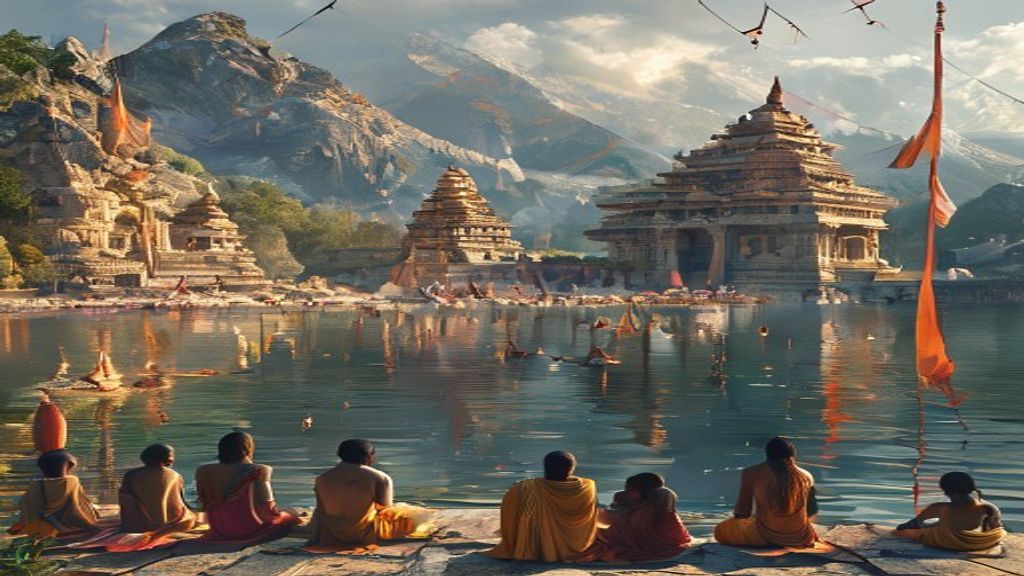
The lake’s crystal-clear, deep blue waters reflect the surrounding snow-capped peaks, offering a mesmerizing panorama that captivates the soul. Scientifically, Mansarovar holds immense significance as the source of four of Asia’s greatest rivers: the Brahmaputra (Yarlung Tsangpo), the Indus (Sindhu), the Sutlej, and the Karnali (a major tributary of the Ganga). This hydrological uniqueness further underlines its role as a cosmic reservoir, distributing life-giving waters across vast civilizations—a true marvel of natural engineering that feeds millions.
Spiritually, the circular shape of Mansarovar Lake is often interpreted as a mandala, a cosmic diagram representing the universe, perfectly complementing the pyramidal form of Mount Kailash. This juxtaposition of the feminine (the lake, representing creation and nurturing) and the masculine (Kailash, representing destruction and meditation) embodies the sacred polarity of existence, perpetually inspiring inner transformation for those who visit. Delving deeper into such intricate spiritual symbology is a core pursuit at Hindutva.online.
Rituals and Puja Vidhi at the Sacred Lake
Pilgrimage to Mansarovar is a profound act of devotion, and performing the correct rituals amplifies its spiritual benefits. While elaborate temple rituals are not possible at such a remote location, the simplicity of the offerings only intensifies their purity:
- Sacred Bath (Snana): The foremost ritual is to take a dip in the holy waters of Mansarovar. Devotees believe this purifies the body, mind, and soul, cleansing accumulated karmas. It is performed with utmost reverence, often with prayers to Lord Shiva.
- Parikrama (Circumambulation): Performing a circumambulation around the lake is highly meritorious. The full parikrama of Mansarovar is approximately 100 kilometers and can take several days on foot. Shorter symbolic circumambulations are also performed near the shore.
- Jalabhishek and Pind Daan: Offerings of the sacred water (jalabhishek) to Lord Shiva and other deities are common. Many also perform pind daan for ancestors on the banks, seeking liberation for departed souls.
- Meditation and Chanting: The serene environment is ideal for deep meditation (dhyana) and chanting mantras. Sitting quietly by the lake, absorbing its vibrations, is a powerful spiritual practice.
- Water Collection: Devotees often collect Mansarovar water to bring back home as Gangajal (holy water) for purification rituals and daily worship.
Mantras and Chants for Mansarovar Darshan
When in the presence of Mansarovar, chanting the divine names and mantras enhances the spiritual experience. The most potent mantra associated with Lord Shiva, and thus with Kailash and Mansarovar, is:
ॐ नमः शिवाय (Om Namah Shivaya)
This Panchakshari Mantra is a universal prayer to Shiva, invoking his protective and transformative energies. One can also chant:
ॐ त्र्यम्बकं यजामहे सुगन्धिं पुष्टिवर्धनम्। उर्वारुकमिव बन्धनान् मृत्योर्मुक्षीय माऽमृतात्॥ (Om Tryambakam Yajamahe Sugandhim Pushtivardhanam | Urvarukamiva Bandhanan Mrityor Mukshiya Maamritat ||)
This Mahamrityunjaya Mantra is for longevity, well-being, and liberation from the cycle of birth and death, highly appropriate in a place believed to grant moksha.
Dos and Don’ts for Pilgrims
Maintaining the sanctity of Mansarovar requires adhering to certain spiritual and environmental etiquettes:
- Do: Maintain utmost silence and reverence, allowing the sacred vibrations to penetrate your being.
- Do: Dress modestly, respecting the spiritual sanctity of the site.
- Do: Be physically prepared for high-altitude trekking and harsh weather conditions.
- Do: Offer prayers with a pure heart and sincere devotion.
- Do: Carry back holy water from Mansarovar for your home altar.
- Don’t: Litter or leave any waste behind. The environment must be preserved in its pristine state.
- Don’t: Disturb the wildlife or natural ecosystem in any way.
- Don’t: Engage in loud conversations, excessive photography, or any activity that disrupts the spiritual ambiance.
- Don’t: Consume alcohol, tobacco, or non-vegetarian food in the sacred vicinity.
- Don’t: Take any geological or botanical samples from the region.
Frequently Asked Questions About Mansarovar Lake
Is Mansarovar Lake considered a Shakti Peeth?
No, Mansarovar Lake is not formally recognized as one of the 51 Shakti Peethas. However, its spiritual connection to Goddess Sati and the larger Kailash mythos, where Shiva wandered with her body, means the entire region is imbued with the divine feminine energy, making it exceptionally sacred.
What is the spiritual significance of bathing in Mansarovar Lake?
Bathing in Mansarovar Lake is believed to cleanse all sins committed over a hundred lifetimes, purify the mind (manas), and grant liberation (moksha) from the cycle of rebirth. It is considered an act of ultimate spiritual purification, connecting the devotee directly to the divine consciousness of Lord Shiva and Brahma.
What makes Mansarovar Lake unique compared to other holy lakes?
Its uniqueness stems from its divine origin from Lord Brahma’s mind, its direct proximity to Lord Shiva’s abode, Mount Kailash, and its role as the source of four major Asian rivers. These combined attributes imbue it with a cosmic significance unparalleled by any other lake in the world, making it a place where the physical and spiritual realms profoundly merge.
The Dharmic Significance: A Path to Moksha
Mansarovar Lake is more than a pilgrimage destination; it is a profound symbol of our spiritual journey. It reminds us that purity of mind (manas shuddhi) is paramount for true spiritual realization. The arduous journey to reach its shores mirrors the inner struggles and perseverance required on the path of Dharma. Each ripple on its pristine surface, each gust of wind carrying the mountain’s silence, speaks of the eternal truths of Sanatan Dharma: detachment, purity, devotion, and the ultimate pursuit of liberation. By visiting Mansarovar, devotees are not just performing a ritual; they are immersing themselves in a cosmic reality, reaffirming their faith, and seeking to align their inner self with the supreme consciousness of Shiva. It is a testament to the enduring power of faith and a living conduit to the divine, preserving the timeless heritage of Hindu spirituality for generations to come.