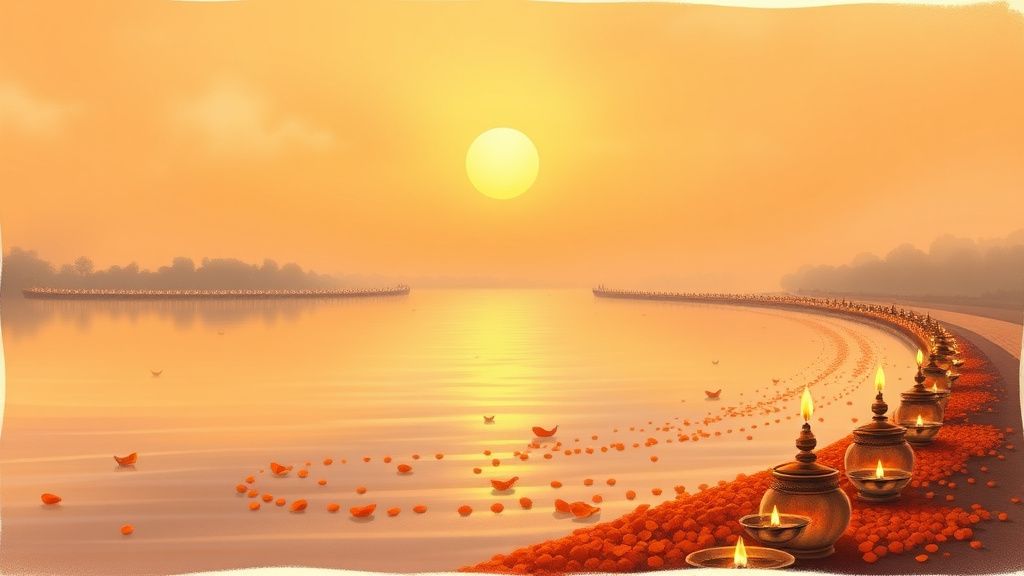
The Kumbh Mela is held at four locations linked to four sacred rivers: Prayagraj at the Triveni Sangam (the confluence of the Ganga, Yamuna, and the mythical Saraswati) in Uttar Pradesh; Haridwar on the Ganga in Uttarakhand; Ujjain on the Shipra in Madhya Pradesh; and Nashik-Trimbakeshwar on the Godavari in Maharashtra. The four-site rotation runs on a 12-year cycle, with a smaller Ardh Kumbh every six years at Haridwar and Prayagraj. The site for each year is determined by the astrological positions of Jupiter (Brihaspati), the Sun, and the Moon, which trigger the kumbha yoga at a specific location. This article explains why these four sites, what the river symbolism means, and the cycle of the festival.
The four sites and their rivers
The four locations and the river at each:
- Prayagraj (formerly Allahabad), Uttar Pradesh: at the Triveni Sangam where the Ganga and the Yamuna physically meet and the unseen Saraswati is held to merge underground. The Kumbh here is the largest of the four; the 2025 Maha Kumbh drew an estimated 660 million visitor-attendances over the 45-day festival, the largest religious gathering in recorded history.
- Haridwar, Uttarakhand: on the Ganga at the point where the river leaves the Himalayan foothills and enters the plains. The bathing ghat is Har ki Pauri (the footstep of Hari), with the main bathing at the Brahma Kund.
- Ujjain, Madhya Pradesh: on the Shipra river, at the ghats around Ramghat in the old city. The Ujjain Kumbh is called the Simhastha because it occurs when Jupiter is in Simha (Leo).
- Nashik-Trimbakeshwar, Maharashtra: on the Godavari river, with the two principal bathing sites at Ramkund in Nashik city and at Kushavarta Kund near the Trimbakeshwar Jyotirlinga, 30 km away.
The Samudra Manthan origin
The mythological origin of the Kumbh Mela comes from the Samudra Manthan (churning of the cosmic ocean), recounted in the Bhagavata Purana, the Vishnu Purana, and the Mahabharata. The gods (devas) and the demons (asuras) churned the milky ocean to extract amrita, the elixir of immortality, using Mount Mandara as the churning rod and the cosmic serpent Vasuki as the rope. When the kumbha (pot) of amrita emerged, Vishnu in the form of Mohini distracted the asuras while the celestial physician Dhanvantari carried the pot away.
During the flight of the amrita kumbha, drops of the elixir fell at four earthly sites: Prayag, Haridwar, Ujjain, and Nashik. These four spots, made sacred by the amrita, became the four Kumbh Mela sites. The Sun (Surya), the Moon (Chandra), and Jupiter (Brihaspati) were said to have protected the kumbha during the carrying, which is why their astrological positions determine the timing of each Mela.
The astrological cycle
The Kumbh year and site for each cycle are determined by Jupiter’s position in the zodiac, paired with the Sun and Moon’s positions. Jupiter takes approximately 12 years to complete one orbit through the twelve zodiac signs, which gives the basic 12-year cycle. The specific yogas for each site:
- Haridwar: Jupiter in Aquarius (Kumbha) and the Sun in Aries (Mesha). The festival name “Kumbha Mela” comes directly from Jupiter’s position in Kumbha at this site.
- Prayagraj: Jupiter in Taurus (Vrishabha) and the Sun in Capricorn (Makara) during Magha month. The Magh Mela held annually is a smaller version of the same observance.
- Ujjain: Jupiter in Leo (Simha) and the Sun in Aries (Mesha). Called the Simhastha for this reason.
- Nashik-Trimbakeshwar: Jupiter in Leo (Simha) and the Sun in Cancer (Karka). Also a Simhastha by the Jupiter placement.
The Ardh Kumbh (half Kumbh) is held at Haridwar and Prayagraj six years after each full Kumbh at those sites. The Maha Kumbh at Prayagraj specifically occurs once every twelve years, with a Purna Kumbh slightly different in some classifications. The 2025 Maha Kumbh at Prayagraj concluded on February 26, 2025; the next Kumbh in the rotation is the 2027 Nashik Kumbh (Simhastha).
Why these four rivers specifically
The four rivers are not chosen at random. The mythological reading is that the amrita drops fell at these four places. The geographical and ritual reading is that each river represents one of the major sacred river traditions:
- The Ganga is the central sacred river of North India, descending (in the Bhagiratha story) from Shiva’s hair. Haridwar and the Prayagraj Sangam are the upper and lower anchors of the Gangetic plain pilgrimage.
- The Yamuna joins the Ganga at Prayagraj, doubling the sacredness of that confluence. The Yamuna is also the river of Vraj, of Krishna’s childhood.
- The Saraswati, present at Prayagraj only in mythical (antarvahini) form, represents the ancient Sarasvati river of the Rig Veda, now identified by historians with the dried-up Ghaggar-Hakra system. Its underground presence at the Sangam is treated as a real but unseen confluence.
- The Shipra at Ujjain is the river that flows past the Mahakaleshwar Jyotirlinga, one of the twelve Jyotirlingas of Shiva.
- The Godavari is the Dakshin Ganga, the southern Ganga, the longest river of the Deccan plateau and the river associated with Rama’s exile at Panchavati in Nashik.
For what it’s worth, the geographic spread of the four sites (north, east, west, south on the Indian map, roughly) gives the Kumbh a national rather than regional reach, which is part of why it has survived as a unified institution across many centuries.
The shahi snan and royal bath days
At each Kumbh, several specific dates are designated as Shahi Snan (royal bath) or Amrit Snan dates, on which the akharas (the monastic orders) bathe in procession. These dates are the most ritually charged of the festival:
- At Prayagraj 2025, the three Amrit Snan dates were Mauni Amavasya (Jan 29), Basant Panchami (Feb 3), and Maghi Purnima (Feb 12), with Makar Sankranti (Jan 14) and the closing Mahashivratri (Feb 26) as additional principal bathing days.
- At Haridwar, the Shahi Snan dates align with Makar Sankranti, Mauni Amavasya, Basant Panchami, Maha Shivaratri, Somvati Amavasya, Baisakhi, Chaitra Amavasya, and Chaitra Purnima.
- At Ujjain Simhastha, the principal bathing days fall on Vaishakh Purnima and other days through Chaitra and Vaishakh.
- At Nashik Simhastha, the bathing days are spread across Shravan-Bhadrapad months.
The thirteen akharas (Naga Sannyasi, Bairagi, Udasin, and Sikh, broadly grouped) participate in the Shahi Snan procession in a fixed order of precedence. The Juna Akhara is the largest among the Shaiva akharas and typically leads.
Common questions
Are there really only four Kumbh sites?
Yes by mainstream tradition: Prayagraj, Haridwar, Ujjain, and Nashik-Trimbakeshwar. A fifth claim, Kumbakonam in Tamil Nadu, holds a Mahamaham festival every 12 years that is sometimes called the “South Indian Kumbh,” but it is a separate institution, not part of the canonical four-site Kumbh rotation. The 2025 Maha Kumbh at Prayagraj and the upcoming 2027 Nashik Kumbh are the immediate next two in the canonical cycle.
When is the next Kumbh after Prayagraj 2025?
The Nashik-Trimbakeshwar Simhastha Kumbh in 2027 is the next major Kumbh in the rotation. The Ujjain Simhastha is scheduled for 2028. The Haridwar Ardh Kumbh follows in the cycle after that, and the next Prayagraj Ardh Kumbh falls in 2031. The exact dates within each Kumbh year are determined by the panchang once the astrological positions are computed; the principal bathing dates are announced one to two years ahead by the respective Mela administrations.
How are crowd numbers calculated?
The crowd figures reported for the Kumbh are visitor-attendances summed over the full festival period, not unique individuals. The 660 million figure for the 2025 Prayagraj Maha Kumbh is the cumulative count across 45 days, including pilgrims who visited and bathed multiple times. Headcounts are estimated by state government tourism, police, and crowd-monitoring CCTV systems, with refinements based on ticket sales, transport ticketing, and aerial photography of the Mela ground.
A limitation worth noting
The article describes the canonical four-site Kumbh rotation. There are smaller “kumbh-like” gatherings in other places (the Magh Mela at Prayagraj is annual, the Kumbakonam Mahamaham is a separate 12-year cycle), and the exact astrological computations for each Kumbh year are done by panchang specialists from the akhara councils. For the precise Shahi Snan dates of upcoming Kumbhs, the Mela administration’s official notification (released about a year before each Mela) is the authoritative source.
For background on the festival, see the Kumbh Mela entry on Wikipedia and the Britannica entry on the Kumbh Mela.
