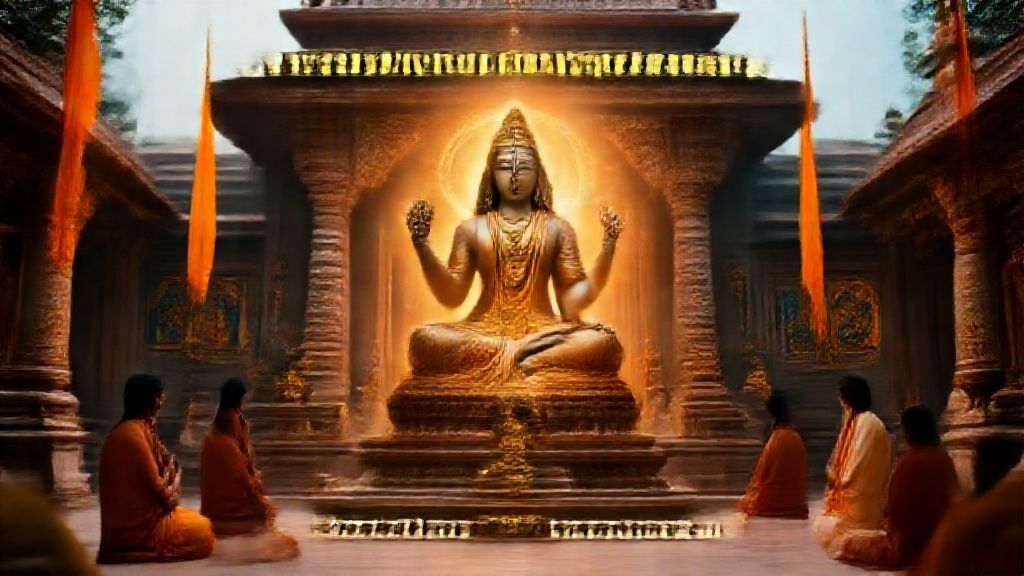
Mantra for peace and stress removal chants are powerful Vedic sound vibrations, revered in Sanatan Dharma, designed to calm the mind, purify the spirit, and alleviate mental anguish. Rooted deeply in ancient scriptures like the Vedas and Upanishads, these sacred syllables act as spiritual tools, fostering inner tranquility and guiding the practitioner towards a state of profound equipoise and resilience amidst life’s challenges.
| Attribute | Details |
|---|---|
| Purpose | Cultivating inner peace, reducing stress, enhancing mental clarity, spiritual upliftment. |
| Core Principle | The transformative power of sound (Shabda Brahma) and focused repetition (Japa). |
| Key Deities/Energies | Savitri (Gayatri), Shiva, Vishnu, Divine Mother (Shakti), Universal Brahman (Om). |
| Scriptural Origin | Vedas (Rig Veda, Yajur Veda), Upanishads (Mandukya, Shvetashvatara), Puranas, Yoga Sutras. |
The Sacred Resonance: Invoking Serenity through Mantras
In the timeless tapestry of Sanatan Dharma, the human mind is often described as a turbulent ocean, perpetually agitated by the waves of desires, fears, and attachments. The ancient Rishis, through profound spiritual insight, discovered that sacred sound vibrations – mantras – possess an unparalleled ability to calm this inner storm. These are not mere words but conduits of divine energy, carefully structured phonetic expressions imbued with specific spiritual potencies. Chanting a mantra for peace is a revered spiritual practice, a direct pathway to inner harmony, mental clarity, and profound stress removal, reconnecting the individual consciousness with the universal cosmic rhythm. It is a cornerstone of Hindutva.online‘s understanding of holistic well-being.
The practice of mantra chanting is a central pillar of Vedic tradition, recognized as Nada Yoga – the yoga of sound. It transcends mere psychological comfort, delving into the very fabric of existence, acknowledging sound as the primordial creative force (Shabda Brahma). Through disciplined chanting, devotees can purify their minds, stabilize their emotions, and dissolve the incessant mental chatter that often manifests as stress and anxiety. The profound peace derived from this practice is not transient but enduring, fostering a resilient inner core capable of navigating life’s inevitable challenges with grace and equanimity.
The Ancient Lineage: Puranic Roots and Yogic Wisdom
The efficacy of mantras for peace and stress removal is not a modern discovery but a wisdom codified millennia ago, attested in numerous scriptures. The very concept of mantra-drashta – the seers who “saw” or intuited these sacred sounds in their meditative states – highlights their divine origin. The Rig Veda, the oldest of the Vedas, is replete with hymns (mantras) dedicated to various deities, chanted to invoke cosmic order and inner peace. The Mandukya Upanishad extensively delineates the significance of ॐ (Om) as the embodiment of all existence, the past, present, and future, and transcending time itself, offering profound liberation and peace through its contemplation.
The Itihasas and Puranas frequently recount instances of great sages, kings, and even deities employing specific mantras to overcome adversity, achieve mental equilibrium, and gain spiritual insight. In the Bhagavad Gita (Chapter 6, verses 34-36), Lord Krishna instructs Arjuna on the nature of the restless mind (chañchalaṁ hi manaḥ kṛṣṇa) and advises that it can be controlled through consistent practice (abhyāsena tu kaunteya) and dispassion (vairāgyeṇa ca gṛhyate). Mantra chanting is a fundamental *abhyasa* (practice) that aids in this mental discipline. Similarly, the Yoga Sutras of Patanjali (Chapter 1, Sutra 27-29) acknowledge the power of chanting Om (Praṇava) for concentration and the removal of obstacles (antarāyāḥ) that disturb mental peace.
The spiritual biographies within the Skanda Purana and Padma Purana often illustrate how devotion coupled with mantra japa enabled devotees to achieve extraordinary states of mental fortitude and inner calm, even amidst the most trying circumstances. These ancient narratives serve not just as historical accounts but as enduring testaments to the timeless efficacy of mantra practice in cultivating a peaceful and resilient mind.
The Vibrational Science of Mantras: Beyond Mere Sound
While not “architectural marvels” in the conventional sense, mantras represent an intricate science of sound and vibration, a marvel of ancient spiritual engineering. The profound impact of mantra chanting stems from the understanding of शब्द ब्रह्म (Shabda Brahma) – the concept that the universe itself originated from sound, and that all manifest forms are essentially condensed sound vibrations. Each mantra is a carefully crafted sound formula designed to resonate with specific energy centers (chakras) within the body and specific aspects of cosmic consciousness.
Modern science, through studies in psychoacoustics and neuroscience, is beginning to validate what Rishis knew intuitively for millennia. Chanting stimulates the vagus nerve, which plays a crucial role in regulating stress responses. The rhythmic repetition, especially of elongated vowel sounds and nasal consonants, creates distinct brainwave patterns (often associated with meditative states like alpha and theta waves), promoting relaxation and reducing cortisol levels. The precise pronunciation (śabda), rhythm (laya), and intention (bhāva) during chanting create a harmonious internal environment that quietens the sympathetic nervous system (fight-or-flight) and activates the parasympathetic nervous system (rest-and-digest).
The primordial sound ॐ (Om/Aum) is considered the most fundamental vibration, encompassing all sounds and frequencies. Its three components (A-U-M) correspond to creation, preservation, and dissolution, resonating with various physical and energetic aspects of the human system. Chanting Om alone can induce a profound state of meditative calm, grounding the individual and expanding their awareness, thus proving to be one of the most effective stress removal chants known.
Sacred Practice: Rituals & Puja Vidhi for Mantra Chanting
The practice of chanting mantras for peace and stress removal, known as Japa, is a powerful ritual that can be integrated into daily life. While formal puja involves elaborate steps, personal mantra japa can be simple yet profoundly effective. Here is a step-by-step guide:
- Purification (Śuddhi): Begin by taking a bath or washing your hands and face. Ensure your chanting space is clean and conducive to quiet contemplation.
- Setting Intention (Saṅkalpa): Sit comfortably in a meditative posture (e.g., Padmasana, Sukhasana) with your spine erect. Close your eyes gently. Take a few deep breaths, centering yourself. Mentally (or verbally) state your intention for the practice – to seek peace, remove stress, or connect with the divine.
- Invocation (Āvāhana): You may light a lamp or incense stick as an offering. Silently invoke your chosen deity or guru, seeking their blessings for your practice.
- Chanting (Japa):
- Hold a Hindutva.online-approved Japa Mala (rosary beads, typically 108 beads plus a ‘meru’ bead) in your right hand.
- Begin chanting your chosen mantra. Use your thumb to count the beads, moving one bead with each complete recitation.
- Keep your focus on the sound of the mantra, its meaning, and the vibration it creates within you.
- You can chant audibly, whisper, or mentally repeat the mantra. Each has its unique benefit.
- Complete at least one full round of the mala (108 repetitions). More rounds amplify the effect.
- Concluding Meditation (Dhyāna): After completing your japa, sit in silence for a few minutes. Absorb the vibrations and the feeling of peace. Visualize the stress dissolving, replaced by serenity.
- Dedication (Samarpaṇa): Conclude by offering the merits of your practice to the divine for the welfare of all beings.
Potent Mantras for Inner Peace & Stress Removal
Here are some of the most powerful mantras revered for their ability to bring peace and alleviate stress:
1. Om (ॐ) – The Pranav Mantra
The primordial sound, the essence of all creation. Chanting Om alone is a complete spiritual practice, purifying the mind and connecting one to the universal consciousness.
Mantra: ॐ (Om)
Meaning: The sacred syllable representing the Brahman, the Absolute Reality, the sound of the universe.
2. Gayatri Mantra – The Savitri Mantra
Revered as the mother of the Vedas, this mantra invokes the intellect and wisdom of the divine. Chanting it brings clarity, dispels ignorance, and bestows profound peace.
Mantra: ॐ भूर्भुवः स्वः। तत्सवितुर्वरेण्यं भर्गो देवस्य धीमहि। धियो यो नः प्रचोदयात्॥
(Om Bhur Bhuvah Svah, Tat Savitur Varenyam, Bhargo Devasya Dhimahi, Dhiyo Yo Nah Prachodayat.)
Meaning: “We meditate on the adorable glory of the Divine Light of the Creator (Savitri), who is worthy of worship. May He inspire and enlighten our intelligence.” (From Rig Veda 3.62.10)
3. Maha Mrityunjaya Mantra – The Great Death-Conquering Mantra
Primarily associated with Lord Shiva, this mantra grants health, longevity, and liberation. It also bestows profound inner peace and courage, helping overcome fear and anxiety.
Mantra: ॐ त्र्यम्बकं यजामहे सुगन्धिं पुष्टिवर्धनम्। उर्वारुकमिव बन्धनान् मृत्योर्मुक्षीय माऽमृतात्॥
(Om Tryambakam Yajamahe, Sugandhim Pushti Vardhanam, Urvarukamiva Bandhanan, Mrityor Mukshiya Maamritat.)
Meaning: “We worship the Three-Eyed Lord Shiva, who is fragrant and who nourishes all beings. May He liberate us from death for the sake of immortality, just as a ripe cucumber is severed from its stalk.” (From Yajur Veda, Taittiriya Samhita 1.8.6.i)
4. Om Namah Shivaya – The Panchakshara Mantra
A powerful mantra dedicated to Lord Shiva, the embodiment of auspiciousness and transformation. Chanting it purifies the mind, removes negativity, and brings deep calm.
Mantra: ॐ नमः शिवाय (Om Namah Shivaya)
Meaning: “I bow to Shiva.” (From Shri Rudram Chamakam, Yajur Veda)
5. Hare Krishna Maha-Mantra
A powerful mantra from the Vaishnava tradition, considered a potent chant for Kali Yuga, bringing joy, spiritual awakening, and peace by connecting with the divine names.
Mantra: हरे कृष्ण हरे कृष्ण कृष्ण कृष्ण हरे हरे। हरे राम हरे राम राम राम हरे हरे॥
(Hare Krishna Hare Krishna, Krishna Krishna Hare Hare, Hare Rama Hare Rama, Rama Rama Hare Hare.)
Meaning: “O Lord Krishna, O Lord Rama, please engage me in Your service.” This mantra invokes the divine energies of Vishnu and His avatars, Radha-Krishna and Sita-Rama, for spiritual liberation and peace.
6. Shanti Mantras – Peace Invocations
These mantras are often chanted at the beginning and end of spiritual practices to invoke peace in all realms – physical, mental, and spiritual.
Mantra Example: ॐ सह नाववतु। सह नौ भुनक्तु। सह वीर्यं करवावहै। तेजस्वि नावधीतमस्तु मा विद्विषावहै। ॐ शान्तिः शान्तिः शान्तिः॥
(Om Saha Navavatu, Saha Nau Bhunaktu, Saha Viryam Karavavahai, Tejasvi Navadhitamastu Ma Vidvishavahai, Om Shantih Shantih Shantih.)
Meaning: “Om. May He protect us both (teacher and student). May He nourish us both. May we work together with great energy. May our study be enlightening and fruitful. May we never hate each other. Om peace, peace, peace.” (From Katha, Taittiriya, Shvetashvatara Upanishads)
Dos and Don’ts of Mantra Chanting
To maximize the benefits of mantra chanting for peace and stress removal, observe these guidelines:
- Do be Consistent: Regular practice, even for short durations, is more effective than sporadic long sessions.
- Do Maintain Purity: Chant with a clean body and mind.
- Do Have Devotion (Bhava): Chant with faith and genuine intention, understanding the meaning of the mantra.
- Do Focus: Keep your attention on the sound and vibration of the mantra, preventing the mind from wandering.
- Do Respect the Mantra: Treat the mantra as divine, understanding its sacred nature.
- Don’t Rush: Chant at a comfortable, steady pace, allowing the sound to resonate fully.
- Don’t Be Distracted: Choose a quiet environment free from interruptions.
- Don’t Expect Instant Results: While immediate calm can be felt, profound transformation requires patience and persistence.
- Don’t Be Reckless: Avoid chanting mantras with a negative or irreverent attitude, as it diminishes their potency.
Do I need initiation (Diksha) to chant mantras?
For most general peace and stress-removal mantras like Om, Gayatri, Maha Mrityunjaya, or Om Namah Shivaya, formal initiation (Diksha) is not strictly necessary for personal practice. However, receiving a mantra from a qualified Guru (spiritual teacher) can deepen its power and provide proper guidance on pronunciation, meaning, and subtle aspects, accelerating one’s spiritual journey. For highly specific or esoteric mantras, Diksha is traditionally considered essential.
How long should I chant for?
Even 5-10 minutes of dedicated chanting can bring noticeable benefits. For deeper impact, practicing for 15-30 minutes daily is highly recommended. Traditionally, one full mala (108 repetitions) is a common standard. Consistency is far more important than duration.
Can I chant any mantra for peace?
While many mantras naturally bring peace, choosing one specifically known for its calming and purifying effects is more direct. The ones listed above are universally acknowledged for their ability to foster inner tranquility and alleviate stress. It’s best to choose one mantra and stick with it for a period to experience its full depth.
What time of day is best for chanting?
The early morning hours (Brahma Muhurta, approximately 1.5 hours before sunrise) are considered most auspicious for spiritual practices as the mind is naturally calmer and the atmosphere is serene. However, any time of day when you can dedicate focused, undisturbed attention is beneficial. Chanting before bedtime can also help induce restful sleep.
Sustaining Sanatan Dharma: Why Mantras Matter for Every Hindu
In an increasingly frenetic and stress-ridden world, the practice of chanting mantras for peace and stress removal stands as a profound testament to the enduring wisdom of Sanatan Dharma. It offers not merely a coping mechanism but a pathway to holistic well-being, grounding individuals in their spiritual essence. By engaging in this ancient practice, Hindus not only cultivate personal tranquility but also contribute to the collective spiritual upliftment, upholding and transmitting a vital aspect of their cultural and spiritual heritage. These sacred sound vibrations are timeless gifts from our Rishis, empowering us to transform inner chaos into cosmos, ensuring that the light of Dharmic wisdom continues to illuminate generations to come. Embracing mantra sadhana is an act of preserving our rich tradition and fostering a future steeped in inner peace and harmony.
