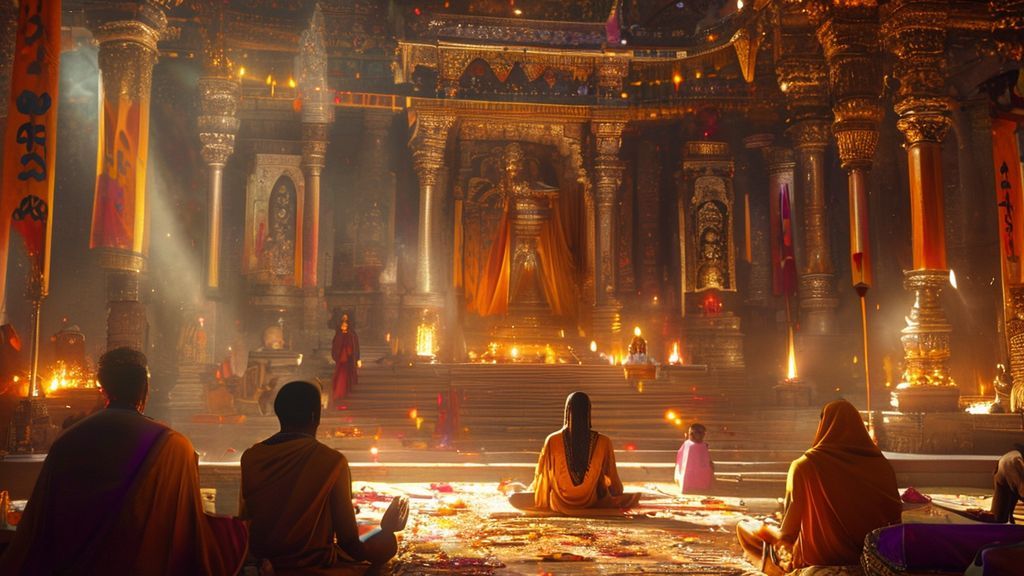
Mantra Therapy, or Mantra Chikitsa, is an ancient Sanatana Dharma practice utilizing specific Sanskrit sound vibrations to harmonize mind, body, and spirit, promoting holistic well-being and spiritual awakening. Rooted in Vedic tradition, it asserts that cosmic energy manifests as sound, capable of healing, purifying, and transforming an individual’s inner and outer reality.
| Attribute | Details |
|---|---|
| Concept | The therapeutic application of sacred Sanskrit sounds (Mantras) to influence consciousness, energy fields, and physical health. |
| Origin | Traced back to the primordial sounds of creation and extensively detailed in the Vedas, Upanishads, and Tantras. |
| Key Principles | Sound as Brahman (Shabda Brahman), vibration influencing subtle energy (Prana, Nadis, Chakras), intention (Sankalpa), and repetition (Japa). |
| Primary Scriptures | Rig Veda, Yajur Veda, Atharva Veda, Taittiriya Upanishad, Mandukya Upanishad, Yoga Sutras of Patanjali, various Tantras and Puranas. |
The Resonance of Divinity: Understanding Mantra Therapy
In the vast expanse of Sanatana Dharma, the profound power of sound stands as a cornerstone of spiritual practice and healing. Mantra Therapy, known in Sanskrit as Mantra Chikitsa, is not merely a linguistic exercise but a sophisticated science of vibration, designed to realign the human system with cosmic harmony. From the ancient Rishis who perceived the Vedas to modern devotees seeking solace and spiritual growth, the chanting of mantras has been a timeless vehicle for transformation. This sacred practice acknowledges that the universe itself emerged from sound, an idea encapsulated in the concept of Shabda Brahman—the Absolute as Sound. Every syllable, every intonation in a mantra carries a specific energetic blueprint, capable of purifying the mind, invigorating the body, and elevating the spirit. It is through dedicated practice that a devotee can unlock the immense healing potential inherent in these divine vibrations, fostering a state of inner peace, clarity, and well-being. This profound wisdom, transmitted through millennia, offers a pathway to not just physical or mental relief, but to ultimate liberation.
Vedic and Upanishadic Roots: The Genesis of Sacred Sound
The genesis of Mantra Therapy is deeply embedded in the most ancient layers of Hindu scripture, primarily the Vedas. The Rig Veda, for instance, contains numerous hymns (mantras) that were chanted not just for prayer but for invoking specific energies, warding off negativity, and healing ailments. The very act of discerning these divine sounds, or shruti, was considered a mystical process, where Rishis (seers) tuned into the subtle vibrations of the cosmos. As mentioned in the Taittiriya Upanishad (Shikshavalli, Anuvaka 8), the components of speech—वर्ण (varna, sound), स्वर (svara, accent), मात्रा (matra, quantity), बलम् (balam, emphasis), साम (sama, continuity), सन्तानः (santana, connection)—are meticulously detailed, underscoring the precise science of Vedic chanting. The iconic syllable Om (ॐ) is revered as the primordial sound, the very fabric of existence, as expounded in the Mandukya Upanishad. It is the sound of creation, preservation, and dissolution, embodying the entire cosmos. Patanjali’s Yoga Sutras (I.27-29) also highlight the significance of pranava (Om) for overcoming obstacles and realizing inner consciousness. Thus, the foundation of Mantra Therapy rests on a profound understanding of sound as a divine, intelligent force, capable of intricate interactions with human consciousness and physiology.
The Vibrational Science of Mantras: Nadis, Chakras, and Cosmic Resonance
Beyond the mystical, Mantra Therapy operates on a precise understanding of the human subtle energy system. Our physical body is interwoven with a network of Nadis (subtle energy channels) and concentrated energy centers called Chakras. Each mantra, particularly Bija Mantras (seed sounds) like “Ram,” “Om,” “Hrim,” “Klim,” vibrates at a specific frequency designed to stimulate, purify, and balance these energy centers. As described in various Tantric texts, including the Shiva Samhita and Gheranda Samhita, there are 72,000 to 350,000 Nadis, with Ida, Pingala, and Sushumna being the most crucial, running along the spinal column. The chanting of mantras generates vibrations that resonate through these Nadis, clearing blockages and allowing the free flow of Prana (life force). For example, the mantra “Lam” is associated with the Muladhara (Root) Chakra, “Vam” with the Svadhisthana (Sacral) Chakra, and “Om” with the Ajna (Third Eye) Chakra. The repetitive chanting creates a powerful sonic field that not only impacts the subtle body but also influences brain wave patterns, leading to states of deep relaxation, increased focus, and heightened spiritual awareness. The perfect phonetic structure of Sanskrit, often called the “language of the Gods,” ensures that these sound formulas have maximum efficacy, aligning the individual microcosm with the macrocosmic vibrations of the universe. This profound interrelationship between sound, energy, and consciousness is what makes mantra therapy a uniquely powerful tool for holistic well-being, a concept well explored on platforms like Hindutva.online.
Practicing Mantra Chikitsa: A Guide to Japa Vidhi
The core practice of Mantra Therapy revolves around Japa, the repetitive chanting or mental recitation of a mantra. For sincere seekers, understanding the proper Vidhi (methodology) is crucial for optimal benefits. Here is a step-by-step guide:
- Choosing Your Mantra: Select a mantra that resonates with your intention or spiritual goal. This could be a personal mantra (Ishta Mantra) received from a Guru, a universal mantra like Om, or a specific deity mantra like the Gayatri Mantra or Mahamrityunjaya Mantra.
- Purification (Shuddhi): Begin with a bath to purify the body. Ensure your surroundings are clean and peaceful, perhaps with a lit lamp or incense.
- Posture (Asana): Sit in a comfortable meditative posture (e.g., Padmasana, Sukhasana) with a straight spine, allowing free flow of energy.
- Breath Control (Pranayama): Take a few deep, conscious breaths to calm the mind and prepare for concentration.
- Intention (Sankalpa): Clearly state your intention or purpose for the Japa practice. This focuses your energy.
- Japa Mala: Traditionally, Japa is performed using a Mala (rosary) of 108 beads (plus a Meru or Guru bead). Hold the Mala in your right hand, using your thumb to move each bead after completing one mantra repetition. Avoid crossing the Meru bead; instead, turn the Mala around and continue in the reverse direction.
- Recitation (Vachika, Upanshu, Manasika):
- Vachika Japa: Audible chanting, good for beginners to maintain focus.
- Upanshu Japa: Whispered chanting, where only your lips move and you hear the sound faintly.
- Manasika Japa: Mental recitation, the most advanced form, requiring deep concentration.
- Concentration: Focus your mind on the sound of the mantra, its meaning, and its associated deity or energy. You can also visualize the mantra’s form or the deity it represents.
- Consistency: Practice daily at the same time and place to build positive energetic patterns. A minimum of one Mala (108 repetitions) is recommended.
Sacred Mantras for Healing and Spiritual Elevation
The Sanatana tradition offers a treasure trove of mantras, each with unique vibrational properties. Here are a few foundational mantras integral to Mantra Therapy:
-
Om (ॐ): The Primordial Sound
This monosyllable is the seed of all mantras, representing Brahman, the Absolute Reality. Chanting Om harmonizes the entire system, brings mental clarity, and connects one to universal consciousness. It resonates with the Ajna and Sahasrara chakras.
-
Gayatri Mantra (गायत्री मंत्र)
Om Bhur Bhuvah Svah Tat Savitur Varenyam Bhargo Devasya Dhimahi Dhiyo Yo Nah Prachodayat.
Meaning: “We meditate on the adorable glory of the resplendent vivifier divine Savitri. May he stimulate our intellects.” (Rig Veda 3.62.10). This mantra purifies the intellect, bestows wisdom, and invokes divine light. It is one of the most revered Vedic mantras.
-
Mahamrityunjaya Mantra (महामृत्युंजय मंत्र)
Om Tryambakam Yajamahe Sugandhim Pushtivardhanam Urvarukamiva Bandhanan Mrityor Mukshiya Maamritat.
Meaning: “We worship the Three-eyed Lord Shiva, who is fragrant and nourishes all beings. May he liberate us from death for the sake of immortality, just as the cucumber is severed from its bondage to the creeper.” (Rig Veda 7.59.12). This powerful mantra is chanted for health, longevity, healing, and overcoming fear of death.
-
Om Namah Shivaya (ॐ नमः शिवाय)
Meaning: “Salutations to Shiva.” This Panchakshara (five-syllable) mantra is a powerful invocation of Lord Shiva, bringing peace, inner strength, and spiritual awakening. It helps to purify the lower chakras and align with higher consciousness.
Dos and Don’ts in Mantra Therapy
- Do approach the practice with reverence, faith (shraddha), and a sincere intention (sankalpa).
- Do maintain cleanliness, both personal and environmental, before and during your practice.
- Do practice consistently, ideally at the same time each day, to build energetic momentum.
- Do focus on the sound, rhythm, and meaning of the mantra during recitation.
- Do use a Japa Mala (rosary) for counting to maintain focus and allow for prolonged practice.
- Don’t treat mantras as mere words; recognize them as divine sound vibrations.
- Don’t practice immediately after a heavy meal.
- Don’t interrupt your Japa session unnecessarily.
- Don’t perform Japa when angry, agitated, or in an unclean state of mind or body.
- Don’t boast about your mantra practice or its perceived benefits; maintain humility.
Frequently Asked Questions About Mantra Therapy
Can anyone practice Mantra Therapy?
Yes, the beauty of basic Mantra Therapy is its universality. While certain advanced or potent mantras may require initiation (Diksha) from a qualified Guru for full efficacy and safety, universal mantras like Om, Gayatri, or Om Namah Shivaya can be chanted by anyone with sincere devotion and proper understanding, irrespective of caste, creed, or background.
How long does it take to see results from Mantra Therapy?
The timeframe for experiencing results varies greatly, depending on the individual’s consistency, sincerity, karma, and the specific mantra chosen. Some individuals report immediate calming effects, while deeper physical or spiritual transformations may take weeks, months, or even years of dedicated practice. Patience and unwavering faith are key.
Is Mantra Therapy a substitute for modern medicine?
No, Mantra Therapy should not be considered a substitute for professional medical diagnosis or treatment. It is a complementary healing modality that works on the subtle energy levels to promote holistic well-being. It can enhance the body’s natural healing capabilities and support mental and emotional health, but conventional medical advice should always be sought for physical ailments.
What is the significance of a Guru in Mantra Therapy?
In traditional Sanatana Dharma, a Guru’s role is paramount, especially for powerful or complex mantras. A Guru imparts the correct pronunciation, specific method (vidhi), and the energetic transmission (shakti-pat) of the mantra, ensuring its full potency. They also guide the disciple through potential obstacles and interpret experiences, making the journey safer and more effective. Further insights into the Guru-shishya parampara are available on Hindutva.online.
Dharmic Significance: Preserving the Legacy of Sacred Sound
Mantra Therapy is far more than a healing technique; it is a vital pillar of Sanatana Dharma, embodying the profound connection between sound, consciousness, and divinity. By engaging in this ancient practice, devotees not only seek personal well-being but also actively participate in preserving a timeless spiritual heritage. Each repetition of a sacred mantra reverberates through the cosmos, rekindling the subtle energies that sustain life and dharma. It is a direct pathway to connect with the divine, purify the mind from worldly distractions, and cultivate an unshakeable inner peace that transcends material suffering. In an increasingly noisy and chaotic world, Mantra Therapy offers a sanctuary of serene vibration, guiding individuals back to their true spiritual essence and fostering a global consciousness rooted in harmony and truth. Its continued practice ensures that the profound wisdom of the Rishis remains vibrant and accessible for generations to come, upholding the eternal values of Sanatana Dharma.
