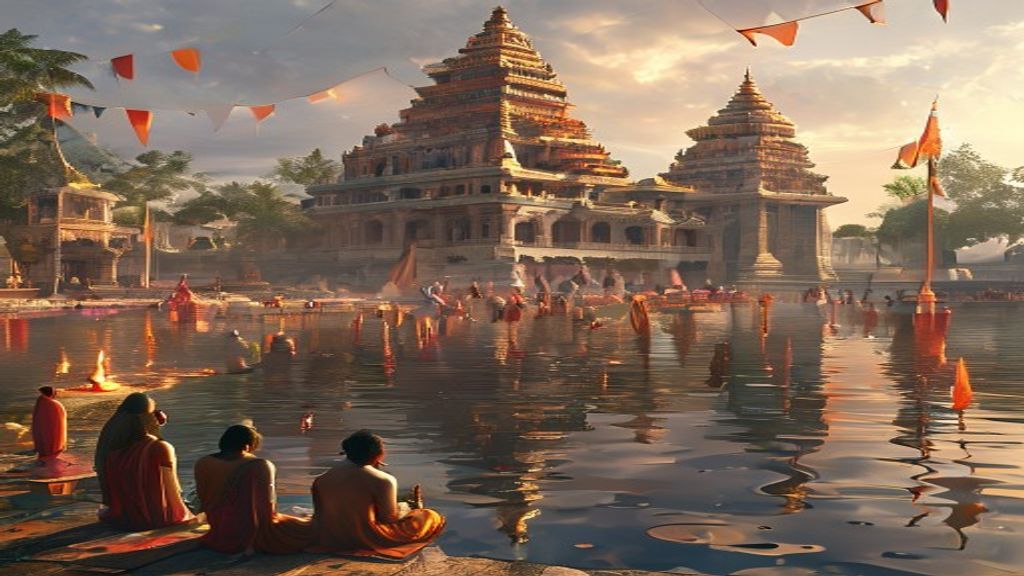
Pushkar Lake is one of the most ancient and sacred water bodies in Sanatan Dharma, renowned as the sole natural abode consecrated to Bhagavan Brahma. According to the Padma Purana, it manifested from a lotus petal dropped by Brahma, making it a pivotal pilgrimage site for attaining spiritual purification, absolving sins, and performing ancestral rites, especially during Kartik Purnima.
| Attribute | Details |
|---|---|
| Presiding Deity | Bhagavan Brahma (Creator God) |
| Location/Origin | Pushkar, Rajasthan, India; Formed from Brahma’s lotus flower (Pushpa-kar) |
| Key Festival | Kartik Purnima Mela, annually during the Kartik month (October/November) |
| Scripture Reference | Padma Purana (Srishti Khanda, Chapter 14-16), Skanda Purana (Kashi Khanda), Mahabharata (Vana Parva) |
The Sacred Heart of Creation: Pushkar Lake’s Enduring Significance
In the vast tapestry of Sanatan Dharma, certain places resonate with the very essence of creation and divine grace. Among these, Pushkar Lake stands as a luminous beacon, a primeval sacred reservoir intrinsically linked to Bhagavan Brahma, the revered Creator of the Cosmos. Unlike countless other holy sites primarily dedicated to Vishnu or Shiva, Pushkar holds the unique distinction of being the foremost pilgrimage destination for the worship of Brahma. For millennia, sincere seekers and devout pilgrims have journeyed to this hallowed ground, believing a dip in its sacred waters can cleanse one of all accumulated sins, confer immense spiritual merit, and facilitate communion with the divine creative energy. This ancient lake, surrounded by 52 bathing ghats and hundreds of temples, is not merely a geographical feature but a vibrant spiritual vortex, perpetually pulsating with the energy of devotion and the echoes of primordial chants.
Puranic History and Divine Legend of Pushkar
The genesis of Pushkar Lake is beautifully detailed in the sacred texts, particularly the Padma Purana (Srishti Khanda, Chapters 14-16) and the Skanda Purana (Kashi Khanda). The legend recounts that Bhagavan Brahma, intent on performing a grand Yajna (fire sacrifice) for the welfare of the universe and to ensure the proper functioning of creation, searched for a suitable and pure location. While meditating, a lotus flower (pushpa) emerged from His hand (kar) and fell to the earth at three distinct spots. These spots miraculously transformed into three lakes: Jyeshtha Pushkar (the elder, the primary Pushkar Lake), Madhya Pushkar (middle), and Kanishtha Pushkar (younger). The primary lake, Jyeshtha Pushkar, is the most revered, formed by the very essence of Brahma’s creative will.
The Purana further elaborates that Brahma chose Jyeshtha Pushkar for His Yajna, but an unforeseen complication arose. His consort, Devi Savitri, was delayed. As the auspicious moment for the sacrifice was fleeting, and a Yajna must be performed with one’s spouse, Bhagavan Indra, fearing a disruption in creation, hastily arranged for a local Gujjar maiden named Gayatri to sit beside Brahma, consecrated as His temporary wife. When Devi Savitri finally arrived, witnessing Gayatri in her rightful place, she was overcome with rage and pronounced a powerful curse. She decreed that Brahma would henceforth be worshipped exclusively at Pushkar and nowhere else on Earth in His physical form. She also cursed Indra, Vishnu, and Shiva, as well as the Agni Devatas and other participating deities, ensuring their worship would also face certain limitations. However, recognizing the gravity of the situation, the other deities pleaded with Savitri, and she softened her curse, allowing for the widespread worship of all deities, while still maintaining Brahma’s unique status at Pushkar. This intricate narrative from the Puranas explains the singular importance of the Brahma Temple in Pushkar, the only major temple dedicated to Him in the entire world, situated strategically by the sacred lake. The Mahabharata, in its Vana Parva, also mentions Pushkar as a significant pilgrimage site, attesting to its ancient reverence.
Architectural Splendor and Mystical Engineering
Pushkar Lake itself is a natural marvel, believed to have formed within a depression, continually fed by subterranean springs, making its waters perennially fresh despite a desert environment. The lake is encircled by 52 Ghats, stone steps leading down to the water, each imbued with its own specific spiritual significance and history. These ghats, built by various kings, maharajas, and wealthy patrons over centuries, are prime examples of traditional Indian architectural prowess, blending functionality with aesthetic devotion. Prominent among them are the Brahma Ghat (where Brahma is said to have performed His Yajna), Gau Ghat (where Krishna’s cows were watered), Varaha Ghat, Ram Ghat, and Savitri Ghat. Each ghat serves as a gateway for pilgrims to perform ritual bathing (snan) and offer prayers. The very structure of the lake’s banks, with their ancient stone masonry, reflects a profound respect for both nature and divine power.
Dominating the landscape near the lake is the iconic Jagadpita Brahma Mandir, the primary temple dedicated to Bhagavan Brahma. While not ancient in its current physical structure, having been rebuilt several times, its foundations are deeply rooted in antiquity. The temple exhibits the distinct Nagara style of architecture, characterized by its curvilinear shikhara (spire) and intricate carvings. The sanctum houses a four-faced (Chaturmukhi) idol of Brahma, a rare sight for devotees. The meticulous planning of the temple complex and the surrounding ghats demonstrates an ancient understanding of hydraulic engineering and urban planning, designed to accommodate thousands of pilgrims while preserving the sanctity of the sacred lake. Exploring this site further enriches one’s understanding of Sanatan Dharma; more insights can be found at Hindutva.online.
Rituals and Puja Vidhi for Devotees
A pilgrimage to Pushkar Lake is a profoundly transformative spiritual journey, meticulously guided by centuries-old traditions. The central ritual involves a holy dip in the sacred waters, particularly potent during the auspicious period of Kartik Purnima. Here is a step-by-step guide for sincere devotees:
- Sankalp (Intention): Before entering the water, stand at one of the sacred ghats and mentally make a sincere intention for your holy dip, specifying your purpose – be it purification from sins, ancestral offerings, or seeking divine blessings.
- Snan (Holy Bath): Descend into the waters of Pushkar Lake. Take at least three dips, fully immersing yourself each time, while chanting relevant mantras or simply meditating on Brahma. It is believed that a dip here during Kartik Purnima is equivalent to bathing in all other holy waters for a hundred years.
- Tarpan and Pind Daan: Many pilgrims perform Tarpan (offering water to ancestors) and Pind Daan (offering rice balls) at the ghats, especially at Gaya Kund, to seek liberation and peace for their departed forefathers.
- Vastra Daan: After the bath, change into clean, fresh clothes, signifying purification. Often, the clothes worn during the dip are donated.
- Darshan at Brahma Temple: Proceed to the Jagadpita Brahma Mandir. Offer prayers, flowers, coconuts, and sweets to Bhagavan Brahma. Circumambulate the temple (parikrama) in a clockwise direction.
- Visit to Savitri Temple: Conclude your pilgrimage with a visit to the Savitri Temple, located atop a hill, offering a panoramic view of the lake and town. This acknowledges Devi Savitri’s presence despite her curse.
Sacred Mantras and Chants for Brahma
Chanting mantras dedicated to Bhagavan Brahma enhances the spiritual experience at Pushkar. The most significant is the Brahma Gayatri Mantra:
ॐ वेदात्मने विद्महे,
हिरण्यगर्भाय धीमहि,
तन्नो ब्रह्म प्रचोदयात् ॥
Om Vedātmane Vidmahe,
Hiranyagarbhāya Dhīmahi,
Tanno Brahma Prachodayāt ॥
Meaning: “Om, we know the self of the Vedas, we meditate upon the Golden Embryo (Hiranyagarbha, referring to Brahma, the cosmic egg); may that Brahma enlighten us.”
Devotees may also chant the basic mantra “Om Namah Brahmane” or verses from the Purusha Suktam, which extols the Cosmic Purusha, often identified with Brahma as the source of creation. Reciting these mantras with devotion amplifies the spiritual vibrations and connects the devotee directly to the creative energy of the universe.
Dos and Don’ts for Pilgrims
To preserve the sanctity of Pushkar Lake and its surrounding temples, devotees are encouraged to observe certain cultural and spiritual etiquettes:
- Do dress modestly, covering shoulders and knees, as a sign of respect for the sacred environment.
- Do remove your footwear before entering temples and stepping onto the ghats.
- Do maintain silence and a reverent demeanor, particularly around the lake and within temple premises.
- Do offer donations to the temples and priests as per your capacity, but be wary of overly insistent touts.
- Do not consume meat or alcohol in Pushkar, as it is a holy town declared a “vegetarian zone.”
- Do not litter or pollute the sacred waters of the lake. Help maintain its cleanliness.
- Do not engage in loud conversations or unruly behavior that may disturb other pilgrims.
- Do not take photographs inside the inner sanctum of the Brahma Temple or at other prohibited areas.
Frequently Asked Questions About Pushkar Lake
Why is Pushkar Lake considered so sacred?
Pushkar Lake is sacred because it is believed to have been formed by a lotus petal dropped by Bhagavan Brahma during His search for a site to perform a Yajna for creation. It is the only place with a major temple dedicated to Brahma, making it a unique and powerful pilgrimage site for His worship and for seeking purification from sins.
What is the best time to visit Pushkar Lake for pilgrimage?
The most auspicious time to visit Pushkar Lake is during the Kartik Purnima Mela, which usually falls in October or November. A holy dip in the lake during this period is considered highly meritorious. However, the lake and temples are open year-round for devotees.
Can women participate in all rituals at Pushkar Lake?
Yes, women can fully participate in all rituals at Pushkar Lake, including taking holy dips, offering prayers, and performing ancestral rites. The sanctity of the lake is accessible to all sincere devotees, regardless of gender. For more insights into sacred sites, visit Hindutva.online.
What is the significance of the 52 ghats around the lake?
The 52 ghats represent various points for pilgrims to access the sacred water. Each ghat holds unique historical or mythological significance, with specific ones dedicated to various deities or purposes, such as the Brahma Ghat for Brahma’s Yajna or Gaya Kund for ancestral offerings.
Pushkar Lake: A Timeless Testament to Sanatan Dharma’s Roots
Pushkar Lake is more than just a body of water; it is a living testament to the eternal principles of Sanatan Dharma. It embodies the profound reverence for Bhagavan Brahma, the often-overlooked Creator, reminding us of the cosmic origins and the intricate dance of creation, preservation, and dissolution. By preserving and honoring such ancient sites, we not only connect with our rich spiritual heritage but also ensure the continuity of our Dharmic values for future generations. A visit to Pushkar is not merely a tourist excursion but a pilgrimage into the heart of Hindu cosmology, offering a chance to purify the soul, seek divine blessings, and deepen one’s understanding of the timeless truths embedded within our scriptures. It is a powerful reminder that the divine presence permeates every aspect of our existence, especially in these consecrated landscapes where the gods themselves have walked.