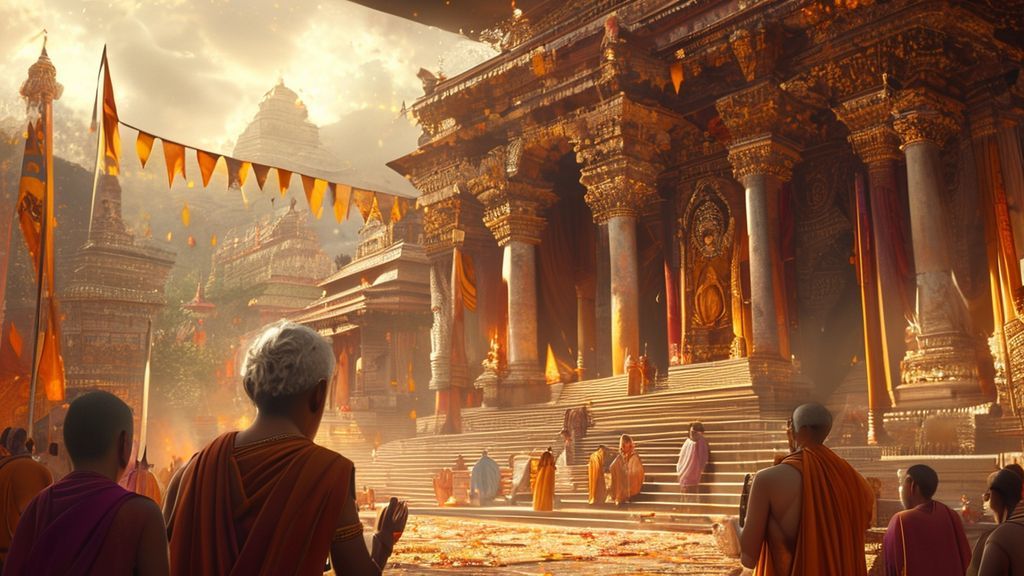
Ramana Maharshi, the revered Sage of Arunachala, elucidated the profound path of Self-Inquiry (Atma-Vichara), urging devotees to relentlessly question “Who am I?” This direct method leads to the realization of the unchangeable, eternal Self, transcending all dualities and illusion. His life exemplified jnana and unconditional love, anchoring seekers in the Advaitic truth amidst the sacred Arunachala Hill.
| Attribute | Details |
|---|---|
| Deity/Sage Status | Bhagavan, Atma-Jnani (Self-realized Sage), embodying the purest Advaita Vedanta |
| Location/Origin | Born in Tiruchuzhi, Tamil Nadu; spent most of his life on and around Arunachala Hill, Tiruvannamalai |
| Key Observance | Ramana Jayanti (his birth anniversary), Mahasamadhi Day, and daily practice of Atma-Vichara |
| Primary Teachings | Self-Inquiry (Atma-Vichara), Silence (Mauna), Surrender (Sharanaagati) |
| Scripture Reference | His own works like Ulladu Narpadu (Forty Verses on Reality), Upadesa Saram (Spiritual Instruction), and the collected Talks with Sri Ramana Maharshi |
The Guiding Light of Arunachala: Introduction to Ramana Maharshi
In the illustrious tapestry of Sanatan Dharma, few figures shine with the luminosity and directness of Bhagavan Sri Ramana Maharshi. His life, a poignant testament to the ultimate truth, was lived primarily on the sacred slopes of Arunachala, a hill revered as Lord Shiva Himself. Ramana Maharshi did not found a new religion or propagate complex philosophies; instead, he pointed humanity to the eternal truth inherent within each being through the direct, scientific path of Self-Inquiry, or Atma-Vichara. For sincere seekers, his presence and teachings offer a beacon of hope and a practical method to transcend suffering and realize the immutable Self, the Brahman.
His profound realization at a young age, without formal instruction, demonstrated that the ultimate truth is not an intellectual acquisition but an inner awakening. He exemplified the ideal of a Jivanmukta, one who is liberated while living, radiating an aura of peace and compassion that drew devotees from all corners of the globe. His legacy continues to inspire millions, making the pilgrimage to Arunachala and the Ramanashramam a vital journey for spiritual aspirants seeking profound realization and solace. His teachings are a cornerstone of Hindutva.online‘s exploration of Advaita Vedanta.
The Divine Play: Ramana Maharshi’s Life and Arunachala’s Mystique
The life of Ramana Maharshi is not merely a biography but a testament to divine grace and human potential. Born Venkataraman Iyer in 1879 in Tiruchuzhi, Tamil Nadu, his early life was unremarkable until the profound death experience at age sixteen. While sitting alone, a sudden, inexplicable fear of death seized him. Instead of succumbing, he deliberately lay down, imitating a corpse, and intensely questioned: “What is it that dies? My body dies, but do *I* die?” This intense, spontaneous Atma-Vichara led to the direct realization that “I” am not the body, nor the mind, but the eternal, deathless Self, the आत्मन् (Atman). This realization was permanent and transformative.
Following this awakening, drawn by an irresistible spiritual pull, he journeyed to Arunachala, the sacred hill in Tiruvannamalai, which he instinctively knew as his spiritual home. The sanctity of Arunachala is deeply rooted in the Puranas. As mentioned in the Arunachala Mahatmyam, a part of the Skanda Purana, Arunachala is revered as the Jyotirlingam, the fiery column of light that Lord Shiva manifested to settle a dispute between Brahma and Vishnu. It represents the formless aspect of Shiva, a beacon of knowledge and liberation. Ramana Maharshi spent the rest of his life there, initially in caves like Virupaksha and Skandashramam, maintaining profound silence (Mauna), and later at the foot of the hill where Ramanashramam was established.
His silent presence was his greatest teaching, communicating profound truths without uttering a word. This period of intense tapas and unwavering connection to the Self cemented his status as a living embodiment of the Advaitic ideal.
The Spiritual Architecture of Self-Inquiry and the Sacred Abode
While Ramana Maharshi’s teachings emphasized the inner spiritual journey over external structures, the Ramanashramam at the foot of Arunachala stands as a spiritual marvel, designed to facilitate the inner quest. Its architecture, simple yet profound, reflects the serene atmosphere cultivated by the Maharshi himself. The main hall, where he gave darshan for many years, still emanates a palpable peace, inviting introspection. The Ashram complex also houses the Sarvadhikari’s Samadhi, the Mother’s Temple, and the Sri Ramana Maharshi’s Samadhi shrine, which is a focal point of meditation and devotion.
The true “architecture” however, lies in the precise, almost scientific methodology of Self-Inquiry. It is not a belief system but a direct path to experience reality. Ramana taught that all thoughts arise from the “I-thought.” By tracing this “I-thought” back to its source, one discovers the pure “I-I,” the unconditioned Self, the substratum of all existence. This is a rigorous internal investigation, a spiritual science that requires unwavering attention and detachment from the mind’s incessant chatter. The efficacy of this method is its directness and universality, making it accessible to anyone, regardless of their background or previous spiritual conditioning.
Furthermore, the very topography of Arunachala, with its numerous caves and quiet paths, served as Ramana’s ashram for many years. Climbing the hill, performing Girivalam (circumambulation) around its base, and meditating in its caves are considered powerful practices, believed to connect one directly to the spiritual energy that permeates this sacred land, a legacy he intensified through his presence.
The Path of Atma-Vichara: Rituals and Practices for the Seeker
For Ramana Maharshi, the ultimate “ritual” was the continuous practice of Self-Inquiry. While traditional Hindu rituals have their place in purifying the mind, the direct path he advocated was the most potent. Here’s a guide to understanding and practicing his core teaching:
- The Core Question: “Who Am I?” (कोऽहम् – Ko’ham?): Instead of identifying with fleeting thoughts, emotions, or bodily sensations, constantly inquire into the source of the “I” thought. When a thought arises, ask, “To whom does this thought arise?” The answer will invariably be “To me.” Then, relentlessly ask, “Who is this ‘I’?”
- Tracing the “I-thought” to its Source: Do not entertain the thought or give it importance. Instead, turn your attention inwards, attempting to locate the origin of the “I.” Ramana Maharshi taught that the mind subsides into the Heart-center (not the physical heart, but the spiritual core) when the attention is steadily fixed on the Self.
- Silence (Mauna): Cultivate inner silence. This is not merely the absence of speech but the cessation of mental chatter. In this profound silence, the true Self reveals itself. Spend time in quiet contemplation, observing the mind without judgment.
- Surrender (Sharanaagati): If Self-Inquiry feels too difficult, Ramana also endorsed complete surrender to the Divine. Offering all actions, thoughts, and desires to a higher power, relinquishing the sense of doership, leads to the same destination of Self-realization.
- Darshan and Proximity: For those visiting Ramanashramam, sitting in the Old Hall or near the Samadhi shrine is considered a form of spiritual practice. The palpable silence and energy of these spaces are conducive to deep meditation and introspection. Participating in the daily pujas and chanting at the Ashram can also support the inward journey.
Mantras & Chants: Echoes of the Self
While Ramana Maharshi emphasized the direct realization of the Self over external chanting, he did acknowledge the power of specific mantras, particularly for devotees who found comfort and focus in them. The most common mantra associated with him is:
ॐ नमो भगवते श्री रमणाय
Om Namo Bhagavate Sri Ramanaya
(Salutations to Bhagavan Sri Ramana)
This mantra invokes his divine presence and grace, aiding the devotee in their spiritual journey. Additionally, verses from his own compositions, such as Ulladu Narpadu (Forty Verses on Reality) and Upadesa Saram (Spiritual Instruction), are chanted for their profound wisdom:
From Ulladu Narpadu (Verse 26):
अहं को नु इति वृत्तिः समूला विनश्यते चेत्
अहं स्वरूपम् विलोकेत आत्मज्ञानं हि तत्
Aham ko nu iti vrittiḥ samūlā vinaśyate chet
Aham svarūpam viloketa ātma-jñānaṁ hi tat
“If the root of the thought ‘Who am I?’ completely perishes, then the true ‘I’ स्वरूपम् (Svarupam) will be revealed. This indeed is Self-knowledge.” This verse beautifully encapsulates the essence of his teaching.
Dos and Don’ts for the Devotee and Seeker
- Do approach the teachings with an open mind and a sincere desire for truth, rather than intellectual curiosity alone.
- Do practice silence and introspection, especially when visiting Ramanashramam or sacred places on Arunachala.
- Do maintain reverence and humility in the Ashram premises and while engaging with the teachings.
- Do engage in Girivalam (circumambulation) of Arunachala, respecting its sacredness, performing it barefoot if possible.
- Do read Ramana Maharshi’s direct dialogues and works, allowing his words to guide your inner inquiry.
- Don’t mistake intellectual understanding of Advaita for actual realization; the path is experiential.
- Don’t engage in excessive philosophical debates or arguments; Ramana emphasized direct experience over mere dialectics.
- Don’t disturb the peace and quiet of the Ashram or other devotees with unnecessary noise or conversation.
- Don’t disrespect the local customs and traditions when visiting Tiruvannamalai and the Ashram.
- Don’t seek external validation or mystical experiences as the goal; the true goal is the realization of the Self within.
Frequently Asked Questions About Ramana Maharshi
What is Ramana Maharshi’s main teaching?
Ramana Maharshi’s primary teaching is Self-Inquiry (Atma-Vichara), the direct method of investigating the source of the “I-thought” to realize the eternal, unconditioned Self. He also emphasized surrender (Sharanaagati) and silence (Mauna) as complementary paths.
Did Ramana Maharshi have a Guru?
Ramana Maharshi did not have a human Guru in the traditional sense. His profound realization occurred spontaneously. However, he considered the sacred Arunachala Hill itself as his Guru, teacher, and spiritual abode, identifying it with Lord Shiva, the ultimate Guru.
Is Ramana Maharshi considered an Avatara (incarnation)?
While devotees often regard Ramana Maharshi as a divine manifestation due to his profound wisdom, compassion, and miraculous life, he never claimed to be an Avatara. He taught that all beings are the Self, and his life exemplified the potential for any individual to realize their true nature as the deathless आत्मन् (Atman).
Can anyone practice Self-Inquiry?
Yes, Ramana Maharshi taught that Self-Inquiry is a universal path accessible to anyone, regardless of their background, religion, or spiritual experience. It requires sincere effort, unwavering attention, and a deep longing to know one’s true Self. His teachings are foundational for understanding Advaita, as explored on Hindutva.online.
Why Ramana Maharshi’s Legacy Preserves Sanatan Dharma
Ramana Maharshi’s life and teachings are a timeless beacon for Sanatan Dharma. In an age often clouded by materialism and spiritual confusion, he provided a direct, pragmatic, and non-sectarian path to the ultimate truth. He demonstrated that the highest realization is not an esoteric pursuit but an inherent potential within every individual, accessible through diligent self-inquiry and surrender. By focusing on the direct experience of the Self, he revitalized the ancient wisdom of Advaita Vedanta, making it relevant and understandable for modern seekers.
His unwavering presence on Arunachala, a sacred site deeply embedded in Hindu mythology, anchored his universal message within the rich tradition of Sanatan Dharma. He showed that true spirituality transcends mere rituals or intellectual constructs; it is about knowing “Who Am I?” This profound inquiry, championed by Ramana Maharshi, ensures that the eternal principles of truth, self-realization, and liberation remain vibrantly alive for generations to come, guiding humanity towards its highest spiritual destiny.
