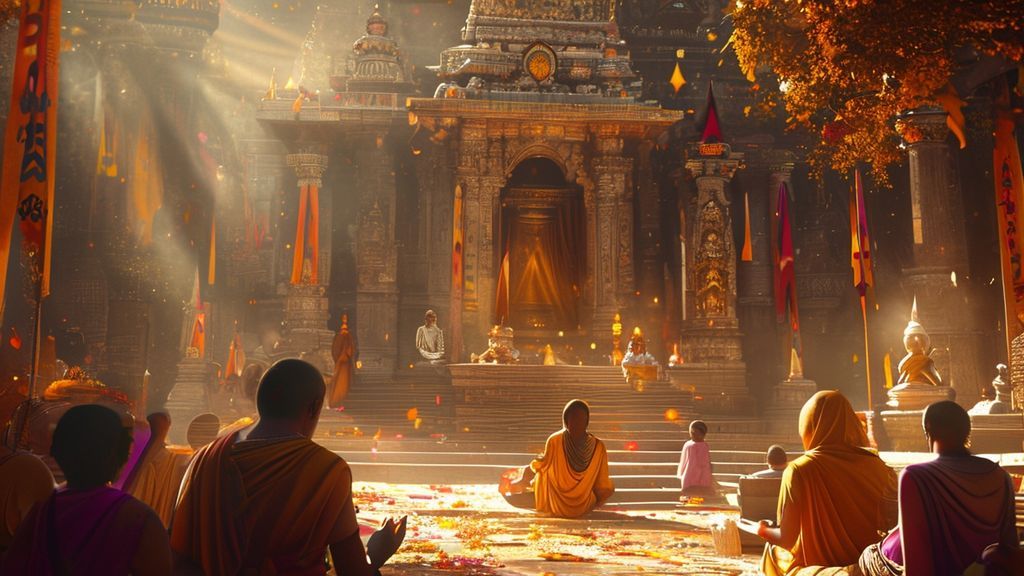
Shanti Mantras are sacred Vedic invocations, primarily from the Upanishads, chanted to invoke peace, tranquility, and harmony in the cosmos, within the self, and in the environment. These profound Sanskrit hymns dissipate obstacles, cultivate a serene mind, and align the individual consciousness with the Universal Spirit, ensuring well-being and spiritual progress.
| Attribute | Details |
|---|---|
| Primary Focus | Cosmic Peace (Adhidaivika), Environmental Peace (Adhibhautika), Inner Peace (Adhyatmika) |
| Origin | Vedas (Yajur Veda, Atharva Veda), Major Upanishads (e.g., Brihadaranyaka, Taittiriya, Ishavasya, Mundaka, Kena) |
| Purpose | Dispelling obstacles (Vighnaharana), Cultivating serenity (Shanti-Stuti), Spiritual harmony (Adhyatmika Samanjasya), Achieving Oneness with Brahman |
| Key Characteristic | Often recited thrice, signifying removal of Tapa-tray (threefold miseries) |
The Universal Call for Peace: An Introduction to Shanti Mantras
In the vast ocean of Sanatan Dharma, the ancient Rishis, in their profound spiritual quest, gifted humanity with timeless wisdom encapsulated in the Vedas and Upanishads. Among these treasures are the Shanti Mantras, sacred invocations that resonate with a deep yearning for universal peace and tranquility. These are not mere prayers for personal solace; they are potent vibrational tools designed to harmonize the individual self with the cosmic rhythm, fostering well-being not just for the chanter but for all beings, known and unknown. The pursuit of Shanti, or peace, is central to the Vedic worldview, recognizing that true spiritual progress (Moksha) is impossible amidst turmoil. These mantras serve as a bridge between the finite and the infinite, a sonic pathway to the realization of Brahman, the ultimate reality.
Each Shanti Mantra, typically recited at the beginning and end of Upanishadic studies or spiritual discourses, acts as a protective shield and an invoking force. They purify the environment, quiet the mind, and prepare the seeker for deeper truths. Their profound efficacy lies in their precise Sanskrit phonetics and rhythmic intonation, which generate specific vibrational patterns capable of influencing both subtle and gross aspects of existence. They embody the essence of Vedic philosophy: interconnectedness, harmony, and the ultimate aim of transcending suffering to attain lasting peace.
The Genesis and Context in Vedic Literature
The tradition of chanting Shanti Mantras is as ancient as the Vedas themselves, having been transmitted through an unbroken lineage (Guru-shishya parampara) from time immemorial. While specific ‘Puranic histories’ detailing their origin are absent, their foundational role is deeply entrenched in the structure and purpose of Vedic revelation. The earliest forms of these peace invocations can be traced to the Rig Veda and Atharva Veda, where hymns often conclude with a prayer for well-being for all realms. However, their systematic compilation and prominence as distinct ‘Shanti Mantras’ are most evident within the Aranyakas and, more profoundly, the Upanishads.
For instance, the Shanti Mantra “Om Sahana Vavatu” appears prominently in the Taittiriya Upanishad, Kena Upanishad, and Katha Upanishad, recited by the teacher and student seeking divine protection and mutual understanding in their pursuit of knowledge. The “Purnamadah Purnamidam” mantra, a profound statement on the completeness of Brahman, hails from the Brihadaranyaka Upanishad and Ishavasya Upanishad. These mantras were not merely ceremonial but vital for creating a conducive atmosphere for Brahma Vidya (knowledge of Brahman), ensuring that the transmission of spiritual wisdom was free from internal and external obstacles. The seers (Rishis) of these Upanishads understood that a tranquil mind and a harmonious environment were prerequisites for the arduous journey of self-realization, a principle continuously upheld within Hindutva.online.
The Vibrational Science and Metaphysical Depth
While Shanti Mantras do not relate to physical temple architecture, their profundity lies in their ‘architectural’ mastery of sound and vibration. The ancient Rishis were profound scientists of consciousness and sound. They understood Shabda Brahman, the concept that the ultimate reality is sound itself. Every sound, especially Sanskrit, carries specific vibrational frequencies that impact the human psyche and the cosmic fabric. The carefully constructed phonemes of Shanti Mantras, with their precise meter (chandas) and intonation (swaras), are not random utterances but powerful sonic tools.
When chanted correctly, these mantras generate a unique resonance that aligns the individual’s subtle energy channels (nadis) and chakras. The repetitive chanting of “Om Shanti Shanti Shantihi” is particularly significant. The triple invocation of “Shanti” is traditionally understood to pacify the three types of miseries (Tapa-tray):
- Adhyatmika Tapa: Sufferings arising from within the self (body and mind), like disease, anger, or anxiety.
- Adhibhautika Tapa: Sufferings caused by other living beings, such as animals, humans, or spirits.
- Adhidaivika Tapa: Sufferings originating from natural calamities or divine sources, like earthquakes, floods, or adverse planetary influences.
The science behind this involves the creation of a ‘vibrational field’ that transmutes negative energies and fosters positive, harmonious frequencies. This is not merely superstition but a deep understanding of how consciousness interacts with energetic patterns, creating a sanctuary of peace both internally and externally.
Rituals and Puja Vidhi for Chanting Shanti Mantras
The chanting of Shanti Mantras is a sacred practice that requires devotion and sincerity. While not a formal Puja Vidhi with elaborate rituals, certain steps enhance their efficacy:
- Purification (Shaucha): Begin with a clean body and mind. A bath is ideal. Ensure your surroundings are also clean and free from distractions.
- Intention (Sankalpa): Before chanting, set a clear intention. While the mantras inherently seek peace, personalizing your intent (e.g., “May this chanting bring peace to my family,” or “May this chanting help me focus on my studies”) can deepen your connection.
- Posture (Asana): Sit in a comfortable, steady meditative posture, such as Sukhasana (easy pose) or Padmasana (lotus pose), with your spine erect. This allows for proper flow of energy.
- Breathing (Pranayama): Take a few deep, conscious breaths to calm the mind and regulate your prana (life force).
- Invocation of Guru/Ishta Devata: Mentally offer respects to your Guru or Ishta Devata (chosen deity). This connects you to the lineage of wisdom and divine grace.
- Recitation (Japa): Chant the Shanti Mantra slowly, clearly, and with correct pronunciation. Focus on the sound and its meaning. Feel the vibrations within your body and radiating outwards.
- Repetition: While not strictly bound by counts like 108 for other mantras, chanting Shanti Mantras multiple times (e.g., 3, 9, 11, or 27 times) can deepen the effect.
- Meditation and Absorption: After chanting, sit in silence for a few minutes, absorbing the vibrations and the feeling of peace.
- Concluding Prayer: Offer a simple prayer of gratitude.
Potent Shanti Mantras for Devotees
Here are a few universally revered Shanti Mantras that devotees can incorporate into their daily practice:
Om Sahana Vavatu
ॐ सह नाववतु । सह नौ भुनक्तु । सह वीर्यं करवावहै । तेजस्वि नावधीतमस्तु मा विद्विषावहै । ॐ शान्तिः शान्तिः शान्तिः ॥
Om Saha nāvavatu | Saha nau bhunaktu | Saha vīryaṁ karavāvahai | Tejasvi nāvadhītamastu mā vidviṣāvahai | Om Shantiḥ Shantiḥ Shantiḥ ||
Meaning: Om. May He protect us both (teacher and student). May He nourish us both. May we work together with great energy. May our study be brilliant and effective. May we not hate each other. Om Peace, Peace, Peace.
Om Purnamadah Purnamidam
ॐ पूर्णमदः पूर्णमिदम् पूर्णात् पूर्णमुदच्यते । पूर्णस्य पूर्णमादाय पूर्णमेवावशिष्यते ॥ ॐ शान्तिः शान्तिः शान्तिः ॥
Om Pūrṇamadaḥ Pūrṇamidaṁ Pūrṇāt Pūrṇamudacyate | Pūrṇasya Pūrṇamādāya Pūrṇamevāvaśiṣyate || Om Shantiḥ Shantiḥ Shantiḥ ||
Meaning: Om. That (Brahman) is full; this (creation) is full. From the full, the full comes forth. When the full is taken from the full, the full alone remains. Om Peace, Peace, Peace.
Om Dyauḥ Śāntiḥ
ॐ द्यौः शान्तिरन्तरिक्षं शान्तिः पृथिवी शान्तिरापः शान्तिरोषधयः शान्तिः । वनस्पतयः शान्तिर्विश्वेदेवाः शान्तिर्ब्रह्म शान्तिः सर्वं शान्तिः शान्तिरेव शान्तिः सा मा शान्तिरेधि ॥ ॐ शान्तिः शान्तिः शान्तिः ॥
Om Dyauḥ śāntirantarikṣaṁ śāntiḥ pṛthivī śāntirāpaḥ śāntiroṣadhayaḥ śāntiḥ | Vanaspatayaḥ śāntirviśvedevāḥ śāntirbrahma śāntiḥ sarvaṁ śāntiḥ śāntireva śāntiḥ sā mā śāntiredhi || Om Shantiḥ Shantiḥ Shantiḥ ||
Meaning: Om. May peace radiate in the sky, in the vast ethereal space, upon the earth, in the waters, in the medicinal herbs, in the trees, in all divine beings, in Brahman, in all things, and in peace itself. May that peace come to me. Om Peace, Peace, Peace.
Dos and Don’ts for Chanting Shanti Mantras
- Do chant with a pure heart and sincere devotion.
- Do strive for clear pronunciation and correct intonation (if learned from a Guru).
- Do maintain consistency in your practice for best results.
- Do focus on the meaning and intention of the mantra.
- Do remember that Shanti Mantras are for universal well-being, not just personal gain.
- Don’t chant mechanically without understanding or devotion.
- Don’t rush the chanting; allow the vibrations to settle.
- Don’t treat them as mere words; recognize their divine potency.
- Don’t engage in negative thoughts or actions immediately after chanting; try to maintain the peaceful state.
- Don’t use them for selfish or harmful purposes, as this negates their power.
Frequently Asked Questions
What is the best time to chant Shanti Mantras?
While Shanti Mantras can be chanted at any time to invoke peace, the most potent periods are during Brahma Muhurta (the hour and a half before sunrise), before commencing any spiritual study, meditation, or important task, and before sleeping to ensure a peaceful night.
Are Shanti Mantras only for Hindus?
No, the message of peace and harmony is universal. Shanti Mantras, though originating from the Vedic tradition, are non-sectarian. Anyone, regardless of their faith or background, can chant them to experience their calming and harmonizing effects, embracing the spirit of universal welfare espoused by Sanatan Dharma, as explored further on Hindutva.online.
How many times should one chant a Shanti Mantra?
There is no strict rule for Shanti Mantras like for Bija Mantras. Often, they are chanted once at the beginning and end of an activity. However, for a more profound effect or to cultivate deeper peace, one can chant them in multiples of three (e.g., 3, 9, 27 times), especially the triple invocation of “Shanti” at the end, which is crucial for addressing the threefold miseries.
Preserving Sanatan Dharma Through the Resonance of Peace
The Shanti Mantras are more than ancient verses; they are living testaments to the eternal pursuit of balance, harmony, and ultimate truth that defines Sanatan Dharma. In an increasingly turbulent world, these invocations remind us of our inherent connection to the cosmos and the profound power of inner peace. By preserving and practicing these mantras, we not only cultivate tranquility within ourselves and our immediate environment but also contribute to a larger tapestry of universal well-being. They serve as a constant reminder that true spirituality is not escapism but the active engagement with the world, transforming it through the purifying power of divine sound. Through the conscious utterance of these sacred words, we uphold the Rishi tradition, ensuring that the wisdom of our ancestors continues to guide humanity towards an enlightened future, steeped in Shanti.
