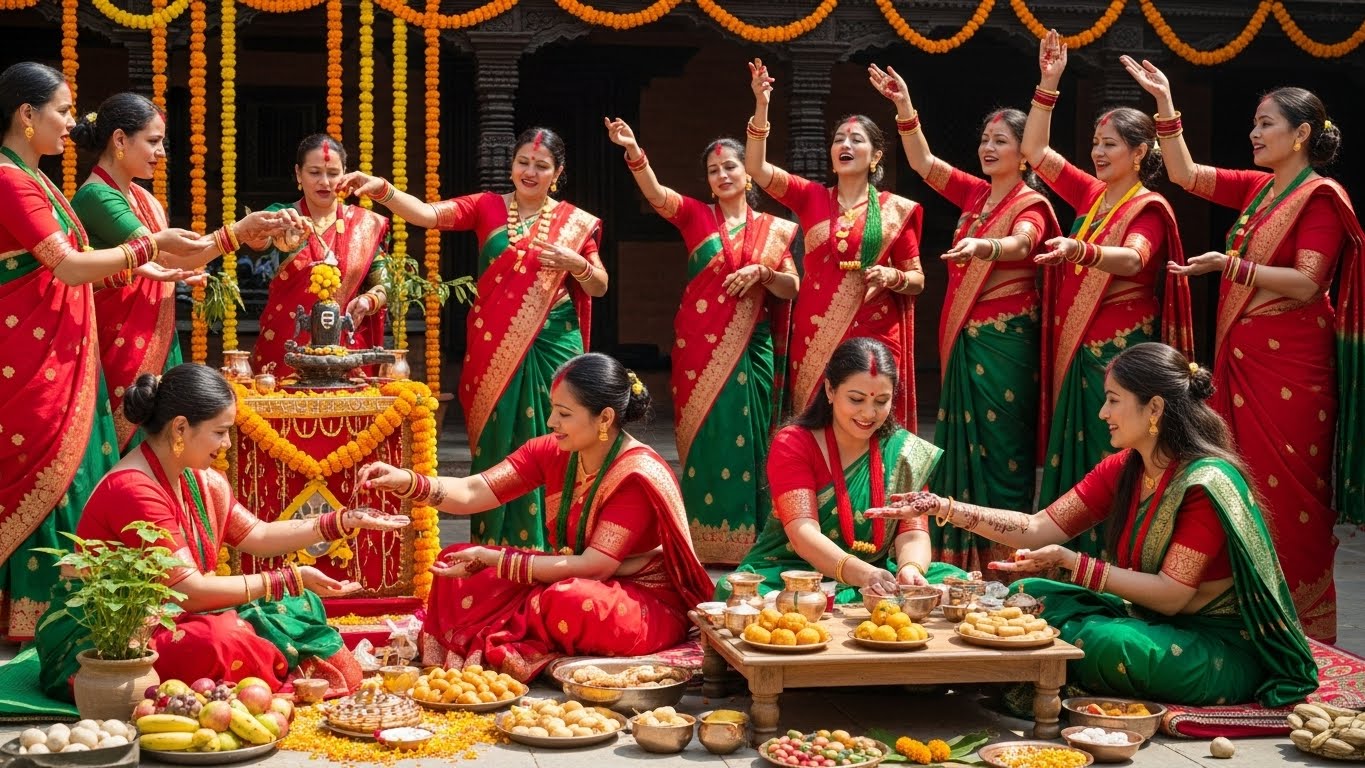
The festival of Teej Festival – from Sanskrit [translate:तीज] (Teej) meaning “third day” referring to Tritiya Tithi (third lunar day) when celebrations occur – represents one of North India’s most joyous, vibrant, and culturally significant festivals where married women and unmarried girls observe rigorous nirjala (waterless) fast honoring divine marriage of Lord Shiva and Goddess Parvati through day-long abstinence from food and water, elaborate evening puja rituals, festive green attire symbolizing monsoon’s lush vegetation, mehndi (henna) application creating intricate designs, swinging on decorated jhulas (swings) singing folk songs celebrating marital love, and listening to Vrat Katha narrating Parvati’s extraordinary penance winning Shiva as husband creating inspirational model of devotion, determination, and feminine spiritual power.
Unlike somber ascetic fasting, Teej uniquely combines rigorous austerity with joyful celebration creating distinctive festival atmosphere where physical hardship of waterless fast balanced by communal festivities, beautiful adornments, playful swinging traditions, and anticipation of reunion/renewal themes echoing divine couple’s cosmic marriage making this observance simultaneously challenging spiritual discipline and exuberant cultural celebration particularly beloved by women across generations.
The complete Teej tradition encompasses understanding three distinct types celebrated at different times – Hariyali Teej (green Teej) during Shravan month’s lush monsoon greenery when Shiva accepted Parvati, Kajari Teej honoring motherhood and agricultural abundance, and Hartalika Teej (most rigorous) commemorating Parvati’s friends kidnapping her to prevent unwanted marriage enabling continued Shiva-worship – each carrying unique significance, timing, and regional emphasis while sharing core elements of feminine devotion, marital prayers, and seasonal celebration, detailed observance procedures from pre-dawn preparations through day-long nirjala vrat’s demanding physical and mental discipline to evening’s elaborate sixteen-adornment (Solah Shringar) beautification recreating bridal splendor, collective sand-idol puja
where women craft temporary Shiva-Parvati images worshipping with flowers and offerings, energetic swing sessions on flower-bedecked jhulas accompanied by traditional songs expressing monsoon romance and marital longing, and overnight vigil (jaagran) some traditions maintain concluding with sunrise fast-breaking ceremony, regional variations creating distinctive local flavors from Rajasthan’s grand processions and royal heritage celebrations through Punjab’s energetic Gidda dances and Sindhara gift exchanges to Nepal’s nationally significant three-day festivities recognized as major cultural event, and contemporary adaptations where urban women balance tradition with modern lifestyles choosing modified fasts, workplace-appropriate celebrations, and personal interpretations while maintaining festival’s essential spirit.
For women in 2025 whether newly married brides experiencing first Teej learning complex rituals while navigating family expectations and personal comfort levels, experienced wives maintaining decades-long tradition connecting annual observance to marital journey’s continuity and seasonal rhythms, unmarried girls fasting for ideal husband following Parvati’s example of choosing desired partner through spiritual power rather than accepting parental arrangements, mothers-in-law sending elaborate Sindhara gifts to daughters-in-law carrying forward generational customs demonstrating
familial bonds and blessings, or simply observers wanting to understand festival’s profound resonance beyond surface merriment recognizing sophisticated integration of devotion, celebration, nature worship, and feminine empowerment, appreciating Teej as multidimensional practice embodying both spiritual austerity and joyful cultural expression enables approaching this tradition with nuanced understanding honoring both ancient wisdom and contemporary perspectives allowing each woman to engage meaningfully whether observing full orthodox fast or participating selectively based on personal values, health considerations, and life circumstances.
What Is Teej? Origins, Types, and Significance
Understanding festival’s multiple forms and deeper meanings provides essential foundation.
The Name and Timing
Etymology:
[translate:तीज (Teej)] = Third
Significance:
Teej festivals occur on Tritiya Tithi (third lunar day) of various months, hence the name.
Monsoon Association:
All three Teej celebrations fall during monsoon season (July-September), connecting festival to:
- Abundant rains
- Lush green vegetation
- Agricultural fertility
- Romantic season in Indian tradition
The Three Types of Teej
1. Hariyali Teej (Green Teej)
When Celebrated:
Hariyali Teej falls on “Tritiya Tithi of Shukla Paksha (waxing moon) in the month of Shravan (July-August).”
2025 Date: July 27, 2025 (verify annually based on lunar calendar)
Name Meaning:
[translate:हरियाली (Hariyali)] = Greenery
Why This Name?
“This festival symbolizes the greenery spread in nature with the arrival of the monsoon.”
During Shravan:
- Peak monsoon season
- Vegetation lush and green
- Fields verdant
- Nature at most vibrant
Primary Significance:
“This festival symbolizes the eternal love and reunion of Lord Shiva and Goddess Parvati.”
The Event Commemorated:
“On this day, Lord Shiva accepted Goddess Parvati as his wife.”
After Parvati’s thousands of years of intense penance, Shiva finally agreed to marry her on this auspicious Shravan Tritiya.
Who Observes:
Married Women:
- Fast for husband’s longevity and marital bliss
- Most popular Teej observance
Unmarried Girls:
- Fast praying for ideal husband
- Following Parvati’s example
Characteristics:
- Green attire mandatory (symbolizing monsoon)
- Swinging on decorated jhulas (swings)
- Most festive and joyful of three Teej celebrations
- Sindhara tradition (gifts from maternal home)
2. Kajari Teej (Badi Teej)
When Celebrated:
Tritiya Tithi of Krishna Paksha (waning moon) in Bhadrapada month (August-September)
Approximately 15 days after Hariyali Teej
Name Meaning:
[translate:कजरी (Kajari)] = A form of folk song/music
Primary Focus:
Motherhood and Children’s Welfare:
Unlike other Teej focused on marital happiness, Kajari Teej emphasizes:
- Children’s health and prosperity
- Mother-child bond
- Family wellbeing
- Agricultural abundance
Who Observes:
Primarily married women with children
Characteristics:
- Less rigorous than other Teej
- Focus on progeny rather than marriage
- Regional importance (especially UP, MP, Rajasthan)
- Neem tree worship (associated with health)
3. Hartalika Teej (Most Rigorous)
When Celebrated:
Hartalika Teej occurs on “Tritiya Tithi of Shukla Paksha in the Bhadrapada month” (August-September)
2025 Date: August 26, 2025
Name Meaning:
[translate:हरतालिका (Hartalika)] = Female friend + Kidnapping
Etymology:
- [translate:हर (Har)] = To take away
- [translate:आलिका/सखी (Aalika/Sakhi)] = Female friend
Combined: “Kidnapping by female friends”
Why This Name?
Based on specific legend (detailed in story section):
When Parvati’s father planned to marry her to Lord Vishnu against her wishes (she wanted only Shiva), her friends kidnapped her and hid her in mountain caves enabling her to continue Shiva penance undisturbed.
Primary Significance:
Most Austere Teej:
“The fast is ideally observed as a nirjala vrat, with no intake of food or water.”
Additional Rigor:
- Overnight vigil (Jaagran) – staying awake entire night
- Sand idol worship – making temporary Shiva-Parvati images
- Strictest rules and procedures
Who Observes:
Both married women and unmarried girls:
- Married women for husband’s longevity
- Unmarried girls for ideal husband
Characteristics:
- Red/yellow attire (vs. green for Hariyali)
- Most spiritually intense
- Complete nirjala fast till next sunrise
- Night-long worship and devotional activities
Core Significance: Parvati’s Penance and Divine Marriage
The Fundamental Story:
According to tradition, “Goddess Parvati was so absorbed in her penance to attain Lord Shiva that thousands of years passed while she was doing her tapasya.”
The Extreme Austerity:
“You gave up food and ate leaves, doing penance for thousands of years.”
Parvati’s Determination:
- Abandoned all comforts
- Survived on leaves, then nothing
- Meditated in isolation
- Refused alternate proposals (even Lord Vishnu!)
- Single-minded devotion to Shiva
Shiva’s Acceptance:
“Pleased by your penance, I accepted you as my consort.”
The Teaching for Women:
Parvati as Ideal:
Her story establishes:
- Spiritual power of feminine devotion – Even ascetic Shiva moved by love
- Agency in choosing husband – Rejected arrangement, chose desired partner
- Determination and discipline – Thousands of years of austerity
- Ultimate success – Divine marriage as reward
Modern Interpretation:
While traditional reading emphasizes Pativrata (husband-devotion), contemporary women also see:
- Independence – Parvati chose her own destiny
- Spiritual equality – Her tapasya rivaled any sage’s
- Power of will – Determination achieves impossible goals
Teej as Annual Renewal:
Each year’s celebration:
- Commemorates divine marriage
- Honors Parvati’s example
- Renews own marital commitment
- Connects with seasonal cycles
Regional Prevalence
Strongest Observance:
North India:
- Rajasthan (especially Jaipur – grand celebrations)
- Punjab
- Haryana
- Uttar Pradesh
- Madhya Pradesh
- Himachal Pradesh
Also Celebrated:
- Gujarat (some communities)
- Bihar
- Chhattisgarh
- Nepal (nationally significant festival)
Generally NOT Observed:
- South India
- East India (Bengal, Odisha)
- Northeast India
Why Regional Variation?
Different cultural traditions:
- South has other women’s festivals
- Regional deity preferences
- Agricultural calendar differences
- Local customs and heritage
The Legendary Vrat Katha: Parvati’s Story
The sacred narrative forms essential part of Teej ritual, especially Hartalika.
The Complete Story: Hartalika Teej Legend
Parvati’s Determination:
“Since the beginning, you wanted to get me as your husband, so you remained absorbed in my penance and meditation.”
Father’s Concern:
“Your father [Himalaya Raja] was very sad and worried to see your condition.”
The Unwanted Proposal:
“One day, Narad Ji came to your father’s house and said that Lord Vishnu wants to marry your daughter.”
Father’s Joy:
“Hearing Narad Ji’s words, Himalaya Raja was very pleased and ready to marry you to Lord Vishnu.”
Parvati’s Distress:
“When you came to know about this, you were very upset.”
Friends’ Intervention (Hartalika):
“Seeing your helpless sorrow, your friends kidnapped you and hid you in the caves of the mountains.”
Continued Devotion:
“There you made a Shivlinga statue out of sand and began worshipping me.”
Father’s Search:
“Hearing about your kidnapping, your father Himalaya Raja started searching for you but could not find you.”
Divine Acceptance:
“Pleased by your penance, I accepted you.“
The Confrontation:
“According to my divine play, Himalaya Raja reached the cave where you were absorbed in penance. At that time, you had already accepted me as your husband.”
Parvati’s Ultimatum:
“You told your father that you will return home only if your marriage is performed with Lord Shiva and not with Lord Vishnu; otherwise, you would give up your life right there.”
The Victory:
“As per your wish, your father married you to me.”
The Blessing:
“I have told you this story which is very auspicious and grants unbroken marital bliss.”
For Listeners:
“Any woman who observes the Hariyali Teej fast and listens to or reads this story will be blessed with unbroken marital bliss, and unmarried girls will get a suitable groom.”
Key Themes in the Story
1. Female Agency:
Parvati chose her husband despite:
- Father’s preference
- Social pressure
- Alternative (prestigious) proposal
Her will prevailed through spiritual power and determination.
2. Feminine Solidarity:
Friends’ support crucial:
- Recognized her genuine desire
- Took bold action (kidnapping!)
- Protected her right to choose
- Enabled continued devotion
“Hartalika” celebrates female friendship
3. Spiritual Power Over Social Convention:
Parvati’s tapasya:
- More powerful than father’s authority
- Overcame social arrangements
- Won divine husband through merit
- Established precedent for choice in marriage
4. Sand Shivlinga Symbolism:
Making Shivlinga from sand:
- Resourceful devotion (using available materials)
- Temporary yet sacred (pure intention matters)
- Accessible worship (no elaborate temple needed)
Modern women replicate during Hartalika puja.
Listening to Vrat Katha
Essential Ritual:
During evening puja:
- Story recited or read aloud
- All fasting women listen devotedly
- Creates collective spiritual energy
- Reinforces fast’s sacred meaning
The Power:
Traditional belief:
- Hearing story = Receiving blessing
- Parvati’s grace flows to listeners
- Strengthens own devotion
- Grants desired boons (good husband, marital bliss)
Complete Fasting Procedure: Step-by-Step Guide
The detailed observance ritual follows prescribed sequence throughout day and night.
Preparation: Day Before Teej
Shopping and Arrangements:
Essential Items:
- Green clothes (Hariyali) or Red/yellow (Hartalika)
- Mehndi (henna)
- 16 Shringar items (see section below)
- Puja materials:
- Flowers (especially jasmine, marigold)
- Incense and lamps
- Fruits and sweets
- Clay/sand for idol making (Hartalika)
- Red cloth, bangles, sindoor for offering
- Swing decorations (if participating)
- Fast-breaking foods for next day
Mehndi Application:
Evening Before:
Women apply intricate mehndi designs:
- Hands and feet adorned
- Traditional patterns (paisley, peacock, flowers)
- Requires overnight setting for deep color
- Darker mehndi = Deeper marital love (belief)
Sindhara Tradition (Hariyali Teej):
Special North Indian Custom:
“Married girls receive ‘Sindhara’ from their parental home.”
What’s Included:
- Traditional clothes
- Jewelry
- Sweets (especially Ghevar – traditional Teej sweet)
- Mehndi
- Bangles and adornments
- Money (sometimes)
Symbolism:
- Parents’ continued blessing and love
- Maintaining daughter’s connection to maternal home
- Supporting her in marital home
- Generational tradition transmission
Sent Before Teej:
Mother or brother delivers to daughter’s in-laws’ home.
Step 1: The Nirjala Fast – Sunrise to Sunrise
Most Rigorous Fast:
[translate:निर्जला व्रत (Nirjala Vrat)] = Without water
The Rules:
“The fast begins at sunrise and continues till the next sunrise.”
Complete Abstinence:
“It is ideally observed as a nirjala vrat, with no intake of food or water.”
Duration:
24+ hours of complete fasting
Exceptions:
Health-Based Modifications:
“Pregnant women and those who are unwell are advised not to observe the fast without water; instead, they may consume fruits.”
Sajal Fast Alternative:
If nirjala impossible:
- Sajal vrat (with water) permitted
- Water consumed as needed
- Still considered valid observance
- Health priority recognized
Water Timing (Modified Fast):
“Women who find it difficult to observe the nirjala fast may drink water after completing the evening puja.”
Physical Challenges:
Hunger:
- 24 hours without food
- Low energy, fatigue
- Stomach discomfort
Thirst (Harder):
- Especially difficult in summer heat
- Dry mouth, headache
- No water even for mouth rinsing
Mental Discipline:
Coping Strategies:
1. Devotional Focus:
- Remember Parvati’s thousands of years
- Pray for desired blessings
- Maintain spiritual consciousness
2. Rest:
- Avoid strenuous activities
- Conserve energy
- Light household tasks only
3. Community Support:
- Fasting with others helps
- Shared experience eases difficulty
- Encouragement from fellow observers
4. Festive Distraction:
- Beautification preparations
- Swinging and singing
- Puja activities
- Keeps mind engaged
Important Rules:
“Once started, this vrat should not be left midway according to tradition.”
Commitment:
- Complete fast considered essential
- Breaking early traditionally discouraged
- Exception for genuine health emergency
Step 2: Morning Preparations and Beautification
Early Morning:
Wake Before Sunrise:
“Women observing the fast wake up before sunrise.”
Bath:
“Take a bath and wear clean, traditional clothes.”
Full purification before beginning fast day.
Sankalp (Vow):
Mental Determination:
Take formal vow of fasting:
- State intention (husband’s welfare/ideal husband)
- Commit to complete observance
- Invoke Parvati’s blessings
Solah Shringar – Sixteen Adornments:
Complete Beautification:
[translate:सोलह श्रृंगार (Solah Shringar)] = Traditional married woman’s 16 adornments
The Complete List:
- Hair washing and styling
- Bindi (forehead mark)
- Sindoor (married women)
- Kajal (eye liner)
- Nose ring (Nath)
- Earrings
- Necklaces
- Mangalsutra
- Bangles (many, colorful)
- Finger rings
- Toe rings
- Anklets
- Waist belt
- Mehndi (already applied previous day)
- Perfume
- Flowers in hair
Plus Traditional Attire:
Hariyali Teej:
- Green clothes mandatory
- Symbolizes monsoon greenery
- Saree, lehenga, or salwar kameez
- Bright festive green
Hartalika Teej:
- Red or yellow clothes
- Traditional auspicious colors
- Often heavily decorated
The Symbolism:
Looking Like Bride:
- Recreating wedding day splendor
- Honoring husband through beauty
- Celebrating femininity
- Goddess Parvati’s adornment
Step 3: Swinging Tradition – Jhoola Celebration
Unique Teej Custom:
The Decorated Swing:
“Women hang swings on trees and sing folk songs while swinging.”
Setup:
Jhoola (Swing) Preparation:
- Wooden plank or rope swing
- Hung from sturdy tree branches (often neem or banyan)
- Decorated with flowers (marigold, jasmine)
- Colorful fabrics draped
- Often adorned with bells, tinsel
The Activity:
Collective Swinging:
Groups of women:
- Take turns on swings
- Sing traditional Teej songs
- Playful, joyful atmosphere
- Dance and celebration
Traditional Songs:
Folk Music:
Teej songs (Geet) typically express:
- Monsoon romance
- Marital longing
- Parvati-Shiva love
- Seasonal beauty
- Women’s experiences
The Symbolism:
Why Swinging?
Multiple Meanings:
1. Monsoon Association:
- Swinging during rains traditional
- Joy of abundant water
- Nature’s renewal
2. Parvati’s Joy:
- Celebrating her union with Shiva
- Swinging represents marital bliss
- Playful divine couple
3. Feminine Freedom:
- Temporary escape from duties
- Collective celebration
- Sisterhood and community
4. Balance and Rhythm:
- Swing’s back-and-forth
- Life’s ups and downs
- Marital harmony
Regional Variations:
Rajasthan:
- Grand community swings
- Elaborate decorations
- Public celebrations
Punjab:
- Combined with Gidda dance
- Energetic performances
- “Teeyan” celebrations
Step 4: Evening Puja – Worshipping Shiva-Parvati
Most Important Ritual:
Timing:
“Puja is performed in the morning and evening, but the evening rituals are considered most important.”
Hartalika Teej Specific:
“During the evening (Pradosh Kaal), idols of Lord Shiva and Goddess Parvati are crafted from sand or clay.”
The Setup:
Creating Sacred Space:
- Clean area designated for puja
- Rangoli decoration optional
- Platform for idol placement
Making Sand/Clay Idols (Hartalika):
Unique Practice:
Women themselves create:
- Shivlinga from sand/clay
- Parvati idol alongside
- Lord Ganesha (sometimes included)
Symbolism:
- Replicating Parvati’s cave worship
- Temporary yet sacred
- Devotion matters more than permanence
Next Day:
“The idols prepared for worship should be immersed the following day after rituals.”
The Puja Vidhi (Worship Procedure):
Step-by-Step:
1. Invocation:
- Light incense and lamps
- Invoke divine presence
- Purify atmosphere
2. Offerings to Parvati:
“All sixteen adornment items such as saree, bangles, sindoor, bindi, mehndi, kajal, etc., are respectfully offered to Goddess Parvati.”
Basket of Suhag Items:
Married women place symbols of marital bliss:
- Red bangles
- Sindoor
- Bindi
- Mehndi
- Flowers
- Sweets
3. Offerings to Shiva:
“Lord Shiva is offered a dhoti and angavastra.”
Plus traditional items:
- Bilva leaves (sacred to Shiva)
- Milk, honey, curd, ghee (Panchamrit)
- Flowers (especially white)
- Fruits
4. Prasad:
“Fruits, kheer (rice pudding) and halwa are offered as prasad.”
Traditional sweets presented.
5. Mantras:
Specific Chants:
For Goddess Parvati:
- [translate:ॐ उमायै नमः] (Om Umaye Namah)
- [translate:ॐ पार्वत्यै नमः] (Om Parvatyai Namah)
For Lord Shiva:
- [translate:ॐ नमः शिवाय] (Om Namah Shivaya)
- [translate:ॐ सम्ब शिवाय नमः] (Om Samba Shivaya Namah)
6. Vrat Katha:
Story Recitation:
- One person reads Parvati’s story
- All listen with devotion
- Essential part of ritual
7. Aarti:
- Collective singing
- Circulating lamps before deities
- Devotional climax
8. Prayers:
Individual silent prayers:
- Married women: Husband’s longevity
- Unmarried girls: Ideal husband
- All: Marital happiness
Duration:
Puja typically 45-90 minutes
Step 5: Night-Long Vigil (Jaagran) – Hartalika Specific
Staying Awake All Night:
“Night-long jagran (staying awake) holds special importance.”
Why Jaagran?
Parvati’s Continuous Penance:
- She never slept during tapasya
- Replicating her dedication
- Heightened spiritual state
- Demonstrates commitment
Activities During Night:
Devotional Engagement:
- Continuous prayers and chanting
- Singing devotional songs (bhajans, kirtans)
- Repeating mantras
- Listening to spiritual discourses
- Community gathering – women together
- Storytelling – religious narratives
Physical Challenge:
After 20+ hours of fasting without water:
- Staying awake extremely difficult
- Requires strong determination
- Community support crucial
- Devotional fervor sustains
Modern Modification:
Some women:
- Sleep for few hours
- Wake for final morning puja
- Balance health with tradition
Step 6: Breaking the Fast – Next Morning
The Completion:
“The fast is broken only after sunrise the following day.”
Final Ritual:
Morning Puja:
“Women perform the final puja, apply sindoor to Goddess Parvati and then to themselves.”
Transfer of Blessing:
- Sindoor first offered to goddess
- Then applied to own forehead/parting
- Receiving divine grace
Traditional First Foods:
“Accept prasad of soaked gram, cucumber and halwa before ending the vrat.”
Specific Items:
- Soaked chana (chickpeas) – Light, traditional
- Cucumber – Hydrating, gentle on stomach
- Halwa – Sweet auspicious prasad
Donation (Hartalika):
“After puja, the suhag items are donated to a Brahmin couple following blessings from the mother-in-law.”
Giving away:
- Basket of marital symbols
- Clothes offered to deities
- Traditional charity completing vrat
Gradual Rehydration and Eating:
Important:
After 24+ hour nirjala fast:
- Don’t eat/drink heavily immediately
- Small sips of water first
- Light foods gradually
- Allow body to adjust
Full Meal:
Later in day:
- Regular festive meal
- Celebrating successful completion
- Family gathering
Frequently Asked Questions
What’s the difference between Hariyali Teej and Hartalika Teej?
Two distinct celebrations though related: Timing: Hariyali Teej falls in Shravan month (July-Aug), Hartalika in Bhadrapada month (August-Sept) about one month apart. Attire: Hariyali requires green clothes (monsoon greenery symbolism); Hartalika prefers red/yellow (traditional auspiciousness). Rigor: Hariyali can be nirjala or sajal (water allowed); Hartalika strictly nirjala (no water) plus overnight vigil making it more austere.
Mood: Hariyali more festive/joyful with swinging and celebrations; Hartalika more intense spiritual focus with sand idol worship. Story emphasis: Hariyali celebrates Shiva accepting Parvati; Hartalika emphasizes friends’ kidnapping enabling her continued penance. Both valid: Some regions prioritize one over other; devout women may observe both. Core similarity: Both honor Parvati-Shiva union and pray for marital bliss.
Can unmarried girls observe Teej fast?
Absolutely yes – strongly encouraged! Traditional practice: Unmarried girls fast praying for ideal husband, following Parvati’s example who chose Shiva through penance rather than accepting arranged match. The belief: “Unmarried girls also fast on this day praying for a worthy and virtuous husband.” Just as Parvati won desired groom through spiritual power, girls seek same blessing.
What they pray for: Not just any husband but specifically compatible, loving, spiritually-oriented partner meeting their ideals. Modern interpretation: Beyond literal husband-seeking, also praying for right life partner, agency in choosing, and successful relationship. Equal observance: Unmarried girls follow same procedures (nirjala fast, puja, swinging) as married women, just with different intention. Empowering message: Spiritual discipline and determination help achieve desired goals – applicable beyond marriage too.
Is it mandatory to observe nirjala (waterless) fast for Teej?
Ideally yes, practically flexible: Traditional ideal: Nirjala fast (no food, no water) considered most authentic and powerful, especially for Hartalika Teej. However: “In cases of physical inability, a fast with water (sajal vrat) is also acceptable.” Health always prioritized over rigid adherence. When water allowed: Pregnant women, chronically ill, elderly, those with medical conditions should drink water.
Some traditions: Allow water consumption after evening puja if continuing till morning without water too difficult. The principle: Sincere devotion matters more than perfect mechanical compliance. God sees intention and effort, not just external rules. Honest self-assessment: Choose level you can complete without endangering health. Incomplete fast due to breakdown worse than modified fast completed successfully. Modern reality: Many urban working women choose sajal fast as practical adaptation.
What if I have my period during Teej? Can I still fast?
Complex traditional rules evolving: Orthodox view: “Women are advised not to skip the fast even during menstruation; someone else can perform the puja on their behalf.” Fasting continues but puja delegation allowed due to temple/idol proximity restrictions during menses. Progressive perspective: Increasingly rejected as baseless taboo; menstruating women fully capable of worship and fasting. Practical considerations: Period + nirjala fast = Physically very challenging (dehydration, cramps, fatigue). Many women wisely choose modified fast or postponement.
Personal choice: Range of options: 1) Fast fully and perform own puja (modern view), 2) Fast but delegate puja (traditional compromise), 3) Modified sajal fast, 4) Postpone to next year (health priority). No divine punishment: Missing one year due to menstruation or health doesn’t doom marriage or prayer efficacy. Respectful approach: Family understanding crucial – women shouldn’t be pressured into health-compromising observance.
Why is green color worn on Hariyali Teej specifically?
Deep symbolic connection to monsoon season: Primary reason: “This festival symbolizes the greenery spread in nature with the arrival of the monsoon” during Shravan month when Hariyali Teej occurs. Nature’s abundance: Peak monsoon brings lush vegetation, revived fields after summer heat, life-giving rains – all symbolized by green.
Fertility and prosperity: Green universally represents growth, fertility, new life, abundance – perfect for festival celebrating marriage and marital fertility. Shiva’s association: Lord Shiva associated with nature, forests, Himalayas where vegetation green and abundant. Parvati as nature goddess: Daughter of Himalaya mountain, connected to earth’s fertility and natural cycles. Tradition specific: Hartalika Teej (different month, less green monsoon) uses red/yellow instead. Beyond clothing: Green bangles, bindis, decorations all emphasize this color creating cohesive festive atmosphere celebrating nature’s bounty.
What is Sindhara and why is it important?
Beautiful North Indian Teej tradition: Definition: Sindhara = Gifts sent from married woman’s parental home (maternal family) to her in-laws’ house before Teej. Who sends: Mother, father, or brother delivers to daughter/sister’s marital home. What’s included: Traditional clothes (often green for Hariyali), jewelry, sweets (especially Ghevar – special Teej delicacy), mehndi, bangles, adornments, money, fruits.
Symbolism: 1. Parents’ continued blessing – Marriage doesn’t end daughter’s connection to birth family, 2. Supporting her – Providing materials for proper Teej celebration, 3. Honoring in-laws – Showing respect to family who cares for daughter, 4. Generational continuity – Mothers received Sindhara, now send to daughters. Emotional significance: Often tearful moment representing parents’ eternal love and concern for married daughter’s happiness. Modern adaptation: If living far, items shipped or money transferred, but emotional essence maintained.
Can pregnant or breastfeeding women observe Teej fast?
Strong medical caution advised: Pregnancy: Traditional view varies – some allow, others discourage. Medical reality: 24-hour nirjala fast potentially dangerous for fetus; dehydration affects pregnancy. Doctor consultation mandatory before attempting. If observing: Must take sajal (water) version minimally; better to eat small fruits too. Honest assessment: Is proving devotion worth potential pregnancy risk? Most religious authorities agree health paramount. Breastfeeding: Milk production requires hydration; nirjala fast depletes supply harming baby.
Modified observance: Consume water and light foods if nursing. Alternative devotion: Perform puja, wear traditional attire, participate in celebrations without full fast – devotion expressed differently. Remember: Parvati herself later became mother to Ganesha and Kartikeya – she would understand motherhood’s demands. Postpone if necessary: Can resume full fasting after pregnancy/nursing period ends.
What should I do if I feel very weak or faint during the fast?
Health emergency overrides ritual: Warning signs: Severe dizziness, fainting sensation, extreme weakness, confusion, rapid heartbeat, blurred vision. Immediate action: 1. Sit or lie down preventing fall injury, 2. Tell someone – don’t suffer alone, 3. Break fast immediately – your wellbeing matters most, 4. Drink water first (dehydration likely culprit), 5. Small sugar source – juice, sweet, candy for blood sugar, 6. Medical help if symptoms persist – don’t hesitate. No guilt necessary: God doesn’t want devotees harming themselves.
Sincere intention and effort already counted; completing to point of medical crisis not virtuous. Prevention: Adequate sargi (if tradition allows pre-fast meal), rest during day, avoid overexertion, realistic self-assessment of health capability. Next year: Can try again with better preparation or choose modified version knowing your limits.
Conclusion
The festival of Teej represents joyous yet rigorous tradition embodying profound feminine spirituality, seasonal celebration, marital devotion, and cultural heritage – simultaneously serving as challenging spiritual discipline through demanding nirjala fast testing physical endurance and mental determination while also creating exuberant communal celebration through decorated swings, traditional songs, green festive attire, intricate mehndi, and collective worship creating distinctive festival atmosphere beloved by women across generations connecting individual practice to timeless cycles of nature’s renewal and divine love’s triumph.
Understanding complete framework – that three distinct types (Hariyali celebrating monsoon’s green abundance and Shiva accepting Parvati, Kajari honoring motherhood and agricultural fertility, Hartalika commemorating friends’ kidnapping enabling Parvati’s continued Shiva-penance with strictest overnight nirjala vigil) each carry unique timing, emphasis, and regional importance while sharing core elements of feminine devotion and marital prayers, that legendary Vrat Katha narrating Parvati’s extraordinary thousands-years penance, friends’ protective intervention, her ultimatum choosing desired husband over convenient arrangement, and ultimate
victory winning Shiva through spiritual power establishes inspirational model of determination, agency, and devotional strength transcending passive acceptance, that detailed observance from pre-dawn preparations through rigorous day-long waterless fast to elaborate Solah Shringar beautification, energetic swing sessions with traditional songs, evening sand-idol worship, overnight vigil, and sunrise fast-breaking creates multifaceted experience engaging
body, emotions, spirituality, and community simultaneously, and that modern adaptations allowing health-conscious modifications, workplace-appropriate celebrations, and personal interpretations demonstrate living tradition’s flexibility honoring both ancient wisdom and contemporary realities – enables approaching Teej with nuanced appreciation respecting both orthodox practitioners maintaining full traditional rigor and those adapting selectively based on health, circumstances, and personal comfort levels.
As you engage with Teej festival in 2025, whether newly married bride experiencing first Teej learning complex rituals while discovering personal meaning beyond family expectations, experienced wife maintaining decades-long practice where annual observance marks seasonal rhythms and marital journey’s continuity, unmarried girl fasting for ideal partner following Parvati’s empowering example of choosing desired husband through spiritual strength rather than passive acceptance, mother preparing to send loving Sindhara to married daughter carrying forward generational blessing traditions, traditional observer maintaining full nirjala overnight vigil honoring festival’s austere spiritual core, modern adapter participating in cultural celebrations while modifying fast for health or practical reasons, or simply curious observer understanding
festival’s profound resonance recognizing sophisticated integration of devotion, nature worship, feminine power, and joyful community bonding, remember that tradition’s ultimate value emerges when ancient practice meets informed contemporary choice where observance stemming from genuine devotion, personal meaning, and free will proves far more spiritually powerful than that maintained through social pressure or unthinking compliance, that Teej’s remarkable synthesis of rigorous austerity and exuberant celebration, individual discipline and collective festivity, Parvati’s determination and nature’s abundance demonstrates
Hinduism’s holistic approach honoring multiple dimensions of human experience simultaneously serving spiritual, emotional, social, and aesthetic needs, and that whether observing complete traditional fast with full rituals, choosing modified version respecting health needs, participating in cultural aspects without fasting, or consciously deciding not to observe while respecting others’ choices, approaching this tradition with understanding its complete significance, honoring Parvati’s powerful feminine example, celebrating monsoon’s life-giving abundance, and maintaining open dialogue about personal autonomy and meaningful practice transforms potentially rigid ritual into conscious engagement with heritage allowing each woman to craft relationship with tradition serving her unique values, circumstances, and spiritual journey.
[translate:॥ गौरी शंकरं ध्यायेत् सर्वकामार्थसिद्धये॥]
(Meditate upon Gauri [Parvati] and Shankara [Shiva] for fulfillment of all desires and objectives.)
About the Author
Kavita Iyer – Women’s Rituals, Fasting Traditions, and Devotional Practices Expert
Kavita Iyer is a dedicated researcher and practitioner specializing in Hindu women’s religious practices, fasting traditions, seasonal festivals, and the intersection of devotional discipline with feminine spirituality particularly as experienced and transmitted through female lineages. Drawing from personal experience growing up in traditional Rajasthani
family where Teej celebrations were major annual events she witnessed her mother, aunts, and grandmother observe with deep devotion while also maintaining joyful festive atmosphere through swinging, singing, and collective worship creating lasting impressions of women’s spiritual power and community bonding, combined with academic training in religious studies and gender anthropology.
her work examines how festivals like Teej encode complex meanings about feminine agency, devotional strength, seasonal awareness, and cultural identity while navigating contemporary challenges of health considerations, personal autonomy, and evolving gender consciousness. Kavita has extensively researched Teej’s historical evolution from ancient Parvati legends through regional variations (Hariyali, Kajari, Hartalika) to modern urban adaptations documenting how this tradition simultaneously preserves profound spiritual meaning for many women while also requiring honest acknowledgment of physical demands and personal choice considerations.
She regularly counsels newly married women approaching first Teej helping them understand complete significance, procedures, and health-conscious modifications balancing family expectations with personal wellbeing, teaches workshops on women’s fasting traditions explaining spiritual purposes alongside practical health guidelines, and facilitates intergenerational conversations where mothers and daughters navigate different perspectives on rigorous practices finding respectful common ground.
Her teaching emphasizes that festivals gain rather than lose vitality when participants understand complete significance including both spiritual depth and practical implications, that traditions serve communities best when they enhance rather than endanger participants’ wellbeing, and that Teej’s future depends on honoring both its beautiful devotional aspects (Parvati’s determination, feminine spiritual power, seasonal celebration) and legitimate health concerns (nirjala fast’s physical demands, individual capacity variations, medical conditions requiring modification) allowing evolution toward forms preserving essential meaning while respecting contemporary realities.