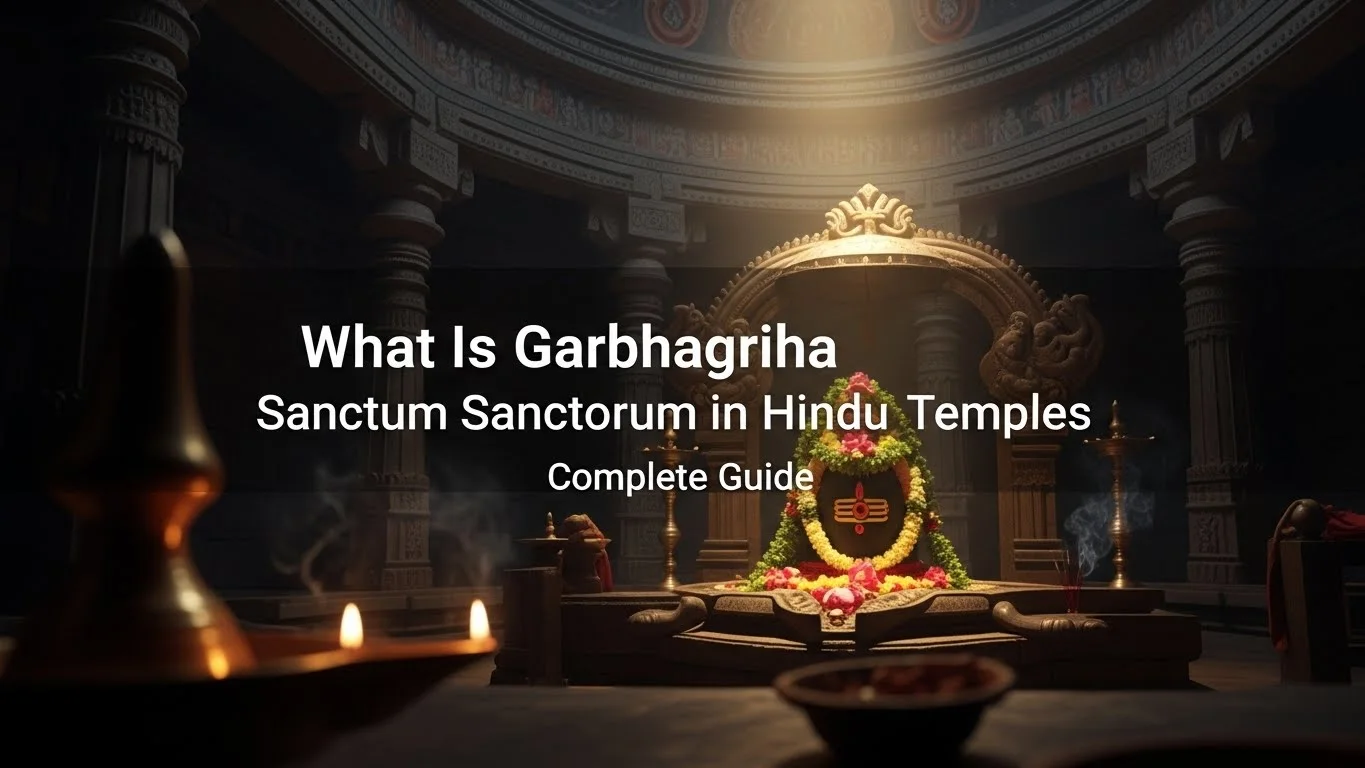
What Is Garbhagriha (also spelled garbha griha or garbhagruha) is the innermost sanctum sanctorum of a Hindu temple—a sacred womb chamber where the temple’s main deity resides in the form of a consecrated idol (murti) or abstract representation like the Shiva lingam. The term derives from Sanskrit: “garbha” meaning “womb” or “embryo” and “griha” meaning “house” or “chamber”, literally translating to “womb chamber” or “house of the embryo”. This profound nomenclature reflects the garbhagriha’s theological significance as the cosmic womb from which all creation emerges—the sacred space representing primordial creation, divine presence that nurtures life, and the ultimate source from which the universe manifests.
The garbhagriha is typically a small, square or rectangular chamber with thick walls, minimal lighting (often completely dark except during rituals), and access restricted primarily to priests, creating an atmosphere of mystery, interiority, and concentrated spiritual energy that distinguishes it from all other temple spaces.
According to Vastu Shastra and Agama Shastra (ancient Indian architectural sciences), the garbhagriha must be positioned precisely at the Brahma pada or Brahmasthan—the sacred center of the Vastu Purusha Mandala, the geometric grid diagram that forms the mathematical and cosmological foundation of temple planning. This central placement, with the temple’s shikhara (tower) or vimana rising vertically above it, transforms the garbhagriha into the axis mundi (world axis)—the cosmic pillar connecting earth to heaven, the material to the spiritual, and human consciousness to divine reality.
This comprehensive guide explores the garbhagriha’s architectural features, symbolic meanings, placement principles according to Vastu Shastra, associated rituals including pradakshina (circumambulation), the significance of darkness, and its central role in Hindu philosophy and temple worship.
Etymology and Core Meaning
The Womb Chamber Symbolism
The designation “garbhagriha” carries profound theological implications that extend far beyond literal architectural description:
Cosmic Womb: The garbhagriha symbolizes the primordial cosmic womb from which the universe emerged, mirroring biological creation where life originates in the mother’s womb. Just as an embryo develops within the protective enclosure of the womb, the deity resides within the garbhagriha’s protective chamber, representing the divine creative principle that generates and sustains cosmic existence.
Hiranyagarbha (Golden Egg): Hindu cosmology describes creation emerging from Hiranyagarbha—the golden cosmic egg or womb containing the entire potential universe before manifestation. The garbhagriha architecturally embodies this concept, housing the concentrated divine essence from which all cosmic diversity emanates.
Spiritual Rebirth: For devotees, entering or viewing the deity in the garbhagriha symbolizes spiritual rebirth and self-realization. The person who approaches the garbhagriha with proper devotion experiences transformation in its sacred darkness, achieving a “new birth” through direct encounter with divine presence. This represents the death of the ego-bound false self and the awakening of true divine consciousness.
Moksha (Liberation): The garbhagriha represents the ultimate goal of Hindu spiritual practice—moksha, liberation from the cycle of rebirth (samsara). Just as all beings are born from the cosmic womb and transformed again in the same womb, spiritual seekers recognize the garbhagriha as the primordial source, merge their consciousness with it, and escape the never-ending cycle of rebirth.
Alternative Terms
The sanctum sanctorum is known by various Sanskrit terms reflecting different aspects of its nature:
- Garbhagriha/Garbhagruha: Most common designation emphasizing womb symbolism
- Purusa Space: Representing the Universal Principle (Brahman) present in everything
- Mula Sthana: The “root place” or foundational space
- Adytum: Western architectural term for the innermost sanctuary
Architectural Features and Design
Spatial Characteristics
The garbhagriha follows specific architectural prescriptions that distinguish it from all other temple spaces:
Shape and Proportions: Typically square or rectangular in plan, reflecting principles of balance, perfection, and cosmic order prescribed by Vastu Shastra. The square form embodies stability and the four cardinal directions’ cosmic balance, while rectangular variations accommodate specific deity requirements or site constraints.
Dimensions: The chamber is intentionally small and enclosed, creating an intimate, concentrated atmosphere that amplifies spiritual energy. Unlike the expansive pillared halls (mandapas) designed for congregation, the garbhagriha’s limited size restricts access and enhances the sense of approaching an exclusive, sacred core.
Wall Construction: Four massive, thick interior walls provide structural support for the shikhara/vimana rising above while creating acoustic isolation and visual privacy. The walls’ thickness also has practical purposes—supporting the temple tower’s immense weight through compressive strength and maintaining relatively stable interior temperature despite external climate variations.
Ceiling Height: Often relatively low compared to mandapa ceilings, the garbhagriha’s modest vertical dimension creates an enveloping, protective quality reminiscent of the womb’s enclosure.
Entrance and Access
Single Doorway: The garbhagriha typically features only one entrance in the front (eastern) wall, creating a single controlled access point. This architectural restriction serves multiple purposes:
- Maintains security for valuable deity images and temple treasures
- Controls who may approach divine presence (traditionally only consecrated priests)
- Creates psychological threshold marking transition from accessible to restricted sacred space
- Enables complete darkness when the door is closed
Doorway Ornamentation: The entrance is usually richly decorated with bands of floral motifs, figural sculptures, geometric patterns, and figures of river goddesses (Ganga and Yamuna in North Indian temples) or dwarapalas (guardian figures in South Indian temples). This elaborate decoration marks the entrance as a sacred threshold deserving special reverence and awe.
Restricted Entry: Traditionally, only consecrated priests (pujaris) may physically enter the garbhagriha during worship rituals, while devotees receive darshan (sacred viewing) of the deity from outside the chamber. This restriction, rooted in concepts of ritual purity and priestly authority, has been historically controversial and varies by temple and regional tradition.
Orientation
Eastward Facing: The garbhagriha entrance typically faces east so the rising sun’s first rays can enter the chamber during dawn, symbolically dispelling cosmic darkness with divine light. This orientation aligns with Vedic solar symbolism where the sun represents spiritual illumination, knowledge dispelling ignorance, and the daily renewal of cosmic creation.
Alternative orientations occur based on:
- Deity Requirements: Specific deities may require particular directional alignments
- Site Constraints: Topography, water bodies, or existing structures may necessitate variations
- Theological Traditions: Different sampradayas (religious denominations) may prescribe different orientations
Vastu Shastra: Sacred Geometry and Placement
The Vastu Purusha Mandala
The Vastu Purusha Mandala forms the geometric foundation of all traditional Hindu temple architecture—a sacred diagram dividing the temple site into a grid of square units (padas) inhabited by specific deities and cosmic principles. The mandala exists in multiple configurations:
- 64-Pada Grid: 8×8 configuration for smaller structures
- 81-Pada Grid: 9×9 configuration commonly used for residential and medium temples
- 100-Pada Grid: 10×10 configuration for large temple complexes
The mandala’s spatial zones include:
Brahma Padas (Central Zone): The innermost sacred squares where Lord Brahma resides at the cosmic center (Brahmasthan or Brahma Vithi), representing the creative principle and universal consciousness. This zone must remain open, unobstructed, and reserved for the garbhagriha.
Devika Padas: Surrounding the Brahma padas; inhabited by 13 deities in inner enclosures, representing divine energies and celestial forces.
Manusha Padas: Outer zones inhabited by humans; suitable for mandapas, circumambulatory paths, and functional spaces for devotee activities.
Paisachika Padas: Outermost zones inhabited by lower beings; appropriate for temple boundaries, service areas, and peripheral structures.
Garbhagriha at the Brahma Pada
The garbhagriha’s placement at the Brahma pada is absolutely mandatory in traditional temple architecture. This central positioning ensures:
Cosmic Alignment: The deity resides at the universe’s symbolic center, the point from which all creation radiates and to which all existence returns
Vertical Axis: The shikhara/vimana rises perfectly aligned above the garbhagriha, creating an unbroken vertical axis (axis mundi) connecting the underworld (foundation), earth (temple floor), and heaven (shikhara summit)
Energy Concentration: Vastu Shastra teaches that maximum cosmic energy (prana) concentrates at the Brahmasthan, making it the ideal location for divine presence
Stability: Placing the heaviest load (deity image, shikhara weight) at the structural center ensures optimal weight distribution and earthquake resistance
Directional Deities and Orientations
The Vastu Purusha Mandala assigns specific deities to different directions:
- East: Ruled by Indra (king of gods); associated with sunrise, new beginnings, knowledge
- Southeast: Agni (fire god); represents transformation, purification, heat
- South: Yama (death god); symbolizes endings, ancestors, karmic justice
- Southwest: Nirriti (goddess of destruction); location for Vastu Purusha’s feet
- West: Varuna (water god); associated with sunset, emotions, dissolution
- Northwest: Vayu (wind god); represents movement, communication, breath
- North: Kubera (wealth god); symbolizes prosperity, abundance, treasures
- Northeast: Ishana (Shiva aspect); most auspicious direction; location for Vastu Purusha’s head
- Center: Brahma (creator god); the sacred Brahmasthan where garbhagriha resides
This directional theology influences deity placement within the garbhagriha—Shiva temples often orient the deity toward the northeast (Ishana’s direction), while other deities follow orientations harmonizing with their cosmic associations.
The Significance of Darkness
Symbolic Meanings of Garbhagriha Darkness
The garbhagriha’s characteristic darkness carries profound theological significance that distinguishes it from well-lit public temple spaces:
Cosmic Darkness at Creation’s End: The darkness represents the primordial void enveloping the universe at the end of each cosmic cycle (pralaya) when creation dissolves back into undifferentiated potential. In this cosmic night, all forms, names, and distinctions cease, leaving only the formless Supreme Truth (Brahman) as the sole reality.
Hidden Divine Essence: The darkness symbolizes that the Supreme Truth remains hidden, mysterious, and imperceptible to ordinary consciousness bound by sensory perception and conceptual thinking. Just as physical eyes cannot perceive objects in complete darkness, the mind’s ordinary faculties cannot directly apprehend the infinite, formless divine essence underlying all manifest existence.
Source of Light Within Darkness: Paradoxically, the only true source of light and creation hides within the cosmic darkness—the Supreme Truth or Brahman that transcends all dualities including light/dark, manifest/unmanifest, known/unknown. The murti (deity image) within the garbhagriha represents this formless truth taking temporary form to satisfy devotees’ need for tangible focus during worship.
Interior Journey: The darkness compels devotees to turn attention inward rather than relying on external visual stimulation. This architectural design supports meditation practices emphasizing withdrawal from sensory distractions (pratyahara) toward interior contemplation of divine presence.
The Garbhagriha as Microcosm of the Human Body
The garbhagriha symbolically represents the Supreme Truth residing within the human body. Just as the body is merely the external covering (like the temple’s outer structures) enveloping the divine Self (Atman), the garbhagriha’s walls enclose the deity representing ultimate reality. This theological principle teaches:
Embodied Divinity: Every human body contains the Supreme Being at its core, though obscured by layers of ignorance (avidya), ego (ahamkara), and attachment (raga)
Temple as Human Form: The entire temple mirrors the human organism—the foundation represents the feet, the mandapa the body, the garbhagriha the heart or spiritual core, and the shikhara the crown of the head where consciousness merges with infinite awareness
Self-Realization: When devotees approach the garbhagriha with proper understanding, they recognize not an external deity but their own innermost divine nature reflected in the consecrated murti
Body as Temporary: Just as the temple’s elaborate outer architecture ultimately serves only to support the garbhagriha’s essential deity, the body merely houses the eternal Self. When the body “drops” at death, what remains is the Supreme Truth—immortal, unchanging, and divine.
Light Dispelling Darkness
Despite the prevailing darkness, ritual illumination during worship carries symbolic importance:
The Diya (Oil Lamp): The lamp waved before the deity during aarti represents the eternal flame or unfathomable energy source keeping the universe alive. This light symbolizes:
- Divine knowledge dispelling the darkness of ignorance
- The imperishable Self shining within the body’s darkness
- Brahman’s self-luminous nature requiring no external illumination
- The devotee’s offering of consciousness to divine presence
Sunrise Illumination: When the garbhagriha door opens at dawn, allowing sunrise rays to enter, the ritual symbolizes spiritual awakening and cosmic renewal. This daily event recreates creation’s mythological moment when light first emerged from primordial darkness, dispelling chaos and establishing cosmic order.
Associated Rituals and Practices
Darshan: Sacred Viewing
Darshan literally means “seeing” or “viewing” the deity, but carries deeper significance than ordinary visual perception—it represents divine reciprocal viewing where the devotee sees the deity and, simultaneously, receives the deity’s grace-filled gaze. The garbhagriha serves as the focal point for darshan:
Limited Access: Since most devotees cannot physically enter the garbhagriha, they receive darshan by viewing the deity from the doorway or from mandapas positioned on the temple’s main axis
Sacred Sight Lines: Temple architecture carefully orchestrates unobstructed visual paths from entrance gopurams through successive mandapas to the garbhagriha, ensuring devotees can glimpse the deity even from considerable distances during festivals when inner chambers become crowded
Hierarchical Access: Different worship contexts determine proximity:
- Priests: Enter the garbhagriha directly for daily rituals
- Patrons and VIPs: May approach closer than general devotees during special ceremonies
- General Devotees: Receive darshan from mandapas or courtyard spaces
- Special Darshan: Paid fast-track access in some contemporary temples
Pradakshina: Ritual Circumambulation
Pradakshina (from Sanskrit pra “forward” + dakshina “right”) means circumambulation—walking around sacred objects or spaces in a clockwise direction while keeping them on one’s right side. Circumambulation of the garbhagriha constitutes one of Hindu worship’s most essential ritual acts:
The Pradakshina Patha: A covered corridor or pathway surrounding the garbhagriha, specifically designed to facilitate ritual circumambulation. This architectural feature appears universally in Hindu temples, ranging from narrow passages barely accommodating single-file walking to broad galleries supporting mass circumambulation during festivals.
Directional Symbolism: The clockwise direction aligns with the sun’s apparent movement across the sky from east to south to west, connecting the ritual with cosmic order and the passage of time. Keeping the deity on the right side shows respect, as the right side traditionally holds greater auspiciousness in Hindu culture.
Number of Circumambulations: Different traditions prescribe varying numbers:
- One: Minimum respectful circumambulation
- Three: Common practice representing homage to the trinity (Brahma, Vishnu, Shiva)
- Seven: Extended devotion representing the seven chakras or spiritual centers
- 108: Complete devotion; 108 holds sacred significance across Hindu numerology
Mindful Practice: Pradakshina should be performed meditatively with focused attention on the deity, mantras, or spiritual contemplation. The physical act engages the entire self—body through walking, speech through chanting or prayer, and mind through concentrated devotion.
Spiritual Purpose: Circumambulation serves multiple functions:
- Purification: Walking in sacred circles cleanses karma and negative energies
- Merit Accumulation: Generates spiritual merit (punya) through devotional action
- Symbolic Journey: Represents the soul’s journey inward toward the cosmic center
- Integration: Connects devotees physically with sacred space through embodied ritual
- Meditation: Creates rhythmic, repetitive movement supporting meditative states
Daily Temple Rituals (Nitya Puja)
The garbhagriha serves as the focal point for daily temple worship conducted by hereditary priests following ancient Agamic prescriptions:
Morning Rituals (Kaala Sandhi):
- Awakening the deity with bell sounds and mantras
- Ritual bathing (abhishekam) with water, milk, honey, ghee, etc.
- Dressing and adorning with fresh clothes and ornaments
- Offering morning food (naivedya)
Midday Rituals (Uchikalam):
- Noon worship and additional offerings
- Decoration changes and flower offerings
Evening Rituals (Sayaratchai):
- Evening aarti with lamp offerings
- Devotional hymns and bhajans
- Evening food offerings
Night Rituals (Palliarai):
- Preparing the deity for sleep
- Closing the garbhagriha doors
- Final prayers and lamps
These daily cycles treat the deity as a living monarch requiring royal attendance, demonstrating the Hindu temple practices concept that consecrated murtis serve as actual divine presence rather than mere symbolic representations.
Historical Exclusions and Contemporary Reforms
Caste-Based Restrictions
Historically, certain communities faced exclusion from garbhagriha access based on caste hierarchies and purity concepts. This discrimination prevented Dalits and other marginalized groups from entering temples or approaching sanctums, reflecting social inequalities justified through religious authority. Such practices generated:
Alternative Sacred Spaces: Excluded communities created temples in the open under trees and on riverbanks where garbhagriha’s restricted architecture couldn’t enforce discrimination
Reform Movements: Social and religious reformers including Mahatma Gandhi, Dr. B.R. Ambedkar, and various bhakti saints challenged caste-based temple entry restrictions as contrary to Hinduism’s spiritual egalitarianism
Temple Entry Proclamations: Progressive rulers like the Maharaja of Travancore issued proclamations opening temple access to all castes, though implementation faced resistance
Contemporary Accessibility
Modern Indian constitutional law guarantees temple access regardless of caste, though practices vary:
Legal Framework: The Constitution’s Article 25 (freedom of religion) and various temple entry acts prohibit caste-based discrimination in publicly accessible Hindu temples
Implementation Challenges: Despite legal protections, informal discrimination persists in some regions, while many temples have genuinely opened access
Ongoing Debates: Questions about gender restrictions (women of menstruating age), non-Hindu visitors, and photography prohibitions continue generating discussion about balancing traditional sanctity with contemporary values
Major Examples of Garbhagrihas
Brihadeeswara Temple, Thanjavur
The massive garbhagriha houses a 4-meter tall Shiva lingam positioned precisely at the Brahma pada beneath the 216-foot vimana. The chamber’s scale matches the temple’s monumental ambitions, with thick granite walls supporting the 80-ton capstone above.
Meenakshi Temple, Madurai
Multiple garbhagrihas exist for Goddess Meenakshi and Lord Sundareswarar, each with elaborate silver or gold plating on doors and interior walls. The main sanctums receive thousands of darshan-seekers daily, demonstrating living worship traditions.
Kailasa Temple, Ellora
The monolithic rock-cut temple carved top-down features a garbhagriha hewn from living rock, demonstrating how subtractive architecture creates sacred spaces without conventional construction.
Virupaksha Temple, Hampi
The garbhagriha maintained continuous worship even after Hampi’s 1565 destruction, preserving ritual traditions spanning over 1,400 years from the Chalukya period through Vijayanagara to the present.
Frequently Asked Questions
What is garbhagriha in Hindu temples?
Garbhagriha is the innermost sanctum sanctorum—a sacred womb chamber housing the temple’s main deity. Deriving from Sanskrit “garbha” (womb) and “griha” (house), it symbolizes the cosmic womb from which creation emerges. The garbhagriha is typically a small, dark, square chamber with thick walls positioned at the Vastu Purusha Mandala’s sacred center (Brahma pada), with the temple’s shikhara/vimana rising directly above it.
Why is the garbhagriha dark?
The darkness symbolizes cosmic void at creation’s end, representing primordial darkness enveloping the universe when all forms dissolve. It signifies that the Supreme Truth (Brahman) remains hidden and mysterious to ordinary perception, with the only true source of light and creation concealed within darkness. The darkness also compels devotees to turn attention inward rather than relying on external visual stimulation, supporting meditative contemplation.
What is the Brahma pada in temple architecture?
Brahma pada or Brahmasthan is the sacred center of the Vastu Purusha Mandala—the geometric grid forming the temple’s mathematical foundation. Lord Brahma resides at this cosmic center, representing the creative principle and universal consciousness. The garbhagriha must be positioned precisely at the Brahma pada, with the shikhara/vimana rising vertically above it, creating the axis mundi connecting earth to heaven.
What is pradakshina in Hindu worship?
Pradakshina means ritual circumambulation—walking clockwise around sacred objects or spaces while keeping them on the right side. Devotees walk around the garbhagriha along the pradakshina patha (circumambulatory corridor) as an essential worship act. This mindful practice purifies consciousness, generates spiritual merit, represents the soul’s inward journey toward the cosmic center, and connects devotees physically with sacred space.
Who can enter the garbhagriha?
Traditionally, only consecrated priests (pujaris) physically enter the garbhagriha during worship rituals, while devotees receive darshan (sacred viewing) from outside. This restriction, based on ritual purity concepts and priestly authority, has been historically controversial and varies by temple. Modern constitutional law in India guarantees temple access regardless of caste, though specific garbhagriha entry practices remain governed by temple traditions.
Why does the garbhagriha face east?
The garbhagriha entrance typically faces east so sunrise rays can enter at dawn, symbolically dispelling cosmic darkness with divine light. This orientation aligns with Vedic solar symbolism where the sun represents spiritual illumination, knowledge dispelling ignorance, and daily cosmic renewal. Alternative orientations occur based on specific deity requirements, site constraints, or theological traditions.
What is the difference between garbhagriha and mandapa?
The garbhagriha is the small, dark inner sanctum housing the deity with restricted access primarily for priests. The mandapa is the pillared hall where devotees congregate for darshan and worship. While the garbhagriha emphasizes interiority, mystery, and concentrated spiritual energy, mandapas provide open, accessible spaces for communal participation. The mandapa connects to the garbhagriha through the antarala (antechamber or vestibule).
What is the spiritual significance of garbhagriha darkness?
The darkness represents spiritual rebirth and self-realization. Devotees experience transformation in the sacred darkness, achieving a “new birth” through divine encounter that represents the ego-bound false self’s death and true divine consciousness awakening. The garbhagriha also symbolizes the Supreme Truth within the human body—the eternal Self obscured by layers of ignorance but revealed through spiritual practice and grace.
Conclusion
The garbhagriha stands as Hindu temple architecture’s spiritual and cosmological center—the sacred womb chamber where abstract theological concepts about creation, divine presence, and spiritual transformation manifest through architectural form, spatial design, and ritual practice. Its designation as “womb chamber” reflects profound understanding of creation’s cyclic nature, the cosmic principle’s hiddenness within manifest existence, and the devotional path’s potential for facilitating spiritual rebirth through direct divine encounter.
The precise placement at the Brahma pada according to Vastu Shastra demonstrates how Hindu architecture integrates sacred geometry, cosmological principles, and theological concepts into unified built expressions that function as three-dimensional yantras channeling cosmic energies. The vertical alignment of garbhagriha, deity, and shikhara/vimana creates the axis mundi connecting earthly worship with celestial realities, transforming the entire temple into a cosmic diagram bridging material and spiritual dimensions.
The characteristic darkness within the garbhagriha carries multiple symbolic meanings—representing cosmic void at creation’s end, the Supreme Truth’s mysterious hiddenness, the necessity of interior spiritual seeking beyond sensory perception, and the paradox that the ultimate source of light and creation conceals itself within darkness. This architectural darkness creates contemplative atmosphere encouraging devotees to turn attention inward, preparing consciousness for genuine divine encounter rather than external spectacle.
Understanding the garbhagriha’s theological, architectural, and ritual dimensions enriches temple visits beyond superficial tourism, revealing how every design element—from wall thickness to directional orientation, from access restrictions to circumambulatory paths—carries precise symbolic meanings supporting Hindu philosophy‘s comprehensive vision of cosmic order, divine presence, and the spiritual path toward liberation. The garbhagriha reminds us that temples aren’t merely impressive buildings but carefully orchestrated sacred environments designed to facilitate transformation of ordinary consciousness into divine awareness through architectural form, ritual practice, and devotional surrender.
About the Author
Rajiv Anand – Cultural Heritage & Temple Architecture Specialist
Rajiv Anand is an accomplished writer and researcher specializing in Hindu festivals, temple architecture, and India’s rich cultural traditions. With a Master’s degree in Indian Art History from Maharaja Sayajirao University, she has extensively documented pilgrimage sites, temple iconography, and folk traditions across India. Her work focuses on making India’s spiritual heritage accessible to contemporary audiences while preserving authentic cultural narratives.