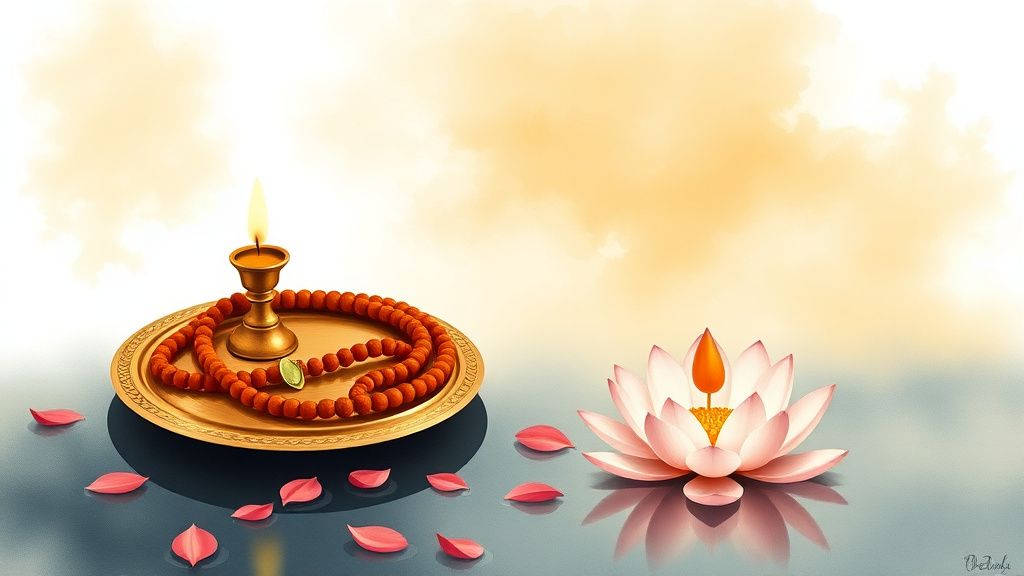
What Is Japa Meditation Mantra Japa meditation represents one of the most accessible yet profoundly transformative spiritual practices in Hindu tradition, involving the systematic repetition of a sacred mantra – a divine name, sound, or phrase – either vocally, whispered, or mentally, typically counted using a mala (prayer beads) to maintain focus and track progress toward the traditional goal of 108 or multiples thereof.
The Sanskrit term japa derives from the root jap meaning “to utter in a low voice” or “to repeat muttering,” suggesting the gentle, sustained, meditative quality distinguishing this practice from loud proclamation or casual speaking. For practitioners in 2025 seeking meditation approaches that combine structure with spiritual depth, require no special abilities or circumstances, and produce tangible progress through measurable repetition, understanding and practicing Japa offers invaluable methodology – accessible enough for complete beginners yet sophisticated enough to occupy serious practitioners throughout lifetimes, creating the concentrated devotion and mental purification essential for spiritual realization while providing immediate benefits of reduced anxiety, enhanced focus, and the deep peace arising when consciousness aligns repeatedly with sacred vibration.
Understanding Japa: The Practice of Repetition
Before learning specific techniques, establishing clear understanding of what Japa is, why repetition proves spiritually powerful, and how the practice works proves essential for approaching meditation with proper context.
What Is Japa?
Japa constitutes the methodical repetition of a mantra – a sacred sound, word, or phrase – with the intention of purifying consciousness, developing concentration, and establishing communion with the divine reality the mantra represents or invokes. The practice involves choosing a specific mantra, then repeating it continuously for a set duration or number of repetitions (traditionally 108, 1,080, or larger multiples), using prayer beads (mala) to count while maintaining focused attention.
The essential components:
- A mantra – the sacred sound being repeated (Om, deity names like “Om Namah Shivaya,” or guru-given personal mantras)
- Repetition – sustained continuous recitation creating momentum and depth
- Counting – using mala beads or mental tracking to maintain structure
- Attention – bringing complete focus to the sound, meaning, and divine presence
- Duration/quantity – establishing minimum commitment (time or number) supporting consistency
Unlike casual repetition or affirmations, Japa involves sacred sounds specifically, carrying vibrational and symbolic power beyond ordinary language. The mantras used in Japa have been refined through centuries, selected for their spiritual efficacy rather than semantic meaning alone.
Why Repetition Works
The spiritual power of repetition might seem counterintuitive to modern minds valuing novelty and variety, but traditional teaching recognizes several mechanisms through which sustained mantra repetition produces transformation:
Concentration development: Returning attention repeatedly to the same sound trains the capacity for sustained focus – the mental muscle essential for meditation deepening beyond surface distraction.
Subconscious impression: Like water wearing away stone through constant flow rather than single impact, repeated mantra gradually rewrites deep mental patterns, replacing habitual negative thoughts with sacred vibration.
Vibrational alignment: Each mantra carries specific energetic quality. Sustained repetition allows your consciousness to resonate with and embody that quality – chanting “Om Namah Shivaya” (salutations to Shiva) progressively aligns you with Shiva’s consciousness.
Mind purification: Continuous sacred sound crowds out the usual mental chatter – worries, plans, judgments, and distractions – creating space for deeper awareness to emerge.
Divine connection: Traditional teaching holds that deities and divine consciousness respond to sincere invocation. Sustained Japa creates the conditions for grace to flow and direct experience of the sacred to occur.
Neurological rewiring: Modern neuroscience confirms that repetitive practices create new neural pathways, literally restructuring the brain toward the states practiced – calm, devotion, focused awareness.
The Progression: Vaikhari to Ajapa
Traditional texts describe four stages or types of Japa representing progressive refinement:
1. Vaikhari Japa (Audible/Loud): The mantra is chanted aloud so others nearby can hear. This represents the beginning stage – easiest to maintain because the external sound provides clear anchor preventing mental drift. The vocal vibration also cleanses the environment and one’s energy field.
2. Upamshu Japa (Whispered/Soft): The mantra is whispered or murmured – audible only to you, with lips moving but minimal sound. This intermediate stage requires more concentration than loud chanting while the subtle movement of lips and tongue still provides physical anchor. Traditional teaching states Upamshu proves ten times more powerful than Vaikhari.
3. Manasika Japa (Mental/Silent): The mantra repeats purely mentally without any sound or lip movement – completely internal practice. This advanced stage demands strong concentration as no external anchor exists, but operates at subtler consciousness levels. Tradition considers Manasika 100 times more powerful than Upamshu.
4. Ajapa Japa (Effortless/Spontaneous): The ultimate stage where mantra repetition continues spontaneously without conscious effort or counting – the mantra has become so deeply established that it flows continuously like one’s heartbeat, often synchronized with breath. This represents complete internalization where the sacred sound becomes your natural state of consciousness.
Most practitioners progress through these stages, beginning with vocal practice then gradually incorporating whispered and mental repetition as concentration capacity develops.
The Japa Mala: Sacred Prayer Beads
The traditional tool for Japa practice is the mala – a string of 108 beads (plus one larger “guru” or “meru” bead) used to count repetitions while providing tactile anchor supporting sustained practice.
Understanding the Mala Structure
108 beads: The number holds sacred significance across traditions – representing the 108 Upanishads, 108 sacred sites, the 108 names of deities, and various cosmological calculations. Practically, 108 provides sufficient repetitions for meaningful practice while remaining achievable in single session.
Guru/Meru bead: The 109th bead, typically larger or distinctively marked, marks the starting and ending point. This bead represents your spiritual teacher or the divine itself and should never be crossed during counting – when reaching it after 108 repetitions, you reverse direction if continuing rather than crossing over.
Materials: Traditional malas use materials carrying specific properties:
- Rudraksha seeds – associated with Shiva, supporting concentration and calm
- Tulsi (holy basil) wood – associated with Vishnu/Krishna, supporting devotion
- Sandalwood – cooling, calming properties
- Gemstones – various stones for specific purposes (rose quartz for love, amethyst for spiritual awareness, etc.)
- Crystal – amplifying and clarifying
The tassel: The decorative thread extending from the guru bead symbolizes the connection between individual practitioner and the lineage of spiritual teachers, representing the flow of grace and wisdom.
How to Hold and Use the Mala What Is Japa Meditation Mantra
Proper technique ensures the practice remains meditative rather than mechanical:
Hand position: Hold the mala in the right hand (left hand holds significance in different traditions but right proves most common). Let it drape over the middle or ring finger, with the guru bead hanging toward you.
Moving beads: Use the thumb to pull each bead toward you (symbolizing drawing the divine toward yourself) while the middle finger supports from below. The index finger should not touch the beads – traditional teaching holds this finger represents ego/individual will which should be transcended in spiritual practice.
One bead, one mantra: Chant the mantra once, then move one bead. Complete the mantra fully before moving to the next bead – don’t rush ahead or fall behind. The bead movement provides rhythm and physical engagement supporting sustained attention.
Completing rounds: When you complete 108 repetitions, you’ll return to the guru bead. If continuing additional rounds, reverse direction without crossing the guru bead – this honors its sacred significance while creating brief pause preventing mindless mechanical continuation.
Eyes: Practice with eyes closed or partially closed with soft downward gaze. This supports inward focus while the mala beads provide tactile orientation preventing complete spatial disorientation.
Choosing Your Mantra
The mantra selected for Japa practice significantly affects both the experience and the spiritual direction of practice.
Types of Mantras
Bija (Seed) Mantras: Single-syllable sounds like “Om,” “Aim,” “Hrim,” “Shrim” – concentrated energetic formulas producing specific effects. These work primarily through vibrational quality rather than semantic meaning.
Deity Mantras: Names or phrases invoking specific deities:
- Om Namah Shivaya – Salutations to Shiva
- Om Namo Narayanaya – Salutations to Vishnu/Narayana
- Hare Krishna Hare Rama – Invoking Krishna and Rama
- Om Sri Mahalakshmyai Namaha – Honoring Lakshmi
Guru Mantras: Personal mantras given by one’s spiritual teacher during formal initiation, selected specifically for the individual student based on their nature and needs.
Saguna vs. Nirguna: Mantras with form (saguna) invoke specific deity qualities and personalities. Mantras without form (nirguna) like simple “Om” point toward the formless absolute beyond personal attributes.
Selecting Your Mantra
Traditional path: In formal spiritual traditions, the guru assigns a personal mantra during initiation (dīkṣā). This mantra, kept private, serves as the primary practice throughout life. The guru’s wisdom in selection ensures appropriateness for the student’s temperament and path.
Self-selection: For those without guru relationships, choose a mantra that genuinely resonates:
Research mantras’ meanings and associated qualities. If seeking peace, mantras like “Om Shanti” or “Om Namah Shivaya” suit. For devotion and love, Krishna mantras or “Om Namo Bhagavate Vasudevaya.”
Experiment briefly with candidates, noticing which creates natural attraction and feels comfortable for sustained repetition.
Once selected, commit fully rather than constantly changing. Depth develops through sustained practice with one mantra, like digging one deep well rather than many shallow holes.
Universal recommendations: “Om” serves as universal mantra suitable for anyone regardless of tradition or belief. The Gayatri Mantra, while traditionally requiring initiation, is sometimes practiced after studying its meaning. “So-Ham” (“I am That”) coordinates naturally with breath.
Step-by-Step Japa Practice
Once you’ve selected your mantra and obtained a mala, the actual practice follows clear systematic steps.
Preparation (5 minutes)
Physical preparation:
Sit in comfortable meditation posture – cross-legged on floor, kneeling on bench, or in chair with spine naturally erect and unsupported. You’ll maintain this position for extended time, so comfort proves essential.
Place the mala where you can easily pick it up, or hold it in your right hand already positioned correctly.
Mental preparation:
Take several deep breaths, allowing the body to settle and mind to shift from activity into meditative receptivity.
Set clear intention – perhaps “I practice Japa to purify my mind and connect with the divine” or “May this practice benefit all beings.”
Some practitioners begin with brief invocation – a prayer to their chosen deity, the guru, or simply expressing gratitude for the opportunity to practice.
Beginning the Practice (First Round – 108 Repetitions)
Starting position: Hold the mala with the guru bead in starting position. The first regular bead next to the guru bead is where you’ll begin counting.
First mantra: Take a centering breath, then chant your mantra for the first time – either aloud, whispered, or mentally depending on your practice level and circumstances.
Moving to next bead: Complete the mantra fully, then use your thumb to pull the first bead toward you, moving to the second position.
Establishing rhythm: Chant the mantra again, pull the next bead, and continue establishing steady rhythm. Don’t rush – quality matters far more than speed. Each mantra should receive your complete attention.
Maintaining focus: Your attention should encompass several dimensions simultaneously:
- The sound of the mantra (hearing it clearly whether vocal or mental)
- The meaning (remembering what the mantra represents)
- The feeling/devotion (connecting emotionally with the divine)
- The tactile sensation (feeling each bead move)
- The breath (allowing natural breathing, perhaps coordinating with mantra rhythm)
Handling distractions: When attention wanders into thoughts – which happens constantly – gently return to the mantra without frustration. The return itself constitutes practice. Continue the bead you’re on, completing the mantra before moving to the next.
Continuing Through 108 Repetitions
Middle phase: As you progress through the mala, various experiences may arise:
The mantra might flow easily, creating pleasant meditative state. Enjoy this while maintaining attention rather than spacing out.
Boredom or restlessness may emerge. Continue steadily – these represent mental purification occurring as deeper conditioning surfaces.
Deep devotion or emotional release might occur. Allow whatever arises while maintaining the practice structure.
Approaching the guru bead: As you near completion of 108, you’ll recognize returning to the guru bead. Complete the final regular bead’s mantra.
Completing first round: When you return to the guru bead after 108 repetitions, pause. Don’t automatically continue – this moment provides natural break for integration.
Continuing Additional Rounds
Integration pause: Sit quietly for 30-60 seconds, allowing the effects of the first round to settle. Notice the quality of consciousness, any shifts in energy or awareness.
Deciding continuation: Many practitioners commit to multiple malas daily – perhaps 2-5 rounds. Others do a single round. Honor your commitment.
Reversing direction: If continuing, reverse the mala without crossing the guru bead – begin the next round moving in the opposite direction along the same beads. This maintains the guru bead’s sacred status while creating brief pause preventing mechanical unconscious continuation.
Subsequent rounds: Continue with the same technique, structure, and attention. Later rounds often feel different – sometimes deeper, sometimes more challenging. Both prove valuable.
Closing the Practice (5 minutes)
After completing your committed rounds:
Final integration: Sit in complete silence for several minutes without the mala or mantra. Notice:
- The quality of mental quiet and stillness
- The subtle continuation of mantra vibration even without active repetition
- Any sense of peace, clarity, or connection
- The state of your body and breath
Gratitude: Mentally express thanks – to the deity, the guru, the tradition, or simply for the opportunity to practice.
Dedication: Traditional practice includes dedicating the merit of practice – “May whatever benefit this creates serve the liberation of all beings.”
Gentle transition: Take several deep breaths, slowly move fingers and toes, and gently open eyes when ready. Allow gradual return to activity rather than rushing immediately back into external demands.
Advanced Practices and Variations
Once basic Japa is established, several refinements and variations deepen the practice.
Likhita Japa (Written Mantra)
Likhita Japa involves writing the mantra repeatedly in a dedicated notebook while mentally repeating it simultaneously. This engages multiple faculties – hand movement, visual perception, and mental repetition – creating particularly concentrated practice.
Method: Choose a notebook exclusively for this purpose. Write the mantra carefully, one complete repetition per line, filling pages. Track progress by pages or lines completed. Some practitioners aim for specific large numbers – 10,000, 100,000, or more written repetitions over months or years.
Benefits: The physical activity prevents drowsiness; visual engagement supports focus; the written record provides tangible evidence of accumulated practice; and the slower pace compared to vocal Japa allows very deep contemplation of meaning.
Panchakshari/Shadakshari Japa
Certain mantras have specific syllable counts carrying particular significance:
Panchakshari (five syllables): “Om Namah Shivaya” – five-syllable mantra sacred to Shiva
Shadakshari (six syllables): “Om Mani Padme Hum” – six-syllable mantra in Buddhism
These structured mantras naturally create rhythm and completeness, with each syllable associated with specific meanings and energetic effects.
Breath-Coordinated Japa
Coordinate mantra repetition precisely with breathing:
So-Ham: Natural breath mantra – “So” on inhalation, “Ham” on exhalation. This can continue throughout the day, not requiring formal session.
Longer mantras: Break multi-syllable mantras across breath cycles – perhaps first half on inhale, second half on exhale, or one complete mantra per breath cycle if brief.
Benefits: The breath anchor makes wandering more obvious while the coordination creates meditative state naturally. However, ensure breath remains natural rather than forced to match mantra speed.
Japa with Visualization
Combine mantra repetition with mental imagery:
While chanting deity mantras, visualize the deity’s form – perhaps Krishna with flute, Shiva in meditation, or Divine Mother in blessing posture.
Visualize the mantra as light or energy – perhaps seeing “Om” written in light at the third eye center, pulsing with each repetition.
Imagine the mantra’s vibration radiating outward in all directions, blessing all beings it touches.
Benefits of Regular Japa Practice
Sustained Japa practice produces comprehensive benefits across multiple dimensions of human experience.
Mental and Emotional Benefits
Enhanced concentration: The sustained focus required develops general attention capacity transferring to work, study, and all activities requiring mental discipline.
Reduced anxiety: The repetitive sacred sound calms the nervous system, reducing rumination and worry while increasing sense of peace and trust.
Emotional regulation: Regular practice creates space between stimulus and response, allowing conscious choice rather than automatic reaction.
Mental clarity: The purification of thought patterns reduces mental fog and confusion, supporting clearer perception and better decision-making.
Improved sleep: Evening Japa quiets mental chatter interfering with rest, leading to faster sleep onset and better quality.
Spiritual Benefits
Divine connection: Sincere repetition of sacred names creates the conditions for direct experience of the divine presence being invoked.
Devotion development: The practice naturally cultivates bhakti (devotion) – the heart opening toward love of the divine.
Karmic purification: Traditional teaching holds that mantra repetition burns away karmic seeds, releasing past conditioning enabling freer future.
Grace attraction: Sustained sincere Japa invokes divine grace – the blessing and support of the reality toward which practice directs attention.
Progress toward realization: Ultimately, Japa can lead to direct recognition of one’s essential nature – the realization that individual consciousness and the divine consciousness invoked through mantra are fundamentally one.
Physical Benefits
Stress reduction: The meditative state activates parasympathetic nervous system, reducing cortisol and stress-related health impacts.
Blood pressure regulation: Studies show mantra meditation helps normalize blood pressure in hypertensive individuals.
Immune function: Regular meditation practices including Japa enhance immune response and overall physiological resilience.
Pain management: The altered consciousness accessed through sustained Japa increases pain tolerance and reduces chronic pain perception.
Frequently Asked Questions
How many repetitions should I do daily?
Traditional minimum: 108 (one mala). Many practitioners commit to 2-3 malas (216-324) daily. Serious aspirants might practice 10 malas (1,080) or more. Begin with what feels sustainable – even one mala (about 10-15 minutes) provides significant benefit if done consistently. Quality and consistency matter more than quantity.
Can I do Japa while doing other activities?
Mental Japa (Manasika) can accompany many activities – walking, household chores, even driving once well-established. However, optimal benefit comes from dedicated practice time with full attention. Use informal Japa throughout the day as supplement, not replacement, for focused sessions.
What if I lose count or get distracted?
Completely normal, especially initially. If you lose track of where you are on the mala, simply continue from the next bead – the exact number matters less than sustained attention. When distracted by thoughts, gently return to mantra and bead counting. The practice involves endless gentle returns rather than never wandering.
Do I need a guru to receive a mantra?
Traditional path involves guru giving personal mantra during initiation. However, many people practice effectively with self-selected mantras like Om, deity names, or other sacred sounds. A guru-given mantra carries particular power through the lineage and personalization, but sincere practice with any authentic mantra produces benefit. If you have access to a qualified teacher, guidance proves valuable.
Should I practice the same mantra always or can I change?
Generally, commit to one mantra for extended periods (months or years) allowing depth to develop. Constantly changing prevents the deep establishment necessary for transformation. However, life stages or spiritual development might naturally call for different mantras. Major changes (perhaps consulting a teacher) are appropriate; frequent casual switching undermines practice.
How is Japa different from affirmations?
Key differences: Japa uses sacred sounds/mantras with specific vibrational and spiritual properties, not ordinary language. Japa aims toward spiritual realization and divine connection, not merely personal improvement. The practice involves sustained repetition creating altered consciousness states, not brief positive thinking. Traditional mantras carry power from centuries of use by realized beings, unlike modern affirmations.
Can I practice Japa from different traditions?
Yes, though some teachers recommend choosing one primary tradition maintaining consistency and depth rather than mixing indiscriminately. You might practice Hindu mantras one period, Buddhist mantras another, or combine them consciously. However, during single session, stick with one mantra rather than switching partway through. Respect each tradition’s integrity while recognizing universal spiritual principles underlying various forms.
What if I don’t believe in the deity my mantra invokes?
The mantras work through vibration and focus regardless of theological belief. You can practice deity mantras appreciating them as representations of divine qualities (Shiva as consciousness, Lakshmi as abundance) without literal belief in personal gods. Alternatively, choose mantras like Om that point toward formless absolute. However, if specific deity feels incompatible with your worldview, select a different mantra you can practice sincerely.
Conclusion
Japa meditation – the systematic repetition of sacred mantras using prayer beads to count – represents one of the most accessible yet profoundly transformative practices in spiritual tradition, offering modern practitioners a clear, structured methodology for developing the sustained concentration, mental purification, and divine connection essential for spiritual growth while requiring no special abilities, circumstances, or even prior meditative experience beyond willingness to sit regularly and repeat sacred sound with sincere attention. Through the simple yet powerful practice of chanting a chosen mantra 108 times (or multiples thereof) while moving through prayer beads, practitioners engage in a technique refined over millennia that simultaneously occupies the hands, voice, and mind in unified activity naturally conducive to meditative absorption.
The essential wisdom involves recognizing that Japa’s power derives not from mechanical repetition but from the combination of sacred sound, sustained attention, devotional feeling, and consistent daily practice creating the conditions for consciousness to align with and ultimately recognize itself as the divine reality the mantra represents or invokes. Whether beginning with simple vocal repetition gradually progressing toward whispered and mental Japa, or eventually reaching the spontaneous effortless repetition characteristic of Ajapa Japa, the practice offers a complete path from beginning meditation to advanced spiritual realization through the ancient methodology of allowing sacred vibration to progressively purify and transform consciousness.
For practitioners in 2025 seeking meditation approaches combining accessibility with depth, structure with spiritual richness, and measurable progress through countable repetitions, dedicating oneself to regular Japa practice offers invaluable vehicle – simple enough to begin immediately yet profound enough to sustain practice throughout lifetimes, providing both the immediate benefits of reduced anxiety and enhanced focus alongside the ultimate possibility of using sacred sound as vehicle for recognizing one’s essential nature as identical with the divine consciousness toward which every mantra ultimately points.
About the Author
Rajiv Anand – Spiritual Guide & Blogger
A dedicated spiritual teacher and author, Rajiv Anand has over 15 years of experience in Vedic teachings, yoga, and meditation. He writes about holistic living, Hindu spirituality, and self-awareness, guiding people on how to integrate Hindu principles into daily life. His expertise includes meditation and mindfulness in Hinduism, Bhakti, Jnana, and Karma Yoga practices, Hindu rituals and their spiritual significance, and Ayurveda and natural healing. Notable books include Vedic Wisdom for the Modern Mind and Meditation in Hinduism: A Path to Enlightenment. Rajiv conducts workshops on meditation, holistic healing, and spiritual well-being, emphasizing the practical application of Hindu teachings in the modern world.
