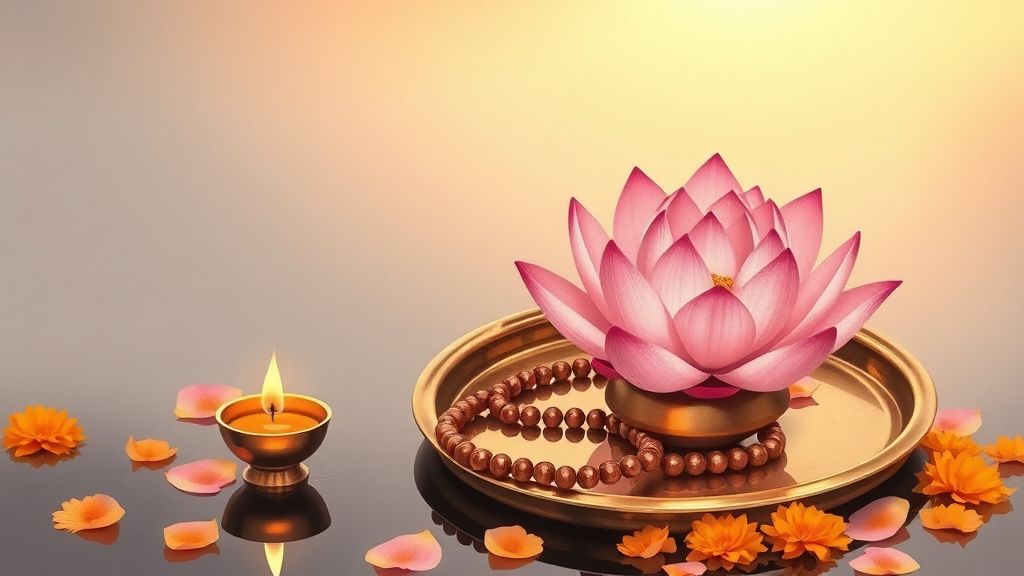
The Durga Chalisa is a 40-verse devotional poem to the goddess Durga, traditionally attributed to a composer named Devidas, of whom little is reliably known beyond the name. The text follows the standard chalisa structure (an opening doha, 40 chaupais, and a closing doha) in Awadhi-Hindi. It praises Durga in her nine forms (the Navadurga), recalls her victories over the asuras Mahishasura, Shumbha and Nishumbha, and ends with the standard chalisa phalashruti. Full recitation takes around 8 to 10 minutes. The principal recitation occasions are Navaratri (twice a year), Tuesdays and Fridays, and the eighth (Ashtami) and ninth (Navami) lunar days of each fortnight in observant Shakta households.
Who Durga is
Durga is the goddess of victory over evil, the principal form of Shakti in the Smarta and Vaishnava-Shakta traditions. Her canonical scriptural source is the Devi Mahatmya (the Durga Saptashati or Chandi Path), 700 verses embedded in the Markandeya Purana. The text narrates her manifestation from the combined energies of the gods to defeat asuras whom the male deities could not slay; her principal feat is the killing of Mahishasura, the buffalo-demon, which gives her the name Mahishasura-mardini. The standard iconography shows her with eight, ten or eighteen arms, riding a lion or tiger, holding weapons received from each of the gods, with her trident piercing Mahishasura’s chest.
The Navadurga, the nine forms of Durga worshipped sequentially during the nine nights of Navaratri, are: Shailaputri (daughter of the mountain), Brahmacharini (the ascetic), Chandraghanta (bell-mooned), Kushmanda (the egg-bearer), Skandamata (mother of Skanda), Katyayani (daughter of Katyayana), Kalaratri (the dark night), Mahagauri (the great fair one), and Siddhidatri (the giver of perfection). Each Navaratri night is dedicated to one form. The Durga Chalisa is recited across all nine nights, sometimes with the chalisa for the specific form added on the corresponding day.
The opening and structure
The opening line: Namo Namo Durge Sukh Karani / Namo Namo Ambe Dukh Harani. (“Salutations, salutations to Durga, giver of happiness; salutations, salutations to Mother, remover of sorrow.”) This couplet establishes the two principal functions invoked: the giving of well-being and the removal of difficulty. Both are repeated through the chalisa.
The 40 chaupais move through:
- Verses 1-10: Durga’s appearance, the lion mount, the eight arms holding the weapons of the gods, the radiance of her form.
- Verses 11-20: the slaying of Mahishasura, the Shumbha-Nishumbha episode, the manifestation of Kali from her forehead during the battle.
- Verses 21-30: the Navadurga forms, the temples and pilgrimage sites associated with her, the protection she gives.
- Verses 31-40: the petition for grace, the standard phalashruti, the request that she remain in the devotee’s heart.
Several specific lines are widely quoted: Tu Sadhik Sant Ki Sahay Karani (“You are the helper of practitioners and saints”), Asur Sanhar Karahu Devi Tum (“You destroy demons, O Devi”), and the standard closing benediction asking for protection at home, on travel, and in difficulty.
The Devidas attribution
The traditional attribution to Devidas is universally accepted in devotional practice but historically thin. The name “Devidas” (servant of the goddess) functions as much as a pen name or devotional signature as a verifiable historical identity. No detailed biography of this Devidas exists in the way that the lives of Tulsidas and Surdas are documented. The text was likely composed in the post-Tulsidas chalisa-genre period, somewhere between the 17th and 19th centuries, by a devotee working within the established template. The lack of certain authorship does not affect the devotional standing of the text.
Where Durga is worshipped
The principal Durga temples and Shakti Peethas:
- Vaishno Devi (Jammu and Kashmir): the cave shrine in the Trikuta hills, dedicated to the three forms of the goddess (Mahakali, Mahalakshmi, Mahasaraswati). One of the most visited Devi pilgrimage sites in north India.
- Kamakhya (Guwahati, Assam): the supreme Shakti Peetha, where Sati’s yoni is said to have fallen.
- Vindhyachal (Uttar Pradesh): the temple of Vindhyavasini, the form of Durga in the Vindhya range.
- Jwalamukhi (Himachal Pradesh): one of the 51 Shakti Peethas, where natural gas flames are worshipped as the goddess.
- Karnaprayag, Naina Devi, Chamunda Devi: other principal north Indian Devi pilgrimage sites.
- Mookambika (Kollur, Karnataka): the principal Devi temple of coastal Karnataka.
- Kanaka Durga (Vijayawada, Andhra Pradesh): a major Telugu Devi temple, with continuous worship.
The autumn Navaratri (Sharad Navaratri), falling in the lunar month of Ashvin (September-October), is the principal Durga festival across India. The spring Navaratri (Vasant Navaratri), in the month of Chaitra (March-April), is the secondary observance. The Bengali Durga Puja, in the autumn Navaratri, is the most elaborate regional celebration, with public pandals housing temporarily installed Durga images.
Standard chanting rules
- Bath: before recitation, particularly for morning recitation. Clean clothes; red is conventionally preferred for Devi observance.
- Direction: facing east or north.
- The lamp: two oil lamps lit before the Durga image, conventionally one with ghee and one with sesame oil.
- The mala: for those who chant the chalisa multiple times in a single session, a 108-bead mala is used to count repetitions. The mala for Durga is conventionally sandalwood or red coral.
- The seat: a clean mat, fixed seat, not on a bed or directly on the floor.
- Uninterrupted reading: the chalisa is read from start to finish without breaks for conversation or other activity.
For what it’s worth, the most useful initial commitment for new practitioners is one daily recitation of the Durga Chalisa for the nine nights of Navaratri, twice a year. This pattern, sustained across years, provides the rhythm without the burden of daily commitment outside the festival periods. Practitioners drawn to deeper Shakta practice typically add Tuesdays and Fridays, then daily recitation, then move to the longer Devi Mahatmya for festival days.
The Chalisa and the Devi Mahatmya
The Devi Mahatmya is the canonical 700-verse Shakta text; the Durga Chalisa is a compressed 40-verse vernacular devotional poem that draws on its imagery. The Mahatmya takes around 90 minutes to recite; the chalisa takes around 10. Practitioners typically use the chalisa for daily commitment and the Mahatmya for festival days, particularly the Ashtami and Navami of Navaratri. The Bengali tradition prefers the full Chandi Path on Mahashtami; north Indian Smarta and Vaishnava households more commonly use the chalisa supplemented by the Saptashati’s first chapter.
Common questions
Should men and women recite differently?
No textual rule distinguishes recitation by gender. The Durga Chalisa is widely recited by men and women in household practice; women are traditionally the principal reciters in many north Indian families. Some lineages observe that women in menstruation suspend formal seated recitation; this is a household custom rather than a rule of the text.
Is fasting required during recitation periods?
During Navaratri, partial or full fasting (avoiding grains, salt, certain vegetables) is widely observed in households that recite the chalisa across the nine days. Fasting is the household devotional convention; it is not strictly required by the chalisa text. Practitioners with health considerations or work demands often modify the fasting while maintaining the recitation.
Can the chalisa be sung rather than recited?
Yes. The chalisa lends itself to musical rendering, and several recorded versions are widely circulated. Sung recitation is conventional in group settings, particularly during Navaratri jagran (all-night worship). Solo recitation more commonly uses a spoken or chanted rhythm rather than a tune. The choice depends on context and is not regulated by the text.
One thing this article does not claim
Specific outcomes attached to specific repetition counts (101, 108, 1001 recitations bringing specific results) are part of the popular devotional discourse around the chalisa but are not in the text itself. The chalisa’s phalashruti speaks in general terms of grace, protection and freedom from sorrow. Online claims attaching specific counts to specific outcomes (career success, marriage, childbirth, recovery from a named disease) are devotional overlays. Practitioners who chant for specific intentions are working within a valid devotional tradition; the article does not stand in for those specific claims.
For broader textual context, see the entries on Durga at Wikipedia and on the canonical Devi Mahatmya. The festival itself is covered at Navaratri.
