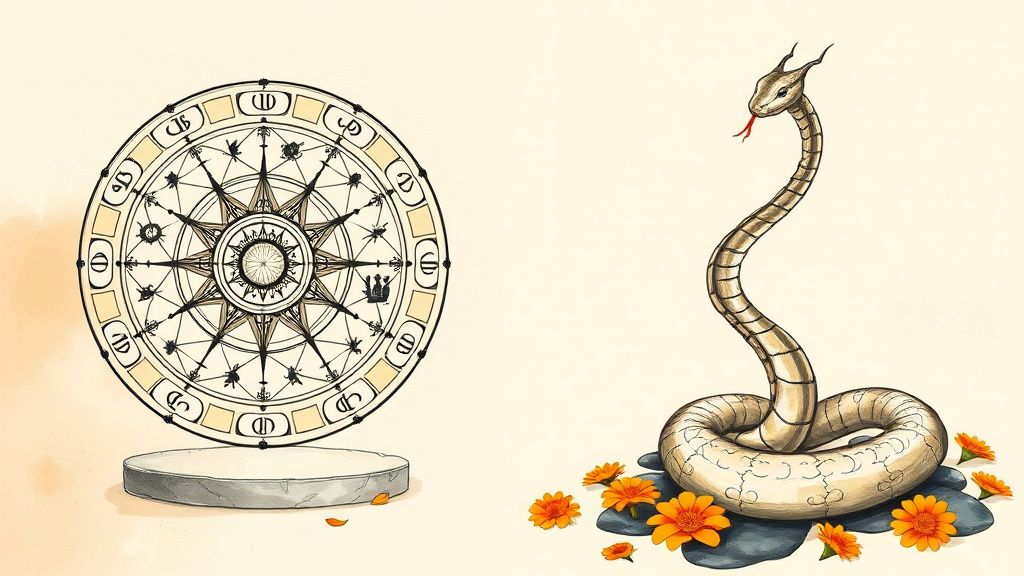
Ashlesha is the ninth of the 27 nakshatras, spanning 16°40′ to 30°00′ of Karka (Cancer). It is ruled by Mercury (Budha), with the Nagas (serpent deities) as presiding deities. Its symbol is the coiled serpent, the yoni is the male cat, and the gana is rakshasa. The four padas carry the syllables Di, Du, De, Do. The name ashlesha means “embrace” or “entwining,” and the classical Jyotisha reading centres on serpent-energy themes of kundalini, hypnotic charm, deep-change power, and the ability to constrict or release. Principal stars are Epsilon, Delta, Eta, Rho, and Sigma Hydrae in the constellation Hydra. The Tamil and Malayalam name is Ayilyam, and the nakshatra is the focal point of the Sarpa Dosha tradition in South India.
Key attributes at a glance
- Position: 16°40′ to 30°00′ Cancer.
- Ruling planet: Mercury.
- Presiding deity: Nagas (the serpent race led by Vasuki and Shesha).
- Symbol: Coiled serpent.
- Yoni (animal): Male cat (Marjara).
- Gana: Rakshasa.
- Varna: Mleccha (some sources).
- Pada syllables: Di, Du, De, Do.
- Classification: Tikshna/Daruna (sharp/intense), suitable for intense and assertive activities.
- Regional names: Ayilyam (Tamil and Malayalam).
Mythological background: the Nagas
The Nagas are the serpent race of Hindu mythology, often depicted with human upper bodies and serpent lower halves, occupying the netherworld of Patala. Their king is Vasuki (used as the rope in Samudra Manthana), and Shesha (Adishesha) supports Vishnu in cosmic sleep. The Mahabharata’s Astika Parva details the Nagas’ history. Nagas are double-natured: associated with hidden wisdom, immortality, and protection of treasure, but also with venom, deceit, and destructive power. Ashlesha inherits both polarities. Mercury’s lordship adds the dimension of communication, intelligence, and dual-natured expression typical of Buddha (Mercury).
Classical reading of personality
- Hypnotic presence: the serpent yoni and Naga deity combine in classical sources to produce a description of natives who can fix and hold attention.
- Penetrating intelligence: Mercury’s signature, given depth by the Naga association.
- Capacity for hidden work: classical Jyotisha frequently links Ashlesha natives to occupations involving secrets, codes, and strategy.
- Possessive intensity: the embrace symbol points to holding on tightly, sometimes to a fault.
- Reinvention capacity: the serpent’s symbolism of shedding skin maps to the native’s ability to reinvent identity through life crises.
For what it’s worth, Ashlesha is the nakshatra most often described in classical texts as carrying both significant gift and significant shadow. The gift is depth and persuasive intelligence; the shadow is tendency to hold and control.
Career associations in classical Jyotisha
- Psychology, psychoanalysis, hypnotherapy.
- Espionage, intelligence services, security.
- Research and investigative work.
- Surgery, especially intricate procedures.
- Toxicology, snake research, herpetology.
- Sales and negotiation requiring sustained persuasive engagement.
- Tantric practice and esoteric studies.
- Politics and diplomacy.
Pada-wise variations
- Pada 1 (16°40′-20°00′ Cancer, syllable Di): Sagittarius navamsa. Classical reading: philosophical bent, principled stance, dharma-orientation.
- Pada 2 (20°00′-23°20′ Cancer, syllable Du): Capricorn navamsa. Classical reading: discipline, structural thinking, slow consolidation.
- Pada 3 (23°20′-26°40′ Cancer, syllable De): Aquarius navamsa. Classical reading: unconventional approach, humanitarian leaning.
- Pada 4 (26°40′-30°00′ Cancer, syllable Do): Pisces navamsa. Classical reading: spiritual depth, intuition, mystical leanings. This is the Gandanta pada (junction between water and fire signs), classically requiring shanti rituals.
Sarpa Dosha and Ashlesha
Birth in Ashlesha or its adjacent Naga-related nakshatras is sometimes flagged as Sarpa Dosha, particularly in South Indian Jyotisha. The traditional remedy is Sarpa Samskara at Kukke Subramanya temple in Karnataka, Sarpa Pooja at Mannarasala Temple in Kerala, or Rahu-Ketu shanti at Tirunageshwaram and Thirupampuram in Tamil Nadu. The dosha reading depends on whether other chart factors (Rahu-Ketu placement, 5th and 9th house affliction) reinforce the Naga affliction; not every Ashlesha-born native is treated as carrying the dosha.
When Ashlesha is and isn’t used in muhurta
- Used for: destruction of enemies (in classical tantric muhurta), tantric initiation, breaking unfavourable contracts, snake-related rituals, beginning intense austerities.
- Avoided for: marriage (Ashlesha is in the Tikshna group), griha pravesh, child-naming, journey-start, conciliation activities. Most modern panchangs flag Ashlesha as a muhurta-restricted nakshatra for benevolent beginnings.
Common questions
Are Ashlesha natives doomed to negative outcomes?
No. Classical Jyotisha treats no nakshatra as deterministic. Ashlesha’s classification as Rakshasa-gana and its serpent symbolism flag it as an intense star, but many Ashlesha natives lead full, accomplished lives, especially in vocations that suit the depth-and-persuasion signature. The dosha-related remedies are precautionary; they are not a prediction of misfortune.
What is the Vimshottari Dasha at birth?
An Ashlesha-born child enters life in the Mercury Mahadasha (17 years total). Following Mercury, the sequence runs Ketu (7), Venus (20), Sun (6), Moon (10), Mars (7), Rahu (18), Jupiter (16), Saturn (19).
What is Gandanta and why does Ashlesha’s last pada have it?
Gandanta is the junction between a water sign and the following fire sign. The last 3°20′ of Ashlesha (Cancer, water) abuts the first 3°20′ of Magha (Leo, fire). Births in the Gandanta minutes are traditionally considered to require Gandanta shanti pooja, performed within 27 days of birth. The reading is that the child’s life force traverses an astrologically sensitive boundary at birth and benefits from ritual smoothing.
A limitation worth noting
Ashlesha’s classical readings about personality, dosha, and remedy are interpretive Jyotisha traditions, not empirically tested predictions. The Sarpa Dosha framework in particular is regional (South Indian) and depends heavily on broader chart factors. Modern users should consult a competent astrologer for a personalised reading rather than self-applying classical descriptions, and should treat any dosha verdict as an interpretive heuristic rather than a deterministic outcome.
Reference for the astronomical position: Ashlesha on Wikipedia.
