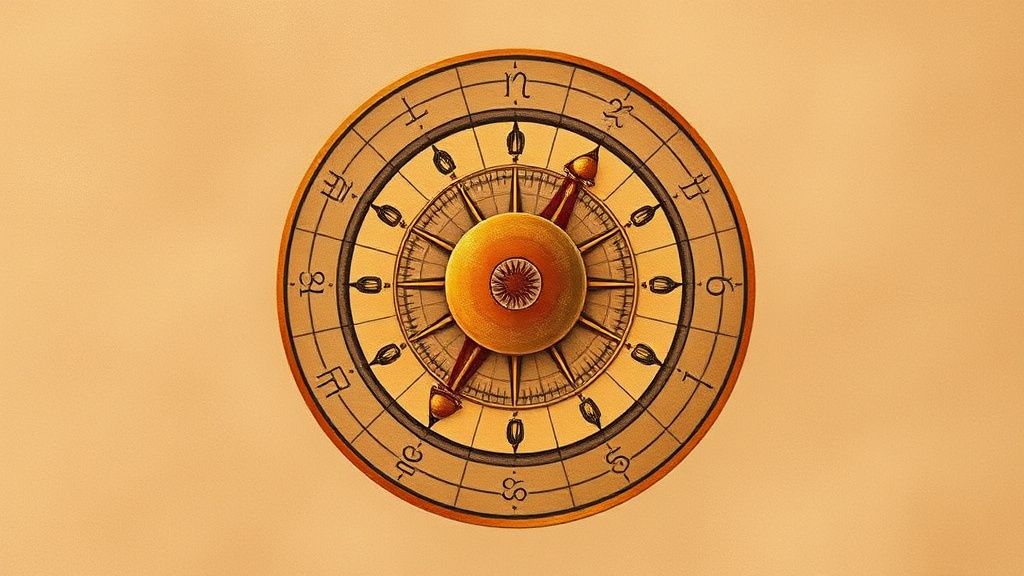
In the Hindu naming tradition, the first syllable of a child’s given name is selected from the Janma Nakshatra (birth star) and the specific pada (quarter) the Moon occupied at the moment of birth. Each of the 27 nakshatras spans 13°20′ of the ecliptic and divides into four padas of 3°20′ each; each pada has an assigned starting syllable. The system produces 108 possible starting sounds, matching the count of beads on a japa mala. The naming ceremony itself, Namakarana, is performed on the 11th or 12th day after birth, and the chosen name is announced first into the infant’s right ear.
How the syllable is selected
- Compute the Janma Kundli using the exact birth date, time, and place. Most families use the Lahiri ayanamsa.
- Identify the Moon’s longitude. The nakshatra and pada follow directly from that longitude.
- Look up the syllable assigned to that pada. Drikpanchang, Kalnirnay, and most software return this value automatically.
- Family elders and the officiating priest then propose names beginning with that syllable. The shortlisted name is finalised during the Namakarana ceremony.
Pada-syllable table for all 27 nakshatras
- 1. Ashwini (0°-13°20′ Aries): Chu, Che, Cho, La
- 2. Bharani (13°20′-26°40′ Aries): Li, Lu, Le, Lo
- 3. Krittika (26°40′ Aries-10° Taurus): A, I, U, E
- 4. Rohini (10°-23°20′ Taurus): O, Va, Vi, Vu
- 5. Mrigashira (23°20′ Taurus-6°40′ Gemini): Ve, Vo, Ka, Ki
- 6. Ardra (6°40′-20° Gemini): Ku, Gha, Ng, Chha
- 7. Punarvasu (20° Gemini-3°20′ Cancer): Ke, Ko, Ha, Hi
- 8. Pushya (3°20′-16°40′ Cancer): Hu, He, Ho, Da
- 9. Ashlesha (16°40′-30° Cancer): Di, Du, De, Do
- 10. Magha (0°-13°20′ Leo): Ma, Mi, Mu, Me
- 11. Purva Phalguni (13°20′-26°40′ Leo): Mo, Ta, Ti, Tu
- 12. Uttara Phalguni (26°40′ Leo-10° Virgo): Te, To, Pa, Pi
- 13. Hasta (10°-23°20′ Virgo): Pu, Sha, Na, Tha
- 14. Chitra (23°20′ Virgo-6°40′ Libra): Pe, Po, Ra, Ri
- 15. Swati (6°40′-20° Libra): Ru, Re, Ro, Ta
- 16. Vishakha (20° Libra-3°20′ Scorpio): Ti, Tu, Te, To
- 17. Anuradha (3°20′-16°40′ Scorpio): Na, Ni, Nu, Ne
- 18. Jyeshtha (16°40′-30° Scorpio): No, Ya, Yi, Yu
- 19. Mula (0°-13°20′ Sagittarius): Ye, Yo, Bha, Bhi
- 20. Purva Ashadha (13°20′-26°40′ Sagittarius): Bhu, Dha, Pha, Dha
- 21. Uttara Ashadha (26°40′ Sagittarius-10° Capricorn): Bhe, Bho, Ja, Ji
- 22. Shravana (10°-23°20′ Capricorn): Khi, Khu, Khe, Kho
- 23. Dhanishtha (23°20′ Capricorn-6°40′ Aquarius): Ga, Gi, Gu, Ge
- 24. Shatabhisha (6°40′-20° Aquarius): Go, Sa, Si, Su
- 25. Purva Bhadrapada (20° Aquarius-3°20′ Pisces): Se, So, Da, Di
- 26. Uttara Bhadrapada (3°20′-16°40′ Pisces): Du, Tha, Jha, Tra
- 27. Revati (16°40′-30° Pisces): De, Do, Cha, Chi
The Namakarana ceremony
Namakarana is the fifth of the sixteen Hindu samskaras as enumerated in the Manava Grihya Sutra and the Asvalayana Grihya Sutra. The conventional date is the 11th day after birth, though Saturday and Tuesday births are often deferred to the 12th day. The infant is bathed, a small homa is performed, and the chosen name is whispered three times into the right ear by the father or officiating priest. Two or three secondary names are often given alongside the nakshatra-syllable name: a family lineage name, a deity name, and the everyday calling name. The nakshatra-syllable name is the one used in formal rituals and horoscope generation.
Practical examples
- A child born when the Moon is at 8° Aries falls in the third pada of Ashwini. Permitted syllables: Cho. Names like Chodhari or Choodamani fit.
- A child born when the Moon is at 15° Taurus falls in the second pada of Rohini. Permitted syllable: Va. Names like Vasudha, Varun, Vamana fit.
- A child born when the Moon is at 6° Cancer falls in the first pada of Pushya. Permitted syllable: Hu. Names like Humayun-derived or Huma fit; this pada has fewer common Sanskritic names, so families often choose a slightly stretched fit like Hriday with a Hu-leaning pronunciation.
- A child born when the Moon is at 21° Pisces falls in the second pada of Revati. Permitted syllable: Do. Names like Dolan or extended forms work.
For what it’s worth, when the assigned syllable corresponds to a sparse set of conventional names, most families pick the closest acceptable Sanskritic name rather than a strained choice. Priests typically accept a small phonetic latitude (Hu accepting Hru, Da accepting Dha) provided the deity association of the name is suitable.
Regional variations
- Tamil tradition: the same pada-syllable mapping is followed but using Tamil phonetics. Pushya is called Poosam, Magha is called Magham, and the syllables are transliterated accordingly.
- Telugu tradition: Pushya is Pushyami, and the syllable list is identical. Telugu families also frequently combine the nakshatra syllable with a family deity name.
- Malayalam tradition (Kerala): the nakshatra is called Nakshatra or Natchathiram. The Namakarana is sometimes performed on the 28th day rather than the 11th, with the syllable rule unchanged.
- North Indian Hindi belt: Standard pada-syllable mapping is used, and Pandit Lala Ramswaroop’s Panchang is widely consulted for the syllable lookup.
Common questions
What if the family wants a name with a different syllable?
The two-name convention covers this. The nakshatra-syllable name is registered in the kundli and used in ritual contexts, while a second name beginning with whatever the family prefers becomes the everyday calling name. Many families list both in school records, with the syllable name as the formal first name and the chosen name as the middle.
How is the pada determined precisely?
Each pada spans exactly 3°20′ of ecliptic longitude. The Moon’s longitude at the birth moment, expressed in degrees from Mesha 0°, locates the pada when divided by 3°20′. For example, a Moon longitude of 25° (Aries) is 25 ÷ 3.333 = 7.5, meaning the second nakshatra (Bharani) and the second pada within it (Lu).
Is the nakshatra name used legally?
Not formally. Indian birth certificates record the parental choice without reference to nakshatra. The nakshatra-syllable name is a religious-cultural convention, observed within the family and at the priestly level, and is what gets used in subsequent kundli computations and marriage matching reports.
Can the rule be relaxed?
It often is, and not every Hindu family follows it. The system is an interpretive tradition codified across the dharmashastra grihya sutras and reflected in modern Panchangs. Families with strong jyotisha-following lineages are stricter; others use the syllable as a suggestion and choose freely.
A limitation worth noting
The nakshatra-syllable system is a classical interpretive convention from Vedic and grihya literature, not an empirically demonstrated determinant of a child’s character or fortune. Modern child-naming in Hindu families blends this convention with personal preference, deity dedication, family lineage, and contemporary aesthetic. The padas and syllables are mathematically exact given the birth time; the recommended life-impact claims are tradition-based and outside empirical evidence.
For the syllable lookup and exact pada calculation for a given date and time, see the comprehensive table at Nakshatra on Wikipedia. For ceremony scheduling reference Drik Panchang.