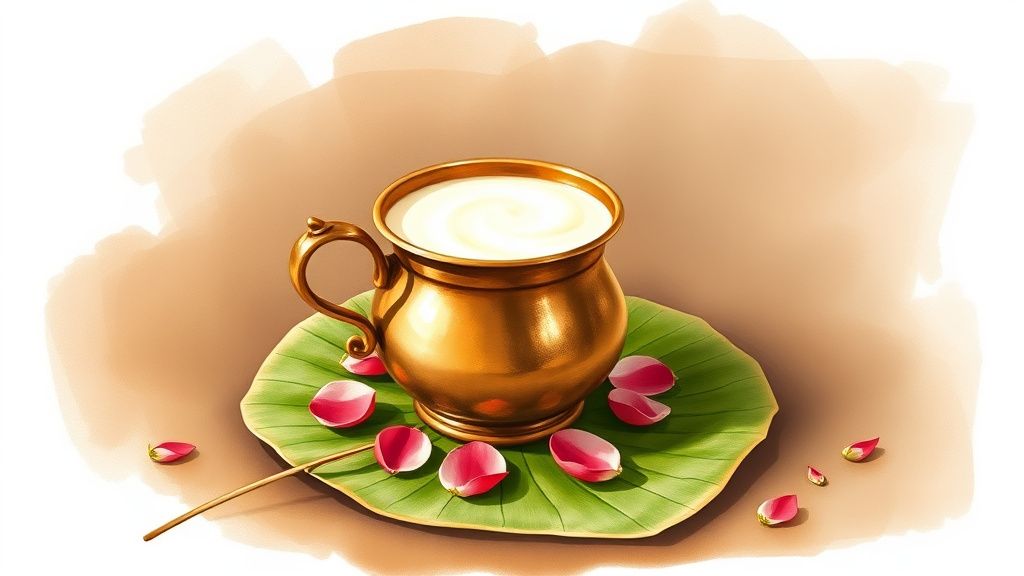
Receiving prasad in a dream is treated in Hindu dream-interpretation tradition (swapna shastra) as one of the more auspicious dream-symbols. The classical dream-interpretation texts (the Swapna Adhyaya of the Garuda Purana, the Brihat Samhita’s chapter on dreams, the Agni Purana’s section on omens) place food-as-offering dreams in the high-auspice category, particularly when the food is sweet, when it is received from a recognised figure (a deity, a priest, a guru), and when the dreamer consumes it. The dream is read as the deity’s anugraha (favour) reaching the dreamer at the subtle-body level. As with all dream interpretation in Hindu tradition, the reading is interpretive rather than predictive in the empirical sense; the framing is theological rather than scientific.
The classical interpretation
The Garuda Purana’s Swapna Adhyaya assigns dream-meanings on a layered set of factors:
- What is received: sweet prasad is the most auspicious; savoury prasad is also auspicious; spoiled or refused prasad has the opposite reading.
- From whom: from a recognised deity (Vishnu, Shiva, Devi, Hanuman, Ganesha) is the highest reading. From a priest in a recognised temple is the next. From an unknown figure with prasad-attributes (white clothes, sacred ash, sandal mark) is also auspicious.
- The dream-state: the prasad-receiving dream in the early morning hours (the brahma muhurta, roughly 4-6 am) carries higher weight than the same dream in the early night.
- The dreamer’s emotional state in the dream: peaceful, reverent receipt is auspicious; anxiety or refusal in the dream alters the reading.
- The consumption: eating the prasad in the dream completes the auspicious cycle. Receiving but not eating is partial.
The specific readings for different prasad types
- Laddu or sweet prasad: material prosperity, household auspiciousness, completion of a pending undertaking. Particularly associated with Ganesha and Hanuman in the dream-interpretation tradition.
- Kheer or milk-based prasad: emotional and family-relational prosperity, particularly associated with Krishna and Vishnu. The dream is read as the deity’s grace flowing into household relationships.
- Sundal or legume prasad: protection in the dreamer’s worldly affairs, particularly associated with Devi. The dream is read as the goddess’s shielding presence.
- Fruit prasad (banana, coconut, mango): the natural fruit dreams carry their own readings, with the prasad-context layering an additional blessing reading on top.
- Pongal or rice-based prasad: wealth and harvest associations, particularly tied to Lakshmi.
- Tirtha (holy water) along with prasad: purification of past karma; particularly auspicious in the dream-interpretation tradition.
When the dream reading is qualified
The classical texts qualify the reading in several ways:
- Refused prasad: if the dreamer refuses the offered prasad in the dream, the reading shifts to “blessing offered but not received”. The interpretation is that the dreamer is not currently in a receptive state.
- Spoiled prasad: dreaming of receiving prasad that is rotten or unfit shifts the reading to “the blessing is delayed by some obstacle”. The classical advice is to perform a small puja and reset the dreamer’s spiritual state.
- Prasad falling to the ground: the dream is read as a near-miss; the blessing came but was momentarily lost. The advice is to be attentive in waking life to opportunities that arrive.
- Sharing the prasad with others in the dream: the reading deepens; the blessing is amplified by being shared. The dream of distributing prasad to others is particularly auspicious.
- Prasad in the dream of someone close to the dreamer: the blessing is associated with the relationship; the dream is read as having a relational implication.
What the tradition advises after such a dream
The classical tradition does not require any specific action after an auspicious prasad dream, but the typical advice from family priests is:
- Wake, perform the morning ablutions, light a small lamp at the home shrine.
- Recite the day’s mantra or chapter (a verse from the Bhagavad Gita, or the family deity’s name 108 times).
- If possible, visit a temple later in the day, particularly the temple of the deity who appeared in the dream.
- Distribute a small prasad in the household; the physical act of distribution echoes the dream’s sharing principle.
- Avoid casual narration of the dream to many people before the morning sandhya is complete; the classical convention is to share the dream selectively.
For what it’s worth, the most defensible reading of a prasad dream is that it indicates a positive spiritual orientation in the dreamer’s current state. The classical tradition treats it as a confirmation rather than a prediction; the dream tells the dreamer about themselves, not about coming events.
Modern context: dreams of specific temples
A specific contemporary form of the prasad dream involves dreaming of a particular temple. Common variants:
- Tirumala laddu in the dream: often read as a call to visit Tirumala; many devotees take this as a sign to plan a pilgrimage.
- Sabarimala aravana payasam in the dream: traditionally read as a call to undertake the 41-day vratham and pilgrimage; particularly for first-time Ayyappa devotees.
- Puri Jagannath mahaprasad: read as a connection to Jagannath worship; some devotees plan a Puri visit following such dreams.
- Sai prasad from Shirdi: read as Sai Baba’s protective blessing; the dream is taken as a sign to maintain the Thursday Sai puja.
- A local temple’s prasad: often read as a call to visit a temple that has been neglected, particularly the family deity’s kuladaivam temple.
Common questions
Is the dream guaranteed to indicate something?
The classical tradition is interpretive, not predictive in any empirical sense. A prasad dream is read as a positive sign within the dream-interpretation framework, not as a guaranteed indicator of any specific future event. The reading is appropriate as religious interpretation; treating it as a forecast tool is outside the classical scope.
What if I dream of prasad but don’t recognise the deity or temple?
The general auspicious reading still applies. The classical interpretation does not require precise identification; the deity may appear in a generic form, and the prasad may be of an unfamiliar variety. The blessing reading depends on the receipt-and-consumption attitude of the dreamer rather than on the specific identification of the deity.
What about dreams of giving prasad to someone else?
The dream of giving prasad to another person is also auspicious in the classical reading, and is interpreted as the dreamer’s spiritual sharing capacity. The combined dream (the dreamer receives prasad from a deity and then distributes it to family or unknown figures) is read as the highest auspicious form; the blessing is received and shared in the same dream sequence.
Should the dream interpretation be taken literally?
The Hindu dream-interpretation tradition is layered and uses symbolic language. Specific predictions (a particular event on a particular day, a specific monetary outcome) are not supported by the classical texts. The general direction of the reading (the dreamer is in a positive spiritual state, the household has divine support) is the typical scope. Beyond this, individual interpretation by a family priest who knows the dreamer’s situation is the traditional way to refine the reading.
A limitation worth noting
Hindu dream interpretation is an interpretive tradition rather than an empirical claim about the future. The article describes classical readings from the Garuda Purana and related texts; these are religious-cultural readings, not predictions in the scientific sense. Modern psychology offers different frames for understanding dreams, and neither tradition contradicts the other when each is treated within its own scope. Treat the prasad-dream reading as a religious-cultural commentary on the dreamer’s spiritual state, not as a forecast of specific worldly events.
See the Wikipedia entry on the Garuda Purana and the broader entry on prasad.