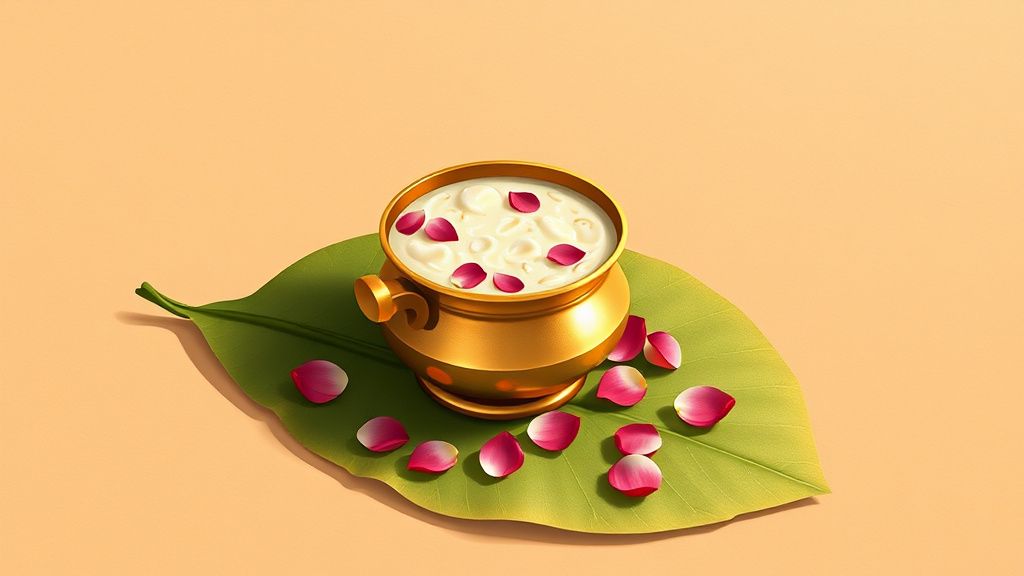
Distributing prasad has its own set of small but real rules in Hindu practice. The food, having been offered to the deity, returns as prasada (favour), and the manner of its handing-out matters as much as the manner of its preparation. The basic conventions: receive it in the right hand placed over the left, do not refuse offered prasad, treat the bare minimum quantity given as the full blessing, do not return half-eaten prasad to the common stock, and do not let it touch the floor. These rules are described in the Brahma Vaivarta Purana, the Padma Purana, and in the household ritual codes of the various Vaishnava and Shaiva traditions. The point is not formality for its own sake; it is treating the food’s character (the deity’s grace) consistently from the priest’s hand to the eater’s mouth.
The principal rules of receiving
- Right hand under, left hand below: the receiver holds the right hand palm-up, with the left hand cupped beneath it. The prasad is received into the right palm. The left hand supporting the right is the standard form.
- Bow slightly while receiving: a small head-bow accompanies the receipt, marking the offering attitude.
- Consume immediately or carry with respect: small portions (a few grains of rice, a small ladu, sugar crystals) are eaten on the spot. Larger portions may be carried home in a clean cloth or paper, but not in a casual pocket.
- Touch the prasad to the eyes or forehead before eating: a small namaskaram with the right hand carrying prasad, lifting it briefly toward the forehead, then bringing it to the mouth.
- Eat without distinction: the prasad is to be eaten regardless of personal dietary preference, with the understanding that it has been blessed and shared. Even a person who normally avoids sugar takes the prasad as offered.
The principal rules of giving
- Use the right hand: the giver dispenses prasad with the right hand. The left hand is used for support if needed but is not the dispensing hand.
- Do not use the same hand the prasad was sitting on: if the prasad is held in a vessel, a clean serving spoon is used. Bare-hand dispensing requires that the hands have been washed and have not touched contaminating surfaces.
- Pour onto the receiver’s right palm: the prasad is placed gently onto the receiver’s open right palm. The giver’s hand should not touch the receiver’s palm if avoidable.
- Equal distribution: all who present themselves receive prasad. Discrimination by caste, gender, or any other category is not permitted in the temple distribution. The classical and modern practice is uniform.
- Distribute systematically: in a small gathering, the eldest is served first; in a large gathering, distribution proceeds in order along the row of seated devotees.
- Do not refuse anyone: if a person presents themselves, they are given at least a small portion. Even children and infants receive a token quantity.
The handling of the prasad container
The container or plate from which prasad is distributed has its own etiquette:
- It should be a clean dedicated vessel, not a household everyday plate that has been used for other food.
- Banana leaf, silver, copper, brass and stainless steel are all standard. Plastic is increasingly used in volume distribution but is not the traditional choice.
- The vessel should be placed at a height that does not require devotees to bend awkwardly.
- The vessel should not be set on the floor during distribution. A small stand or a cloth-covered table is the standard arrangement.
- After distribution, the vessel is washed separately from regular household dishes, in the home shrine area if possible.
The quantity question
There is no minimum or maximum prescribed quantity for an individual portion of prasad. The classical convention is:
- A small quantity is sufficient: a few grains of rice, a small piece of fruit, a teaspoon of payasam, half a laddu. The portion size is symbolic; the consumption of any amount is the offering received.
- More for those who have travelled: pilgrims who have come from afar and may not return soon are given larger portions; locals who come daily receive smaller amounts. The convention is informal.
- Do not waste the dispensed quantity: once a portion has been placed in the receiver’s hand, it is to be consumed (or carried home) but not refused or left aside.
- Multiple visits: a devotee who completes multiple pradakshinas or visits multiple shrines in the temple receives prasad at each, with the cumulative quantity being whatever the day’s distribution produces.
For what it’s worth, the most overlooked element of prasad etiquette is the pause before eating. Most people receive the prasad and consume it within seconds. The pause, the brief lifting toward the forehead, the moment of acknowledgement, is the bit that transforms the act from snack-receipt to devotional receipt.
The home prasad distribution
At a household puja, prasad distribution has slightly different parameters from the temple version:
- The puja’s offering items (fruits, sweets, flowers) are touched by the priest or the host to the deity, then taken from the puja area to be distributed.
- The host, having performed the puja, distributes to family members first, then to guests, in order of age (eldest first), then by household role.
- Children present are given small portions and are taught the receiving etiquette during this domestic distribution.
- Some portions are kept aside to be taken to neighbours or relatives who could not attend; the typical custom is to send prasad to the close family circle that did not gather.
- If guests are non-Hindu, they are offered prasad as a courtesy; they may accept or politely decline. The convention is that prasad is offered to all present at a function regardless of religious background.
Common questions
What if I am fasting and cannot eat the prasad on the spot?
Receive the prasad with the standard etiquette, touch it briefly to the forehead, and carry it in a clean cloth or paper. Consume it after the fast ends, or share it with family who can consume it that day. Refusing the prasad outright is not the convention.
What if the prasad falls to the floor?
The dropped prasad is picked up, touched briefly to the forehead, and either consumed (if the receiver chooses) or placed at the base of a Tulsi plant or in flowing water rather than the trash. The classical convention does not treat the dropped prasad as polluted; the casual handling of it as ordinary spilled food is what is to be avoided.
Can prasad be given to animals?
Yes, particularly to cows, dogs, crows and ants, which Hindu tradition considers special recipients. The morning balidana (offering on the doorstep) often consists of prasad scraps for ants, crows and the household dog. The animals are held to be carrying the offering to the ancestors in some readings. Feeding prasad to animals is not considered disrespectful; it is considered an extension of the sharing principle.
Is it permitted to leave the temple without taking prasad?
It is not standard. The convention is that one stops at the prasad counter on the way out and receives at least a token portion. The act of receiving prasad is part of the temple visit’s closing sequence. Practical exceptions (the prasad has run out, the queue is too long) are routinely accommodated; deliberate avoidance is not the convention.
A limitation worth noting
Specific etiquette varies by region and by tradition. Tamil, Bengali, Maharashtrian, Punjabi and Gujarati conventions differ in detail: the precise gestures, the order of distribution, the role of the host versus the priest. The article describes the mainstream pan-Hindu conventions. For a specific community’s exact form, the family elders and the temple’s priest remain the authoritative source. Some Vaishnava temples (notably the Pushtimarg tradition) have additional layers of prasad etiquette that go beyond what is summarised here.
See the Wikipedia entry on prasad and the broader entry on Hindu etiquette.
