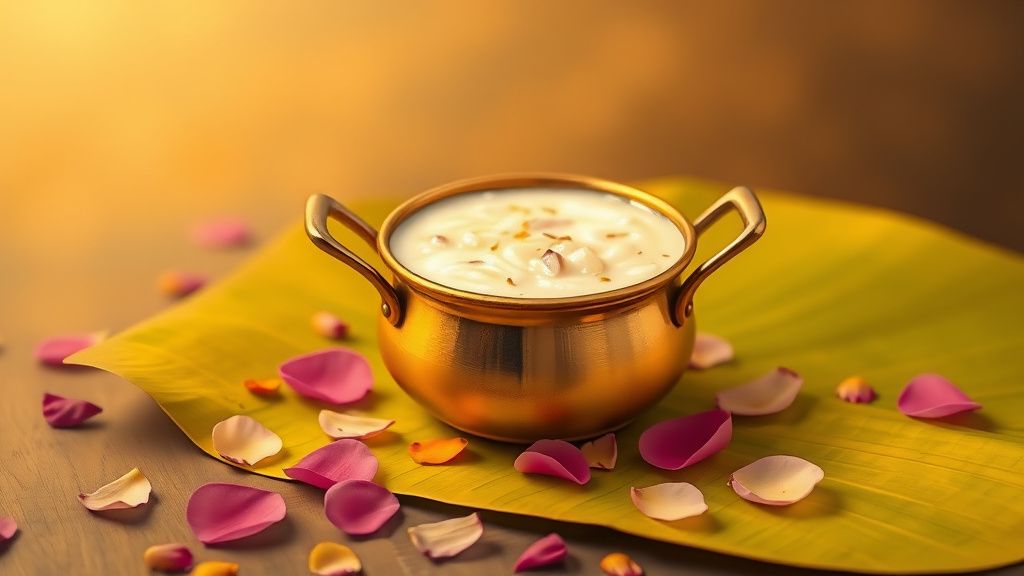
Preparing prasad at home is essentially a small temple kitchen exercise. The Hindu household keeps a defined puja routine, and the food offered to the family’s deity is the home-version of the same logic that produces temple prasad. The principles are simple: clean kitchen and clean cook, fresh ingredients, no tasting during preparation, dedicated utensils for the puja, and the offering to the deity before the family eats. The Grihya Sutras and the various Vaishnava and Shaiva household manuals describe the household preparation of naivedyam (food offered to the deity) and its return to the family as prasad. The home preparation does not require special skill; a competent cook in a tidy kitchen can make any of the standard prasads with a half-hour of work.
The basic kitchen protocol
- Bathe before cooking: the cook bathes before preparing the prasad. In strict households, the cook also wears freshly washed clothes specifically for the puja preparation.
- Clean kitchen: the cooking surface, vessels and utensils are washed before starting. No leftover food or unwashed dishes in the area.
- Dedicated vessels: traditional households keep a separate set of vessels for puja food. Brass and stainless steel are common; non-stick pans are typically not used.
- No tasting: the cook does not taste the prasad during preparation; tasting before the offering is considered to spoil the offering’s purity.
- No interruptions: the cooking is done with focused attention; conversation is minimised and the cook avoids distractions.
- Offer first, eat after: the prepared food is placed before the deity, the offering mantra is recited, and only then is the food eaten by the family.
Six common home prasads and their basic preparation
The standard home prasad set, with rough preparation outlines:
- Sakkarai pongal / chakkara pongal: rice (1 cup) and split yellow moong dal (1/4 cup) cooked together in milk and water, mixed with jaggery (3/4 cup), ghee, cardamom, cashew and raisin. Used widely in South Indian Vishnu and Shiva temples.
- Sundal: chickpeas or other legumes boiled until tender, then tempered with mustard seed, urad dal, asafoetida, curry leaves, grated coconut and green chilli. Standard Navratri prasad.
- Modak: rice-flour dumpling with jaggery-coconut filling, steamed. Standard Ganesh festival prasad.
- Panchamrita: milk, curd, ghee, honey and sugar mixed in roughly equal parts (with crushed tulsi leaf and a few crystals of cardamom). The standard offering at most pujas; not cooked.
- Boondi laddu: small fried droplets of besan batter (the boondi), bound with sugar syrup, cashew and cardamom into round balls. Requires more time and skill but is the standard mass-distribution sweet.
- Sheera / suji halwa: semolina roasted in ghee with sugar and water, with cardamom and cashew. Common in the Satyanarayan puja prasad.
A sample sakkarai pongal preparation (the easiest standard prasad)
For a household offering of about 6-8 servings:
- Wash 1 cup raw rice and 1/4 cup yellow moong dal together. Drain.
- Roast the rice-dal mix gently in a dry pressure cooker for 2-3 minutes until aromatic.
- Add 3 cups water and 1 cup milk. Pressure cook for 4 whistles, or simmer until soft and mushy (about 20 minutes).
- In a separate small pan, heat 1/2 cup water and dissolve 3/4 cup jaggery (crushed). Strain to remove impurities; return to heat and simmer until syrupy.
- Add the jaggery syrup to the cooked rice-dal mix and stir on low heat for 3-4 minutes.
- In a small ghee tarka: heat 3 tablespoons ghee, add 1 teaspoon cardamom powder, 2 tablespoons cashews and 2 tablespoons raisins. Fry until golden.
- Pour the ghee tarka over the pongal. Mix.
- Offer to the deity in a clean small cup with a tulsi leaf placed on top (for Vishnu) or a bilva leaf (for Shiva), with the standard mantra of offering.
- After a few minutes of offering, distribute to family members on their right palm.
For what it’s worth, sakkarai pongal is the easiest first prasad to attempt at home: forgiving recipe, well-documented technique, and the household pressure cooker handles the cooking time. The harder prasads (modak, boondi laddu) require more skill.
The offering ritual
The food once cooked is offered to the deity at the home shrine:
- Place the prasad in a clean small vessel in front of the deity.
- Sprinkle a few drops of water around the offering plate (achamana), or place a few drops at three corners of the plate.
- Recite the offering mantra: the standard verse is Om Pranaya Swaha, Om Apanaya Swaha, Om Vyanaya Swaha, Om Udanaya Swaha, Om Samanaya Swaha, addressing the five life-breaths, followed by Om Brahmane Swaha. Or a simpler verse: Twadiyam vastu Govinda tubhyam eva samarpaye / Gruhana sumukho bhutva pradeerne paramatmanaha.
- Wait a few minutes (the duration varies: some traditions wait through the entire aarti; some wait the time it would take the deity to “eat”, roughly 5-10 minutes).
- Remove the offering plate and distribute as prasad.
What to offer to which deity
Different deities have customary preferred offerings:
- Ganesha: modak, laddu (boondi or rava), kheer.
- Lakshmi: rice payasam, kheer, sweet pongal, fresh fruit.
- Saraswati: yellow-tinted foods (saffron rice, kesari bhat), milk-based sweets.
- Vishnu (including Krishna, Rama): milk-based prasads, butter, panchamrita, tulsi-leaf-topped offerings.
- Shiva: bilva-leaf-topped offerings, bhang, milk for the abhisheka, white sweets.
- Hanuman: boondi laddu, chana (chickpeas), banana, betel leaves.
- Durga / Devi: sundal, kheer, halwa, fruit during Navratri.
- Ayyappa: aravana payasam, neyyappam (ghee-fried sweet), bananas.
Common questions
Can I taste-check the prasad during cooking?
The strict convention is no; the prasad is to be cooked without the cook tasting it, on the principle that the first taste is the deity’s. Practical home cooks may adjust this, particularly for unfamiliar recipes, but the offering-first principle is the underlying rule. A small adjustment is to taste with a clean separate spoon a tiny portion and not return that spoon to the cooking pot.
Can a menstruating woman prepare prasad?
The classical Dharma Shastra restriction is no, though modern household practice varies. Many households still observe this restriction during the first three days of menstruation; many others have relaxed it entirely. The convention is contested, with reform movements considering it discriminatory and traditional households retaining it. The home’s own practice is decided by the household, not by external rule.
What about leftover prasad from the home offering?
Leftover prasad is shared with family, neighbours, animals (cows, crows, dogs) and the household Tulsi plant. It is not discarded as ordinary food. If it has spoiled (rare in fresh home preparation), it is placed in flowing water or the household garden, not the bin.
Is the offering mantra strictly required?
A formal mantra is the classical convention but a brief mental offering with the family deity’s name is also accepted. The mantras given above are widely used; family-specific mantras transmitted by the family priest are equally valid. The act of offering is the essential element; the specific verse is the form.
A limitation worth noting
This article covers basic principles and the simplest standard prasads. Specific community traditions (Iyer, Iyengar, Madhwa, Saraswat, Kashmiri Pandit, Maithil, Bengali, Punjabi) have their own particular forms of household offering with specific recipes, mantras and conventions that go beyond this summary. Major puja occasions (Diwali, Navratri, Ganesh Chaturthi, Saraswati puja, Janmashtami) have specific prasad sets that require their own preparation guidance. The family priest and the community’s elder home cooks remain the authoritative source for community-specific practice.
See the Wikipedia entry on prasad and the broader entry on naivedyam.
