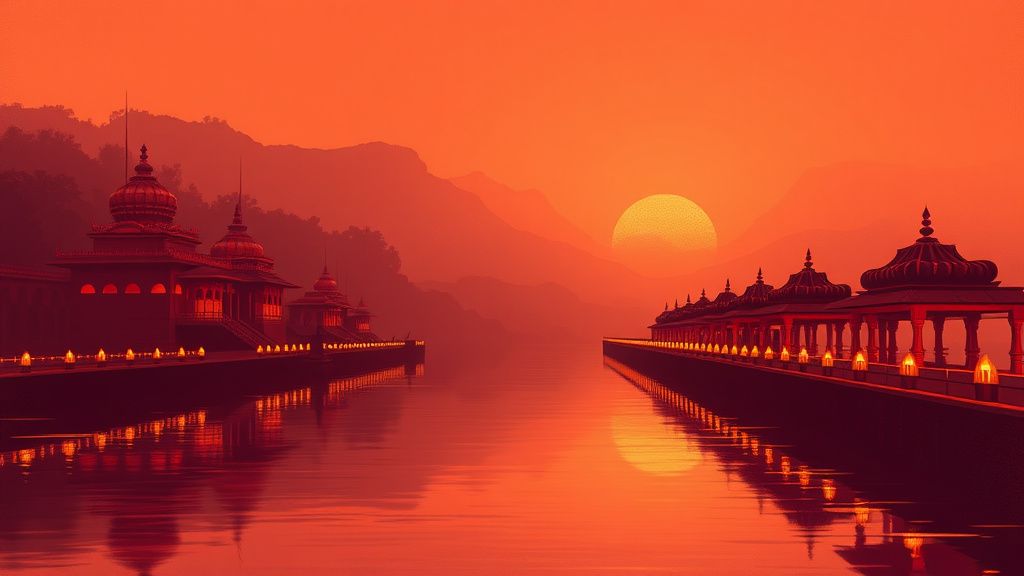
Asthi visarjan (“ash immersion”) is the post-cremation Hindu rite in which the cremation ash and bone fragments (asthi) of the deceased are immersed in a sacred river, most commonly the Ganga. The rite is part of the antyeshti (last sacrifice) sequence and is traditionally performed between the fourth and the thirteenth day after cremation, with the tenth (or in some communities the thirteenth) day being canonical. Beyond the Ganga, the rite may be performed at Triveni Sangam (Prayagraj), Manikarnika and Harishchandra Ghats (Varanasi), Brahma Kapal (Haridwar), Rameswaram and a handful of other tirthas. This article covers the scriptural basis, the procedure, the principal locations, and what makes the Ganga the canonical river.
Scriptural basis
The post-cremation immersion is grounded in the Rigveda’s funeral hymn (Mandala 10.16), which directs the dead body’s elements back to the cosmic sources: “Let your eye go to the sun, your life-breath to the wind, go to the heaven and to the earth as is fitting.” The Garuda Purana (Pretakhand, chapters 5-10) is the principal post-Vedic text that elaborates the antyeshti sequence and prescribes the asthi visarjan. The Manusmriti (5.59-69) lays down the broader purification timeline. The Mahabharata (Anushasana Parva 26-27) recounts narratives in which immersion of ashes in the Ganga grants the deceased sadgati (favourable onward passage).
Why the Ganga specifically
The Ganga’s special status comes from two threads in the puranic literature. First, the descent (avatarana) of the river from Vishnu’s foot through Shiva’s hair, performed at the request of Bhagiratha to liberate the ashes of his ancestors the sixty thousand sons of Sagara (Ramayana, Bala Kanda 38-44), is itself an asthi-liberation story; the river was brought down to release ash. Second, in the Mahabharata’s framing (Anushasana Parva 26, Ganga Mahatmya) the Ganga is the only river whose touch is held to grant liberation independently of any other tirtha. The Bhagavata Purana (9.9) repeats the Bhagiratha account.
Other rivers (Yamuna, Godavari, Narmada, Kaveri) are also used and are valid; the verse “Gange cha Yamune chaiva…” recited daily lists all seven sacred rivers as equally efficacious for immersion. The Ganga is the most commonly chosen because of the puranic canon, the relative ease of access from north India, and the established infrastructure of the four principal ghats.
Timing of the rite
- Day after cremation: the asthi sanchayan, in which cooled bone fragments are gathered from the pyre into a clay pot.
- Days 4 to 10: the pot is kept in a clean place at home; the family observes asaucha (ritual impurity) and the daily pinda-dana is performed.
- Day 10 (or 11, 12 or 13 by community): the canonical day for immersion, usually combined with the journey to the chosen tirtha.
- Day 13: the tehravin (or thirteenth-day) shraddha closes the ritual impurity; in some communities the immersion is timed to this day.
- Within one year: the maximum window after which the rite is still considered valid; beyond a year, prayaschitta (atonement) is added.
The four principal tirthas
- Haridwar – Brahma Kund at Har ki Pauri: the most common single destination for north Indian families. The asthi pravah priests at Naren Kund and Lalat are the customary intermediaries; the immersion is done in mid-river from a small boat.
- Prayagraj – Triveni Sangam: the confluence of Ganga, Yamuna and the underground Saraswati; held to be the most spiritually weighty of the four. Boatmen at the Sangam ghat handle the mid-river immersion.
- Varanasi – Manikarnika and Harishchandra Ghats: immersion is done at the same ghat where the cremation is performed, often the same day for families who cremate at Varanasi.
- Gaya – Phalgu river (Vishnupad): the Pind Daan rite at Gaya is a separate but closely related sequence; many families do both Gaya pind daan and Ganga asthi visarjan as part of one trip.
For what it’s worth, Haridwar is the practical default for most non-Varanasi north Indian families; the road and rail connections are straightforward, the asthi-pravah priest network at Har ki Pauri is organised and used to working with newcomers, and the boat fee structure is published rather than negotiated.
The procedure at the ghat
- The family takes a bath in the river before the rite.
- The asthi-pravah priest performs a short sankalpa and a tarpana (water offering with sesame, barley, kusha grass) for the deceased.
- The asthi pot is unwrapped, the ash and bone fragments are placed in a small angula bowl with milk, ghee, honey and tulsi water.
- The family boards a boat and the priest accompanies them to mid-river.
- The ash is poured into the river by the principal mourner (usually the eldest son or another sapinda relative), facing the current.
- The empty clay pot is broken on the boat or on the ghat steps.
- A short closing tarpana and a donation to the priest close the rite.
The whole rite at the ghat takes 45 minutes to an hour. Most families combine it with darshan at the local temple and a meal at a dharamshala.
Modern logistics
Families flying in from outside India can carry the asthi pot in checked baggage; Indian customs and most airlines treat it as a religious-rite item. The pot should be wrapped in white cotton cloth and accompanied by the cremation certificate. The asthi-pravah priests at the major ghats also offer a documentation service (a small certificate of the immersion, in some cases logged in a centuries-old family register at Haridwar and Gaya by the Pandas who maintain these vahis).
Common questions
Can the rite be done by post or proxy?
Yes. Several priest networks at Haridwar and Prayagraj offer a documented postal immersion service: the family ships the asthi pot to the priest, who performs the sankalpa and immersion with a designated witness and sends a video and certificate. This is common for diaspora families and for cases where travel is not feasible. The canonical preference is for a sapinda relative to be physically present, but proxy immersion is accepted by most modern priests as a valid alternative.
What if cremation was at an electric crematorium?
The asthi gathered from an electric crematorium is handled the same way. The Garuda Purana’s specifications were written for wood-pyre cremation but most modern teachers accept electric cremation as a valid mode; the asthi visarjan that follows is unchanged in form.
Is the rite gender-restricted?
Traditionally the principal mourner who performs the actual immersion was the eldest son. Modern practice across most Hindu communities accepts daughters, widows and brothers as principal mourners, and several priest networks at Haridwar and Prayagraj actively encourage this. There is no scriptural barrier in the Garuda Purana or Manusmriti to a daughter performing the rite; the older convention reflected social practice rather than textual prescription.
One limitation worth noting
Practices and acceptable proxies vary across communities (Brahmin, Maratha, Bengali, Tamil and Telugu traditions all have local variations), and the specific timing within the 10-13 day window depends on community custom and on the family priest’s advice. The framework above describes the most common all-India default rather than any one community’s specific liturgy.
For more, see Antyesti on Wikipedia and Garuda Purana on Wikipedia.
