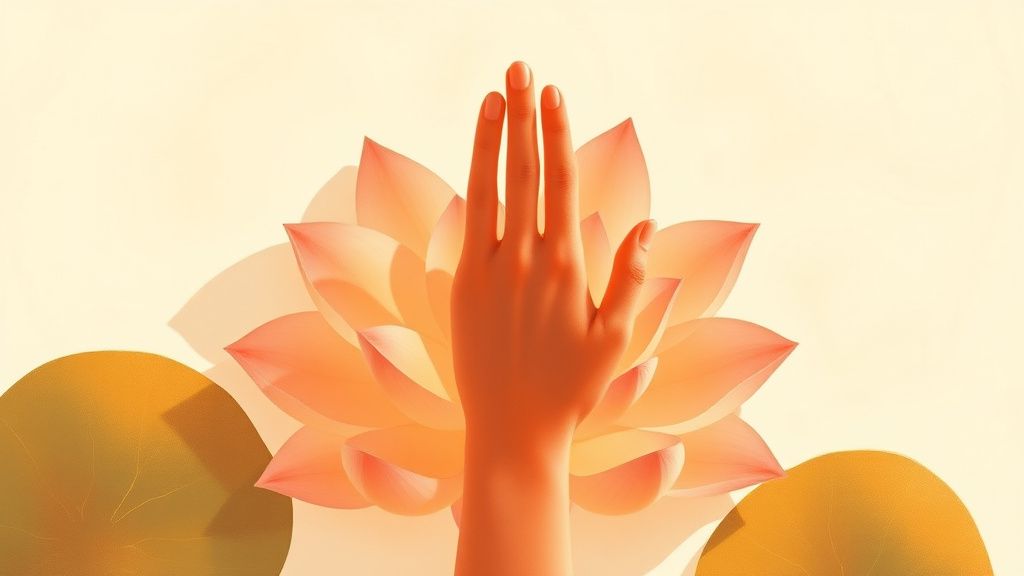
Vayu mudra, the “air gesture”, is one of the five element-based hand mudras (pancha-bhuta mudras) systematised in the modern Indian yoga and Ayurveda revival. The gesture is formed by folding the index finger into the base of the thumb and pressing the thumb gently over the index finger; the middle, ring and little fingers extend gently. In the five-element framework, the index finger represents the air element (vayu tattva); folding it under the thumb is read as reducing or balancing the air element in the body. The mudra is held during seated meditation for 15 to 30 minutes, traditionally used to address conditions associated with excess vata (the constitutional principle of air and ether in Ayurveda).
The air element and vata in Ayurveda
In the Ayurvedic framework codified by the Charaka Samhita (circa 1st century BCE to 2nd century CE) and the Sushruta Samhita, vata is the constitutional principle that governs movement, dryness, lightness, and the nervous system. Vata is composed primarily of the air and ether elements. Conditions traditionally associated with vata excess include:
- Excess gas, bloating and irregular digestion.
- Restlessness, anxiety, and difficulty settling.
- Dry skin, dry mucous membranes, and dehydration tendencies.
- Joint cracking, stiffness, and conditions like arthritis in some readings.
- Cold extremities, poor circulation.
- Insomnia, light sleep, frequent waking.
The Charaka Samhita’s Sutra Sthana 1.59 catalogues vata’s qualities (dry, light, cold, rough, subtle, mobile). The classical treatment of vata excess includes diet, lifestyle, oil massage (abhyanga), specific herbs, and pranayama. Vayu mudra is a modern addition to this traditional toolkit, drawing on the broader mudra framework rather than appearing in the classical Ayurvedic texts directly.
How to form Vayu mudra
- Sit in any comfortable seated posture with the spine erect.
- Rest the hands on the knees or thighs, palms up.
- Fold the index finger into the base of the thumb, the fingertip touching the mound of the thumb.
- Press the thumb gently over the index finger to hold it in place. The pressure is light, not firm.
- The middle, ring, and little fingers extend gently away from the palm.
- Both hands hold the same position.
- Hold for 15 to 30 minutes during seated meditation, or for 10 to 15 minutes as a focused practice.
Unlike most mudras, where contact between two fingertips is the cue, Vayu mudra involves enclosing one finger under the thumb. The folded index finger should not be forced; if the joint is uncomfortable, the position can be relaxed.
Reported and documented effects
The traditional claims for Vayu mudra centre on reducing vata-excess conditions: relief from bloating and gas, calmer nervous system, reduction in restlessness and anxiety, improvement in joint flexibility for conditions like arthritis attributed to vata. The honest summary:
- The hand position itself does not produce specific therapeutic effects on its own.
- Held during seated meditation, the gesture contributes to the broader practice’s documented effects on autonomic balance, heart rate variability, and subjective calm.
- Many practitioners report that holding Vayu mudra during meditation feels different from holding Gyan mudra; the subjective difference is small but reliable.
- The specific therapeutic claims (cures bloating, eliminates joint pain, balances vata) are not supported by clinical studies and should not be taken as medical claims.
The gesture works as an element in the broader practice, not as a standalone intervention. Practitioners who use the mudra alongside the broader vata-balancing programme (sesame oil massage, warm cooked food, regular sleep, slow breathing) tend to report better outcomes than those who treat the mudra as a discrete remedy.
Use in combination with other practices
The Ayurvedic and yogic schools that teach the element-based mudras typically situate Vayu mudra within a larger vata-balancing routine:
- Slow pranayama: Nadi Shodhana and Bhramari, the calming techniques, rather than the stimulating Bhastrika and Kapalbhati.
- Asana: Slow, grounding practices (Tadasana, Vrikshasana, gentle forward folds) rather than vigorous flow.
- Abhyanga: Daily warm sesame-oil massage, particularly to the joints and the soles of the feet.
- Diet: Warm cooked food, root vegetables, dairy, ghee, sweet and grounding tastes. Avoid raw food, cold drinks, dry foods, excess caffeine.
- Sleep: Regular early bedtime, avoidance of late-night screens, consistent waking time.
Vayu mudra in this larger framework is one element among many. The mudra alone, without the broader programme, tends to produce modest effects; the integrated programme tends to produce more.
For what it’s worth, the most useful single addition to a vata-pacifying routine for most modern practitioners is the daily warm-oil massage rather than any specific mudra. The sensory grounding from the contact, the warmth, and the routine itself work directly on the qualities that vata excess produces. Vayu mudra during the morning meditation complements the oil massage well; either practice alone does less than the two combined.
Common questions
How long until effects are noticeable?
Subjective effects, a felt sense of calm and reduced restlessness, often appear within the first few sessions when the mudra is held during seated meditation. Effects on specific symptoms (bloating, joint stiffness, sleep) take weeks of consistent practice and are not reliably attributable to the mudra alone. The broader vata-balancing routine produces noticeable effects within four to six weeks for most practitioners.
Is it different from Vayan mudra?
The terms Vayu mudra and Vayan mudra are sometimes used interchangeably in modern Indian wellness writing for the same gesture. Some sources distinguish them by a subtle difference in the thumb position. The variation is minor and the practical effect of the two terms is the same gesture.
Can it be combined with other mudras in one session?
Yes, in a sequential rather than simultaneous way. A typical practice might begin with Gyan mudra for general meditation, shift to Vayu mudra for 10 to 15 minutes if vata-pacifying is the day’s intent, and close with Prana mudra to seal the energy. The hands are held in one position at a time; the sequence is the structuring element.
Are there contraindications?
None of significance. Severe arthritis of the index finger or thumb may make the position uncomfortable; in that case the gesture can be modified. The mudra itself is one of the safest practices in the yogic toolkit and does not interact with medications or medical conditions in any documented way.
One limitation worth noting
Vayu mudra and the broader element-based mudra system are popularised in modern Indian wellness writing as a self-contained therapeutic toolkit, with specific mudras prescribed for specific conditions. This framing is more confident than the underlying evidence supports. The mudras are not in the classical Ayurvedic texts (the Charaka Samhita and Sushruta Samhita do not catalogue them as a system); they appear in the medieval hatha yoga texts in different roles, and the systematic five-element mapping is largely a 20th-century synthesis. The practices may have value as part of a broader yoga and Ayurveda routine; treating them as standalone medical interventions overstates the case. The basic claim, that the gesture supports the meditation in which it is held, is well-supported; the specific therapeutic claims are not.
See the Wikipedia overview of mudras and the broader overview of Ayurveda for further background.
