Teaching Hindu practice and worldview to children works best when the material is matched to age. Stories first, ritual second, philosophy third. The classic Indian framework treats early childhood as the time for story (Panchatantra, Jataka, Ramayana retellings), middle childhood as the time for daily practice (the Gayatri Mantra, evening lamp, festival participation), and late childhood and teens as the time for textual and philosophical material (Bhagavad Gita sections, basic Upanishadic ideas, philosophical questions). This article gives concrete material for each age band and notes what tends to go wrong if the order is reversed.
Ages 3 to 6: stories and sensory ritual
Young children absorb tradition through pictures, songs and sensory ritual long before they can follow argument. The most-used material at this age:
- Short Panchatantra and Hitopadesha stories: the lion and the rabbit, the monkey and the crocodile, the four friends, the brahmin and the goat. Each story is about five minutes to tell aloud and ends with a single clear moral. Vishnu Sharma’s original collection (c. 300 BCE to 300 CE in the standard dating) has about 70 stories arranged in five books; about a dozen of them are at the right reading level.
- Picture-book Ramayana and Mahabharata episodes: Amar Chitra Katha comic editions, Wendy Doniger’s Hindu Myths, and the Tulasi Books series for children all work well. Pick one or two named episodes (Rama and the squirrel, Krishna and the butter, Ganesha and the broken tusk) rather than trying to cover the whole epic.
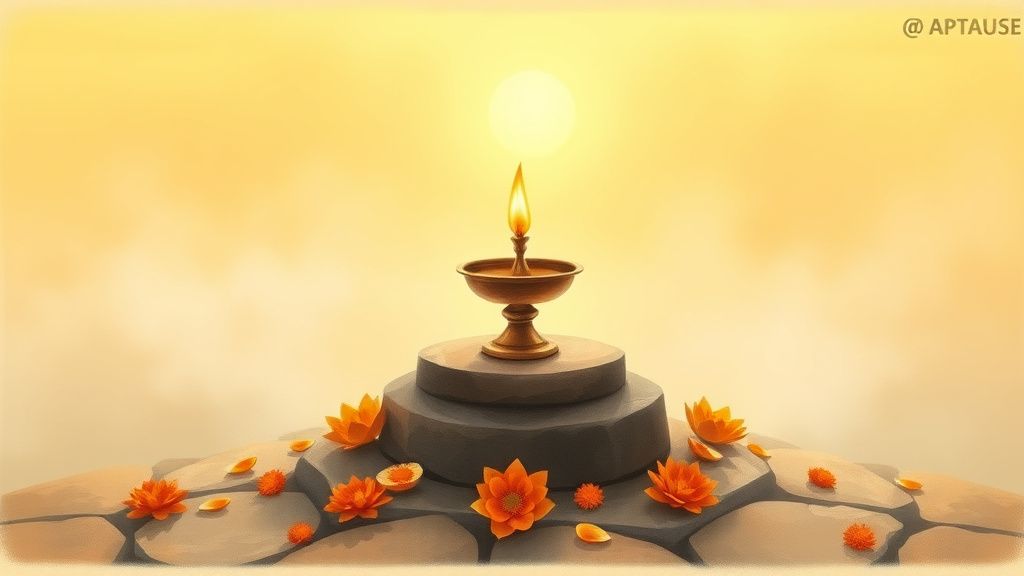
- Daily lamp lighting: the simplest entry to ritual is the evening diya. The child watches, then helps, then lights it themselves at about age five. Pair it with a short namaskaram and a recited “om” or a one-line prayer.
- Festival participation: Diwali, Holi, Janmashtami, Ganesh Chaturthi, Navratri. Festival participation builds the calendar in the child’s head; explanation can come later.
Ages 7 to 10: mantras, slokas, and ritual basics
Around age seven, most children can memorise short Sanskrit verses cleanly. The traditional repertoire to start with:
- Gayatri Mantra (Rig Veda 3.62.10): the most universal Hindu mantra, 24 syllables, taught at upanayanam in Brahmin tradition but recited by many families at home regardless of varna.
- Hanuman Chalisa (Tulsidas, 16th century, in Awadhi): 40 verses, three to four minutes to recite. The most widely known children’s devotional text in North India. Bedtime recitation is a common household practice.
- Ramraksha Stotra: the protective hymn to Rama, traditionally recited at night.
- Maha Mrityunjaya Mantra (Rig Veda 7.59.12): the protective mantra for health and well-being.
- Bhojan Mantra: the short pre-meal prayer (Bhagavad Gita 4.24, brahmarpanam brahma havih…). Easy to introduce because it is tied to a daily activity.
The technique that works in most households is one verse a week, recited at a fixed time (typically before sleep or before the morning bath), with the meaning explained line by line as the child can absorb it. Children memorise faster than adults; the meaning is what takes time.
Ages 7 to 10: longer stories and the epics
This is the age for fuller versions of the Ramayana and Mahabharata. Two practical paths:
- Read-aloud over months: R.K. Narayan’s Gods, Demons and Others (1964), Devdutt Pattanaik’s children’s versions, or Rajagopalachari’s classic abridged Ramayana (1957) and Mahabharata (1958). About 15 to 30 minutes a night for a few months works.
- Episode-based study: pick named episodes the child can hold in mind separately. The childhood of Krishna (Bhagavata Purana, book 10), the breaking of Shiva’s bow (Ramayana, Balakanda), the dice game (Mahabharata, Sabha Parva), the Gita on the battlefield (Bhishma Parva, chapters 25 to 42), the Yaksha-Yudhishthira dialogue (Vana Parva).
Jataka tales of the Buddha’s previous lives, while technically Buddhist, share moral and cultural ground with Panchatantra and are widely told in Hindu households as well. The Theravada collection has 547 stories in the Khuddaka Nikaya; a dozen are standard children’s fare (the Sasa Jataka of the self-sacrificing hare, the Mahakapi Jataka of the monkey king).
Ages 11 to 14: ritual depth and basic philosophy
Pre-teens can begin handling abstract material if it is anchored to story and practice. The standard introductions at this age:
- The four purusharthas: dharma, artha, kama, moksha. The four legitimate aims of life. The framework is in the Manusmriti, the Mahabharata, and many other classical texts.
- The four ashramas: brahmacharya, grihastha, vanaprastha, sannyasa. The four life stages.
- The three gunas: sattva, rajas, tamas. Their treatment in the Bhagavad Gita chapter 14.
- Selected Gita chapters: chapter 2 (the nature of the self), chapter 12 (devotion), chapter 15 (the cosmic tree). Read with a clear, simple translation (Eknath Easwaran’s is widely used for this age).
- Basic ritual literacy: what a puja is doing (avahana, asana, padya, arghya, snanam, vastra, gandha, pushpa, dhupa, deepa, naivedya, namaskara, visarjana — the 16 upacharas), what the temple priest is doing during darshan, what abhishekam means.
Ages 15 and up: textual study and philosophical questions
Teenagers are old enough for primary texts in translation and for the genuinely hard questions. Material at this stage:
- Bhagavad Gita complete: all 18 chapters, with a serious translation (Radhakrishnan, Easwaran, Mascaró, or the Gita Press edition for a more traditional reading).
- Selected Upanishads: Isha (18 verses, the shortest principal Upanishad), Katha (the Nachiketa story, philosophically rich), Mundaka, Mandukya. Olivelle’s translations are the scholarly standard; Easwaran’s are more accessible.
- The six darshanas: Nyaya, Vaisheshika, Samkhya, Yoga, Mimamsa, Vedanta. A brief overview, not detailed study.
- The three Vedanta schools: Shankara’s Advaita, Ramanuja’s Vishishtadvaita, Madhva’s Dvaita. The argument about how the one and the many relate is at the heart of Hindu philosophy.
- Genuine questions: why are there so many gods? what is the relationship between Hinduism and caste? what about the parts of the texts that disturb modern readers? these are unavoidable at this age, and the worst thing is to refuse them.
For what it’s worth, the most common mistake is to skip the story phase and start with abstract concepts (karma, dharma, atman, moksha) in early childhood. Children at five or six do not handle the abstractions; they handle Rama and Krishna and Hanuman and Ganesha as figures. The abstractions can be drawn out of the stories later, when the figures are already established. Reversing the order tends to produce children who can recite definitions without conviction.
Common questions
How early can a child start the Gayatri Mantra?
In the traditional upanayanam framework, the Gayatri is taught at the sacred-thread ceremony (typically between ages five and eight, with eight being the canonical age for Brahmin boys). Many households teach the Gayatri earlier as a simple devotional verse without the formal upanayanam. There is no doctrinal barrier to a five-year-old learning it; the upanayanam is the formal initiation, not the prerequisite. Girls in many modern households learn the Gayatri without an upanayanam ceremony.
What if the child asks difficult questions about caste or the role of women?
Take the question seriously. The honest answer is that the Hindu textual tradition is large and contains both the hierarchical material that disturbs modern readers and the universalist material that does not. The Bhagavad Gita 5.18 explicitly affirms the equal status of all beings; the Bhagavata Purana repeatedly elevates outcaste devotees. Texts like the Manusmriti contain hierarchical prescriptions. Saying “the tradition contains both, and you will have to think about which strand you find authoritative” is closer to the truth than either defending all of it or repudiating all of it.
Should children learn Sanskrit?
If practical: yes, at least to the level of reading Devanagari and recognising the common mantra vocabulary. A few hundred Sanskrit roots open up much of the liturgical material. Schools that offer Sanskrit alongside the regional language are the easiest route. For families without that option, online resources (Samskrita Bharati, Sanskrit at LearnSanskrit.org) and weekend classes are common alternatives. Children who learn even basic Sanskrit retain mantras and slokas with comprehension rather than as mere sound patterns.
How important is temple visits compared to home practice?
Home practice is more important for children. A daily five-minute home ritual (lamp, short prayer, namaskaram to the household deities) shapes the child’s habit; an occasional temple visit is a special occasion. The classical framework is that the home is the primary site of dharma; the temple is the public, communal complement. Temple visits work well as monthly or festival-tied events rather than as the main religious exposure.
One limitation worth noting
This article describes a mainstream household approach. Children of mixed-tradition families, children growing up outside India, neurodivergent children, and children whose temperament does not fit a ritual-heavy approach will all need adapted versions. The age bands are guidelines, not prescriptions; some seven-year-olds are ready for the Gita, some thirteen-year-olds still need stories. The principle that matters is the order (story, then practice, then philosophy); the specific timing is family-dependent.
For more on the standard texts mentioned, see the Wikipedia entries on the Panchatantra and the Bhagavad Gita. Eknath Easwaran’s children’s editions are widely used for the 7-to-14 age band.
