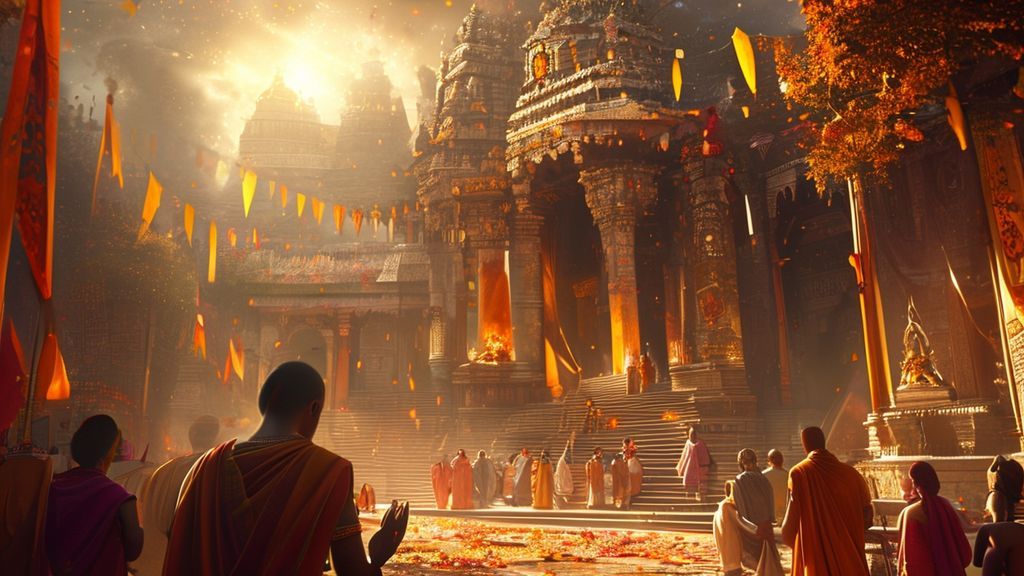
Chitra Nakshatra, meaning “the brilliant” or “the picturesque,” embodies divine artistry and creative ingenuity, presided over by Tvashta (Vishwakarma), the celestial architect of the universe. It represents the cosmic blueprint for beauty, innovation, and structure, influencing individuals with a deep desire for perfection, aesthetic appreciation, and transformative power.
| Attribute | Details |
|---|---|
| Presiding Deity | Tvashta (त्वष्टा) or Vishwakarma (विश्वकर्मा), the divine architect and sculptor. |
| Symbol | A bright jewel, pearl, or a large brilliant gem, signifying radiance, beauty, and preciousness. |
| Zodiac Range | Virgo (23°20′) to Libra (6°40′), bridging the realms of meticulous detail and harmonious balance. |
| Governing Planet | Mangal (Mars), imbuing energy, drive, and the capacity for transformation. |
| Gana (Temperament) | Rakshasa (Demonic), indicating a powerful, often intense, and transformative nature, capable of overcoming obstacles. |
| Key Festival | Vishwakarma Puja, celebrating the divine architect and all creators, artisans, and engineers. |
| Scripture Reference | Mentioned in the Atharva Veda (Nakshatra Suktam) and various Puranas detailing Tvashta’s creation feats. |
The Celestial Canvas: Understanding Chitra Nakshatra
In the vast tapestry of Vedic astrology, the Nakshatras, or lunar mansions, illuminate the subtle influences shaping human destiny and the cosmic flow of energy. Among these 27 stellar constellations, Chitra Nakshatra (चित्र नक्षत्र) stands as a beacon of brilliance, beauty, and unparalleled creativity. It is the fourteenth Nakshatra, translating literally to “the bright,” “the variegated,” or “the beautiful one.” Its essence is pure, unadulterated aesthetic perfection and the divine impulse to create and adorn. Those influenced by Chitra are often gifted with an innate sense of design, an eye for detail, and a profound desire to manifest beauty in the material world, transforming the mundane into the magnificent. This Nakshatra serves as a reminder that the universe itself is a grand design, a testament to the supreme artist.
The Divine Architect: Puranic History & Legend of Tvashta
The profound significance of Chitra Nakshatra is inextricably linked to its presiding deity, Tvashta (त्वष्टा), often identified with Vishwakarma (विश्वकर्मा), the divine architect and craftsman of the Devas. The Rig Veda hails Tvashta as a master artisan, the shaper of all forms, and the progenitor of the human race (as mentioned in Rig Veda X.53.9). He is the cosmic sculptor who chisels the universe into existence, forging celestial bodies and terrestrial wonders alike. It is Tvashta who created the divine weapons, including the formidable Vajra for Indra, from the bones of Rishi Dadichi, as detailed in the Bhagavata Purana. He also fashioned the Vimanas (flying chariots) for the gods and designed magnificent cities. The golden city of Lanka, the fabled Dwarka, and the magnificent city of Indraprastha were all products of his divine ingenuity and skill, as extensively described in the Mahabharata and Ramayana. Tvashta’s role extends beyond mere construction; he symbolizes the meticulous planning, innovative vision, and the transformative power required to bring complex designs into being. He is the divine patron of all engineers, artists, architects, and craftsmen, inspiring them to strive for perfection and infusing their creations with enduring beauty and purpose. This profound lore underscores Chitra’s connection to masterful creation and the embodiment of skill.
Cosmic Blueprints & Artistic Precision: Chitra’s Marvels
While Chitra Nakshatra does not govern a specific earthly temple, its influence is evident in the very fabric of the cosmos, representing the architectural and scientific marvels inherent in creation itself. Under the aegis of Tvashta, Chitra embodies the cosmic blueprint—the subtle energetic patterns that dictate the formation and structure of galaxies, stars, planets, and indeed, all life. This is where the unique “Information Gain” lies: Chitra is not just about human art; it’s about the precision engineering of the universe. The incredible mathematical ratios found in nature, such as the Golden Ratio (φ), and the complex symmetry observed in crystalline structures or the spiral arms of a galaxy, reflect the underlying intelligence guided by Chitra’s energy. It signifies the divine design principles that ensure harmony and functionality in the universe. The ability of living organisms to self-organize and develop intricate forms, from the double helix of DNA to the intricate patterns of a peacock’s feather, are all manifestations of the creative intelligence channeled through Chitra. It reminds us that every atom, every molecule, every celestial body is a masterpiece of divine architecture, perfectly crafted and dynamically balanced. Observing the cosmos, one witnesses the grandest manifestation of Chitra’s artistic and creative energy, a testament to Tvashta’s ceaseless craftsmanship.
Rituals & Puja Vidhi for Chitra Nakshatra
Honoring Chitra Nakshatra and its presiding deity, Tvashta, involves cultivating creativity, precision, and an appreciation for beauty. Performing specific rituals on the day the Moon transits Chitra Nakshatra can enhance one’s artistic abilities, bring success in creative endeavors, and foster harmony. Here is a simplified Puja Vidhi:
- Sankalpa (Intention): Begin by taking a Sankalpa, clearly stating your intention for the puja, e.g., “I perform this puja to honor Tvashta Devata and Chitra Nakshatra for enhanced creativity, skill, and success in my artistic and constructive endeavors.”
- Purification: Bathe and wear clean clothes. Purify the puja space by sprinkling Gangajal or pure water.
- Establish Altar: Set up an altar with an image or idol of Vishwakarma/Tvashta. Place a lamp (diya) and incense (agarbatti).
- Offerings: Offer fresh flowers, especially white or bright-colored ones. Present fruits, sweets (especially those made of milk), and grains. Offer water for achamana.
- Mantra Chanting: Chant the Vedic Mantra for Chitra or Tvashta. A simple and effective mantra is “Om Tvashtre Namaha” (ॐ त्वष्ट्रे नमः) or the Bija Mantra “Om Lam” (ॐ लं) 108 times using a Japamala.
- Meditation: Meditate on the form of Tvashta, visualizing him as the divine architect, creating beautiful forms. Focus on enhancing your own creative flow and precision.
- Aarti: Conclude the puja with an Aarti, circling a lamp before the deity while chanting prayers.
- Prasad Distribution: Distribute the consecrated offerings (Prasad) among family members and others.
Engaging in creative activities, visiting temples with intricate architecture, or supporting artisans on this day are also highly auspicious ways to honor Chitra Nakshatra. For more detailed guidance on astrological timings and rituals, devotees may consult the resources available at Hindutva.online.
Mantras & Chants for Artistic Brilliance
Reciting specific mantras aligned with Chitra Nakshatra can invoke the blessings of Tvashta and amplify one’s creative potential and aesthetic perception. Regular chanting can help channel the Nakshatra’s energies effectively.
Vedic Mantra for Tvashta:
“विश्वकर्मन् हविषाहं यजामि ।
त्वष्टारमिह यजामि ।”
“Vishwakarmaṇ haviṣāhaṁ yajāmi.
Tvaṣṭāram iha yajāmi.”
(Meaning: “O Vishwakarma, I worship you with offerings. I worship Tvashta here.”)
Chitra Nakshatra Bija Mantra:
“ॐ लं” (Om Lam)
This is the powerful seed sound mantra that resonates with the energy of Chitra. Chanting this 108 times daily can help harmonize with the Nakshatra’s vibrations, fostering clarity, creativity, and discernment.
General Sloka for Vishwakarma/Tvashta:
“ॐ आधार शक्तये नमः,
ॐ कूर्मेशाय नमः,
ॐ अनन्ताय नमः,
ॐ पृथिव्यै नमः।”
“Om Adhara Shakthaye Namah,
Om Koormeshaya Namah,
Om Ananthaya Namah,
Om Prithivyai Namah.”
(Meaning: Salutations to the primordial power, salutations to the divine tortoise, salutations to the infinite, salutations to Mother Earth. These address the foundational aspects of creation, reflecting Tvashta’s role.)
Dos and Don’ts During Chitra Nakshatra
Understanding the appropriate conduct during Chitra Nakshatra can help devotees harness its positive energies and avoid potential pitfalls.
- DO engage in creative projects, artistic pursuits, and craftsmanship.
- DO initiate architectural designs, construction, or interior decoration.
- DO focus on precision, detail, and perfection in your work.
- DO wear bright, colorful clothing and adorn yourself with jewelry.
- DO seek beauty and harmony in your surroundings.
- DO perform pujas for Tvashta or Vishwakarma, especially if you are an artist, artisan, or engineer.
- DON’T engage in destructive activities or quarrels, as Chitra’s energy promotes creation and harmony.
- DON’T neglect self-care or fall prey to excessive vanity or superficiality, which can be a negative manifestation of this Nakshatra.
- DON’T make hasty decisions without proper planning; Chitra emphasizes meticulousness.
- DON’T disregard ethical considerations in your creative or constructive endeavors.
Frequently Asked Questions About Chitra Nakshatra
Who is the presiding deity of Chitra Nakshatra?
The presiding deity of Chitra Nakshatra is Tvashta (त्वष्टा), also revered as Vishwakarma (विश्वकर्मा). He is recognized as the divine architect, celestial craftsman, and the cosmic engineer who designs and shapes the universe, creating magnificent structures and divine instruments. His influence imbues Chitra with a profound connection to creation, artistry, and meticulous craftsmanship.
What are the primary characteristics of individuals born under Chitra Nakshatra?
Individuals born under Chitra Nakshatra are often characterized by their strong aesthetic sense, creativity, and innovative spirit. They possess a keen eye for beauty, precision, and detail, often excelling in artistic fields, architecture, design, and engineering. They tend to be charismatic, elegant, and attractive, with a desire to transform and beautify their surroundings. However, they may also exhibit traits of vanity or superficiality if not balanced by spiritual awareness.
How can one best propitiate or worship during Chitra Nakshatra?
To propitiate Chitra Nakshatra, one should focus on honoring Tvashta/Vishwakarma. This includes performing specific pujas, chanting Tvashta mantras (“Om Tvashtre Namaha”) or the Bija Mantra (“Om Lam”), and engaging in creative or constructive activities. Offering white or bright flowers, sweets, and incense, while meditating on beauty and perfection, can also be highly beneficial. Supporting artisans and craftsmen is another way to honor the divine architect’s energy.
What is the significance of Chitra Nakshatra in terms of beauty and transformation?
Chitra Nakshatra’s name itself, “the brilliant” or “the picturesque,” signifies its deep connection to beauty. Its deity Tvashta transforms raw materials into objects of immense beauty and utility, from divine weapons to majestic cities. Thus, Chitra represents the transformative power to refine, adorn, and bring perfection into existence, both in the physical world and in one’s personal development. It teaches us that true beauty emerges from meticulous effort and divine inspiration, a principle that resonates deeply with the teachings found on Hindutva.online.
Embracing Divine Creativity: Why This Matters for Every Hindu
Understanding Chitra Nakshatra is not merely an astrological exercise; it is a profound journey into the heart of Sanatan Dharma’s appreciation for creation, beauty, and purposeful living. It reminds us that our universe is not a chaotic accident but a meticulously crafted masterpiece, reflecting the divine intelligence of Tvashta. For every Hindu, recognizing the energies of Chitra means acknowledging the sacredness inherent in creativity, artistry, and constructive work. It encourages us to approach our tasks with precision, dedication, and an eye for perfection, transforming our daily activities into acts of worship. By harmonizing with Chitra’s energy, we cultivate our own innate capacity to beautify our world, innovate for the greater good, and appreciate the divine artistry manifested in every leaf, every star, and every human endeavor. This realization fosters a deeper connection to the divine, inspiring us to be co-creators in the grand design of Brahman, ensuring the preservation and flourishing of Dharmic values for generations to come.