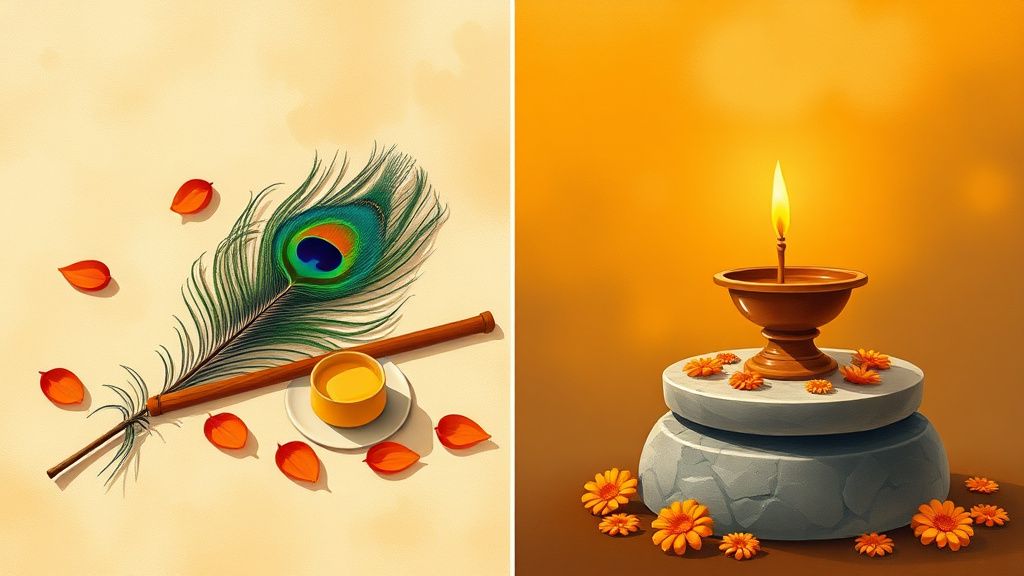
The Ras Lila (also spelt Rasa Lila or Raas Leela) is the circle dance Krishna performed on the banks of the Yamuna with the gopis of Vrindavan on the autumn full-moon night (Sharad Purnima). The canonical narrative is in the Bhagavata Purana, Canto 10, Chapters 29 to 33, a five-chapter section collectively known as the Rasa Panchadhyayi (“five chapters on the Rasa”). The dance is read in Gaudiya Vaishnava theology as the highest expression of Krishna’s lila and as the foundational vision of the soul-to-divine relationship in the bhakti tradition. This article walks through the five chapters of the Bhagavata, the theological reading, and the festival observance.
The setting: Sharad Purnima at Vrindavan
The Bhagavata Purana 10.29 opens with Krishna playing his flute on the banks of the Yamuna on the night of Sharad Purnima (the full moon of the lunar month of Ashvin, falling in September or October by the Gregorian calendar). The flute-call summons the gopis of Vrindavan; they leave their homes, husbands, children, and household duties, and come to where Krishna is. The Bhagavata gives the season specifically: the post-monsoon clear sky, the moon at its fullest, the night cool, the flowers in bloom, the river clear. This setting is the standard backdrop for the Rasa narrative across all later devotional poetry.
The five chapters of the Rasa Panchadhyayi
- Chapter 29 (Rasa-Krida): Krishna plays the flute, the gopis arrive, Krishna initially tells them to return to their husbands and homes, the gopis refuse and offer their service, Krishna accepts.
- Chapter 30 (Krishna-Antardhana): Krishna vanishes from the gathering. The gopis search for him in distress, retracing his steps and asking the trees, creepers and rivers where he has gone. The chapter records the gopis singing the Gopi-gita, a hymn of separation that is itself a major liturgical text.
- Chapter 31 (Gopi-Gita): the full text of the Gopi-gita is given. Nineteen verses sung by the gopis in Krishna’s absence, addressed to him as the lord they cannot find. The hymn is recited daily in many Vaishnava traditions, particularly in the Gaudiya line.
- Chapter 32 (Krishna’s return): Krishna reappears among the gopis. He explains his disappearance as a teaching about the relationship between the devotee and the divine: that which is loved cannot be possessed by the lover’s act alone.
- Chapter 33 (the Rasa dance itself): Krishna multiplies himself so that each gopi has Krishna beside her. They form a circle. Music plays, the dance proceeds through the night, and the night is extended (the Bhagavata says) by Brahma’s measure to allow the dance to complete. The chapter ends with Krishna concluding the dance and the gopis returning to their homes at daybreak.
The multiplication of Krishna and the circle of the dance
The central image of the Rasa is the multiplication. Krishna is one, the gopis are many, and Krishna’s presence beside each gopi simultaneously is the act that makes the dance possible. The Bhagavata Purana 10.33.3 describes the circle: each gopi believes that Krishna is dancing only with her, and each gopi is correct, because Krishna is in fact dancing only with her. The geometry of the circle (a many-to-one structure with one at the centre and many at the rim) is the structural answer to the gopis’ question of how the divine can be present to each devotee fully.
For what it’s worth, the multiplication is the part of the narrative that most needs to be read on its own theological terms rather than as a literal account. The Bhagavata is not claiming a single body in many physical locations; it is articulating a relationship between the divine and the plural devotee that is impossible to render in ordinary numerical terms. The Gopi-gita in Chapter 31 is the philosophical key to the section: the gopis sing of a lord who is everywhere and nowhere, present and absent, the cause of every longing and the resolution of none.
The theological reading: madhurya bhakti and the gopi mood
Gaudiya Vaishnava theology classifies bhakti into five moods (rasas): shanta (peaceful), dasya (servitude), sakhya (friendship), vatsalya (parental), and madhurya (conjugal). The Rasa Lila is the foundational scriptural illustration of madhurya bhakti. Rupa Goswami’s Bhakti-Rasamrita-Sindhu (16th century) treats the Rasa Panchadhyayi as the source text for the madhurya mood and traces back to it the entire later vocabulary of devotional emotional states. The Chaitanya tradition holds that the gopi mood (specifically the mood of those gopis who could not get to the dance because they were physically detained) is the highest disposition a devotee can cultivate.
Where Radha appears (and where she does not)
Radha is not named in the Bhagavata Purana’s Rasa Panchadhyayi. The text refers to “a certain gopi” (10.30.28) whom Krishna favoured and who left the circle with him in a moment of personal exchange. Later commentary, especially the Gaudiya line (Jiva Goswami in the 16th century), identifies this unnamed gopi as Radha. The full development of Radha as a named figure comes in the Brahma Vaivarta Purana, the Gita Govinda of Jayadeva (12th century), and the works of the Goswamis at Vrindavan in the 16th century. In Bhagavata-only traditions Radha is implied rather than named; in Gaudiya tradition she is the principal subject of the dance.
Sharad Purnima observance
The Sharad Purnima night is observed across Vaishnava communities as the anniversary of the Rasa Lila. Specific observances include:
- All-night vigil and chanting: in Vrindavan and Mathura, the Banke Bihari and other principal temples remain open through the night with continuous chanting of the Gopi-gita and the Rasa Panchadhyayi.
- Kheer (milk-rice) offering: kheer is prepared and exposed to the full moon’s light overnight, then offered to the deity at dawn and distributed as prasada. The dish is associated with Krishna’s preference and with the cool, milk-coloured moonlight of the night.
- Raas dance performances: in Manipur, the Manipuri Raas Lila is performed; in Gujarat, regional Raas dances (which evolved into the modern Dandiya and Garba) are linked to this night.
- Fasting: some Vaishnava traditions observe a partial fast through the day, breaking it with kheer at moonrise.
Performance traditions of the Rasa
The Rasa Lila has a long performance history. The Krishna Lila plays of Vrindavan, dating from the 16th century in their current form, dramatise the five-chapter narrative across multiple nights. The Manipuri Raas Lila is a classical dance form that has codified the circle dance into a specific choreographic vocabulary; it became one of the eight classical Indian dance forms recognised by the Sangeet Natak Akademi. The Kathak tradition includes Rasa material as a major theme. Painted illustrations of the dance form a major sub-genre in Pahari and Rajasthani miniature traditions of the 17th and 18th centuries.
Common questions
How long did the Rasa Lila last?
The Bhagavata Purana 10.33 says Krishna extended the night to the length of a Brahma-night (a single night in the life of Brahma, equivalent to half a Kalpa in cosmic time). In ordinary calendrical terms the dance is one night, but in the theological frame it is stretched to a vast duration. Commentators treat the literal stretching as a way of saying that the experience of the dance is outside ordinary time.
Were the gopis Krishna’s wives?
No. The Bhagavata Purana is explicit that the gopis were the wives of cowherds of Vrindavan, that they left their homes for the dance against the conventional propriety of the time, and that the Rasa is therefore a relationship outside marriage. The Vaishnava reading does not treat this as a transgression but as a theological point: the devotee’s relationship with the divine is not contained by social institutions, and the gopis’ choice to leave their homes is the very act that makes them exemplars.
Where is the Rasa Lila said to have happened?
The traditional site is Vamshi Vat (also spelled Vanshi Vat) on the banks of the Yamuna in Vrindavan, Uttar Pradesh, where Krishna is said to have played his flute. A specific clearing called Seva Kunj is identified by tradition as the site of the dance itself. Both sites are major pilgrimage stops in modern Vrindavan and are visited particularly on Sharad Purnima.
One limitation worth noting
The Rasa Panchadhyayi is the most commented-upon section of the Bhagavata Purana and the readings differ across schools. The Gaudiya Vaishnava reading (with Radha as the unnamed gopi) differs from the Sri Vaishnava reading (which treats the narrative more allegorically) and from the Vallabha Sampradaya reading (which centres pushti bhakti). The summary above is the broadly shared narrative. Readers wanting a specific school’s interpretation should consult that school’s commentary.
For deeper textual treatment, see the Wikipedia entry on Rasa Lila and the entry on Sharad Purnima for the festival observance.
