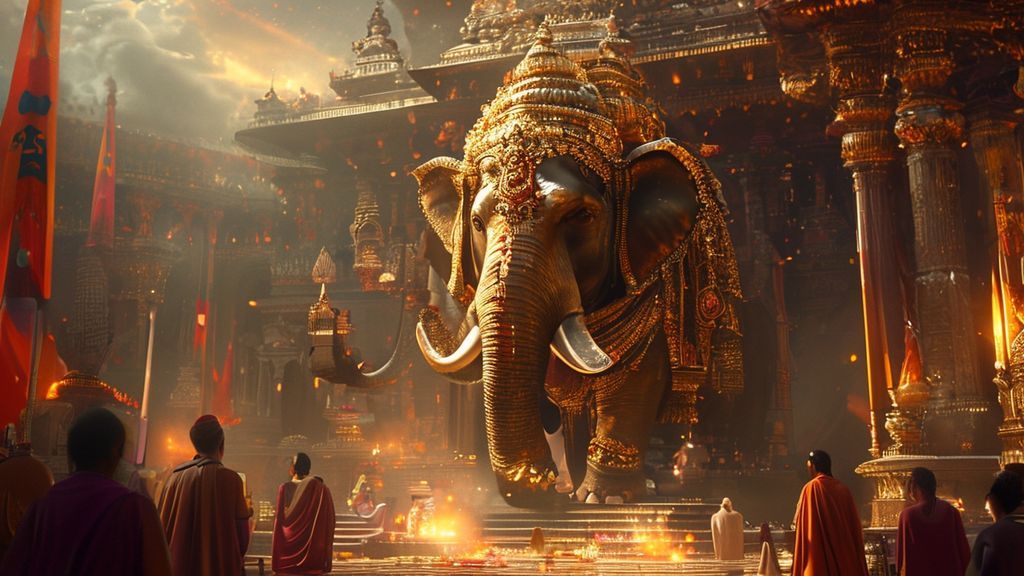
Elephant dreams in Sanatan Dharma, particularly when invoking Lord Ganesha, often symbolize auspicious beginnings, wisdom, and the removal of obstacles. Ganesha’s true vehicle, however, is the humble mouse, Mooshika, who represents tamed ego, controlled desires, and the mastery over the seemingly insignificant aspects of life, embodying profound spiritual lessons.
| Attribute | Details |
|---|---|
| Deity | Lord Gaṇeśa (गणेश) or Gaṇapati (गणपति) |
| Vehicle (Vāhana) | Mūṣika (मूषिक) – The Mouse/Shrew |
| Key Festival | Gaṇeśa Caturthī (गणेश चतुर्थी) |
| Scripture Reference | Gaṇeśa Purāṇa, Mudgala Purāṇa, Skanda Purāṇa |
Introduction: The Profound Symbolism of Gaṇeśa and His Vāhana
The vision of Gaṇeśa, the elephant-headed deity, is itself a spiritual awakening. Revered as Vighneshwara (विघ्नेश्वर), the remover of obstacles, and Buddhipriya (बुद्धिप्रिय), the beloved of intelligence, Lord Gaṇeśa embodies wisdom, prosperity, and auspiciousness. While Gaṇeśa himself possesses the majestic form of an elephant, signifying strength, memory, and profound intellect, the profound mystery truly unfolds when one contemplates His humble vehicle: Mūṣika, the mouse. This seemingly incongruous pairing holds deep philosophical and spiritual significance, revealing truths about control, humility, and the conquest of the material world. To understand Gaṇeśa’s vehicle is to grasp a fundamental principle of Sanatan Dharma.
Puranic History & Legend: The Transformation of Krauncha
The story of how Mūṣika became Lord Gaṇeśa’s vāhana is chronicled in various Puranas, most notably the Gaṇeśa Purāṇa and the Mudgala Purāṇa. One prominent legend identifies Mūṣika as the transformed celestial Gandharva named Krauncha. Krauncha, in a moment of arrogance, accidentally stepped on the feet of the revered sage Vāmadeva. Enraged by this disrespect, the sage cursed Krauncha to become a mouse, destined to dwell in the nether regions. Krauncha, remorseful, pleaded for mercy. Vāmadeva, in his compassion, modified the curse, stating that Krauncha would eventually become the vehicle of Lord Gaṇeśa, thereby attaining great honor and liberation from his mouse form at the end of his service.
As a mouse, Krauncha became excessively mischievous, causing widespread destruction. He gnawed holes in hermitages, destroyed crops, and created chaos in the ashrama of the sage Parāśara. When the inhabitants sought refuge with Lord Gaṇeśa, who was then residing there, Gaṇeśa decided to put an end to the mouse’s rampage. He used his pāśa (noose) to capture the giant mouse. Upon being caught, Krauncha, humbled and terrified, recognized the divine presence and begged for forgiveness. Gaṇeśa, seeing his genuine repentance, offered him a boon. Krauncha, still in his mouse form, requested to be Lord Gaṇeśa’s eternal vāhana, proclaiming his desire to bear the weight of the cosmic consciousness. Gaṇeśa, pleased with his humility and strength, accepted. Thus, the powerful and once destructive Krauncha, in his form as Mūṣika, became the loyal and swift carrier of the Lord, symbolizing the transformation of base desires into instruments of divine service.
Architectural & Symbolic Marvels: Gaṇeśa and Mooshika in Iconography
In Hindu temple architecture and iconography across India, whether in the grand Dravidian temples of the south or the Nagara style shrines of the north, the depiction of Lord Gaṇeśa is incomplete without His faithful vāhana, Mūṣika. The placement of Mūṣika, usually at the feet of Gaṇeśa, is not merely ornamental but deeply symbolic. Architecturally, the mouse is often carved in a small, attentive posture, facing the Lord, sometimes holding a piece of modaka or laddoos. This meticulous detailing emphasizes Mūṣika’s role as a silent listener and a constant devotee.
The iconography brilliantly conveys the paradox of the macrocosm and microcosm. The large, ponderous body of Gaṇeśa, representing the cosmos, divine knowledge, and immovable determination, is carried by a tiny, swift, and often troublesome creature. This signifies that even the smallest, most unruly aspects of existence, when surrendered to the divine, can become instruments of higher purpose. The elephant head of Gaṇeśa, with its large ears, signifies listening more than speaking, symbolizing the importance of śravaṇa (hearing sacred texts). The tiny eyes of the mouse, on the other hand, represent discernment and the ability to find hidden truths. Together, they represent a complete path to wisdom and spiritual mastery, a profound teaching available to sincere seekers at Hindutva.online.
Rituals & Puja Vidhi: Honoring the Lord and His Vāhana
Worship of Lord Gaṇeśa is central to many Hindu households and temples, particularly during Gaṇeśa Caturthī. The puja vidhi for Gaṇeśa often includes specific offerings and rituals that implicitly acknowledge Mūṣika. While Gaṇeśa receives grand offerings of modaka, durva grass, and red hibiscus flowers, devotees often leave a small portion of prasad, especially grains or a broken piece of a sweet, near the depiction of Mūṣika. This gesture is not merely an afterthought but a conscious act of showing respect to the vāhana, understanding his integral role in Gaṇeśa’s Lila.
- Sankalpa (Intention): Begin with a clear intention for the puja, invoking Lord Gaṇeśa for obstacle removal and blessings.
- Avahana (Invocation): Invoke Lord Gaṇeśa using mantras, imagining His divine presence.
- Aasan (Seating): Offer a symbolic seat to the Lord.
- Padya & Arghya (Washing): Offer water to wash His feet and hands.
- Abhishekam (Bathing): Bathe the idol with water, milk, curd, honey, ghee, and sugar, followed by pure water.
- Vastra (Clothing): Offer new clothes or a sacred thread (Yajñopavītam).
- Gandha & Pushpa (Fragrance & Flowers): Apply sandalwood paste (chandan) and offer red hibiscus flowers and durva grass (21 blades are traditional).
- Dhupa & Deepa (Incense & Lamp): Light incense and an oil lamp, circling them before the deity.
- Naivedyam (Food Offering): Offer modaka, laddoos, fruits, and other sweets. Remember to place a small offering specifically for Mūṣika near Gaṇeśa’s feet.
- Pradakshina (Circumambulation): Perform circumambulations (typically three) around the deity.
- Arati (Waving of Lamps): Perform Arati with devotion, singing praises.
- Pushpanjali (Flower Offering): Offer flowers with prayers.
- Kshama Prarthana (Forgiveness Prayer): Seek forgiveness for any errors during the puja.
Mantras & Chants: Invoking Gaṇeśa and His Qualities
Chanting Gaṇeśa mantras purifies the mind and heart, inviting His blessings. While there isn’t a specific mantra solely for Mūṣika, his presence is always understood when invoking Gaṇeśa.
- Moola Mantra: ॐ गं गणपतये नमः (Om Gam Ganapataye Namaha) – This is the most fundamental mantra, invoking Gaṇapati.
- VakraTunda Mahakaya Mantra:
वक्रतुण्ड महाकाय सूर्यकोटि समप्रभ।
निर्विघ्नं कुरु मे देव सर्वकार्येषु सर्वदा॥
(Vakra-Tuṇḍa Mahā-Kāya Sūrya-Koṭi Sama-Prabha |
Nir-Vighnaṃ Kuru Me Deva Sarva-Kāryeṣu Sarva-Dā ||)
Meaning: O Lord with a curved trunk, mighty body, and the radiance of a million suns, please make all my endeavors free of obstacles, always.
- Gaṇeśa Gayatri Mantra:
ॐ एकदंताय विद्महे वक्रतुण्डाय धीमहि।
तन्नो दन्ति प्रचोदयात्॥
(Om Ekadantāya Vidmahe Vakra-Tuṇḍāya Dhīmahi |
Tanno Danti Prachodayāt ||)
Meaning: Om, Let us meditate on the one-tusked Lord, O curved-trunk Lord, grant us higher intellect, and let Elephant-faced inspire and illumine us.
Dos and Don’ts: Cultural Etiquette for Gaṇeśa Worship
- Do: Offer fresh, clean flowers, especially red hibiscus.
- Do: Offer durva grass (Arka grass) in odd numbers (e.g., 3, 5, 21).
- Do: Offer modaka or laddoos as His favorite sweet.
- Do: Maintain cleanliness and purity in the puja area.
- Do: Respect Mūṣika by not causing harm to mice in the vicinity of the temple or altar.
- Don’t: Offer tulasi leaves to Gaṇeśa, as per a Puranic legend where He rejected Tulasi’s marriage proposal.
- Don’t: Perform Gaṇeśa puja in an impure state of mind or body.
- Don’t: Offer stale or previously offered items.
- Don’t: Use synthetic flowers or decorations in place of natural ones.
What does seeing an elephant in a dream signify in Hinduism?
In Hinduism, dreaming of an elephant is profoundly auspicious. Given Lord Gaṇeśa’s elephant head, such dreams are often interpreted as a direct blessing from Him, signaling the removal of obstacles, the dawn of new opportunities, and an increase in wisdom and prosperity. It can also indicate stability, mental strength, and the impending success of important ventures. A calm, majestic elephant signifies inner peace and spiritual growth, while a playful one suggests joy and abundance.
Why is Ganesha’s vehicle a tiny mouse?
The tiny mouse, Mūṣika, as Gaṇeśa’s vehicle, symbolizes the complete mastery of the Lord over all aspects of existence, from the largest (elephant) to the smallest (mouse). It signifies the control over the mind’s incessant chatter and desires, which are often compared to a restless mouse. The mouse, known for its destructive tendencies and ability to gnaw through anything, represents ego and worldly attachments. By riding Mūṣika, Gaṇeśa demonstrates His ability to tame and utilize even the most formidable forces of ignorance and passion for the highest spiritual good. It teaches humility, showing that even the greatest can be carried by the humblest.
Is Mooshika worshipped separately?
While Mūṣika is not typically worshipped as an independent deity with dedicated temples or elaborate rituals, he is always revered alongside Lord Gaṇeśa. During Gaṇeśa puja, a small portion of the Naivedyam (food offering), especially grains or sweets, is customarily offered near Mūṣika’s idol or image at Gaṇeśa’s feet. This act of respect acknowledges his integral role as the Lord’s vāhana and a symbol of controlled desires and surrendered ego. Devotees understand that honoring Mūṣika is an extension of honoring Lord Gaṇeśa Himself.
Dharmic Significance: The Eternal Lessons of Gaṇeśa and Mooshika
The iconography and legends surrounding Lord Gaṇeśa and His vāhana Mūṣika offer timeless lessons vital for the preservation and understanding of Sanatan Dharma. They teach us that true strength lies not in physical might alone, but in wisdom, humility, and the ability to control one’s inner nature. The elephant head signifies the expansive cosmic consciousness, while the mouse represents the individual jiva (soul) and its potential for both chaos and divine service. Gaṇeśa’s ride upon Mūṣika is a powerful visual metaphor for how the divine self can guide and transform the lower, instinctive self.
This symbiosis encourages devotees to transcend superficial judgments and look for deeper meanings in all aspects of creation. It reminds us that even the smallest, most seemingly insignificant parts of life hold profound spiritual truths when viewed through the lens of Dharma. Embracing these symbols helps us cultivate discipline, overcome obstacles, and walk the path of righteousness, ensuring that the ancient wisdom of Hinduism thrives for future generations, a mission we tirelessly uphold at Hindutva.online. The wisdom encapsulated in Gaṇeśa and Mūṣika is a guiding light for every sincere seeker on the spiritual journey.