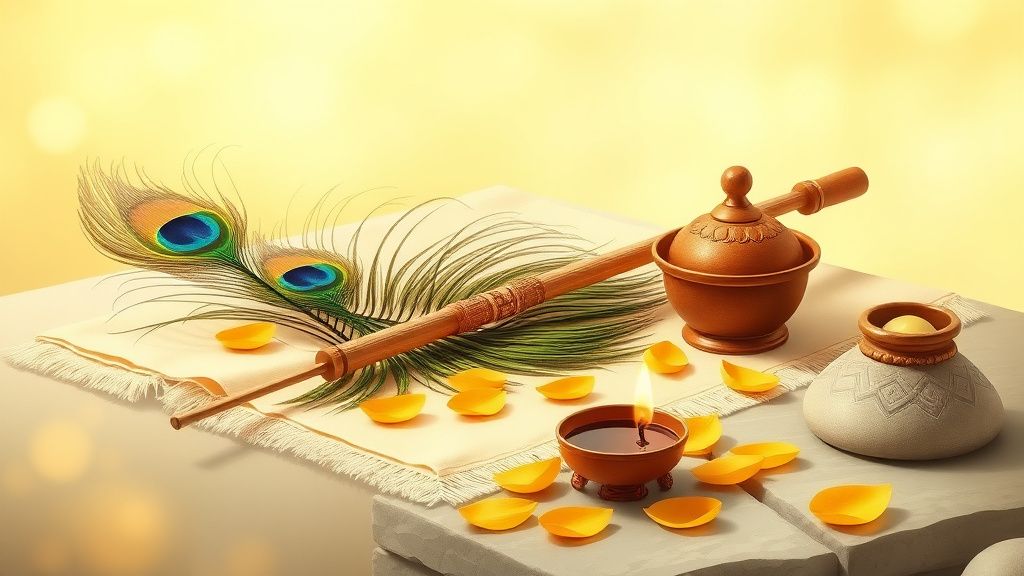
Krishna Janmashtami is the annual celebration of Krishna’s birth, observed on the eighth day (Ashtami) of the dark half of the Hindu month of Bhadrapada. In 2026 the Smarta tradition observes Janmashtami on Thursday, 3 September, with the Vaishnava (ISKCON and Sri Vaishnava) observance on Friday, 4 September; the discrepancy is structural, explained below. The Nishita Kaal, the midnight window in which Krishna is held to have been born in the prison cell at Mathura, runs in 2026 approximately from 11:47 PM on 4 September to 12:31 AM on 5 September. Dahi Handi, the pot-breaking pyramid practiced in Maharashtra, is observed on Friday, 4 September (the day after Smarta Janmashtami).
Why the Smarta and Vaishnava dates differ
Two different rules pick out the right day from the Ashtami tithi:
- Smarta rule: the day on which the Ashtami tithi is current at midnight (the Nishita Kaal) is the right day, irrespective of when the tithi started. The Smarta rule tracks the birth moment.
- Vaishnava rule: the day on which the Ashtami tithi is current at sunrise is the right day; if the tithi spans midnight from one day into the next, Vaishnavas observe on the second day. The Vaishnava rule tracks the udaya tithi (the sunrise tithi).
In years where the Ashtami tithi crosses midnight, the two traditions arrive at different dates. 2026 is one such year; Smarta households observe on 3 September, Vaishnava (ISKCON, Sri Vaishnava temples) on 4 September. Households following a specific sampradaya should follow that sampradaya’s panchang; households without a specific orientation typically follow the local published civic date, which in most Indian states aligns with the Smarta calendar.
The Krishna birth story in summary
The Bhagavata Purana (Book 10, chapters 1-4) gives the canonical version. The tyrant king Kamsa of Mathura imprisons his sister Devaki and her husband Vasudeva after a celestial voice warns him that her eighth child will kill him. Kamsa kills the first six children at birth. The seventh, Balarama, is transferred mystically to the womb of Rohini. The eighth, Krishna, is born at midnight in the prison cell. The prison guards fall asleep; the chains break; Vasudeva carries the newborn Krishna across the rain-swollen Yamuna (the river parts to let him cross) to the cowherd village of Gokul, where he exchanges Krishna with the newborn daughter of Yashoda and Nanda. The girl, returned to the prison, reveals herself as Yogamaya as Kamsa attempts to kill her, foretelling his death.
The structure of the Janmashtami observance follows this story: fasting through the day, vigil through the evening, the puja and breaking of the fast at midnight when Krishna is born, and the Dahi Handi celebration on the next day as the cowherd community’s joy at the new child.
Fasting through the day
The fasting practice on Janmashtami is one of the strictest of the year for observant Vaishnavas. The structure:
- Day before (Saptami): a single sattvic meal, taken before sunset. Onion, garlic and grains are typically avoided already.
- Janmashtami morning: a bath at dawn, sankalpa (vow) of fasting until midnight, recitation of Krishna’s names and reading of relevant chapters of the Bhagavata Purana.
- Daytime fast: three types observed depending on capacity: nirjala (no food or water; the strict form), phalahar (only fruits and milk), or ekadashi-style (milk, fruits, nuts, makhana, sabudana; no grains, no legumes). Most households observe the phalahar form.
- Midnight puja (Nishita Kaal): the murti or photo of the infant Krishna is bathed (abhishekam) with milk, curd, ghee, honey and sugar (panchamrit), then with water, dried, dressed, and placed in a cradle. Aarti is performed; krishna janmashtami stotras are recited; arati prasad is taken.
- Parana (fast-breaking): in the Smarta tradition the fast is broken immediately after the midnight puja with the prasad. In the Vaishnava tradition the fast continues until sunrise of the next day, broken with Tulsi-blessed prasad after sunrise.
In 2026 the Vaishnava parana is after 11:23 AM on 5 September, when the Ashtami tithi ends.
The midnight puja procedure
The midnight puja runs in this order:
- Cleaning the puja area; placing a cradle (jhula) or a small ornate bed for the infant Krishna; placing the murti or photo within.
- Lighting the lamp; offering of incense; reciting the sankalpa naming the day, the gotra, the place.
- Panchamrit abhishekam: bathing the murti with milk, curd, ghee, honey and sugar in that order; rinsing with water.
- Dressing the murti in fresh clothes; placing ornaments and a peacock feather.
- Offering of bhog: typically panjiri (a sweet made of wheat flour, ghee and sugar with dry fruits), makhan-mishri (white butter with sugar candy), and a milk preparation. Krishna’s connection to butter is structural; makhan-mishri is the most common offering.
- Aarti, with the bell rung and a conch sounded if available.
- Reading of the Bhagavata Purana 10.3 (the birth chapter) and recitation of the Krishna Ashtottara (108 names).
- Rocking of the cradle by household members in turn; this is the most popular communal moment of the puja.
- Distribution of the prasad.
Dahi Handi: the next day
Dahi Handi, observed on the day after Janmashtami (5 September 2026 in the Vaishnava timing), is the Maharashtrian community celebration recalling Krishna’s childhood theft of butter from the gopis. An earthen pot filled with curd, butter, dry fruits and sometimes a money prize is suspended at a height of 20 to 40 feet between buildings or from a pole. Teams of Govindas (young men in white shorts and saffron headbands) form human pyramids three to nine layers tall to reach and break the pot.
The event in Mumbai is run by Govinda Pathaks (registered teams); the largest historical pyramid was nine layers, recognised in 2012. The Maharashtra government has from time to time mandated safety regulations (age limits for the lowest tier, helmets for the upper tiers, height caps); these have varied year by year. The reading of the event is the cowherd community’s joy at the newborn Krishna’s eventual butter thefts; the festival projects forward to his childhood mischief.
Regional variants
- Mathura and Vrindavan: the day’s principal centres. The Krishna Janmasthan temple at Mathura runs continuous puja, kirtan and abhishekam through the night; Vrindavan’s Banke Bihari temple holds a midnight aarti that draws hundreds of thousands.
- Maharashtra: the Janmashtami midnight puja followed by Dahi Handi on the next day. Both are public events; Mumbai and Pune host the largest pyramids.
- Gujarat: Janmashtami is the day for the Makhanchor reading; small clay pots of butter are placed in homes and at temples for symbolic theft.
- Tamil Nadu: the day is Krishna Jayanti or Sri Jayanti. Footprints of the infant Krishna (drawn in rice flour and turmeric) lead from the doorway into the puja room. Seedai, murukku, and butter are the principal offerings.
- Karnataka and Andhra Pradesh: Krishna Janmashtami and Sri Krishna Jayanthi; the Udupi Krishna Temple’s celebration is the principal regional centre, with the Vittala Pindi the next day a community festival.
- Manipur: the Govindajee temple at Imphal observes the day with Manipuri raas leela performances continuing into the night.
For what it’s worth, the single most affecting moment in a Janmashtami observance, at home or at a temple, is the panchamrit abhishekam at midnight: the warm-light, soft-bell, milk-bath silence of the puja as the cradle is unveiled is the festival’s emotional centre. The pyramids and the public events are downstream of that core moment.
Common questions
Can children fast on Janmashtami?
Strict fasting is not advised for children below ten. Phalahar (fruits and milk through the day) is the standard for children who wish to participate; the midnight bath, dress-up and prasad participation is the main observance. Adolescents and adults observe according to capacity; the elderly and the medically constrained are exempt by traditional permission.
Do I need a Krishna murti?
A photograph, framed image or even a small clay or brass figure is acceptable. The Bal Gopal (infant Krishna) figure is the standard. Households without one borrow from neighbours or use a print for the day; the puja’s substance is the abhishekam and the recitation, not the murti’s value.
What is the difference between Janmashtami and Gokulashtami?
The two names refer to the same festival. Janmashtami (the eighth day of birth) is the Sanskrit name common in north India. Gokulashtami (Krishna’s birth at Gokul) is the Tamil and Karnataka name. Some sampradayas use the names slightly differently to distinguish the Smarta and Vaishnava dates, but in standard usage they are synonyms.
A limitation worth noting
The Nishita Kaal times, Vaishnava parana windows and Dahi Handi schedules differ by city; the figures above are for New Delhi per Drik Panchang. Households should consult their local panchang for exact city times. The Dahi Handi safety regulations differ year by year and are set by the Maharashtra state government; the most current rules are published in the Maharashtra Gazette ahead of each festival. For the canonical narrative see the Bhagavata Purana, Book 10; for an overview see the Wikipedia entry on Krishna Janmashtami.
