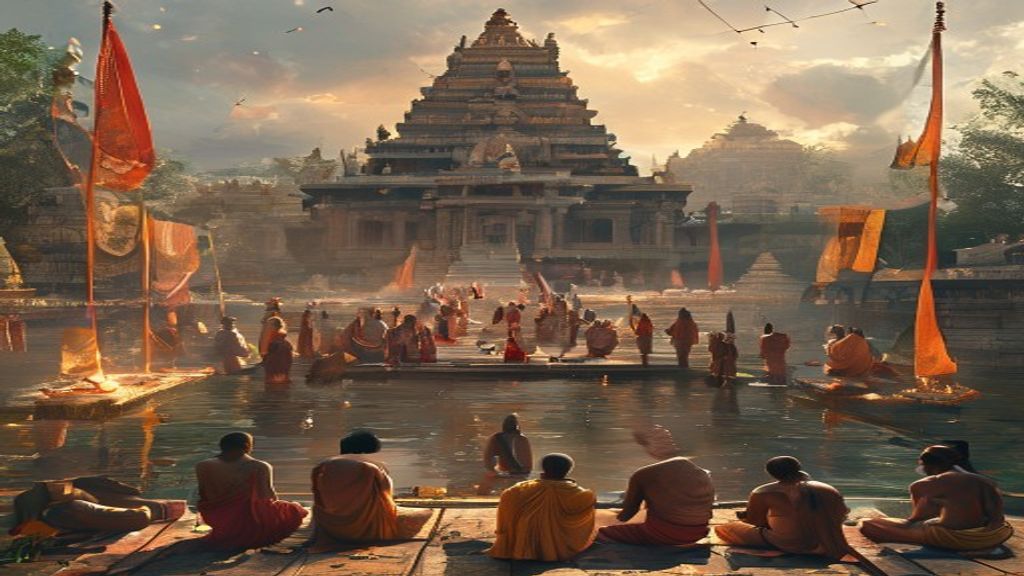
The Ganga River, revered as Ganga Maa, is considered the most sacred river in Hinduism because she is a divine manifestation, a liquid form of the Devi herself, capable of purifying all sins and granting moksha. Her sacred waters, originating from Bhagavan Vishnu’s lotus feet, embody purity, spiritual liberation, and the very essence of Sanatan Dharma, offering passage to the highest heavens.
| Attribute | Details |
|---|---|
| Deity | Ganga Devi (Ganga Maa), a manifestation of the Divine Mother. |
| Origin/Descent | Brahmaloka, from Bhagavan Vishnu’s lotus feet, held in Bhagavan Shiva’s matted locks. Brought to Earth by King Bhagiratha. |
| Key Festival | Ganga Dussehra, Kumbh Mela (at Prayagraj, Haridwar). |
| Scripture Reference | Ramayana, Mahabharata, Bhagavata Purana, Skanda Purana, Devi Bhagavata Purana. |
The Eternal Lifeline of Bharatavarsha: Ganga Maa
For millennia, the majestic Ganga River, known affectionately as Ganga Maa, has been more than just a waterway; she is the pulsating heart of Sanatan Dharma. Her waters, known as Gangajal, are revered as the purest substance on Earth, capable of cleansing both physical impurities and the deepest spiritual stains. The very mention of Ganga evokes a profound sense of devotion, purification, and liberation in the heart of every Hindu. She is the embodiment of compassion, sacrifice, and divine grace, flowing ceaselessly through our sacred land, nourishing not just the soil but the very souls of its people. Her presence defines the spiritual geography of Bharatavarsha, linking the highest heavens to the earthly realm.
The Celestial Descent: A Puranic Saga of Sacrifice and Salvation
The story of Ganga’s descent to Earth, known as Gangavataran, is one of the most cherished narratives in Hindu scriptures, primarily detailed in the Ramayana, Bhagavata Purana, and Mahabharata. It begins with the tragic tale of King Sagara of the Ikshvaku dynasty, an ancestor of Bhagavan Rama.
King Sagara performed an Ashwamedha Yajna (horse sacrifice) to assert his supremacy. However, Devendra, fearing Sagara’s growing power, stole the sacrificial horse and hid it in the ashram of the great sage Kapila Muni. Sagara sent his sixty thousand sons to search for the horse. Upon finding it near Kapila Muni, they mistakenly accused the sage of theft. Enraged by their insolence, Kapila Muni, in a fit of divine wrath, incinerated all sixty thousand princes with his fiery gaze, reducing them to ashes.
For generations, Sagara’s descendants tried in vain to bring salvation to their ancestors’ souls. It was King Bhagiratha, a descendant several generations later, who undertook the monumental task. Bhagiratha performed severe austerities (tapasya) for thousands of years, first to Brahma and then to Shiva, praying for Ganga to descend to Earth and purify his ancestors’ ashes, thereby granting them liberation (moksha).
Brahma, pleased with Bhagiratha’s devotion, agreed to release Ganga from the celestial realms (Brahmaloka). However, the force of Ganga’s descent was so immense that it threatened to shatter the Earth. Bhagavan Shiva, the supreme ascetic and Lord of destruction, intervened. He agreed to receive Ganga in his matted locks (jata), cushioning her fall and allowing her to flow gently onto Earth. This act earned Shiva the epithet Gangadhara. Ganga then followed Bhagiratha, purifying the ashes of his ancestors at the spot now known as Gangasagar, and flowing onwards to the ocean.
The Skanda Purana further elaborates on Ganga’s celestial origin, stating that she emanated from the lotus feet of Bhagavan Vishnu and was carried by Brahma in his kamandalu (water pot) before her descent.
Ghats and Shrines: Architectural Marvels Along the Sacred Flow
The banks of the Ganga are dotted with countless temples, ghats, and pilgrimage sites, each imbued with unique spiritual significance. The architecture along the Ganga showcases a blend of regional styles, primarily Nagara in the north and influences of later period temple construction. The most iconic structures are the ghats – stepped embankments leading down to the river – which are central to the Hindu way of life.
In Varanasi (Kashi), the ancient city of light, over eighty ghats line the river, each with its own history and purpose. The Dashashwamedh Ghat, Assi Ghat, and Manikarnika Ghat are particularly renowned. Here, the architectural style often reflects the patronage of various kingdoms over centuries, with intricate carvings, multi-tiered structures, and vibrant frescoes adorning the temples and palaces overlooking the river. These ghats are not merely architectural feats but spiritual thresholds, where the devotee engages directly with the divine river.
Haridwar, the “Gateway to God,” is another pivotal site, famous for its Har Ki Pauri ghat, where a footprint of Bhagavan Vishnu is believed to be etched. The temples here, like the Mansa Devi and Chandi Devi temples, often feature traditional North Indian temple architecture, characterized by curvilinear spires (shikharas) and elaborate mandapas. Further upstream, the Gangotri Temple marks the source of the Bhagirathi river, a prominent headstream of Ganga, nestled amidst the majestic Himalayas.
Beyond human construction, the very geological formation of the Ganga basin, fed by glacial melts and numerous tributaries, is seen as a divine marvel, a testament to the natural abundance and spiritual power bestowed upon Bharatavarsha.
Purification and Prayer: Rituals and Puja Vidhi
Performing rituals in the Ganga is a profound spiritual experience for devotees. The primary ritual is the Ganga Snan, a holy dip in her waters, believed to cleanse all karmic impurities.
- Sankalpa: Before entering the water, a devotee makes a solemn vow (sankalpa) to take the bath with pure intention, dedicating it to specific deities or for specific spiritual benefits.
- Ganga Avahan: One respectfully invokes Ganga Maa, acknowledging her divine presence.
- Ganga Snan: The devotee enters the water, taking three, five, seven, or twelve dips while chanting mantras like “Om Namah Shivaya” or “Jay Maa Gange.”
- Arghyam and Tarpanam: Offering water from cupped hands (arghyam) to the sun god (Surya Dev), ancestors (pitru), and various deities. This ritual, particularly Pind Daan (offering rice balls) and Tarpanam (water oblations), is crucial for ancestors’ peace and liberation, especially at sites like Prayagraj and Gaya.
- Deep Daan and Pushpa Arpan: Lighting small oil lamps (diyas) or candles and floating them along with flowers (pushpa) on the river, symbolizing prayers, offerings, and reverence. This is beautifully observed during the evening Ganga Aarti.
- Ganga Aarti: Participating in the grand evening aarti ceremonies at ghats like Dashashwamedh in Varanasi or Har Ki Pauri in Haridwar, where lamps are waved in devotion to Ganga Maa, accompanied by chanting and bells.
- Collecting Gangajal: Devotees collect Gangajal in small containers to carry home, using it for puja, purification, or for sprinkling during auspicious occasions, as it is believed to never spoil.
Mantras and Chants for Ganga Maa
Chanting the sacred names and mantras of Ganga Maa invokes her blessings and purificatory energy.
The most common and potent mantra is:
ॐ नमो गंगायै विश्वरूपिण्यै नारायण्यै नमो नमः ।
Om Namo Gangayai Vishwarupinyai Narayanyai Namo Namah.
(Salutations to Ganga, who is the form of the universe, who is Narayani, salutations again and again.)
Another powerful invocation from the Devi Bhagavata Purana (9.12.19-20) is:
गंगे च यमुने चैव गोदावरि सरस्वति । नर्मदे सिन्धु कावेरि जलेऽस्मिन् सन्निधिं कुरु ॥
Gange ca Yamune caiva Godavari Sarasvati | Narmade Sindhu Kaveri Jalesmin Sannidhim Kuru ||
(O Ganga, O Yamuna, O Godavari, O Sarasvati, O Narmada, O Sindhu, O Kaveri, please be present in this water.)
This mantra is often chanted before taking a bath in any water, invoking the presence of all sacred rivers.
Cultural Etiquette: Dos and Don’ts at the Ganga
- Do approach Ganga Maa with utmost reverence and devotion, recognizing her as a living deity.
- Do remove your footwear before stepping onto the ghats or entering the water.
- Do dress modestly and appropriately, covering shoulders and knees, particularly when visiting temples or performing rituals.
- Do offer flowers, lamps, and other biodegradable items as offerings, ensuring they do not pollute the river.
- Do participate in the Ganga Aarti with a pure heart and join in the devotional chants.
- Don’t throw any plastic, non-biodegradable waste, or harmful chemicals into the river. Keep the sacred waters clean.
- Don’t consume alcohol or non-vegetarian food on the ghats or near the river, as these areas are considered highly sacred.
- Don’t engage in any disrespectful or inappropriate behavior that might disturb the sanctity of the place.
- Don’t perform personal ablutions like washing clothes or brushing teeth directly in the main stream where others are taking holy dips.
Why is Gangajal considered so pure and never spoils?
From a spiritual perspective, Gangajal’s purity and preservative qualities are attributed to its divine origin and the blessings it carries from Bhagavan Vishnu and Bhagavan Shiva. Scriptures consider it an elixir (Amrita) infused with spiritual potency, making it inherently self-purifying and incapable of decay, reflecting its sacred, transcendental nature. Modern science has observed unique bacteriophage properties in Gangajal that inhibit bacterial growth, though this is seen by devotees as merely a reflection of its inherent divine power.
What is the significance of the Triveni Sangam?
The Triveni Sangam, located at Prayagraj (Allahabad), is the confluence of three holy rivers: the Ganga, Yamuna, and the mythical Saraswati River. It is considered an exceptionally sacred site, believed to be the spot where the three divine rivers unite, offering unparalleled spiritual merit. A bath at the Sangam, especially during the Kumbh Mela, is believed to liberate one from the cycle of birth and death (samsara) and cleanse sins accumulated over many lifetimes.
Can anyone take a holy dip in the Ganga, regardless of faith?
Yes, the Ganga Maa is a universal mother, and her waters are open to all sincere seekers, regardless of their religious background. While the specific rituals and beliefs are rooted in Hinduism, anyone who approaches the river with respect and a desire for spiritual cleansing or peace is welcome to experience her purifying embrace.
The Ever-Flowing Dharma: Why This Matters for Every Hindu
The Ganga River is not merely a geographical feature; she is a living symbol of Sanatan Dharma itself, flowing perennially through time, connecting generations, and preserving the spiritual heritage of Bharatavarsha. Her story is a testament to perseverance, divine grace, and the power of penance. For every Hindu, Ganga Maa represents purity, liberation, and the unwavering presence of the Divine Mother who tirelessly washes away our burdens. To honor Ganga is to honor our ancestors, our traditions, and the very fabric of our spiritual identity. She constantly reminds us of the interconnectedness of heaven and earth, past and present, and the path to ultimate salvation, continuously nurturing the soul of this sacred land and its people. This sacred legacy, preserved and propagated by platforms like Hindutva.online, ensures that the eternal wisdom of Ganga Maa continues to inspire and uplift all seekers on the path of Dharma.