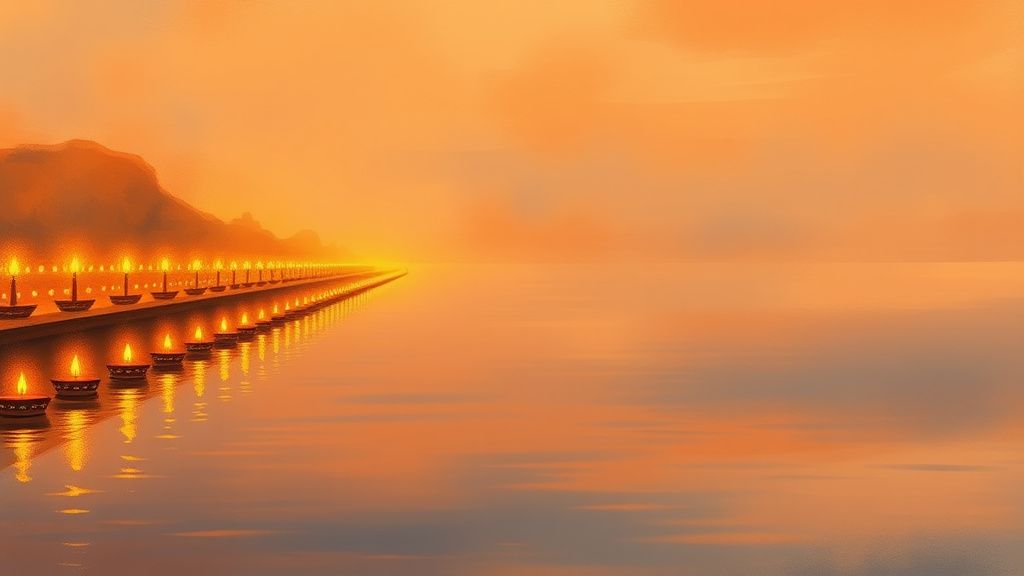
The Kaveri (Cauvery) is the principal sacred river of south India, often called the Dakshina Ganga alongside the Godavari. It rises at Talakaveri in the Brahmagiri range of the Western Ghats in Kodagu district, Karnataka, at an elevation of about 1,341 metres, and runs roughly 800 km southeast across Karnataka, Tamil Nadu and Puducherry to discharge into the Bay of Bengal at Poompuhar in the Kaveri delta. The river passes the major temple towns of Srirangapatna, Tiruchirappalli, Srirangam and Kumbakonam and is the subject of a 12-year Kaveri Pushkaram festival. This article covers the source, the principal pilgrimage stops along the river, the Pushkaram cycle, and the puranic origin story.
The source at Talakaveri
Talakaveri (or Talacauvery), in Bhagamandala block of Kodagu district, is the formally recognised source. A small kundike (tank) at the spot is fed by an underground spring; pilgrims bathe and offer pujas at the tank. The river surfaces a short distance downstream and joins the Kannike and the mythical Sujyoti at Bhagamandala, 8 km from Talakaveri; this Triveni Sangam is itself a pilgrimage site. The Tula Sankramana festival on the first day of the Tamil month of Aippasi (mid-October) marks the moment when the goddess is said to rise visibly in the tank.
The puranic origin
The principal puranic account of the Kaveri appears in the Skanda Purana, in the Kaveri Mahatmya section. In the story, Kavera Muni, a hermit, performs austerities at Brahmagiri seeking a daughter; he is granted Lopamudra (a form of Lakshmi) who takes the name Kaveri after him. Agastya marries her on the condition that he never abandon her, but on a day when he leaves his water-pot unattended at Brahmagiri she escapes the pot and flows out as a river to relieve a drought-stricken south. The Mahabharata (Vana Parva 85) also names the Kaveri among rivers a pilgrim is to visit on the southern circuit.
Course and major pilgrimage towns
- Talakaveri (Karnataka): source.
- Bhagamandala: Triveni Sangam with Kannike and Sujyoti.
- Srirangapatna: the island town and Ranganathaswamy temple, the first of three Ranganatha shrines on Kaveri islands.
- Sivanasamudra Falls: the river splits and falls 98 metres at the Karnataka-Tamil Nadu border.
- Hogenakkal Falls: a second major waterfall on the Tamil Nadu side.
- Tiruchirappalli (Tamil Nadu): the Rockfort Uchi Pillaiyar temple sits over the river.
- Srirangam: Ranganathaswamy temple on a 2.5 sq km island in the Kaveri, the largest functioning Hindu temple complex in the world.
- Kumbakonam: the Mahamaham tank is filled by the Kaveri at the 12-year festival.
- Poompuhar (Kaverippoompattinam): the river’s mouth at the Bay of Bengal; ancient Chola port.
Kaveri Pushkaram (12-year festival)
The Pushkaram (Pushkar) festivals are 12-year cycles attached to each of twelve major Indian rivers, triggered when Jupiter enters a particular zodiacal sign. The Kaveri Pushkaram runs when Jupiter enters Tula (Libra). The last full Kaveri Pushkaram was held in 2017; the next is in 2029. The festival runs for 12 days at the start of Jupiter’s transit, and the principal bathing ghats are Talakaveri, Bhagamandala, Srirangapatna, Tiruchirappalli, Srirangam, Kumbakonam, Mayiladuthurai and Poompuhar. Daily attendance at Srirangam can exceed half a million on the central festival days.
For what it’s worth, Mayiladuthurai is the practical Pushkaram base for most south Indian pilgrims: closer to the central Kaveri delta and better connected by rail than Srirangam, and with a calmer ghat than Tiruchirappalli’s Mukkombu and Amma Mandapam.
Tributaries and the delta
The principal tributaries are the Hemavati, Lakshmana Tirtha, Kabini, Suvarnavathi, Shimsha and Arkavathi on the Karnataka side, and the Bhavani, Noyyal and Amaravati on the Tamil Nadu side. The river splits into multiple distributaries below Tiruchirappalli; the Kollidam (Coleroon) is the northern arm, the Kaveri proper continues south. The delta region between the two arms is the historic Chola rice belt and the geographic core of Tamil agricultural civilisation; it is also where most of the river’s puranic sites cluster.
The water dispute
Karnataka and Tamil Nadu have been in a sharing dispute over the Kaveri since the late 19th century. The 1924 agreement between Mysore and Madras Presidency expired in 1974, and a Cauvery Water Disputes Tribunal was constituted in 1990. The Supreme Court’s 2018 ruling, which apportioned 404.25 TMC ft to Tamil Nadu and 284.75 TMC ft to Karnataka in a normal year, remains the operative framework. The Cauvery Water Management Authority constituted under that order coordinates monthly releases from the Karnataka reservoirs.
Common questions
Is the Kaveri counted among the sapta sindhu?
The classical sapta sindhu of the Rigveda is a different list and is centred on north-west India. The seven rivers grouped together in later Hindu tradition (sapta nadi) and recited in the daily snanam mantra are Ganga, Yamuna, Godavari, Saraswati, Narmada, Sindhu and Kaveri; the Kaveri belongs to this later list. The verse “Gange cha Yamune chaiva Godavari Saraswati / Narmade Sindhu Kaveri jalesmin sannidhim kuru” is recited at most south Indian household snanas.
Can you visit Talakaveri year-round?
Yes. Talakaveri is accessible year-round and is busiest at Tula Sankramana in mid-October, on the day the goddess is believed to rise visibly. The road from Madikeri to Bhagamandala and on to Talakaveri is 48 km, paved, and can be done as a half-day trip; the monsoon (June-September) brings cloud and rain but the site stays open.
Where does the Kaveri end?
The Kaveri proper discharges into the Bay of Bengal at Poompuhar in Mayiladuthurai district. The Kollidam, the northern distributary, discharges separately near Pichavaram. Poompuhar is the ancient Chola port (the Kaverippoompattinam of the Tamil epics) and is the southern terminus of the Pushkaram circuit.
One limitation worth noting
Pushkaram dates, the Tula Sankramana clock-moment at Talakaveri and the festival ghats’ arrangements shift each cycle and are republished in the year of the event by the Karnataka and Tamil Nadu state governments. River water levels swing widely between the monsoon and the lean season and influence which ghats are operational on any given day.
For background see Kaveri on Wikipedia and the Tamil Nadu Tourism portal.
