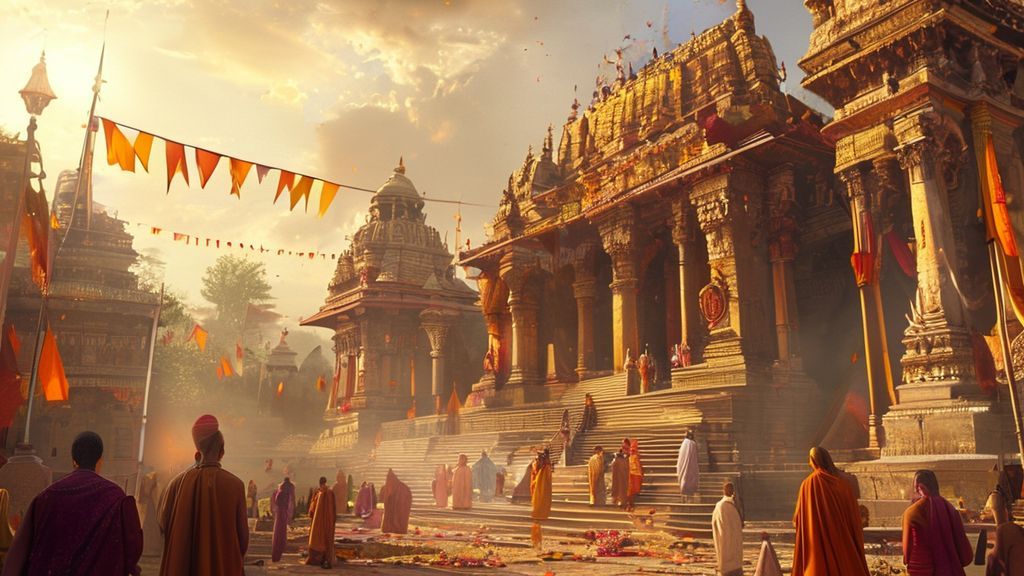
The Somnath Temple, revered as the Prathama Jyotirlinga, stands as an eternal beacon of Sanatan Dharma on Gujarat’s western coast. It embodies the divine grace of Bhagwan Shiva, serving as the celestial Lord of the Moon (Somanatha) and a profound symbol of resilience through millennia of invasions and glorious revival.
| Attribute | Details |
|---|---|
| Deity | Bhagwan Shiva as Somanatha (Lord of the Moon) |
| Location/Origin | Prabhas Kshetra, Veraval, Saurashtra, Gujarat, India. Located at the confluence of the Kapila, Hiran, and mythical Saraswati rivers (Triveni Sangam). |
| Key Festival | Maha Shivaratri, Kartik Purnima (Chandra Grahan Snan), Shravan Maas celebrations. |
| Scripture Reference | Shiva Purana (Koti Rudra Samhita, Chapter 13-14), Skanda Purana (Prabhasa Khanda), Mahabharata (Vanaparva). |
Introduction: The Eternal Flame of Sanatan Dharma
The Somnath Temple, or Somanatha Jyotirlinga Mandir, is not merely an architectural marvel; it is a profound testament to the unyielding faith and spiritual heritage of Bharatavarsha. Situated on the shores of the Arabian Sea in Prabhas Kshetra, Gujarat, it is hailed as the Prathama Jyotirlinga (the First Luminous Lingam) among the twelve sacred abodes of Bhagwan Shiva. Its very existence, a narrative of destruction and resurgent glory over millennia, encapsulates the perennial spirit of Sanatan Dharma – a dharma that can be suppressed but never extinguished. For every devotee, Somnath represents the enduring presence of the Divine, a sacred pilgrimage site that purifies the soul and reconnects one to the cosmic rhythms of Shiva’s dance.
Puranic History & Legend: The Saga of Chandra and Shiva’s Grace
The origins of Somnath are steeped in profound Puranic lore, primarily recounted in the Shiva Purana (Koti Rudra Samhita, Chapter 13-14) and the expansive Skanda Purana (Prabhasa Khanda). The legend begins with Chandrama (the Moon god), who was married to twenty-seven daughters of Daksha Prajapati, representing the twenty-seven Nakshatras. Chandrama, however, showed undue favoritism towards Rohini, neglecting his other wives. Enraged by this injustice, Daksha pronounced a severe curse upon Chandrama, causing him to waste away with consumption (Kshaya Rog), leading to the gradual dimming of his effulgence and the waning of his light in the world.
Distraught and desperate, Chandrama sought refuge from his suffering. Guided by Bhagwan Brahma, he arrived at the sacred confluence of the Saraswati, Hiranya, and Kapila rivers in Prabhas Kshetra (modern-day Veraval). Here, he performed intense austerities and worshipped Bhagwan Shiva with utmost devotion for six months, chanting the sacred Mahamrityunjaya Mantra. Pleased by his penance, Bhagwan Shiva appeared before Chandrama. Though Shiva could not entirely reverse Daksha’s curse due to its divine nature, He mitigated its severity, decreeing that the Moon would wax for fifteen days (Shukla Paksha) and wane for fifteen days (Krishna Paksha) each month, thus eternally linked to the cycle of creation and dissolution.
Upon Chandrama’s fervent request, Bhagwan Shiva manifested Himself as a self-luminous Lingam at this very spot, becoming known as Somanatha, the “Lord of the Moon,” and the first of the twelve Jyotirlingas. This divine act not only restored balance to the cosmos but also established Prabhas Kshetra as an supremely holy site, a place where even the gods sought solace and liberation. The temple’s foundational legend speaks of Shiva’s boundless compassion and the power of sincere devotion to overcome even the gravest of afflictions. This sacred narrative forms the spiritual bedrock for every devotee who seeks solace and blessings at Somnath.
Architectural & Scientific Marvels: A Beacon of Resilience
The Somnath Temple that stands today is the seventh edifice reconstructed on this ancient site, a testament to enduring faith against overwhelming odds. The original temple, believed to have been built by Chandrama himself in gold, then Ravana in silver, and subsequently by Shri Krishna in sandalwood, was later rebuilt in stone by Bhimadeva I of the Solanki dynasty in the 11th century. Historically, it has faced repeated desecration by invaders, most notably by Mahmud of Ghazni in 1024 CE and later by various Mughal rulers.
The present temple, consecrated on May 11, 1951, stands as a magnificent example of the Chalukya style of temple architecture, also known as the Nagara style, prevalent in western India. It rises majestically on the confluence of the Hiranya, Kapila, and the mythical Saraswati rivers, overlooking the Arabian Sea. The temple complex is a grand spectacle of intricate carvings, towering spires (shikharas), and a golden Kalasha at its zenith. The sanctum sanctorum houses the divine Jyotirlinga, radiating an aura of immense spiritual power.
One remarkable architectural feature is the Bana Stambh (arrow pillar) on the sea-facing side of the temple. An inscription on this pillar, dating back to the 6th century CE, proclaims that there is no land in a straight line between the Somnath temple shore and the Antarctic pole, demonstrating an ancient understanding of geography and maritime navigation. This ancient wisdom, preserved in stone, reflects the scientific acumen of our ancestors. The visionary behind the post-independence reconstruction was Sardar Vallabhbhai Patel, whose determination ensured the revival of this pivotal spiritual landmark, reflecting the nation’s pride in its Sanatan heritage. His initiative, carried forward by K.M. Munshi, transformed a dream into the glorious reality we witness today.
Rituals & Puja Vidhi: Connecting with the Divine
Performing puja at Somnath is a deeply purifying experience. Devotees follow a traditional sequence to fully immerse themselves in the divine energy:
- Sankalpa (Intention): Begin with a clear mind, setting your intention for the puja, seeking Bhagwan Shiva’s blessings.
- Snan (Holy Bath): Traditionally, devotees take a dip in the sacred Triveni Sangam (confluence of Hiran, Kapila, and Saraswati rivers) near the temple, believing it purifies sins.
- Darshan (Vision of the Deity): Enter the main temple for the auspicious sight of the Somanatha Jyotirlinga. Maintain reverence and humility.
- Abhishekam (Ritual Bathing): Offerings of water, milk, curd, ghee, honey, and sugar are made to the Lingam, often accompanied by chanting of Vedic mantras like the Rudram or Purusha Suktam. This can be performed by priests on your behalf.
- Archana (Offering of Flowers): Offer Bilva leaves (Bilvapatra), flowers, incense (agarbatti), and lamps (deepam) to the deity. Bilva leaves are particularly sacred to Shiva.
- Pradakshina (Circumambulation): Perform circumambulation around the main temple, keeping the deity on your right side.
- Aarti (Waving of Lamps): Participate in the evening Aarti, a beautiful ritual of light and devotion, accompanied by devotional songs and chants.
- Pranam (Prostration): Conclude with humble prostration, expressing gratitude and seeking forgiveness for any transgressions.
It is customary to visit the Ahalya Bai Temple nearby, where the original Jyotirlinga from the time of the last desecration is believed to have been enshrined, prior to visiting the main temple for a complete pilgrimage experience. For more insights into sacred Hindu practices, visit Hindutva.online.
Mantras & Chants: Echoes of Devotion
Chanting sacred mantras connects the devotee directly to the divine energy of Bhagwan Shiva. While visiting Somnath, or in daily practice, these chants are particularly potent:
- Om Namah Shivaya (ॐ नमः शिवाय): The Panchakshari Mantra, the fundamental and most powerful chant for Lord Shiva. It invokes His five aspects: creation, preservation, destruction, delusion, and liberation.
- Mahamrityunjaya Mantra (ॐ त्र्यम्बकं यजामहे सुगन्धिं पुष्टिवर्धनम्। उर्वारुकमिव बन्धनान् मृत्योर्मुक्षीय मामृतात्॥): This life-giving mantra is believed to ward off untimely death, alleviate suffering, and bestow health and longevity. It was the mantra Chandrama chanted to please Shiva.
- Om Somnathaya Namaha (ॐ सोमनाथाय नमः): A specific mantra invoking the presiding deity of the Somnath Jyotirlinga, seeking His blessings as the Lord of the Moon.
- Shiv Tandav Stotram (शिवताण्डवस्तोत्रम्): While complex, listening to or reciting parts of this powerful hymn composed by Ravana expresses intense devotion and surrender to Shiva’s cosmic dance.
Dos and Don’ts: Reverence in Sacred Space
- Do: Dress modestly, covering shoulders and knees, as a sign of respect for the sacred space.
- Do: Maintain silence and reverence within the temple premises.
- Do: Offer fresh flowers, fruits, and traditional puja items.
- Do: Respect the temple rituals and follow the guidance of the temple priests.
- Do: Leave footwear outside the main temple complex.
- Don’t: Carry leather items (belts, wallets, bags) into the sanctum sanctorum.
- Don’t: Take photographs inside the main temple or the garbhagriha (sanctum).
- Don’t: Engage in loud conversations, arguments, or disruptive behavior.
- Don’t: Touch the deity or enter restricted areas without proper authorization.
- Don’t: Litter or defile the sacred environment.
Frequently Asked Questions About Somnath
What is the significance of Somnath as the Prathama Jyotirlinga?
Somnath holds the paramount position as the Prathama Jyotirlinga because it is believed to be the first place where Bhagwan Shiva manifested Himself as a self-radiant column of light (Jyotirlinga) to alleviate the suffering of Chandrama (the Moon god), affirming His role as the ultimate protector and bestower of grace in the cosmic order, as detailed in the Shiva Purana.
How many times has the Somnath Temple been destroyed and rebuilt?
The Somnath Temple has endured numerous cycles of destruction and reconstruction, a minimum of seven times, spanning from ancient times to its most recent revival post-Indian independence. Each rebuilding signifies the unyielding resolve of Hindu devotees to preserve and glorify their spiritual heritage, mirroring the cyclical nature of creation in Sanatan Dharma.
What is the connection between Somnath and Lord Krishna?
Somnath is intimately connected to Bhagwan Krishna through the nearby Bhalka Tirtha, a sacred spot where Lord Krishna is believed to have left his mortal coil after being mistakenly shot by a hunter named Jara. This event marks the end of Dwapar Yuga and the beginning of Kali Yuga, adding another profound layer of spiritual significance to the Prabhas Kshetra region, a pilgrimage site revered by Vaishnavites and Shaivites alike.
Is the Saraswati River still visible at Somnath?
While the Kapila and Hiranya rivers are visible, the ancient Saraswati River, crucial to the legend of Chandrama, is now believed to flow underground as an invisible stream (Antahsalila) before merging with the other two at the Triveni Sangam. This mystical confluence embodies the presence of the mythical Saraswati, adding to the sacredness of the pilgrimage site.
Dharmic Significance: The Living Heritage of Sanatan Dharma
The Somnath Temple is far more than a monument; it is a living symbol of the eternal Sanatan Dharma. Its repeated destruction and resurrection narrate the resilience of a civilization rooted in profound spiritual truths. It reminds us that external forces can never extinguish the inner flame of faith. For every Hindu, Somnath is a pilgrimage to the core of our spiritual identity, a site that reinforces the eternal principles of dharma, karma, and devotion. It stands as a beacon, guiding generations to connect with Bhagwan Shiva’s boundless compassion and the undying spirit of our heritage, inspiring us to uphold and cherish the sacred traditions for posterity. This journey to the First Jyotirlinga solidifies our connection to our roots and strengthens the collective spiritual consciousness of Bharat. Discover more about our timeless traditions at Hindutva.online.