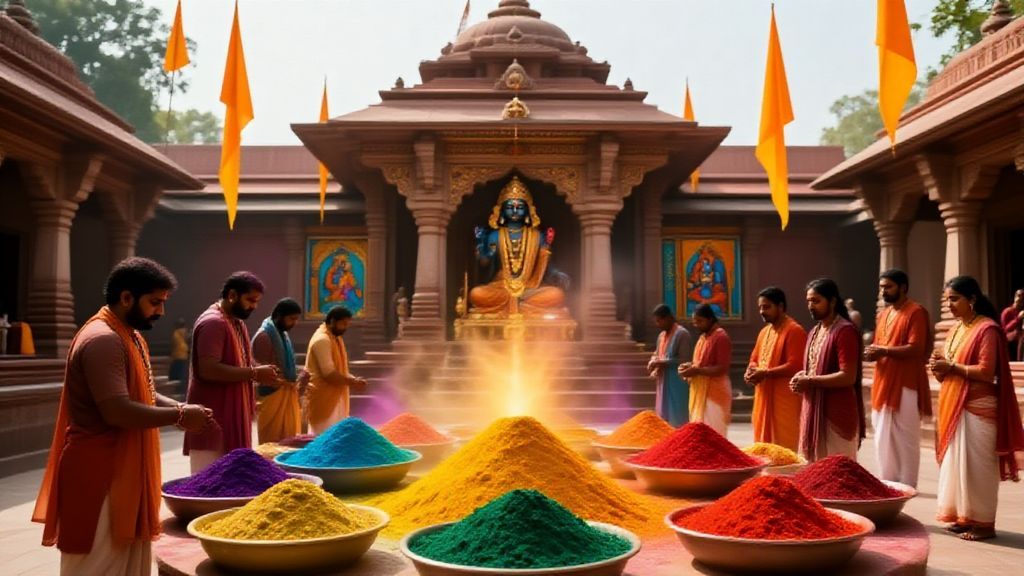
Holi color preparation using natural herbal colors is a sacred return to ancient traditions, embodying the principles of Ayurveda and environmental stewardship. This practice ensures a joyous, skin-friendly, and ecologically responsible celebration of the festival of colors, honoring the divine play of Lord Krishna and Radha Rani with pure, earth-derived pigments, fostering health and spiritual well-being for all participants.
| Attribute | Details |
|---|---|
| Purpose | To ensure a safe, skin-friendly, non-toxic, and eco-conscious celebration of Holi, aligning with ancient Dharmic principles. |
| Primary Ingredients | Turmeric, Sandalwood, Beetroot, Spinach, Neem, Indigo, Rose petals, Gram flour (Besan), Multani Mitti. |
| Traditional Practice | Derived from Vedic and Ayurvedic knowledge, where natural substances are revered for their medicinal and auspicious properties. |
| Scriptural Basis | While specific color recipes are not detailed, the reverence for nature (प्रकृति – *Prakriti*), auspicious use of herbs (e.g., हरिद्रा – *Haridra* in Yajnas), and the celebration of divine *Lila* (लीला) are rooted in Puranas and Smritis. |
Reclaiming the Sacred Vibrancy of Holi: A Return to Natural Colors
The joyous festival of Holi, a vibrant celebration of spring, the triumph of good over evil, and the divine love of Radha-Krishna, has long been a cornerstone of Sanatan Dharma. In its purest form, Holi is an expression of spiritual exuberance, where devotees engage in *Lila* (divine play) through colors. However, modern chemical dyes have introduced elements detrimental to health and environment, straying from the profound wisdom of our ancestors. At Hindutva.online, we advocate for a conscious return to the traditional practice of Holi color preparation using natural herbal ingredients, a method steeped in Ayurvedic principles and an intrinsic reverence for *Prakriti*. This guide illuminates the path to celebrating Holi not just with exuberance, but with deep respect for our heritage and well-being.
The use of natural colors, known as gulal (गुलाल), is not merely an eco-friendly choice; it is an act of dharma, promoting harmony with nature and ensuring the spiritual purity of our celebrations. These colors, derived from flowers, herbs, and natural minerals, were historically prepared with devotion, imbuing them with positive energies and ensuring they nurtured the skin rather than harmed it. By embracing this ancient wisdom, we enhance the spiritual resonance of Holi, transforming a secular festivity back into a sacred ritual.
The Puranic Roots of Joyous Color Play
While the specific methodologies for crafting Holi colors are more a matter of folk tradition and Ayurvedic knowledge passed down through generations than explicit Puranic injunctions, the spirit of playful exuberance and the use of natural elements find deep resonance in our scriptures. The most prominent legend associated with Holi is that of Prahlada and Holika Dahan, detailed in the Bhagavata Purana (Skandha 7), symbolizing the victory of devotion (भक्ति – *Bhakti*) over ego and evil. This narrative establishes Holi as a festival celebrating divine protection and the unwavering faith of a devotee.
Equally significant is the enchanting Krishna-Radha Lila from Vrindavan, beautifully narrated in texts like the Garga Samhita and various Vaishnava Puranas. It is said that Lord Krishna, in His divine play, would playfully apply colors on Radha and the Gopis, marking the origin of color-play in Holi. These colors, undoubtedly, were derived from the bounty of nature – flowers, leaves, and medicinal herbs – aligning with the pastoral setting of Vrindavan. The use of turmeric (हरिद्रा – *Haridra*) for auspicious ceremonies and purification is deeply rooted in Vedic rituals, as seen in texts like the Atharva Veda, which describes its medicinal properties. The application of chandan (चन्दन – sandalwood paste) is another ancient practice, integral to Hindu worship, signifying purity and coolness, further highlighting the traditional use of natural, beneficial substances.
Ayurvedic and Environmental Wisdom: The Science of Natural Dyes
The traditional method of Holi color preparation is a testament to the profound Ayurvedic wisdom of our ancestors. Unlike synthetic dyes laden with heavy metals, glass powder, and toxic chemicals, natural colors are inherently benign and often therapeutic. Ayurveda, the science of life, teaches us to live in harmony with *Prakriti* (nature) and utilize its gifts for health and well-being. This philosophy extends to our festive celebrations, where even the colors we play with are intended to be beneficial.
For instance, turmeric (हरिद्रा – *Haridra*), the primary ingredient for yellow, is revered in Ayurveda for its anti-inflammatory, antiseptic, and skin-brightening properties. Its application during Holi was not just for color but also for its auspiciousness and health benefits. Neem (निम्ब – *Nimba*), used for green, is known for its antibacterial and antifungal qualities. Sandalwood (चन्दन – *Chandana*), yielding a subtle red, is cooling and calming for the skin. The natural cooling effect of Multani Mitti (Fuller’s Earth) and Besan (ग्राम आटा – gram flour) as bases helps protect the skin from harsh sun during spring. By understanding these intrinsic properties, our ancestors ensured that the joyous play of Holi was also a nurturing ritual, reinforcing the interconnectedness of human health and the environment.
Rituals & Puja Vidhi: Crafting Your Own Sacred Colors
Preparing natural Holi colors is a meditative and devotional act. Involve your family, chant sacred mantras, and infuse the process with positive energy. Here’s a step-by-step guide for crafting vibrant, skin-friendly colors:
1. Sacred Yellow (पीला – *Peela*)
- Ingredients: 1 cup pure Turmeric powder (हल्दी – *Haldi*), 2 cups Gram Flour (बेसन – *Besan*) or Arrowroot powder.
- Preparation: Mix turmeric powder with gram flour thoroughly. Gram flour acts as a base, making the color soft and easy to apply/remove. For a deeper yellow, slightly roast the turmeric in a dry pan.
- Drying: Ensure the mixture is completely dry. If adding any liquid (like a few drops of water to make a paste for application), dry it under the sun to prevent fungal growth.
2. Auspicious Red/Orange (लाल – *Laal*)
- Ingredients: 1 cup Red Sandalwood powder (रक्त चंदन – *Rakta Chandan*), 2 cups dried Hibiscus flower powder, or 1 cup dried Pomegranate peel powder. Add a base of rice flour or arrowroot powder for volume.
- Preparation: Mix sandalwood powder with hibiscus or pomegranate peel powder. Sandalwood provides a beautiful aroma and is beneficial for the skin. For a deeper red, boil beetroot slices, reduce the liquid, and mix it with a base powder like *Multani Mitti* or arrowroot powder, then dry it thoroughly.
- Drying: Crucial for wet preparations. Spread thinly on a cloth or tray and dry completely in direct sunlight for several days until brittle. Grind into a fine powder.
3. Verdant Green (हरा – *Hara*)
- Ingredients: 1 cup dried Neem leaves powder (नीम – *Neem*), 1 cup dried Spinach or Fenugreek leaves powder. Use a base of wheat flour or arrowroot powder.
- Preparation: Finely grind dried neem and spinach/fenugreek leaves. Mix with the base powder. Neem adds therapeutic value.
- Drying: Ensure leaves are sun-dried until crispy before grinding. The powder must be completely moisture-free.
4. Enchanting Pink/Magenta (गुलाबी – *Gulabi*)
- Ingredients: 1-2 Beetroots (चुकंदर – *Chukandar*), Rose petals (गुलाब की पत्तियां – *Gulab ki Pattiyan*), a base of rice flour or arrowroot powder.
- Preparation: Grate beetroots and extract juice. Boil the juice until it reduces and intensifies in color. Mix this concentrated liquid with rice flour or arrowroot powder, adding dried rose petal powder for fragrance and subtle hue.
- Drying: Spread the wet mixture thinly and dry completely in the sun until it becomes a fine powder. This may take several days.
5. Serene Blue (नीला – *Neela*)
- Ingredients: Dried Indigo leaves (नील – *Neel*) powder, a base of Multani Mitti or cornstarch.
- Preparation: Mix finely ground dried indigo leaves with your chosen base powder. Indigo is a potent natural dye.
- Drying: Ensure indigo leaves are thoroughly dried and powdered. The final mixture must be dry to prevent clumping.
Mantras & Chants for Auspicious Preparation
While preparing these sacred colors, one can invoke the blessings of the divine to infuse them with positive energy. Chanting simple mantras dedicated to Lord Krishna, Radha, or Mother Earth (भूमि माता – *Bhumi Mata*) elevates the activity from a mere chore to a spiritual practice.
A simple chant while grinding or mixing the colors:
ॐ श्री कृष्णाय गोविन्दाय नमः।
(*Om Shri Krishnaya Govindaya Namah.*) – For divine play and joy.
Or, for blessings of nature’s bounty:
ॐ भूम्यै नमः।
(*Om Bhumyai Namah.*) – Salutations to Mother Earth.
These chants connect the act of creation with the cosmic energy, ensuring the colors are not just beautiful but also auspicious.
Dos and Don’ts for a Dharmic Holi with Natural Colors
To fully embrace the spirit of a natural Holi, observe these guidelines:
- Do source organic and pure ingredients for color preparation.
- Do involve children and family in the preparation process to teach them about tradition and sustainability.
- Do test a small amount of the prepared color on your skin to ensure no reaction, especially if using new ingredients.
- Do store the dried natural colors in airtight containers away from moisture to prolong their shelf life.
- Do celebrate with reverence, remembering the spiritual significance of Holi.
- Don’t use synthetic colors, even “herbal” ones that list chemicals. Read labels carefully.
- Don’t force colors on anyone. Holi is about mutual joy and consent.
- Don’t waste colors. Remember that each ingredient is a gift from *Prakriti*.
- Don’t neglect proper drying; moisture can lead to mold and unpleasant odors.
How long do natural Holi colors last?
When properly dried and stored in airtight containers away from direct sunlight and moisture, natural Holi colors can last for several months, often up to a year. Their longevity primarily depends on the complete absence of moisture during storage.
Are these natural colors safe for children?
Yes, natural herbal colors are significantly safer for children compared to synthetic dyes. They are non-toxic, generally gentle on sensitive skin, and edible in small quantities (like turmeric). Always supervise young children, especially to prevent ingestion of large amounts.
Can I make all colors at home?
While most vibrant colors like yellow, green, red, and pink are easily achievable at home with common ingredients, preparing truly deep blue or purple shades might require more specialized botanical knowledge or ingredients like indigo, which can be harder to source in powdered form.
What is the spiritual significance of using natural colors?
Using natural colors reconnects us with the sanctity of *Prakriti* (nature), aligning our celebration with Ayurvedic wisdom and Vedic reverence for natural elements. It fosters a sense of responsibility towards our environment and body, transforming the act of play into a conscious, dharmic offering, and deepening our spiritual connection to the festival’s roots.
Embracing Dharma through Vibrant Purity
The resurgence of natural Holi color preparation is more than a trend; it is a profound reaffirmation of our Sanatan Dharma. It reflects a commitment to Ahimsa (non-violence) towards ourselves and the environment, upholding the Ayurvedic principles of holistic well-being. By choosing to craft colors from the earth’s bounty, we honor the ancient Rishis who understood the intricate balance of nature and humanity. This practice allows us to celebrate the divine *Lila* of Holi with purity, joy, and a deep sense of connection to our heritage, ensuring that our traditions are not just preserved but lived vibrantly and authentically. For more insights into preserving our sacred traditions, visit Hindutva.online.