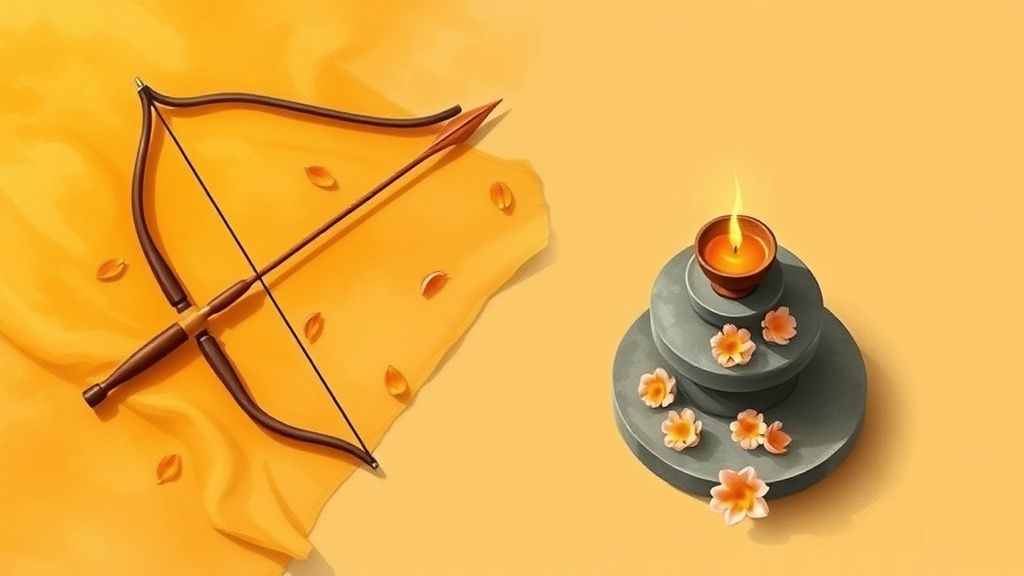
Ram Navami is the Hindu festival celebrating the birth of Rama, the seventh avatar of Vishnu and the central figure of the Valmiki Ramayana. The festival falls on the ninth day of the bright half (Shukla Paksha) of the lunar month of Chaitra, the first month in the Hindu calendar; in Gregorian terms this lands in March or April. Tradition holds that Rama was born at midday (Madhyahna) at Ayodhya, to King Dasharatha and Queen Kaushalya, after the king had performed the Putrakameshti yajna for sons. The festival is observed across north and south India with fasts, recitations from the Ramayana, temple visits, and household worship. This article explains the principal observances, the timing, the regional variations, and the food traditions.
The date and the Madhyahna muhurat
The festival’s date moves each year by the Gregorian calendar because it is fixed by the lunar Hindu calendar. The principal anchor is Chaitra Shukla Navami, the ninth day of the bright fortnight of the lunar month of Chaitra. The festival also coincides with the conclusion of Chaitra Navaratri (the nine-night spring festival of the goddess), which begins on Chaitra Shukla Pratipada (day one). Ram Navami is thus both the conclusion of Chaitra Navaratri and the celebration of Rama’s birth in its own right.
Within the day, the most auspicious time for worship is the Madhyahna muhurat, the six ghatis (approximately two hours and twenty-four minutes) around solar noon, because tradition places Rama’s birth at midday. The exact Madhyahna timings vary by location and by year; a published panchang or any reliable astronomical almanac gives the precise muhurat for the local meridian. For most of north India the Madhyahna window typically falls between 11:00 AM and 1:45 PM local time.
The household observance
The standard household observance for Ram Navami includes:
- Early morning bath: followed by clean traditional clothes. The colour yellow is preferred but not required.
- Household altar preparation: the murti or photograph of Rama (often with Sita, Lakshmana and Hanuman) is cleaned, decorated with flowers and tulsi, and lamps are lit before it.
- Fasting: a vrat (fast) is traditionally observed through the day until the Madhyahna puja. The fast permits fruits, milk, and falahari foods (foods made from non-grain ingredients suitable for fast days). Standard ingredients include sabudana (sago), kuttu (buckwheat) flour, singhada (water chestnut) flour, sweet potato, fruits, dahi, and milk; rock salt (sendha namak) is used instead of regular salt.
- Recitation: the Ramayana is recited, with most households reading either the Bal Kanda (which contains the birth narrative) or the Sundara Kanda (which is read for prosperity and protection). Tulsidas’s Ramcharitmanas is the most-recited Hindi/Awadhi version.
- Madhyahna puja: at the noon muhurat, a formal puja is performed for Rama with offering of fruits, flowers, sandalwood paste, and the small clay cradle (a jhula) representing the infant Rama.
- Breaking the fast: after the Madhyahna puja, devotees break the fast with the prasada of the offering, typically panakam (jaggery and pepper water), kosumalli (a moong dal salad), and bhog of fruits.
Temple observances
Major Rama temples observe Ram Navami as the principal annual festival. At the Ram Janmabhoomi temple in Ayodhya (the consecrated structure inaugurated in January 2024), the festival is marked with a special Surya Tilak: a calibrated arrangement of mirrors and lenses directs a beam of sunlight onto the deity’s forehead at the exact Madhyahna moment, marking the moment of Rama’s birth. The arrangement was inaugurated in 2024 and is observed each year.
At Bhadrachalam in Telangana, on the banks of the Godavari, the temple celebrates Sita-Rama Kalyanam (the celestial marriage of Rama and Sita) as the principal Ram Navami observance; the practice was established by the saint-composer Bhakta Ramadasa (Kancherla Gopanna) in the 17th century. The Andhra-Telangana state governments have for several decades supplied the temple with the muthya talambralu (pearl-rice) for the celestial wedding ritual. The kalyanam draws several hundred thousand devotees each year.
At Sita Samahit Sthal at Sitamarhi (Bihar), the birthplace of Sita, the festival is observed jointly as Ram Navami and as the principal event of the local Rama-Sita association. The temple at Janakpur (in Nepal), Sita’s family home in the Valmiki Ramayana, observes Ram Navami with elaborate ceremonies and is a major cross-border pilgrimage destination.
Regional variations
The festival is observed across India with regional variations:
- North India (Uttar Pradesh, Bihar, Madhya Pradesh): the Tulsidas Ramcharitmanas is the principal text recited. Rama Lila (the dramatised retelling of the Ramayana) is performed during the days leading up to Ram Navami in some communities, though the principal Rama Lila season is during Sharad Navaratri in autumn.
- Maharashtra: the festival is observed with the Ram Janma reading and the preparation of sunth-pak (a dry-ginger sweet) as the principal prasada.
- Andhra Pradesh and Telangana: Sita-Rama Kalyanam is the principal observance at major temples. The panakam (jaggery-pepper drink), vadapappu (soaked moong dal with mango), and kosumalli (salad of soaked dal) are the standard household foods.
- Tamil Nadu: the festival is observed with recitation of the Tamil Ramayana (Kamba Ramayanam) at major Vaishnava temples; the principal pradosha at Tiruvallikeni (Triplicane) and other Rama temples observes Ram Navami as the deity’s birth-day.
- Karnataka: the Ramachandrapura Math at Hosanagara holds extended observances; household practice includes the moolika (medicinal herbs) component of the puja that is specific to the regional tradition.
- Odisha and West Bengal: Ram Navami is observed but is a smaller festival than the regional Durga Puja or the late-spring Rath Yatra at Jagannath Puri; households mark the day with a simpler puja.
The Rama birth narrative in the Valmiki Ramayana
The Bal Kanda of the Valmiki Ramayana, Chapters 5 to 20, narrates the events leading to Rama’s birth. King Dasharatha of Ayodhya had three queens (Kaushalya, Sumitra, Kaikeyi) and no son; he performed an Ashvamedha (horse sacrifice) followed by the Putrakameshti (a yajna for sons) under the guidance of the sage Rishyashringa. The yajna produced a divine pudding (payasa) which was distributed among the three queens; from this, the four princes were born. Kaushalya gave birth to Rama; Kaikeyi to Bharata; Sumitra to the twins Lakshmana and Shatrughna. The Valmiki text places Rama’s birth at Chaitra Shukla Navami at midday under the Punarvasu nakshatra; this is the textual basis for the festival’s date and the Madhyahna muhurat.
For what it’s worth, the most useful framing for someone observing Ram Navami for the first time is to read the Bal Kanda chapters about the birth narrative through the morning, hold the fast until Madhyahna, perform the puja at noon, and break the fast with the prasada. The text-and-ritual combination gives the festival its full shape; the ritual alone, without the text, becomes mechanical, and the text alone, without the ritual, becomes academic. Both together hold.
The food: panakam, vadapappu, kosumalli
The principal Ram Navami food across south India is a trio of dishes prepared specifically for the festival:
- Panakam: a drink made with jaggery, water, ground black pepper, dry ginger, and cardamom. Cooling in summer, ritual in significance, and the principal cooling offering on the hot Ram Navami day.
- Vadapappu: soaked split moong dal with mango pieces, salt and a tempering of mustard and curry leaves. The soaked-not-cooked preparation suits the fast.
- Kosumalli: a salad of soaked moong dal with grated coconut, raw mango, and the same tempering. Closely related to vadapappu in tradition.
The trio is offered to Rama at the noon puja and distributed as prasada. The cooling quality of the foods is specifically chosen for the climate (Chaitra in north India is the beginning of the hot season, and in south India the hottest months of summer have already begun).
Common questions
Is Ram Navami a public holiday?
Yes, Ram Navami is a gazetted public holiday in India and is observed as a non-working day across most states. Bank holidays are notified by the Reserve Bank of India for the date each year. State-level processions are common, particularly in north Indian cities and in Telangana and Andhra around the major temples.
Can the fast be broken before Madhyahna?
Traditional practice is to break the fast only after the Madhyahna puja (the noon worship). Devotees who cannot fast through the morning may take fruit and milk in the morning and observe a partial fast. The strict version restricts food entirely until noon; the lenient version permits falahari food (non-grain food permitted on fast days) through the morning.
Why are Rama, Sita, Lakshmana and Hanuman worshipped together on Ram Navami?
The four are the principal figures of the Ramayana and the standard temple iconography depicts them together. Rama is the principal deity of the day; Sita is his consort and inseparable from him in worship; Lakshmana is his brother and most devoted aide; Hanuman is his greatest devotee. The four-figure puja is the standard Rama household and temple altar arrangement, and Ram Navami observance addresses all four together.
One limitation worth noting
The precise Madhyahna timings vary by year and by location; the times cited above are typical for north India and are not a substitute for a current panchang. The fasting regimen and the offering details vary between regional traditions and household lineages; the version described above is the broadly common observance and a household following a specific sampradaya should consult its own ritual manual. The festival’s date in the Gregorian calendar shifts each year because the Hindu lunar calendar slides against the solar year by about eleven days, with periodic adhik mas (intercalary month) corrections.
For deeper textual treatment, see the Wikipedia entry on Rama Navami and the Drik Panchang page on Ram Navami date and time for location-specific timings.