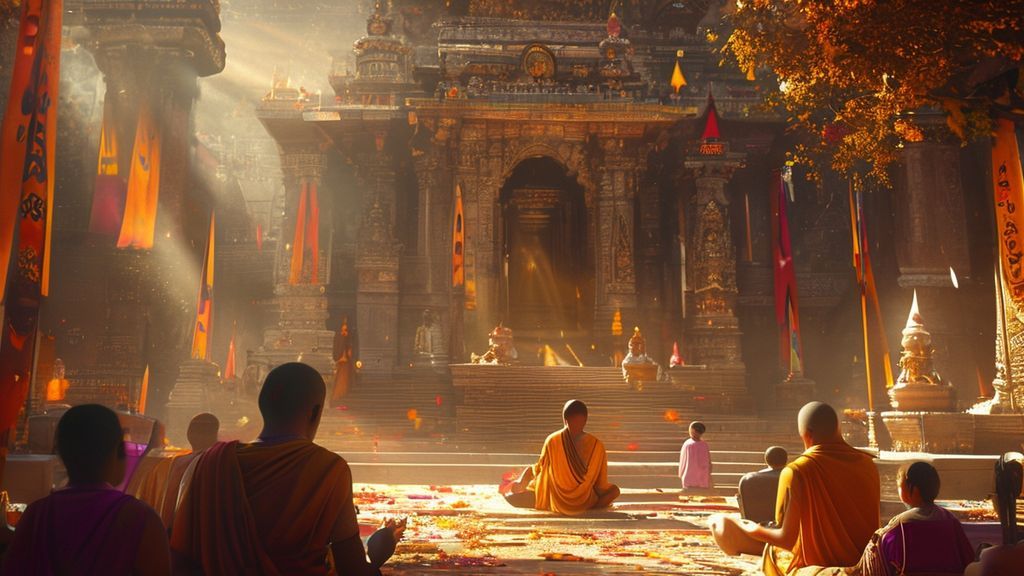
Mindfulness in Hinduism, known primarily as Sati or aspects of Dhyana and Smriti, is an ancient practice deeply embedded in Vedic wisdom, Upanishadic philosophy, and Yogic traditions. It is the cultivation of present-moment awareness, leading to inner tranquility, spiritual discernment, and ultimately, self-realization, as expounded in foundational scriptures like the Bhagavad Gita and Yoga Sutras.
| Attribute | Details |
|---|---|
| Core Concept | Smriti (recollection/awareness), Dhyana (meditation), Sati (mindfulness, particularly in Buddhist derivations from Vedic roots). Focus on present moment, non-judgmental observation. |
| Origin/Source | Vedas, Upanishads, Bhagavad Gita, Yoga Sutras of Patanjali. It is a fundamental aspect of Sanatan Dharma’s spiritual path. |
| Key Practice | Dharana (concentration), Dhyana (meditation), Pranayama (breath control), chanting of Mantras. Integral to daily Sadhana. |
| Scripture Reference | Bhagavad Gita Chapter 6 (Dhyana Yoga), Yoga Sutras of Patanjali (Ashtanga Yoga), Mandukya Upanishad (AUM contemplation), Katha Upanishad (control of senses). |
The Ever-Present Truth: Mindfulness in Sanatan Dharma
In the relentless current of modern existence, the ancient wisdom of Hinduism offers a profound anchor: the practice of mindfulness. Far from being a modern import, mindfulness, or aspects closely akin to it such as Smriti (recollection, awareness) and Dhyana (meditation), lies at the very heart of Sanatan Dharma. It is the foundational skill for all spiritual endeavors, from daily puja to the highest states of samadhi. For a sincere seeker, understanding and integrating these practices is not merely about stress reduction, but about realizing one’s true divine nature, the Atman, and its union with Brahman. This profound journey, articulated in countless scriptures, is designed to bring about an inner transformation that transcends the transient world, offering a pathway to lasting peace and liberation.
The Eternal Pedigree: Puranic History and Scriptural Roots
The concept of mindfulness is not explicitly termed “mindfulness” in the earliest Vedic texts in the modern sense, but its essence is woven throughout the fabric of Hindu thought. The Vedas, particularly the Aranyakas and Upanishads, speak of profound self-inquiry and the need for concentrated awareness to understand the ultimate reality. The famous Chandogya Upanishad’s महावाक्य (Mahavakya) “तत्त्वमसि” (Tat Tvam Asi – Thou Art That) is not merely a philosophical statement but an invitation to mindful introspection, guiding the seeker to realize their identity with Brahman.
The Katha Upanishad (1.3.3-9) provides a powerful analogy: the Atman is the master of the chariot (the body), the intellect (Buddhi) is the charioteer, the mind (Manas) is the reins, the senses (Indriyas) are the horses, and the sense objects are the roads. To navigate this chariot successfully, the charioteer (Buddhi) must be ever-vigilant and mindful, holding the reins (mind) firmly to control the horses (senses). This is a quintessential description of mindful self-governance.
The Bhagavad Gita, often called the “Yoga Shastra,” dedicates an entire chapter (Chapter 6) to Dhyana Yoga, the yoga of meditation, which is fundamentally a practice of mindfulness. Lord Krishna instructs Arjuna: “तत्रैकाग्रं मनः कृत्वा यतचित्तेन्द्रियक्रियः। उपविश्यासने युञ्ज्याद्योगमात्मविशुद्धये॥” (Bhagavad Gita 6.12). This sloka emphasizes concentrating the mind, controlling thoughts and senses, and sitting in an appropriate posture for the purification of the self—a direct teaching on mindful meditation.
Furthermore, the Yoga Sutras of Patanjali delineate the Ashtanga Yoga (eight-limbed path), where Dharana (concentration), Dhyana (meditation), and Samadhi (absorption) are the higher limbs, building upon foundational ethical and physical practices. Pratyahara, the withdrawal of senses from external objects, is a vital step, requiring immense mindful awareness to redirect attention inward. These ancient texts lay bare a sophisticated, millennia-old tradition of cultivating internal awareness, far preceding any modern nomenclature.
The Architecture of Awareness: Inner & Outer Structures
While mindfulness itself isn’t a physical structure like a temple, the principles that govern temple architecture and sacred geometry are deeply mindful in their design, reflecting cosmic order. More profoundly, Hinduism offers an “architecture of awareness” – a meticulously designed framework for the inner life, which is itself a marvel of spiritual engineering. The human subtle body, with its chakras and nadis, is envisioned as an intricate system, which through mindful practices like pranayama and meditation, can be cleansed and activated.
The practice of Yoga, as codified by Patanjali, provides a precise, step-by-step methodology for constructing this inner sanctuary of peace and wisdom. The scientific rigor lies in its experiential, repeatable nature. Just as an engineer builds a stable edifice, a yogi builds a stable mind through consistent practice. The *Bhagavad Gita* (6.20-23) describes the state of the yogi whose mind, disciplined by the practice of yoga, becomes steady and unwavering, like a lamp in a windless place—a testament to the engineering of mental stability through mindfulness. This inner architecture allows the devotee to perceive the divine within and without, aligning their individual consciousness with the universal. Discover more profound insights into these ancient sciences at Hindutva.online.
The Path of Presence: Rituals and Puja Vidhi for Mindfulness
Mindfulness in Hinduism is not confined to seated meditation; it permeates all aspects of spiritual life. Every ritual, every puja, and every daily activity can become an exercise in mindful awareness when performed with the right attitude. Here’s how one can integrate mindful practices:
- Sankalpa (Intention): Begin any practice, be it meditation or puja, by consciously setting a clear, pure intention. This brings your entire being into focus.
- Asana (Posture): Sit in a stable, comfortable meditative posture (e.g., Padmasana, Sukhasana) with a straight spine. This physical alignment aids mental clarity and alertness.
- Pranayama (Breath Control): Practice mindful breathing. Observe the natural rhythm of your breath. Gradually move to structured breathing exercises like Anulom Vilom or Ujjayi. The breath is a primary anchor for the mind.
- Pratyahara (Sense Withdrawal): Consciously withdraw your senses from external distractions. Close your eyes gently. Acknowledge sounds without engaging with them. Focus inward.
- Dharana (Concentration): Choose a single object of focus—it could be the breath, a mantra, or an image of your Ishta-Devata. Gently bring the mind back whenever it wanders. This develops the muscle of attention.
- Dhyana (Meditation): As concentration deepens and becomes effortless, it transitions into Dhyana. Here, there is a continuous flow of awareness towards the object, without interruption. This is the state of sustained mindfulness.
- Chanting and Arati: During puja, chant mantras with full awareness of their sound, meaning, and vibration. Perform arati with complete devotion, observing the flame, the incense, and the deity with mindful reverence.
- Seva (Selfless Service): Perform all actions, especially acts of service, with full attention and an attitude of offering to the Divine. This transforms mundane tasks into spiritual practice.
Echoes of Eternity: Mantras for Mindful Awareness
Mantras are powerful tools for cultivating mindfulness, as they provide a focal point for the wandering mind and resonate with spiritual energy. Chanting them with awareness grounds the practitioner in the present moment.
- Om (ॐ): The primordial sound, representing Brahman. Chanting Om brings the mind to a state of stillness and universality. It is the sound of cosmic vibration.
- Gayatri Mantra: “ॐ भूर् भुवः स्वः तत् सवितुर्वरेण्यं भर्गो देवस्य धीमहि धियो यो नः प्रचोदयात्॥” (Om Bhur Bhuvah Svah Tat Savitur Varenyam Bhargo Devasya Dheemahi Dhiyo Yo Nah Prachodayat). This sacred mantra invokes the divine light to enlighten the intellect. Chanting it mindfully cultivates wisdom and sharpens awareness.
- Soham (सोऽहम्): “I am That.” This mantra, often integrated with breath (So on inhale, Ham on exhale), aligns the individual self with the Supreme Self, fostering a continuous awareness of one’s true nature.
- Nama Japa: Repeating the name of your Ishta-Devata (e.g., “Om Namah Shivaya,” “Om Namo Narayanaya,” “Om Shri Ramaya Namah,” “Hare Krishna Hare Krishna Krishna Krishna Hare Hare / Hare Rama Hare Rama Rama Rama Hare Hare”). This constant remembrance keeps the mind absorbed in the divine, making every moment an act of devotion and mindfulness.
The Inner Compass: Dos and Don’ts for the Mindful Devotee
To truly embrace mindfulness within the Hindu tradition, certain ethical and practical considerations are paramount:
- Do Practice Consistency: Regularity, even for short durations, is more beneficial than sporadic long sessions. Build a daily routine (sadhana).
- Do Cultivate Detachment (Vairagya): Learn to observe thoughts and emotions without judgment or attachment. Let them pass like clouds in the sky.
- Do Observe Yama and Niyama: Adhere to ethical principles like non-violence (Ahimsa), truthfulness (Satya), contentment (Santosha), and self-study (Svadhyaya), as these purify the mind for deeper practice.
- Do Seek Guidance: If possible, learn from an experienced Guru or teacher who can provide personalized instruction and clarify doubts.
- Don’t Force It: Mindfulness is not about suppressing thoughts, but about gently redirecting attention. Be patient and compassionate with yourself.
- Don’t Expect Instant Results: Spiritual progress is gradual. Remain steadfast in your practice, trusting the process of inner transformation.
- Don’t Confuse Mindfulness with Escapism: True Hindu mindfulness leads to greater engagement with life and duties (Dharma) from a place of clarity and peace, not avoidance.
- Don’t Neglect Physical Well-being: A healthy body supports a healthy mind. Maintain a sattvic diet and incorporate appropriate physical exercise.
Frequently Asked Questions on Hindu Mindfulness
Is Mindfulness a new concept adopted by Hinduism from other traditions?
No, mindfulness, in its essence as present-moment awareness, focused attention, and internal observation, is an ancient and intrinsic part of Sanatan Dharma. Its principles are deeply rooted in the Vedas, Upanishads, Bhagavad Gita, and Yoga Sutras, long predating modern mindfulness movements. While terminology may differ, the practice and its spiritual goals are foundational to Hindu spirituality.
How does Hindu mindfulness differ from secular mindfulness or Buddhist mindfulness?
While the techniques of cultivating present-moment awareness may appear similar, Hindu mindfulness is intrinsically woven into the spiritual fabric of Sanatan Dharma. Its ultimate aim is not just stress reduction or improved focus, but Moksha (liberation), Atma-Jnana (Self-realization), and Brahma-Jnana (knowledge of the Absolute Truth). It is often integrated with devotion (Bhakti), karma yoga, and jnana yoga, and is guided by the philosophy of the Vedas and Upanishads, emphasizing the eternal Atman and Brahman.
Can anyone practice mindfulness in the Hindu tradition, regardless of their background?
Absolutely. The core practices of mindfulness, such as mindful breathing, concentration, and observing thoughts, are universal and can benefit anyone. While a deeper understanding and integration into the full scope of Sanatan Dharma enriches the practice profoundly, the foundational techniques are accessible to all sincere seekers. Many spiritual teachers within Hinduism welcome individuals from all backgrounds to learn and practice these techniques.
What are the practical benefits of practicing Hindu mindfulness in daily life?
Beyond spiritual growth, consistent practice of Hindu mindfulness offers numerous practical benefits. It enhances concentration, reduces mental agitation, improves decision-making, fosters emotional balance, and cultivates a deeper sense of peace and contentment. It helps devotees perform their duties (Dharma) with greater clarity and efficiency, leading to a more harmonious and purposeful life.
Embracing the Present: Why This Matters for Every Hindu
The cultivation of mindfulness is not merely a spiritual luxury; it is an absolute necessity for every Hindu seeking to live a life aligned with Dharma. In an age of unprecedented distraction and mental fragmentation, returning to the ancient practice of presence allows us to reconnect with our inner divinity, the Atman. It is through sustained awareness that we can truly understand the profound teachings of our scriptures, integrate them into our being, and experience the transformative power of Sanatan Dharma. Mindfulness empowers us to navigate life’s challenges with wisdom, to perform our actions with sincerity, and to ultimately achieve the highest goal of human existence: liberation from suffering and union with the Divine. By embracing these timeless practices, we not only enrich our individual lives but also contribute to the preservation and flourishing of the eternal Dharma, ensuring its light continues to guide future generations. For further exploration of these deep truths, visit Hindutva.online.