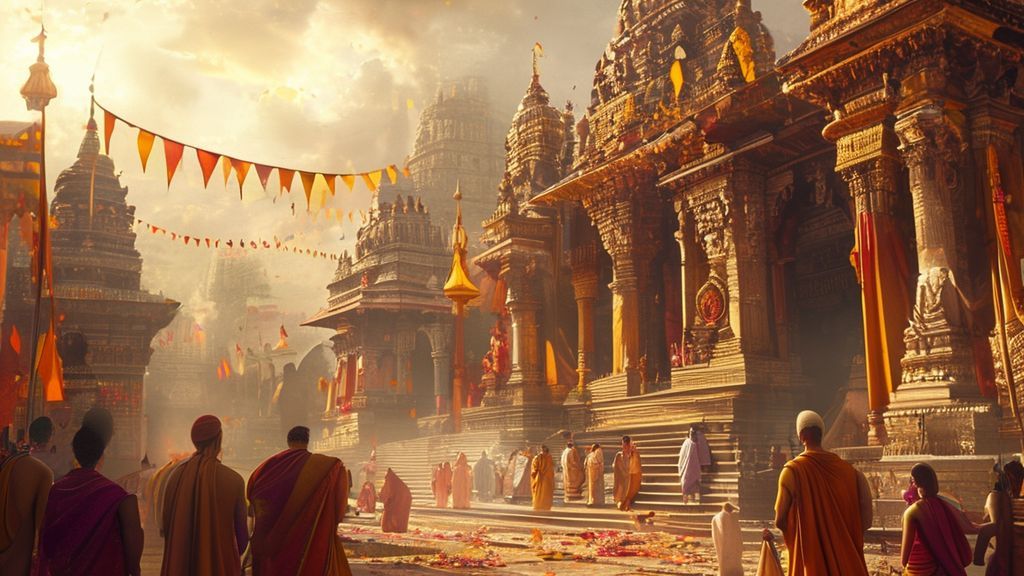
Odia Hindu Culture’s Jagannath Temple Traditions represent a vibrant, living testament to Sanatan Dharma, centering around Lord Jagannath, Balabhadra, and Subhadra in Puri. These unique practices, rooted in the Skanda Purana, embody a syncretic devotion, democratic spirit, and a profound daily ritualistic life that culminates in the world-renowned Ratha Yatra, preserving ancient spiritual heritage.
| Attribute | Details |
|---|---|
| Deity | Lord Jagannath (Krishna), Balabhadra (Balarama), Subhadra (Sister), Sudarshana Chakra |
| Location/Origin | Puri, Odisha, India |
| Key Festival | Ratha Yatra (Chariot Festival), Snana Yatra, Navakalevara |
| Scripture Reference | Skanda Purana (Utkala Khanda), Brahma Purana, Narada Purana |
Introduction to the Abode of Lord Jagannath
The Jagannath Temple in Puri, Odisha, stands as one of the most sacred and distinctive pilgrimage sites within Sanatan Dharma, embodying a profound spiritual and cultural significance. More than just a temple, it is a living universe of unique traditions, rituals, and philosophical tenets that have shaped Odia Hindu culture for millennia. The presiding deities—Lord Jagannath, His elder brother Lord Balabhadra, and His sister Devi Subhadra—are worshipped in a truly unique form, as wooden effigies known as Daru Brahma. This sacred complex is a vibrant confluence of Vaishnavism, Shaktism, Shaivism, and tribal traditions, reflecting an inclusive and democratic spirit that welcomes all, irrespective of caste or creed, to partake in the divine grace. The traditions here are not mere historical relics but a dynamic, uninterrupted stream of devotion that continues to inspire millions across the globe.
Puranic History & Divine Legend
The origin of Lord Jagannath and His siblings is shrouded in divine mystique, primarily detailed in the Skanda Purana’s Utkala Khanda and sections of the Brahma Purana and Narada Purana. The legend begins with King Indradyumna of Avanti, a great devotee of Lord Vishnu. He yearned to see the Lord’s original form, which was worshipped by the tribal chief Vishwavasu as Nila Madhava. When the King’s Brahmin priest, Vidyapati, located Nila Madhava, the deity miraculously vanished.
Distraught, King Indradyumna was instructed by a divine voice to await the manifestation of the Lord in the form of a log of wood floating in the sea. This sacred log, known as Daru Brahma, contained the divine essence. The King arranged for the carving of the deities, and the celestial architect, Vishwakarma (or sometimes identified as Lord Vishnu Himself in the guise of an old carpenter), undertook the task under the condition that he not be disturbed until his work was complete. Impatient and concerned, King Indradyumna’s wife, Gundicha, opened the doors prematurely, revealing the deities in their unfinished state, without hands or feet.
However, a divine voice proclaimed that the Lord wished to remain in this form, symbolizing His boundless nature that transcends physical limitations. Thus, Lord Jagannath, Balabhadra, and Subhadra were installed, representing the continuity of divine presence from a tribal deity to a universally revered form. This narrative underscores the profound spiritual journey and the syncretic nature of the Jagannath cult, bringing together diverse spiritual streams.
Architectural & Scientific Marvels of the Puri Temple
The Jagannath Temple in Puri, often referred to as “Srimandira,” is an architectural masterpiece of the Kalinga style, a distinct sub-style of Nagara architecture. Constructed in the 12th century by King Anantavarman Chodaganga Deva and later completed by King Ananga Bhima Deva, its grandeur is breathtaking. The temple complex is enclosed by two massive walls, the outer Meghanada Pacheri and the inner Kurma Bheda. The main temple stands on a high platform, rising to a height of approximately 214 feet (65 meters).
The temple’s structure consists of four main chambers arranged axially: the Vimana (sanctum sanctorum or Deul), the Jagamohan (audience hall), the Nata Mandapa (dancing hall), and the Bhoga Mandapa (offerings hall). The Vimana, with its curvilinear tower (rekha deul), is adorned with intricate carvings depicting celestial beings, mythological scenes, and tantric motifs. A significant architectural marvel is the temple’s flag, the Nilachakra (Blue Chakra), which always flies against the wind direction—a phenomenon that has baffled scientists and is attributed to divine power.
Beyond its aesthetic appeal, the temple incorporates remarkable engineering feats. The absence of a shadow of the main dome, irrespective of the time of day, is another inexplicable wonder. The temple’s acoustics are designed to amplify chants, and its unique kitchen, reputedly the largest in the world, can feed thousands daily through a traditional cooking process that involves placing pots one above another, with the top pot cooking first. These marvels highlight not just ancient Indian architectural prowess but also a profound understanding of science and spiritual design.
Rituals & Puja Vidhi: The Living Tradition
The daily life within the Jagannath Temple is governed by an elaborate and meticulous schedule of rituals, known as Niti, performed by various classes of servitors (Sevakas). There are over 100 rituals performed daily, starting from the crack of dawn until late into the night. The day begins with Mangala Arati, followed by Mailam (changing clothes), Rosha Homa (sacred fire ritual in the kitchen), and Surya Puja.
The deities are offered six different meals (Bhoga) throughout the day, known as Sakala Dhupa, Madhyahna Dhupa, Sandhya Dhupa, Bada Singhara Bhoga, and others. These offerings eventually become the sacred Mahaprasad, considered the Lord’s grace and consumed by all devotees without discrimination. The process of preparing Mahaprasad in the temple kitchen is unique, using specific earthen pots and firewood, symbolizing purity and sanctity.
Major annual festivals punctuate the temple’s ritual calendar. The Snana Yatra (Bathing Festival) precedes the main Ratha Yatra, where the deities are bathed with 108 pots of sacred water, after which they go into a seclusion period called Anavasara. The most famous festival, the Ratha Yatra, involves the deities embarking on a majestic chariot procession to the Gundicha Temple, their birth home, symbolizing their journey to meet their devotees. Every 8 to 19 years, depending on astronomical calculations, the Navakalevara ritual takes place, where the old wooden deities are replaced by new ones carved from sacred Neem wood (Daru), a profound spiritual renewal and a testament to the living nature of the tradition. Devotees can learn more about these fascinating practices on Hindutva.online.
Mantras & Chants for Lord Jagannath
Devotion to Lord Jagannath is often expressed through powerful mantras and chants that invoke His divine presence and seek His blessings. The simplest and most common mantra is:
ॐ जगन्नाथाय नमः (Om Jagannathaya Namah)
This universal mantra can be chanted by all devotees seeking the Lord’s grace. For deeper meditation and spiritual connection, the Jagannath Gayatri Mantra is highly revered:
ॐ दशरथाय विद्महे सीता वल्लभाय धीमहि तन्नो रामः प्रचोदयात्॥
A variant specific to Jagannath is also popular:
ॐ पद्मनाभाय विद्महे सहस्त्रचक्राय धीमहि तन्नो जगन्नाथ प्रचोदयात्॥
Another significant chant is the Mahamantra or Hare Krishna Mahamantra, as Lord Jagannath is identified with Lord Krishna:
हरे कृष्ण हरे कृष्ण कृष्ण कृष्ण हरे हरे ।
हरे राम हरे राम राम राम हरे हरे ॥
Chanting these mantras with sincerity purifies the mind, fosters devotion, and connects the devotee directly with the Supreme Being, Lord Jagannath, who is considered Purushottama, the Supreme Person.
Dos and Don’ts for Devotees
Adhering to certain customs and etiquette is crucial for devotees visiting the Jagannath Temple or observing its traditions:
- Do dress modestly, covering shoulders and knees, as a mark of respect for the sacred space.
- Do offer sincere prayers and maintain reverence while inside the temple premises.
- Do partake in Mahaprasad; it is considered sacred and should not be wasted or treated as ordinary food.
- Do remove your footwear before entering the temple or any sacred areas.
- Do maintain silence and decorum, especially during puja timings.
- Don’t carry leather articles, cameras, or mobile phones inside the main temple premises (specific storage facilities are available).
- Don’t consume non-vegetarian food or intoxicants before visiting the temple.
- Don’t touch the deities or attempt to climb the chariots during Ratha Yatra without proper authorization; observe from a respectful distance.
- Don’t engage in loud conversations, arguments, or disrespectful behavior.
- Don’t litter the temple premises; help maintain its sanctity and cleanliness.
Frequently Asked Questions About Jagannath Traditions
Why are the Jagannath deities made of wood and incomplete?
The wooden deities (Daru Brahma) symbolize the impermanence of the physical body and the eternal nature of the soul. Their “incomplete” form, without hands and feet, represents the Lord’s transcendental nature (Nirguna Brahman), signifying that He is beyond all material attributes and limitations, yet His divine grace pervades everything. This unique form also connects to ancient tribal traditions of worshipping tree deities.
What is the significance of Mahaprasad?
Mahaprasad is the sanctified food offered to Lord Jagannath and then distributed to devotees. It is considered sacred because it has been blessed by the Lord Himself, purifying anyone who consumes it. Its significance lies in its power to remove sins, bestow liberation, and foster spiritual growth, transcending caste barriers and promoting equality as all partake of the same divine offering.
What is Navakalevara, and how often does it occur?
Navakalevara (literally, “New Body”) is a rare and highly sacred ritual where the old wooden deities of Jagannath, Balabhadra, Subhadra, and Sudarshana are replaced with newly carved ones. This event occurs when a “double Ashadha” month falls in the Hindu lunar calendar, typically every 8, 12, or 19 years. It is a profound process of spiritual renewal, signifying the cyclical nature of creation and destruction, life and rebirth, and the continuous manifestation of the divine.
Are non-Hindus allowed inside the Jagannath Temple?
Historically and by long-standing tradition, entry into the Jagannath Temple in Puri is restricted to Hindus. This policy, stemming from various historical contexts, including invasions and attempts to protect the deity, is maintained to preserve the sanctity and traditional practices of the temple. However, the spirit of Jagannath’s devotion and the message of universal love are open to all, and non-Hindus can witness the grandeur of Ratha Yatra from outside the temple precincts or explore the rich theological discussions at Hindutva.online.
Dharmic Significance: Why This Matters for Every Hindu
The Jagannath Temple traditions are not merely a regional phenomenon but a profound pillar of Sanatan Dharma, offering invaluable lessons for every Hindu. They embody the principle of Sarva Dharma Sambhava (equality of all religions and spiritual paths) through their syncretic origins, embracing Vaishnavism, Shaivism, Shaktism, and tribal spiritual elements. The unique wooden form of the deities challenges conventional iconography, reminding devotees that the Divine is boundless and transcends all material conceptions. The emphasis on Mahaprasad promotes social equality, where everyone partakes of the Lord’s grace without distinction, fostering a sense of community and oneness.
Furthermore, the uninterrupted daily rituals and the spectacular Ratha Yatra exemplify the vibrant, living nature of Sanatan Dharma, demonstrating how ancient traditions can remain relevant and inspiring through centuries. The cyclical renewal of Navakalevara teaches us about impermanence and rebirth, essential philosophical tenets. By preserving and understanding these traditions, we not only honor our rich heritage but also reinforce the universal values of devotion, inclusivity, and spiritual liberation that are at the heart of Sanatan Dharma, ensuring their continuity for future generations.