The question of whether Shiva or Vishnu is supreme in Hindu thought has no single canonical answer, because the answer depends on which scriptural and devotional tradition the question is asked within. The Shaiva tradition (with the Shiva Purana, the Linga Purana, the Skanda Purana, and the Kashmir Shaiva texts as principal sources) holds Shiva as the supreme reality, with Vishnu and Brahma as functional aspects. The Vaishnava tradition (with the Bhagavata Purana, the Vishnu Purana, and the Pancharatra texts as principal sources) holds Vishnu as the supreme reality, with Shiva and Brahma in subsidiary roles. The Smarta tradition, articulated by Adi Shankara in the 8th century, holds all five (Shiva, Vishnu, Devi, Ganesha, Surya) as equal aspects of the single Brahman and worships the Panchayatana set together. This article walks through how each tradition argues its case and where the cross-tradition reconciliations sit.
The Shaiva argument: Shiva as Para-Brahman
The Shaiva tradition argues that Shiva is the absolute reality (Para-Brahman) and that the Trimurti (Brahma, Vishnu, Shiva) describes three functional aspects of Shiva himself. The Linga Purana 17 and the Shiva Purana, Vidyesvara Samhita 7-9, contain the cosmic-linga narrative: Brahma and Vishnu argued over supremacy, Shiva appeared as an infinite fiery linga (the jyotirlinga) between them, and neither could find its end. The narrative is the principal Shaiva proof-text. Shiva-as-the-pillar is not contained by either Brahma or Vishnu; the implication is that Brahma and Vishnu are bounded forms within Shiva, who is the unbounded reality.
Kashmir Shaivism, articulated by Abhinavagupta (10th-11th century) in the Tantraloka and the Paratrimshika Vivarana, gives the philosophical version of the same argument. Shiva is the supreme consciousness; the universe is Shiva’s self-perception; everything that exists (including Vishnu and Brahma) is a vibration (spanda) within Shiva’s awareness. The Pratyabhijna school within Kashmir Shaivism is the most developed Shaiva philosophical system on supremacy.
The Vaishnava argument: Vishnu as Purushottama
The Vaishnava tradition argues that Vishnu is the supreme person (Purushottama) and that Shiva and Brahma are subsidiary aspects who emerged from him. The Bhagavata Purana 1.3.28 contains the most direct Vaishnava proof-text: “krishnastu bhagavan svayam” (“Krishna is the lord himself”). Vaishnava commentary reads this as placing Krishna (and Vishnu, of whom Krishna is the full avatar) as the original source, with all other deities as projections. The Bhagavad Gita 10.20 has Krishna identify himself as the source of all gods: “I am the self seated in the heart of all beings; I am the beginning, the middle, and the end of beings.”
The Pancharatra tradition, the Sri Vaishnavas (after Ramanuja, 11th century), and the Madhva tradition (after Madhvacharya, 13th century) all elaborate the Vaishnava case in different forms. The Madhva position is the most uncompromising: Vishnu is the only supreme; Shiva is decisively subordinate. The Sri Vaishnava position holds Shiva in high regard but as a subsidiary deity who himself worships Vishnu. The Gaudiya Vaishnava position (Chaitanya, 16th century) holds Shiva as the greatest of Vaishnavas (the model devotee of Krishna).
The Smarta synthesis: Panchayatana puja
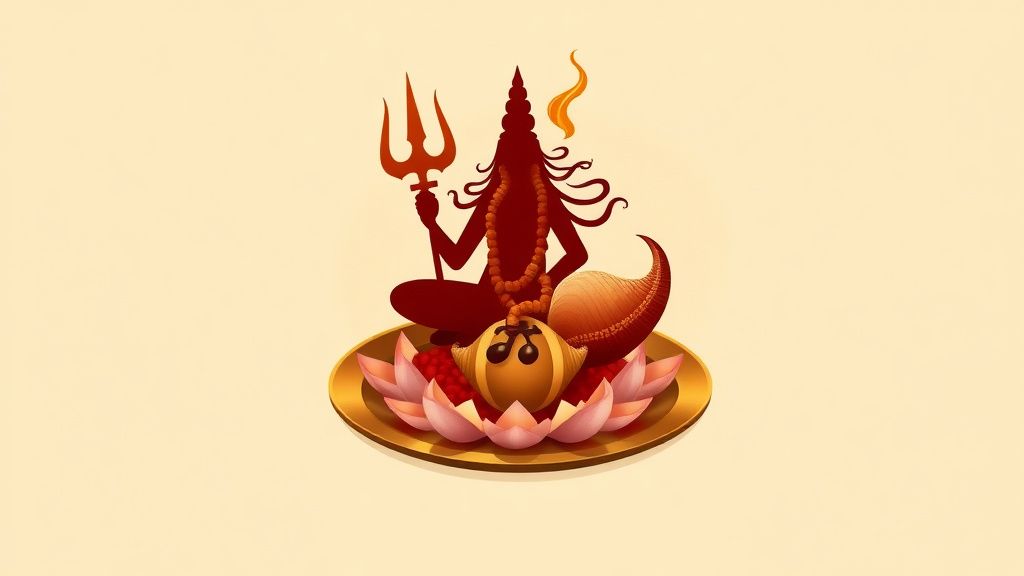
Adi Shankara, the 8th-century Advaita Vedanta master, took a different position. The Smarta tradition he systematised treats Shiva, Vishnu, Devi, Ganesha, and Surya as five aspects of the single non-dual Brahman. The Panchayatana puja arrangement places five small representative murtis or stones (a linga for Shiva, a saligrama for Vishnu, a kumkum-bindu for Devi, a copper coin for Surya, a red stone for Ganesha) on a single tray and worships all five together. The arrangement is the lived expression of the Smarta position: no one of the five is supreme; all are forms of the underlying Brahman.
Shankara’s own hymns are addressed to all major deities; the Saundarya Lahari to Devi, the Shivanandalahari to Shiva, the Bhaja Govindam to Vishnu. The Smarta tradition reads these as illustrating that the devotee may approach any of the five with full devotion because each contains the same Brahman. The position is the principal Hindu reconciliation of the Shaiva-Vaishnava dispute and is still the dominant tradition in much of south India among Brahmin householders.
Where the texts admit the other side
Both the Shaiva and Vaishnava canons contain passages that acknowledge the other deity:
- Skanda Purana, Bhagavata Mahatmya: “He who is Shiva is Vishnu, he who is Vishnu is Sadashiva.” The verse is one of the most cited cross-tradition reconciliations.
- Vishnu Sahasranama: the thousand names of Vishnu include Rudra, Sthanu, Sharva, Bhima and other names traditionally given to Shiva.
- Shiva Sahasranama (in the Mahabharata, Anushasana Parva): the thousand names of Shiva include Vishnu, Narayana, Madhava and other names traditionally given to Vishnu.
- Harihara iconography: a single deity with the right half as Shiva and the left half as Vishnu. The form is depicted at temples like Lepakshi (Andhra Pradesh) and is the iconographic expression of the cross-tradition reconciliation.
For what it’s worth, the most useful reading of the Shiva-vs-Vishnu question for a contemporary Hindu reader is that the question is itself misframed. Both traditions are arguing about which deity is the highest aspect of the same single reality. The Shaiva tradition centres Shiva, the Vaishnava tradition centres Vishnu, and the Smarta tradition refuses to choose. None of the three treats the other deity as false or unreal. The lived practice in most Hindu households does not choose either; the Shaiva temple is visited on Maha Shivaratri, the Vaishnava temple on Janmashtami, and the household altar may include both murtis.
Cosmic functions: the working division
Outside the supremacy question, the working division of cosmic functions is broadly agreed across all three traditions:
- Brahma: creator; brings the universe into being at the start of each Kalpa.
- Vishnu: preserver; maintains the universe through the Kalpa, takes avatars to restore dharma when it declines.
- Shiva: dissolver; ends the universe at the close of each Kalpa, also the principle of yogic transformation in individual life.
This Trimurti distribution is the standard pedagogical answer to “what does each god do” and is functionally the same across traditions. The supremacy dispute is about which of the three is the source of the others (the unmoved mover, the absolute Brahman), not about the day-to-day functions, which are uncontested.
The Vaishnava-Shaiva conflict in history
Historical conflict between Shaivas and Vaishnavas in south India was real and at times violent, particularly in the medieval period (10th-14th centuries). The Chola kings were predominantly Shaiva; the Pallavas before them were mixed; the Vijayanagara empire (14th-17th centuries) was predominantly Vaishnava but maintained major Shaiva temples. The Tamil Nayanmar (Shaiva) and Alvar (Vaishnava) saints of the 6th-9th centuries each composed devotional poetry that occasionally took up the supremacy question; some of the more polemical hymns argue the case for one deity against the other. By the 16th century the Madhva-Smarta debates in Karnataka had given the question a philosophical rather than political form. The 19th-20th-century Hindu reform movements (Brahmo Samaj, Arya Samaj, Ramakrishna Mission) generally bypassed the question by treating both as forms of the same Brahman.
Common questions
Are the Trimurti three separate gods or three aspects of one?
It depends on the tradition. In Shaiva tradition, all three are aspects of Shiva. In Vaishnava tradition, all three are aspects of Vishnu (or, for Madhva, only Vishnu is supreme and the other two are clearly distinct deities subordinate to him). In Smarta tradition, all three plus Devi, Ganesha and Surya are aspects of the single non-dual Brahman. Most contemporary Hindu practice does not require choosing a single answer and the Trimurti is treated functionally as a working division of cosmic labour.
Did Shiva and Vishnu ever fight?
Several Puranic narratives describe encounters between Shiva and Vishnu, usually ending with mutual recognition rather than victory. The Vishnu Purana describes Vishnu (as Mohini) tempting Shiva. The Shiva Purana describes Shiva and Vishnu fighting briefly during the Tripurari narrative before recognising each other. The Skanda Purana includes the cosmic-linga episode in which Vishnu accepts Shiva’s supremacy. None of the canonical encounters ends with one defeating the other in a contest of power; the encounters end with theological clarification.
Which tradition has more followers today?
Both Shaivism and Vaishnavism have large followings across India. Vaishnavism is broadly more numerous, particularly through the Krishna and Rama traditions in north India and through the Sri Vaishnava and Madhva communities in south India. Shaivism is dominant in much of Tamil Nadu, parts of Karnataka and Andhra Pradesh, in Kashmir, and in Nepal. The Smarta tradition cuts across both. Estimates of relative numbers vary depending on whose lived practice is counted; the simple count is misleading because most households practice elements of both.
One limitation worth noting
This article presents the supremacy question as it is argued within each tradition’s own canon, without taking a side. The choice between Shaiva, Vaishnava, and Smarta positions is a matter of theological commitment and not one a neutral exposition can resolve. The cross-tradition reconciliations (Harihara, the Skanda Purana verse, the Panchayatana puja) are themselves theological positions and not neutrally above the dispute. Readers committed to one tradition will find this article incomplete; readers seeking to understand all three should consult the principal texts of each.
For deeper textual treatment, see the Wikipedia entry on the Trimurti and on Harihara as the iconographic reconciliation.