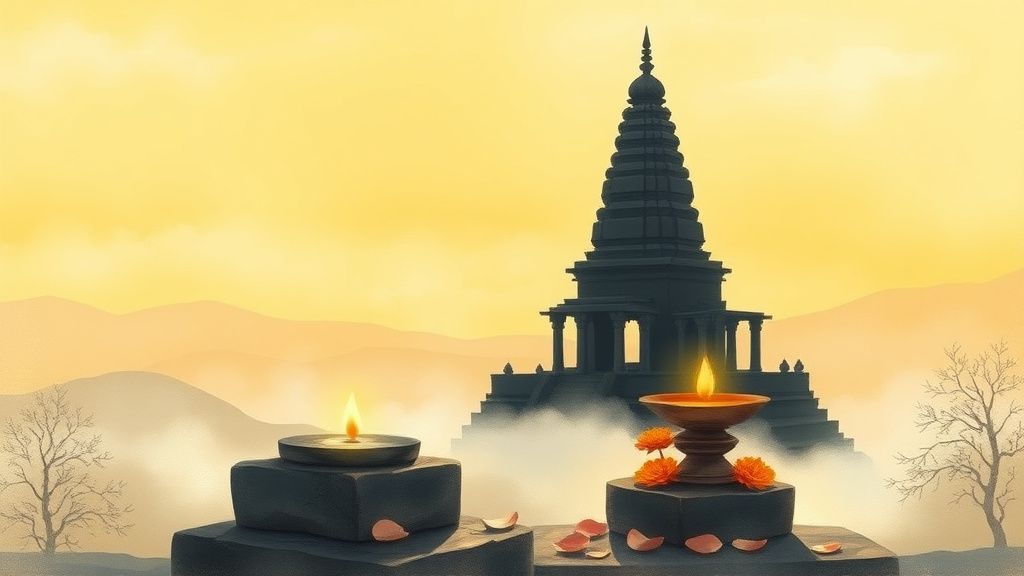
Odia Hindu culture is organised around the Jagannath Temple at Puri, one of the Char Dham pilgrimages identified by Adi Shankara, and the broader temple-and-festival cycle of coastal Odisha. The Jagannath cult is unusual within Hinduism for several reasons: the deities are wooden, not stone or metal; they are replaced every twelve to nineteen years in the Nabakalebara ritual; the temple is one of the few major shrines to admit only Hindus to its sanctum; and the annual Ratha Yatra in June or July sees the three deities (Jagannath, Balabhadra and Subhadra) leave the temple on enormous chariots that millions of devotees pull through the streets of Puri. Odisha’s other major Hindu sites, the Lingaraj Temple at Bhubaneswar and the Sun Temple at Konark, together with Jagannath at Puri, form the Swarna Tribhuja (“Golden Triangle”) of Odia religious tourism.
The Jagannath Temple at Puri
The temple as it stands was built in the 12th century by King Anantavarman Chodaganga of the Eastern Ganga dynasty (reign 1078–1147) and completed by his successor Anangabhima Deva III in 1230. It stands on the Bada Danda (Grand Road) in Puri, 60 kilometres south of Bhubaneswar. The temple’s main shikhara rises 65 metres (214 feet), making it one of the tallest temple towers in eastern India. The complex covers about 4 hectares and contains over 30 subsidiary shrines.
Four distinctive features set the Jagannath cult apart:
- Wooden murtis: the three deities (Jagannath, his elder brother Balabhadra, and their sister Subhadra) are carved from neem wood, with painted faces and large eyes. Their form is geometric rather than naturalistic, recalling earlier tribal Sabara religious imagery.
- Nabakalebara renewal: the wooden murtis are replaced every 12 to 19 years (depending on the lunar calendar; the gap is set by the occurrence of a leap month of Ashadha). The most recent Nabakalebara was in 2015. The ritual involves identifying specific neem trees marked with auspicious signs, carving new murtis in secrecy, and transferring the brahma padartha (the soul-substance) from old to new.
- Mahaprasad system: the temple’s kitchen serves mahaprasad, a 56-item offering (the chappan bhog) made fresh daily on wood-fired clay stoves and distributed without caste distinction in the Ananda Bazaar dining area. The kitchen feeds tens of thousands daily and is among the largest temple kitchens in the world.
- Daitapati priesthood: alongside the Brahmin sevayats, the temple has a separate community of Daitapati priests of mixed-caste tribal-Brahmin descent, who handle the deities directly during the Nabakalebara, the bathing rituals, and the Ratha Yatra. The dual-priesthood structure preserves the tradition’s tribal origins.
Ratha Yatra: the chariot festival
The Ratha Yatra is held annually in the lunar month of Ashadha (June or July), on the second day after the new moon. The festival commemorates the deities’ journey from the Jagannath Temple to the Gundicha Temple, about 3 kilometres distant, where they stay for nine days before returning. Three new chariots are constructed every year for the festival, dismantled and rebuilt from fresh wood.
- Nandighosa: Jagannath’s chariot, 13.5 metres tall, with 16 wheels, painted yellow and red.
- Taladhwaja: Balabhadra’s chariot, 13.2 metres tall, with 14 wheels, painted blue and red.
- Darpadalana (also Devadalana): Subhadra’s chariot, 12.9 metres tall, with 12 wheels, painted black and red.
The chariots are pulled by devotees down the Bada Danda using thick coir ropes. The signature ritual moment is the Chhera Pahara: the Gajapati king of Puri (a hereditary office, currently held by Maharaja Dibyasingha Deb) appears dressed as a sweeper, with a golden broom in hand, and sweeps the chariot platforms with sandalwood water. The Gajapati’s ritual sweeping enacts the principle that before Jagannath all are equal: a king is no different from a sweeper.
The deities stay at the Gundicha Temple for nine days; the return journey, Bahuda Yatra, brings them back to the main temple. The total festival cycle, from Snana Yatra (the preliminary bathing in early Ashadha) through the Niladri Bije (the deities’ formal re-entry into the main temple), runs across roughly six weeks.
The Swarna Tribhuja: Puri, Bhubaneswar, Konark
Three major sites in coastal Odisha form a roughly equilateral triangle and are commonly visited together:
- Puri: Jagannath Temple, 12th century, the principal pilgrimage centre.
- Bhubaneswar: the capital city, called the “temple city” for its concentration of over 700 temples from the 7th to 13th centuries. The principal shrine is the Lingaraj Temple (c. 1100 CE), dedicated to Shiva as Tribhuvaneshwar; the Mukteshwar Temple (10th century) is the smaller but architecturally celebrated example. Bhubaneswar’s temples are organised along the Bindu Sagar tank.
- Konark: the Sun Temple, built around 1250 CE by King Narasimhadeva I of the Eastern Ganga dynasty, designed as the chariot of the Sun god Surya pulled by seven horses, with twelve pairs of stone wheels. The main vimana collapsed centuries ago; the Jagamohan porch and the surrounding sculptural panels remain. Konark is a UNESCO World Heritage Site (1984).
The three sites can be visited in a two- or three-day circuit from Bhubaneswar; the distances are short (Bhubaneswar to Konark 64 km; Konark to Puri 35 km; Puri to Bhubaneswar 60 km).
Odia religious literature and the Bhagavata tradition
Odia religious literature is dominated by two strands. The 16th century poet Jagannath Das composed the Odia Bhagavata, a Krishna-bhakti rendering of the Sanskrit Bhagavata Purana in Odia, which became the principal devotional text recited daily in Odia households and temple courtyards. The earlier 15th century saint-poet Sarala Das produced the Odia Mahabharata, the first Odia retelling of the Mahabharata; Balaram Das composed the Odia Ramayana (the Jagamohana Ramayana). These three vernacular epics formed the basis of Odia bhakti devotion and remain the principal recited texts in non-elite religious practice.
Jayadeva’s 12th century Sanskrit Gita Govinda, written by an Odia poet (though in Sanskrit), is the lyrical Krishna-Radha text most strongly associated with Odisha; selected ashtapadis are sung daily inside the Jagannath Temple as part of the bhitara gaayani service.
For what it’s worth, on attending the Ratha Yatra
For what it’s worth, the Ratha Yatra is one of the largest gatherings of pilgrims in India, with crowds of around a million on the procession day. The Bada Danda is closed to vehicles, body density on the road is high, and the rush during chariot stops is intense. Visitors who want to participate without being in the crush should pick the second or third day of the chariot stationing at Gundicha rather than the first-day pulling, or watch the Bahuda Yatra return journey, which has a similar atmosphere with marginally lower density. Booking accommodation in Puri three to six months in advance for any Ashadha-month date is sensible; the town is fully occupied during the festival.
Common questions
Why are non-Hindus not allowed inside the Jagannath Temple?
The Jagannath Temple is one of a small number of major temples (along with the Padmanabhaswamy Temple in Thiruvananthapuram and Guruvayur in Kerala, among others) that restrict entry to Hindus. The restriction has been challenged legally and politically over decades; the temple management has maintained the policy. Visitors who are not Hindu can view the chariots during the Ratha Yatra (the deities are then publicly outside the temple), see the Bhitara Pavithra view from a designated platform, and visit the surrounding Puri town and other temples.
Why are the murtis incomplete-looking?
The murtis lack the elaborate naturalistic modelling of most temple deities. The traditional explanation, the Indradyumna legend recorded in the Skanda Purana, says that the divine sculptor Vishwakarma agreed to carve the murtis on condition that no one watched him; King Indradyumna lost patience and looked in before the work was finished, leaving the murtis in their present state. Historians read the form as preserving older Sabara tribal religious imagery absorbed into the Jagannath cult during the 8th to 12th centuries. Either reading explains the unusual geometric form.
What is the Nabakalebara and when does it happen next?
Nabakalebara (“new body”) is the periodic replacement of the wooden murtis. It occurs in years that have an additional intercalary month of Ashadha (an Adhika Masa Ashadha) in the lunar calendar. The most recent Nabakalebara was in 2015; the next is expected in 2034. The ritual takes around three months from the search for the trees to the consecration of the new murtis.
A limitation worth noting
This article covers the temple-centred Hindu culture of coastal Odisha (the Jagannath cult and the Bhubaneswar-Puri-Konark triangle). Odisha’s religious life also includes substantial tribal communities (Santal, Ho, Munda, Saora and others) with their own religions, some of them now syncretised with Hindu practice; the Adivasi-Hindu interaction is a major area in its own right. The state’s interior districts (Kalahandi, Koraput, Sambalpur) preserve distinct religious traditions beyond the coastal Jagannath frame.
For further reading, the Jagannath Temple, Puri entry on Wikipedia covers the temple’s history and architecture, and the entry on Ratha Yatra (Puri) covers the festival’s ritual sequence.
