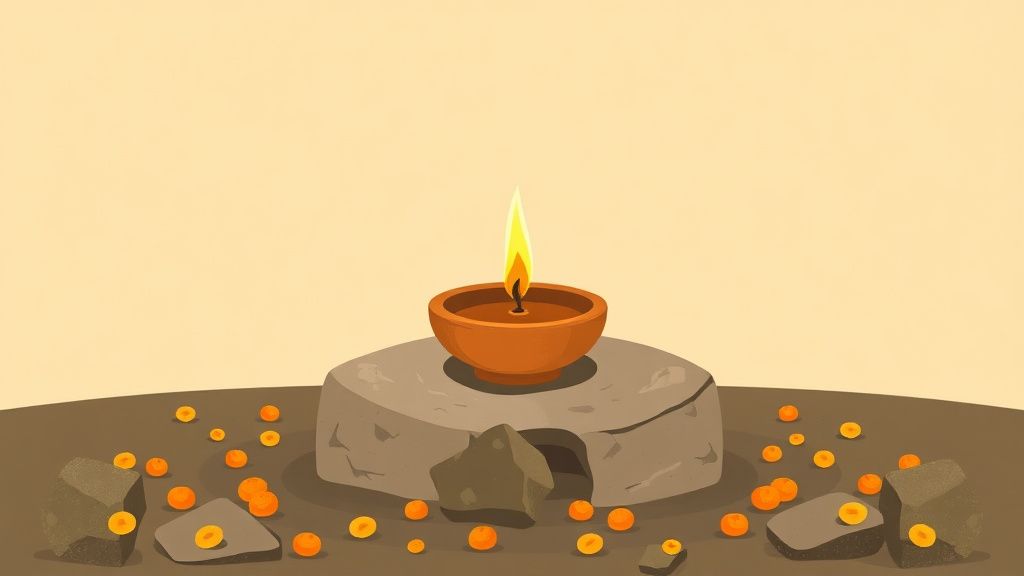
Shraddha is the Hindu ceremony performed for departed ancestors (pitrs), typically observed three times: on the eleventh, thirteenth or sixteenth day after death, on each annual death-anniversary (tithi shraddha), and collectively during the fortnight of Pitru Paksha that falls in the dark half of the lunar month of Bhadrapada (September-October). The ceremony’s core elements are pinda-dana (offering of cooked-rice balls), tarpana (libations of water with sesame seeds), and the feeding of Brahmins or guests who symbolically receive the offerings on behalf of the ancestors. The textual basis sits across the Grihya Sutras, the Dharma Shastras, and the Garuda Purana, with the procedure followed today carrying recognisable continuity with the older sources.
Who is honoured: the three ancestral generations
The Hindu ancestral structure recognises three generations of departed kin on the paternal line, and in many regional practices a parallel set on the maternal line:
- Pita (father), pitamaha (paternal grandfather), prapitamaha (paternal great-grandfather) on the father’s side.
- Mata (mother), matamahi (maternal grandmother), pramatamahi (maternal great-grandmother) on the mother’s side, where the family tradition includes them.
- The collective category of karunika pitrs for departed kin (uncles, aunts, cousins, those without surviving offspring) is honoured alongside the named three generations.
The pindas are made for the named three generations explicitly. The fourth generation upward is treated as having passed beyond the pitru-loka (ancestor realm) into the higher worlds, and is no longer the addressee of the rite. This three-generation structure is consistent across the Grihya Sutras and the principal Dharma Shastra texts (Manusmriti 3.122ff, Yajnavalkya Smriti 1.217ff).
When the ceremony is performed
Shraddha is performed at three principal occasions, each with its own sub-classification:
- Post-death sequence: the ekoddishta shraddha on the eleventh day (or thirteenth in some communities), followed by the sapindikarana rite that joins the newly departed with the existing line of ancestors.
- Annual tithi shraddha: on the lunar date of the death, every year, performed by the eldest son or designated descendant. The location is preferably the home where the deceased lived; many families travel back to the ancestral village for the occasion.
- Pitru Paksha: the dark fortnight of Bhadrapada-Ashvina, a sixteen-day window in which the collective ancestor offerings are made. The specific day of observance is the one matching the lunar tithi of the parent’s death; for ancestors whose tithi is unknown, the Sarvapitri Amavasya (the new-moon day at the end of Pitru Paksha) serves as the catch-all date.
The 2026 Pitru Paksha runs from September 7 to September 21, with Mahalaya Amavasya falling on September 21. The Drik Panchang calendar is the standard reference for the exact tithi each year; family priests work from the same calendar.
The procedure, in order
A traditional shraddha is performed by the eldest son (or, in his absence, the next eligible male descendant; daughters perform shraddha in many modern communities, and the practice is increasingly accepted across regions). The ceremony runs across roughly two hours:
- Preparation: the performer bathes, wears clean clothes (usually a fresh white or pale dhoti for men, a saree for women), and observes a partial fast until the rite is complete.
- Sankalpa: formal declaration of intent, naming the gotra, the deceased, the date, and the purpose.
- Vishvedeva worship: invocation of the universal devas who oversee the rite, before the ancestral offerings.
- Pinda preparation and offering: three rice balls are made (cooked rice mixed with barley flour, sesame seeds and ghee), and placed on darbha grass facing south, the direction of Yama and the ancestors.
- Tarpana: libations of water mixed with black sesame seeds are poured from the pitru-tirtha hand position (between thumb and index finger), with mantras naming each ancestor.
- Brahmin bhojana: Brahmins (or, in modern practice, family members and the needy) are fed; in many North Indian households a portion is offered to a cow, a crow, and a dog before the human meal.
- Visarjana: the pindas are immersed in flowing water (a river, a tank, or the sea) or offered to a cow.
Three offerings to non-human recipients are part of the rite in many traditions: a portion to the crow (treated as a messenger of the ancestors), a portion to the cow (sacred carrier), and a portion to the dog (associated with Yama). The crow’s acceptance of the offering is treated as a sign that the ancestors have received the food; the symbolism is widely respected even where the literal interpretation varies.
Where the ceremony is performed
The standard location is the family home, but specific tirthas are treated as especially efficacious:
- Gaya (Bihar): the principal tirtha for shraddha in the Hindu tradition. The Vishnupad Temple and Phalgu river are the named sites. Pinda-dana at Gaya is treated by the Garuda Purana as definitive for the ancestors’ onward passage. The temple administration coordinates with the local pandas (priestly families) who maintain records of returning lineages.
- Varanasi: the Manikarnika ghat and the Pishach Mochan tank for specific categories of departed.
- Haridwar: the Narayani Shila temple, particularly for those who died away from home.
- Rameswaram: the Agnitirtham bathing area, particularly for those for whom Gaya is impractical.
- Prayagraj (Triveni Sangam): the confluence of the Ganga, Yamuna and Saraswati.
A pinda-dana at Gaya is the one shraddha that the Garuda Purana treats as releasing the ancestor permanently from the cycle of annual offerings. Many families plan a one-time trip to Gaya within a few years of a parent’s death precisely for this reason.
Foods and restrictions during Pitru Paksha
The food prepared for the shraddha follows defined conventions:
- Strictly vegetarian, no onion or garlic, no salt other than rock salt in some traditions.
- Rice is the central grain. Common items include kheer, vegetable preparations, dal, and the deceased’s favourite dishes.
- The food is cooked fresh on the day of the shraddha, not re-used from the household’s earlier meals.
- Auspicious purchases (gold, vehicles, property registrations, new clothes), wedding ceremonies, and house-warming events are conventionally avoided during the Pitru Paksha fortnight.
The fortnight is treated as a time for ancestor focus rather than worldly initiative. Routine work continues; only specific auspicious launches are deferred.
An opinion on the modern performance
For what it’s worth, the most defensible modern form of the shraddha for a family living in the city is to perform the home rite with a family priest each year, and to plan one trip to Gaya (or to Rameswaram, for South Indian families) within five years of a parent’s death. The combination preserves the textual structure, keeps the annual observance grounded in the home, and discharges the Gaya-pinda obligation that the tradition treats as singular. Skipping the home rite while planning to “do Gaya eventually” is the common modern failure mode, and is worth resisting.
Common questions
Can daughters perform shraddha?
The classical texts placed the obligation on the eldest son. Contemporary practice in many communities accepts daughters performing shraddha, particularly where a son is absent or unable. The Vishnupad temple at Gaya formally permits daughters to perform pinda-dana, as confirmed in the temple’s public guidance. Several reformist traditions and many priests in metropolitan areas now treat the daughter’s performance as equivalent. Family tradition determines the practice for any given household.
What if I don’t know my ancestors’ names?
The sankalpa can be performed with the named generations known (typically father, grandfather, great-grandfather) and a general invocation for the unnamed beyond them. The Sarvapitri Amavasya at the end of Pitru Paksha is the day specifically dedicated to ancestors whose names or death dates are not known. A family priest will adapt the sankalpa to what the family can name with confidence.
Is fasting required by the performer?
A partial fast (one meal in the day, taken after the rite is complete) is the standard. Strict fasting through the day is not required by the texts, and is contraindicated for those with diabetes or other conditions for which prolonged abstinence is unsafe. The food taken after the rite should match the sattvic conventions used for the offering itself.
One limitation worth noting
Specific sub-community practices, particularly among Tamil, Telugu, Bengali, Maithil and Kashmiri brahmin families, carry variations in the pinda count, the addressee list, and the order of the steps that this overview does not capture. The framework here follows the broad Smarta convention. For the specifics of a particular family tradition, the household priest (purohit) remains the right source; what one family does on the eleventh day, another does on the thirteenth, and what one performs as a single rite, another splits into two.
For background see Śrāddha on Wikipedia and the Pitru Paksha entry.
