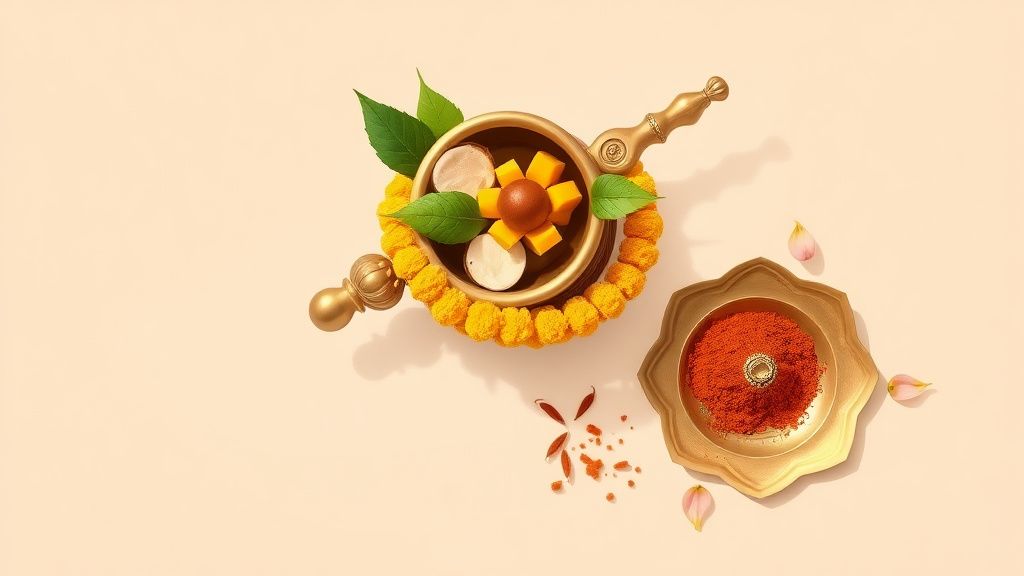
The mangalsutra (a black-and-gold necklace tied by the groom around the bride’s neck) and sindoor (red vermilion powder applied to the parting of her hair) are the two visible markers a Hindu woman wears to signal her married status. Both are tied to specific moments inside the wedding ceremony itself: the mangalsutra at Mangalya Dharanam, immediately after the seven steps, and the sindoor at Sindoor Daan, applied by the groom in the same sequence. Neither symbol is mentioned in the Vedic samhitas. Both entered Hindu wedding practice through later texts and regional custom; the mangalsutra is first attested in the 6th-century CE Lalita Sahasranama context, and sindoor first appears in the Brahmanda Purana.
Where each fits in the ceremony
A standard South Indian Hindu wedding follows roughly this sequence after the Vivaha Homa fire is lit:
- Kanyadana: the bride’s father places her hand in the groom’s hand.
- Panigrahana: the groom takes her hand reciting verses to Bhaga, Aryama, Savita and Purandhi.
- Saptapadi: the seven steps around the fire.
- Mangalya Dharanam: the groom ties the mangalsutra around the bride’s neck.
- Sindoor Daan: the groom applies sindoor to the parting of her hair.
In North Indian Hindu weddings the order is similar, with Sindoor Daan often performed right after the saptapadi and before the final blessings. The two acts are sometimes treated as the formal moment a couple becomes married, even though under the Hindu Marriage Act 1955 the saptapadi is the legal threshold.
Mangalsutra: form, materials, regional variations
The mangalsutra (Sanskrit mangala sutra, “auspicious thread”) was originally a single yellow turmeric-dyed cotton thread with black beads. Gold pendants and chains were added over centuries; today the gold-and-black-bead form is standard. Regional pendant designs are distinctive:
- Maharashtra: two cup-shaped vati pendants on a single thread of black beads, one vati for the bride’s family and one for the groom’s.
- Karnataka: a single vati pendant, often with sub-regional variations between Lingayat, Brahmin and other communities.
- Tamil Nadu: the thaali, a gold pendant whose design changes by community. Iyer thaalis feature a flat disc with Sivalinga; Iyengar use a U-shaped vertical mark; Chettiar thaalis carry coconut motifs. The thaali is traditionally strung on a turmeric-dyed yellow thread for the ceremony and transferred to a gold chain a few days later.
- Kerala: the ela thaali (leaf-shaped), or the minnu among Syrian Christians who adopted the form.
- Bengal and Odisha: the mangalsutra is not part of the traditional wedding; women wear an iron bangle (loha) and conch-shell bangles (shankha) instead, and the sindoor in the hair parting is the primary marker.
The first reference to a mangalya sutra is in the Lalita Sahasranama (4th–6th century CE), where the goddess wears one. The earliest surviving wedding-context description of the necklace tying is in the Tamil Sangam-period text Purananuru, around the 2nd–5th century CE. So the practice is post-Vedic but not modern; it stabilised through the early medieval period.
Sindoor: composition, application, regional variations
Traditional sindoor was a mix of turmeric and slaked lime. The alkaline lime reacts with curcumin in turmeric to yield the bright red colour. Some recipes add a small quantity of alum. The application along the bride’s maang (hair parting) is done at Sindoor Daan, with the groom using either a small applicator or his right thumb.
- North India: sindoor is applied along the full hair parting and is reapplied daily by the married woman.
- Bengal: the application happens at the groom’s home after the bride’s arrival; the shubho drishti follows; daily reapplication is the norm.
- Maharashtra and Karnataka: a smaller dot of kumkum on the forehead is preferred to a full parting application; the parting application is reserved for the wedding day.
- Tamil Nadu, Andhra Pradesh, Kerala: kumkum is applied as a dot on the forehead, not along the parting, and is worn by unmarried girls too. Married status here is signalled primarily by the thaali, not the kumkum.
Sindoor’s textual entry is later than the mangalsutra. The Brahmanda Purana (5th–10th century CE) contains the earliest clear references to sindoor as a married-woman’s marker. Earlier Vedic and Sutra-period texts describe red dye and ornamentation but do not name sindoor specifically as a marriage symbol. For what it’s worth, the most defensible historical reading is that sindoor and the mangalsutra both arose as regional folk customs in the early medieval period and were later folded into pan-Hindu wedding practice, not the other way around.
Modern health concern: lead in commercial sindoor
Sindoor sold commercially has been repeatedly tested and found to contain lead at levels well above safety limits. The US FDA recalled batches in 2008 and 2016 for excessive lead. A 2017 study by researchers at Rutgers University tested 95 sindoor samples sold in the US and India; over a third contained lead exceeding the FDA threshold of 20 ppm, with some samples above 30,000 ppm. The traditional turmeric-and-lime preparation is safe; the unsafe products are the synthetic red lead and mercury-based pigments sold under the same name. Buyers should look for products that list ingredients as turmeric and lime, and avoid loose-bulk vermilion of unknown composition.
Symbolic readings of the two together
Both objects are read on a layered set of meanings in Hindu commentary:
- The colour red: auspiciousness, fertility, Lakshmi and Shakti. Sindoor’s red and the mangalsutra’s gold both align with this colour family. The same red appears in the bride’s saree, the kumkum dot, and the wedding mandap garlands.
- The thread or chain: a bond between two families and two individuals. The mangalsutra cord is tied with three knots in many regions, said to bind the bride to body, mind and the groom’s clan respectively.
- The visible signal: both items make marital status legible at a glance, in a way that the saptapadi vow alone does not. This is the primary social function: a marker, not a contract.
- The widow context: historically, widows removed both the mangalsutra and the sindoor as part of the widowhood rite. This convention has weakened in cities and is openly contested by reform movements since the 19th century. Many widowed women now choose to retain or remove these markers as they prefer.
Common questions
Is the mangalsutra required for a valid Hindu marriage?
No. Under Indian law (Hindu Marriage Act 1955, Section 7), the saptapadi is the operative ritual for a Hindu marriage to be legally valid when the saptapadi is part of the couple’s tradition. The mangalsutra and sindoor are customary, and courts have ruled that the absence of a mangalsutra does not invalidate an otherwise complete ceremony. Many Bengali, Odia and reformist Hindu marriages omit the mangalsutra entirely.
Can the mangalsutra be removed at home?
Practically, yes; most women remove the gold chain at night, during exercise, or while bathing, and many keep only the small thaali pendant on a thinner everyday chain. Traditional households consider continuous daily wear preferable, but no scripture mandates 24-hour wear. The original cotton thread, in fact, was always replaced periodically as it wore out.
Why is sindoor red and not another colour?
Red carries auspicious associations in Hindu thought, tied to Lakshmi (wealth), Shakti (the goddess as creative force), and the rising sun. The pigment’s chemistry was discovered early: turmeric (yellow) plus lime (alkaline) produces a stable bright red, and the red oxide of lead gives a similar result, which is how the mineral pigment came into use. The colour was the constraint; the ingredients were what was available.
Do unmarried women wear sindoor or kumkum?
Sindoor in the hair parting is reserved for married women. Kumkum as a forehead dot is worn by women of all marital statuses in South India and is also given as prasad at temples to be applied by any worshipper. The distinction between the two is positional: parting application equals marriage marker; forehead dot equals general devotional or decorative use.
A limitation worth noting
This article centres mainstream Brahmin and major-community practice in five regions. Specific sub-community variations (Coorgi, Tulu, Saurashtrian, Maithil, Sindhi, Konkani, Marwari) carry their own mangalsutra designs and sindoor customs that are not summarised here. For a particular community’s exact form, the family priest or community elders remain the best source. The dating of when each object entered general practice is also debated by historians, and the figures above represent the cautious mainstream view rather than a settled consensus.
For broader background see the overview entries on mangala sutra and sindoor, and the larger ritual context at Hindu wedding.
