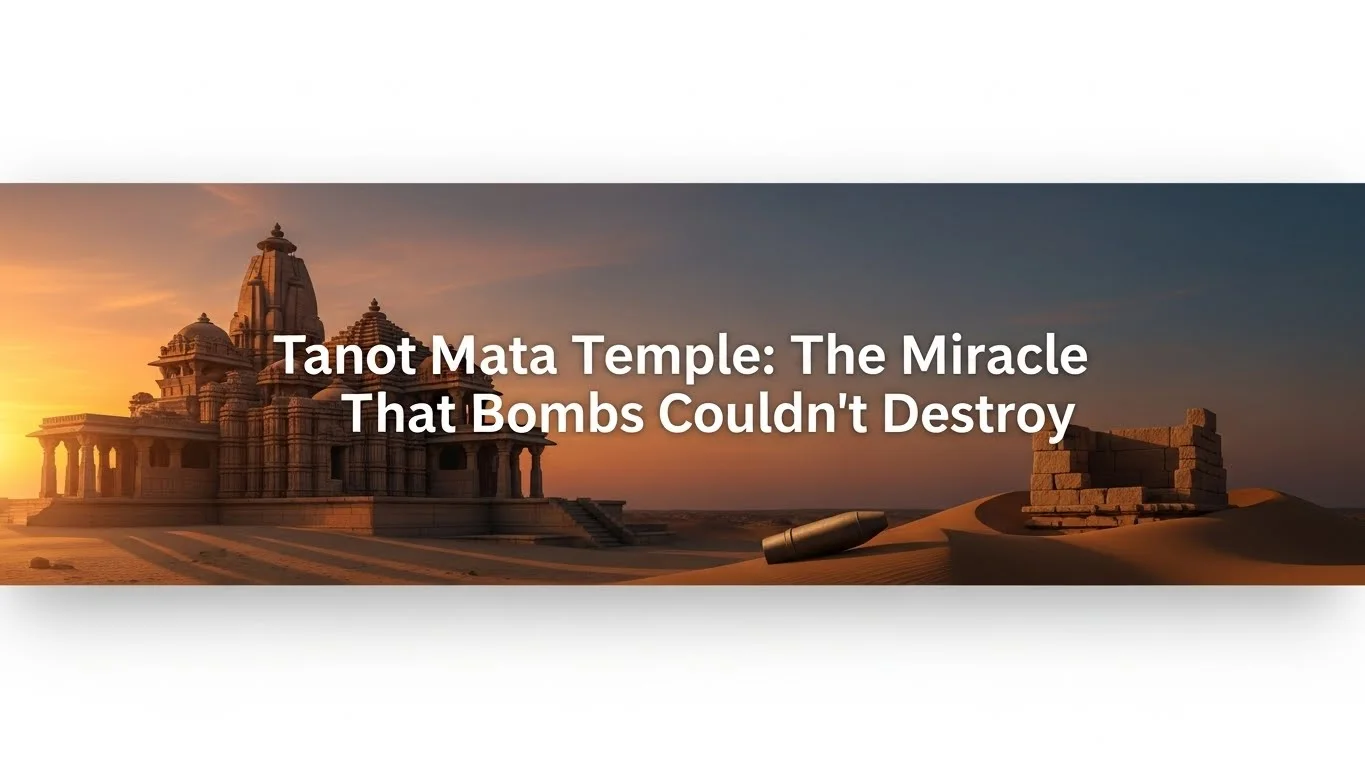
Tanot Mata Temple in Jaisalmer district, Rajasthan, stands as a living testament to faith and divine protection, located just 120 kilometers from Jaisalmer city and approximately 15 kilometers from the India-Pakistan border near the legendary Longewala battlefield. During the Indo-Pakistani War of 1965, Pakistani forces fired over 3,000 bombs toward the temple and surrounding Indian military positions in an attempt to capture this strategic location, yet according to soldiers’ accounts, local folklore, and BSF records, none of the bombs that landed near the temple exploded—a phenomenon that defied military logic and led to the temple being called the “miracle temple” and Tanot Mata being revered as “Bomb Wali Devi” (Goddess of Bombs).

Of these 3,000 shells, approximately 450 bombs landed directly on or very near the temple vicinity without detonating, remaining buried in sand or lying on the surface as silent witnesses to what soldiers and devotees interpreted as divine intervention. The temple’s miraculous protection repeated during the Battle of Longewala in the 1971 Indo-Pakistani War, when Pakistani armored divisions with 2,000 soldiers and 45 tanks attacked a company of merely 120 Indian soldiers led by Major Kuldip Singh Chandpuri—yet the enemy tanks mysteriously became immobilized in desert sand, bombs again failed to explode near the temple, and the Indian forces achieved one of military history’s most remarkable victories.
After both wars, India’s Border Security Force (BSF) assumed complete responsibility for the temple’s management, maintenance, and daily worship, with uniformed BSF personnel conducting regular aartis (worship ceremonies) at 12 PM and 7 PM, making it perhaps the only Hindu temple where armed soldiers serve as priests. The temple complex now houses a War Museum displaying 450 unexploded Pakistani bombs, artillery shells, weapons, and military artifacts from both wars, with each silent projectile narrating the story of what devotees call divine protection and military historians acknowledge as an extraordinary anomaly.
A Vijay Stambha (Victory Tower) commemorating the Battle of Longewala victory stands within the temple compound, and every December 16 is celebrated as Victory Day with military ceremonies and religious observances. This comprehensive guide explores Tanot Mata’s origins and divine significance, the detailed 1965 war miracle and soldiers’ testimonies, the legendary 1971 Battle of Longewala, BSF management and unique military-religious character, the unexploded bomb museum, architectural features, pilgrimage experiences, practical visiting information for 2026, and how this border temple embodies the intersection of faith, patriotism, and divine grace in Hindu philosophy.
Tanot Mata: The Goddess and Her Origins
Divine Identity and Manifestation
Tanot Mata, also known as Awad Mata, is worshipped as a manifestation of Hinglaj Mata, one of the 51 Shakti Peethas (sacred sites where parts of Goddess Sati’s body fell) and a powerful form of Goddess Durga. In Rajasthan’s desert regions, Tanot Mata holds special significance as:
Protector Deity: Goddess who shields devotees from danger, enemies, and misfortune
Regional Manifestation of Shakti: Localized form of the universal divine feminine energy
Warrior Goddess: Particularly invoked for protection during conflicts and battles
Desert Guardian: Special protector of communities living in harsh Thar Desert conditions
Temple Antiquity and Location
The temple is believed to be over 1,000 years old, with origins dating back a millennium or more. Its strategic location near the India-Pakistan border made it:
Frontier Outpost: Positioned in a vulnerable zone during both 1965 and 1971 wars
Last Defense Point: The temple area represented the final barrier before Jaisalmer during Pakistani advances
Spiritual Anchor: Sacred site providing psychological strength to soldiers defending desolate border regions
Geographic Details:
- Distance from Jaisalmer: Approximately 120 kilometers
- Proximity to Border: About 15 kilometers from India-Pakistan international boundary
- Terrain: Located in the Thar Desert with extreme temperatures and sandy landscape
- Nearby Battlefield: Close to Longewala, site of the famous 1971 battle
Pre-War Significance
Before the wars transformed its identity, Tanot Mata Temple served local desert communities as:
Regional Pilgrimage Site: Devotees from surrounding villages worshipped the goddess seeking protection and blessings
Cultural Center: Important religious and social gathering place in the remote desert region
Traditional Worship: Local families maintained ancestral devotion to the goddess across generations
However, the events of 1965 and 1971 catapulted the temple from regional obscurity to national prominence, transforming it into a symbol of divine protection, military valor, and miraculous intervention.
The 1965 War Miracle: 3,000 Bombs That Didn’t Explode
Military Context and Pakistani Offensive
The Indo-Pakistani War of 1965 was a significant conflict primarily fought over the disputed regions of Jammu and Kashmir. In the western sector covering Rajasthan:
Pakistani Strategy: Pakistani forces launched Operation Desert Hawk, attempting to capture strategic locations in Rajasthan’s desert region
Target: After capturing Indian villages of Kishangarh and Sadewala, Pakistani forces focused on Tanot as their final objective before reaching Jaisalmer
Strategic Importance: Capturing Tanot would have opened the pathway to Jaisalmer, one of Rajasthan’s major cities, potentially creating a significant psychological and military victory for Pakistan
The Bombardment: 3,000 Shells Fired
Pakistani forces unleashed devastating artillery bombardment on Tanot and surrounding Indian military positions:
Scale of Attack: Over 3,000 bombs and artillery shells fired toward the temple area and Indian posts
Duration: The bombardment continued from September through November 19, 1965
Intensity: The shelling was designed to destroy Indian defensive positions and the temple structure itself, creating psychological shock among defenders
Expected Outcome: Military planners anticipated complete destruction of the area, forcing Indian forces to retreat and surrendering the strategic location
The Miracle: Not One Bomb Exploded
What happened next defied all military logic and probability:
Complete Failure: According to soldiers’ accounts and local folklore, none of the bombs that landed near the temple exploded
Direct Hits: Of the 3,000 shells fired, approximately 450 landed directly on or very near the temple premises
Unexploded Ordnance: These 450 bombs:
- Either missed their intended targets despite being aimed accurately
- Sank harmlessly into the desert sand without detonating
- Remained on the surface as duds despite proper fusing
- Left the temple structure completely undamaged—”not even a brick was scratched”
Structural Integrity: The ancient temple remained completely unscathed despite being at the epicenter of massive bombardment
Soldiers’ Testimonies and Divine Experiences
Indian soldiers stationed near the temple reported extraordinary experiences:
Dreams and Visions: Soldiers reported that Tanot Mata appeared in their dreams, promising divine protection if they stayed in the temple’s vicinity
Divine Light: Multiple witnesses claimed seeing mysterious divine light near the idol during the night bombardment
Supernatural Protection: Soldiers felt an inexplicable sense of security and confidence despite being heavily outgunned and under constant attack
Renewed Morale: What began as a seemingly hopeless defensive situation transformed into confident resistance as soldiers interpreted the unexploded bombs as divine intervention
Pakistani Intelligence: Even Pakistani military intelligence reports allegedly labeled the phenomenon an “unknown force” protecting the Indian positions
Military Outcome and Victory
Motivated by what they perceived as divine protection, Indian forces:
Held Their Ground: Defenders maintained their positions despite overwhelming firepower arrayed against them
Counterattacked: The psychological boost from the miracle enabled Indian forces to drive Pakistani troops away from Tanot territory
Secured the Border: The defensive success prevented Pakistani advance toward Jaisalmer, protecting Rajasthan’s heartland
Created Legend: The events established Tanot Mata Temple as a symbol of divine intervention in modern warfare
The 1971 War: Battle of Longewala
Military Context and Strategic Situation
The Indo-Pakistani War of 1971 primarily focused on East Pakistan’s liberation (now Bangladesh), but Pakistan opened a western front to divert Indian forces.
Pakistani Objectives: Engage Indian Army on two fronts simultaneously
Western Front: Pakistan launched Operation Snow Leopard targeting Longewala, another post near Tanot Temple
Indian Defenses: Longewala was guarded by a company of only 120 men led by Major Kuldip Singh Chandpuri
Date: December 4-5, 1971
The Pakistani Attack: Overwhelming Force
Pakistani forces attacked with devastating superiority:
Troop Strength:
- Pakistani Forces: Full battalion of approximately 2,000 soldiers
- Tank Squadron: 45 tanks providing armored support
- Indian Forces: Merely 120 infantry soldiers
Military Assessment: By conventional military calculations, defeat for Indian forces seemed inevitable—120 soldiers against 2,000 with tank support represents approximately 17:1 numerical disadvantage plus complete armor superiority
Psychological Factor: Despite overwhelming odds, Indian soldiers maintained faith in Tanot Mata’s protection
The Second Miracle: Tanks Stuck in Sand
Once again, extraordinary events defied military expectations:
Tank Immobilization: Pakistani tanks mysteriously became bogged down in desert sand, becoming immobilized despite the Thar Desert being their intended operating environment
Timing: This mechanical failure occurred at the critical moment, preventing tanks from overrunning Indian positions
Divine Intervention Claims: Soldiers reported:
- Feeling eerie energy emanating from the temple
- Witnessing mystical glow around the temple area
- Sensing that an invisible force had halted enemy advance
Unexploded Bombs: Once again, bombs that fell near the temple and Indian positions failed to explode
Critical Delay: The tank immobilization provided crucial time for Indian Air Force response
Indian Air Force Intervention and Victory
The delay caused by bogged-down tanks proved decisive:
Dawn Attack: At sunrise, Indian Air Force arrived and decimated the immobilized Pakistani forces
Decisive Victory: What began as apparent certain defeat became one of the greatest battles in Independent India’s military history
Historical Significance: The Victory of Longewala entered Indian military legend as a triumph of courage, faith, and strategic air power against overwhelming odds
Cultural Impact: The battle inspired the 1997 Bollywood film “Border”, bringing Longewala and Tanot Mata’s story to millions
Post-1971 Developments
Vijay Stambha: Indian Army constructed a Victory Tower (Vijay Stambha) inside the temple compound commemorating the Longewala triumph
Annual Celebration: Every December 16 is celebrated as Victory Day at the temple with military ceremonies
Enhanced Fame: The temple’s reputation spread nationally, attracting pilgrims, tourists, and military history enthusiasts
Museum Expansion: BSF expanded the temple complex and established a comprehensive war museum
BSF Management: When Soldiers Become Priests
Transfer of Temple Responsibility
After the 1965 war, a unique arrangement emerged:
BSF Takeover: India’s Border Security Force (BSF) assumed complete charge of the temple including management, maintenance, and conducting religious ceremonies
Rationale:
- Temple’s proximity to international border requiring military security
- Recognition of divine protection that BSF soldiers personally experienced
- Ensuring temple’s preservation as both religious and military heritage site
- Maintaining security in sensitive border region
Legal Status: The temple operates under BSF administration with religious functions performed by military personnel
Daily Worship by Uniformed Soldiers
Tanot Mata Temple may be the only Hindu temple where armed soldiers conduct religious ceremonies:
BSF Personnel as Priests: Uniformed BSF jawans (soldiers) perform:
- Daily puja (worship) rituals
- Morning and evening aartis at 12 PM and 7 PM
- Maintenance of deity images and temple sanctity
- Ceremonial protocols and festival celebrations
Military Discipline Meets Spiritual Devotion: The temple represents a unique fusion where:
- Prayers are offered with the same intensity as sentry duty
- Military discipline governs religious schedules and protocols
- Soldiers serve dual roles as border guards and temple priests
Symbolic Significance: This arrangement embodies:
- Gratitude for divine protection during wars
- Continuing bond between military and divine forces
- Recognition that defending borders requires both military strength and spiritual support
Security and Border Proximity
The temple’s location creates unique security considerations:
Restricted Zone: Being only 15 kilometers from the Pakistan border, the area falls under military jurisdiction
Access Control: Visitor entry requires:
- Passing through BSF security checkpoints
- Adherence to military protocols
- Restrictions on photography in certain areas
- Awareness that active military installations operate nearby
Dual Identity: The temple functions simultaneously as:
- Sacred pilgrimage site open to civilians
- Protected military zone under BSF guardianship
- Symbol of India’s border defense capabilities
The Unexploded Bomb Museum: Silent Witnesses
Museum Contents and Layout
The War Museum at Tanot Mata Temple houses extraordinary artifacts:
Unexploded Bombs: 450 unexploded Pakistani bombs and artillery shells from the 1965 war are displayed
Artillery Pieces: Various weapons and military equipment captured or recovered from battlefields
Photographic Documentation: Images of the 1965 and 1971 wars, military operations, and temple protection
Descriptive Panels: Information boards explaining the battles, miracles, and temple history
War Relics: Tanks, ammunition, and other military artifacts from both conflicts
The Bombs: Physical Evidence of Miracles
Each unexploded bomb tells a story:
Technical Anomaly: Military experts acknowledge that the failure rate of 450 bombs from the same batch is statistically extraordinary
Preserved State: The bombs remain in their original unexploded condition, exactly as found after the wars
Types: Various artillery shells, bombs, and explosive devices of different calibers
Silent Testimony: As described in temple literature, these shells “silently narrate the story of a faith-protected frontier”
Visitor Experience
Walking through the museum creates powerful impressions:
Tangible History: Unlike abstract historical narratives, visitors see physical proof of the bombardment and miraculous survival
Scale Recognition: The sheer number of 450 unexploded bombs helps visitors comprehend the bombardment’s intensity
Faith Reinforcement: For believers, each bomb validates divine intervention; for skeptics, the display raises profound questions about probability and chance
Educational Value: The museum educates visitors about:
- Indo-Pakistani wars of 1965 and 1971
- Border conflicts and military strategy
- Soldiers’ sacrifices and courage
- Intersection of faith and warfare in Indian military culture
Memorial Function
The museum serves multiple memorial purposes:
Honoring Soldiers: Commemorating Indian military personnel who defended Tanot and Longewala
Preserving Memory: Ensuring future generations remember these miraculous events and military victories
National Pride: Creating a site where Indian citizens can connect with military heritage and achievements
Spiritual Testament: Providing physical evidence supporting devotees’ faith in divine protection
Temple Architecture and Sacred Spaces
Main Temple Structure
The temple complex features:
Deity Shrine: The sanctum houses the idol of Tanot Mata (Goddess Tanot) adorned with traditional decorations, flowers, and jewelry
Architectural Style: Traditional Rajasthani temple architecture adapted to desert conditions
Marble Work: Portions of the temple feature marble and decorative stonework
Courtyard: Open spaces accommodating pilgrims for darshan and ceremonies
Vijay Stambha (Victory Tower)
The Victory Tower stands as prominent landmark:
Construction: Built by the Indian Army after 1971 war
Purpose: Commemorating the Battle of Longewala victory
Symbolism:
- Military triumph through divine assistance
- Gratitude to Tanot Mata for protection
- National pride in Indian forces’ courage
Design: Traditional victory pillar architecture integrated with temple complex
War Museum Building
Adjacent structure housing military artifacts:
Display Halls: Organized exhibition spaces showing unexploded bombs, weapons, and documentation
Educational Panels: Information about wars, battles, and temple history
Visitor Facilities: Areas for tourists to learn about temple’s military significance
Sacred Kalash
The temple’s sacred kalash (ceremonial water pot) holds special significance:
Wishes and Prayers: Devotees believe that heartfelt wishes made near the sacred kalash are fulfilled by the goddess
Ritual Importance: The kalash serves in daily worship ceremonies and special festivals
Spiritual Power: Considered a direct conduit to Tanot Mata’s divine energy
Pilgrimage Experience and Visitor Information
Journey to Tanot
Reaching the temple involves desert travel:
From Jaisalmer:
- Distance: Approximately 120 kilometers
- Travel Time: 2.5-3 hours by road
- Route: Well-maintained roads through Thar Desert landscape
Transportation Options:
- Private taxis and hired vehicles from Jaisalmer
- Tourist packages combining Tanot with Longewala battlefield visit
- Occasional bus services
Road Conditions: Generally good, though desert driving requires caution
Best Time to Visit
Optimal visiting seasons:
November to January:
- Pleasant winter temperatures (10-25°C)
- Comfortable for desert travel and temple exploration
- Peak tourist season
Avoid Summer (April-June):
- Extreme heat reaching up to 49°C
- Potentially dangerous for unacclimatized visitors
- Limited infrastructure for cooling
Monsoon (July-September):
- Minimal rainfall in desert region
- Moderate temperatures
- Fewer tourists
Temple Timings and Rituals
Daily Schedule:
Temple Opening: Early morning (specific hours vary)
Daily Aartis:
- Afternoon: 12:00 PM
- Evening: 7:00 PM
- Conducted by BSF personnel in full uniform
Darshan: Available throughout day between opening and closing times
Special Occasions: Extended hours during festivals and Victory Day celebrations
Festivals and Special Celebrations
Major observances at Tanot:
Navratri: The nine-day festival dedicated to Goddess Durga sees thousands of devotees visiting Tanot Mata Temple
- Enhanced decorations and ceremonies
- Special pujas and offerings
- Large congregation of pilgrims
Victory Day (December 16): Annual celebration commemorating the 1971 Longewala victory
- Military ceremonies and parades
- Special prayers and thanksgiving
- Veterans and active military personnel attend
Regular Festivals: Diwali, Dussehra, and other Hindu festivals celebrated with traditional observances
Practical Considerations
What to Bring:
- Sufficient water (limited availability in desert)
- Sun protection (hat, sunglasses, sunscreen)
- Modest clothing appropriate for temple visit
- Camera (for museum and exterior; restrictions may apply inside sanctum)
- Cash (limited digital payment infrastructure)
Communication:
- Limited mobile network—only BSNL works in the area
- Other carriers have no signal due to border proximity
- Plan accordingly for communication needs
Border Restrictions:
- Area beyond temple is restricted military zone
- Cannot proceed further toward Pakistan border without military authorization
- Follow all BSF instructions and security protocols
Accommodation:
- No accommodation at temple itself
- Day trip from Jaisalmer most common
- Some basic guesthouses in Jaisalmer serve as base
Combining with Longewala Battlefield
Most visitors combine Tanot with Longewala:
Longewala War Memorial: Located nearby, featuring:
- Military museum with captured tanks and equipment
- Detailed battle history and documentation
- Memorial to soldiers who fought in 1971 battle
Combined Tour: Allows understanding both the spiritual and military dimensions of the region’s 1965-1971 war history
Cultural Impact and National Significance
Bollywood and Popular Culture
The 1997 film “Border” brought Tanot and Longewala to national consciousness:
Film Plot: Depicted the Battle of Longewala with scenes showing soldiers’ faith in divine protection
Cultural Impact:
- Introduced millions to the temple’s story
- Popularized the miraculous events of 1965 and 1971
- Created lasting association between border defense and divine intervention
Tourism Boost: The film significantly increased pilgrimage and tourism to the region
Symbol of Faith and Patriotism
Tanot Mata Temple embodies unique synthesis:
Religious Devotion: Pilgrims seek blessings for protection, wish fulfillment, and spiritual merit
National Pride: Indian citizens connect with military valor, sacrifice, and miraculous victories
Border Defense: The temple represents India’s determination to defend frontiers against aggression
Divine Protection: For believers, Tanot validates faith that higher powers protect righteous causes
Military Morale and Tradition
The temple continues influencing Indian military culture:
Inspiration: New soldiers stationed in border regions learn about Tanot’s miracles, reinforcing belief in divine support
Unit Visits: Military companies make pilgrimage to the temple seeking blessings before deployments
Ceremonial Importance: The temple features in military traditions and commemorations
Spiritual Dimension: Acknowledges that soldiers draw strength from both training and faith
Frequently Asked Questions
What is the Tanot Mata Temple miracle?
During the 1965 Indo-Pakistan War, Pakistani forces fired over 3,000 bombs toward Tanot Mata Temple, yet none of the bombs that landed near the temple exploded. Approximately 450 shells landed directly on or very near the temple without detonating, leaving the structure completely unscathed. Indian soldiers interpreted this as divine protection from Tanot Mata. The miracle repeated in the 1971 Battle of Longewala when Pakistani tanks became stuck in sand and bombs again failed to explode.
Where is Tanot Mata Temple located?
Tanot Mata Temple is located in Jaisalmer district, Rajasthan, approximately 120 kilometers from Jaisalmer city and about 15 kilometers from the India-Pakistan international border. The temple is near the Longewala battlefield site where the famous 1971 battle occurred. It requires 2.5-3 hours by road from Jaisalmer through Thar Desert terrain. The area falls under BSF security jurisdiction due to border proximity.
Who manages Tanot Mata Temple?
India’s Border Security Force (BSF) manages Tanot Mata Temple since taking charge after the 1965 war. Uniformed BSF soldiers conduct daily worship ceremonies including aartis at 12 PM and 7 PM, making it perhaps the only Hindu temple where armed military personnel serve as priests. The BSF handles maintenance, security, religious ceremonies, and museum operations, creating a unique fusion of military discipline and spiritual devotion.
What is displayed in the Tanot Mata Temple museum?
The War Museum displays 450 unexploded Pakistani bombs and artillery shells from the 1965 war that failed to detonate despite landing near the temple. The museum also houses captured weapons, military equipment, tanks, photographic documentation of both wars, and descriptive panels explaining the battles and miraculous events. These artifacts serve as physical evidence of what devotees consider divine intervention and provide educational value about Indo-Pakistani conflicts.
What happened during the Battle of Longewala?
On December 4-5, 1971, Pakistani forces with 2,000 soldiers and 45 tanks attacked Longewala defended by only 120 Indian soldiers led by Major Kuldip Singh Chandpuri. Pakistani tanks mysteriously became stuck in desert sand, delaying their advance. Bombs near Tanot Temple again failed to explode. The delay allowed Indian Air Force to strike at dawn, destroying the immobilized enemy forces and creating one of India’s most remarkable military victories.
When is the best time to visit Tanot Mata Temple?
The best time to visit is November to January when temperatures range from 10-25°C, making desert travel comfortable. Avoid summer months (April-June) when temperatures reach up to 49°C, which can be dangerous for visitors. The temple is open year-round with daily aartis at 12 PM and 7 PM. Navratri (September/October) sees thousands of devotees, while December 16 is celebrated as Victory Day commemorating the Longewala battle.
Can mobile phones work at Tanot Mata Temple?
Mobile networks are extremely limited at Tanot Temple—only BSNL works in the area. Other cellular carriers have no signal due to the temple’s proximity to the Pakistan border and remote desert location. Visitors should plan accordingly, informing family/friends about limited communication, carrying necessary information offline, and not relying on mobile connectivity for navigation or emergency contact during the visit.
How far is Tanot Mata Temple from the Pakistan border?
Tanot Mata Temple is approximately 15 kilometers from the India-Pakistan international border. This proximity made it strategically vulnerable during 1965 and 1971 wars when Pakistani forces attempted to capture the area. The temple falls within restricted military zones managed by BSF, and visitors cannot proceed further toward the border without military authorization. The area remains an active border defense sector with military installations and patrols.
Conclusion
Tanot Mata Temple stands as one of India’s most extraordinary sacred sites—a place where documented historical events, military records, physical evidence, and soldiers’ testimonies converge with faith and devotion to create a narrative that challenges purely materialistic explanations while inspiring millions with the possibility of divine intervention in human affairs. The unexploded 3,000 bombs from 1965 and the miraculous Battle of Longewala in 1971 represent either statistically improbable coincidences or manifestations of protective divine power, depending on one’s worldview, yet both interpretations acknowledge the extraordinary nature of events that unfolded at this desert border temple.
The 450 silent bombs displayed in the museum serve as permanent witnesses to whatever forces—divine protection, equipment failure, soil conditions, or cosmic coincidence—prevented their detonation. For the soldiers who witnessed shells falling around them without exploding, who reported seeing divine light near the idol, who received the goddess’s promise of protection in dreams, and who then achieved impossible victories against overwhelming odds, these events were unambiguously miraculous. The transformation of Tanot Mata from regional deity to “Bomb Wali Devi” (Goddess of Bombs) reflects how extraordinary experiences reshape religious understanding and create new theological meanings.
The unique BSF management where uniformed soldiers conduct daily worship embodies a remarkable synthesis of military discipline and spiritual devotion, acknowledging that defending India’s borders requires both material strength and metaphysical support. This arrangement honors the soldiers’ lived experience of divine protection during combat, maintains the temple’s security in a sensitive border region, and creates a living memorial where military heritage and religious practice intertwine inseparably.
For pilgrims, tourists, and military history enthusiasts visiting Tanot, the experience offers multiple dimensions—sacred darshan of a protective goddess, connection with India’s military heritage, contemplation of war’s realities, and engagement with profound questions about faith, probability, and divine intervention in historical events. Whether one interprets the unexploded bombs as miracles or anomalies, the temple’s story enriches understanding of how Hindu philosophy encompasses divine protection extending beyond individual spiritual practice to collective defense, national security, and the sacred duty of protecting one’s homeland.
Tanot Mata Temple ultimately represents faith standing stronger than bombs—a testament that even in the modern technological age of sophisticated weaponry and scientific rationalism, millions of Indians find meaning, hope, and inspiration in a desert border shrine where 3,000 bombs fell silent, where tanks stuck mysteriously in sand, where 120 soldiers defeated 2,000, and where divine presence manifested through the failure of human destructive capacity, creating a miracle temple that bombs truly couldn’t destroy.
About the Author
Anjali Deshmukh – Cultural Heritage & Temple Architecture Specialist
Anjali Deshmukh is an accomplished writer and researcher specializing in Hindu festivals, temple architecture, and India’s rich cultural traditions. With a Master’s degree in Indian Art History from Maharaja Sayajirao University, she has extensively documented pilgrimage sites, temple iconography, and folk traditions across India. Her work focuses on making India’s spiritual heritage accessible to contemporary audiences while preserving authentic cultural narratives.
