Tulsi Vivah represents one of Hinduism’s most unique and spiritually profound ceremonies—the ritual marriage of the sacred Tulsi plant (Holy Basil) to Lord Vishnu, symbolically represented by the Shaligram stone. Celebrated annually during the Kartik month, typically in October or November, this divine wedding ceremony embodies multiple layers of theological significance while marking critical transitions in the Hindu ritual calendar.
The marriage of a plant to the Supreme Deity might appear peculiar to those unfamiliar with Hindu symbolic thinking yet this ceremony encodes profound teachings about devotion, divine love, ecological consciousness, and the interpenetration of material and spiritual dimensions of existence. In 2025, as environmental degradation threatens the planet’s future, the reverence for Tulsi embodied in this ceremony offers timeless wisdom about humanity’s sacred relationship with the botanical world.
Understanding why Hindus marry Tulsi to Vishnu requires exploring the rich mythological narrative of Vrinda’s unwavering devotion, the theological principles underlying plant worship, and the ritual procedures through which this extraordinary marriage is solemnized. The ceremony also marks the conclusion of Chaturmas—the four-month period when major ceremonies are prohibited—and inaugurates the auspicious wedding season, making Tulsi Vivah both spiritually significant and practically consequential for Hindu social life.
The Sacred Story: Vrinda, Jalandhara, and Divine Transformation
The mythological foundation for Tulsi Vivah derives from the ancient narrative of Vrinda (also called Tulsi or Brinda) and her husband Jalandhara, preserved in various Puranic texts including the Padma Purana and Shiva Purana. This sacred story illustrates themes of devotion, deception, divine justice, and ultimate redemption through transformation.
Jalandhara: The Invincible Demon King
Jalandhara was born from the tejas (divine energy) of Lord Shiva and possessed extraordinary power rivaling the gods themselves. He became a powerful demon king (asura) who conquered vast territories and challenged celestial authority. His power derived not merely from physical strength or martial skill, but from an unusual source—his wife Vrinda’s absolute devotion and chastity (pativrata dharma). Her unwavering faithfulness to her husband created a spiritual protective shield that rendered Jalandhara essentially invincible in battle.
The Devastation of the Celestial Realms
Jalandhara’s growing power threatened the cosmic order itself. He defeated the Devas (celestial gods) repeatedly, driving them from their heavenly abodes and establishing demon supremacy over the three worlds. Even Lord Shiva found Jalandhara’s power formidable in direct combat. The gods recognized that conventional warfare could not defeat someone protected by the spiritual power of pure devotion. They approached Lord Vishnu, the cosmic protector, seeking intervention to restore dharmic balance.
Lord Vishnu’s Difficult Decision
After analyzing the situation, Vishnu understood that Jalandhara’s invincibility stemmed from Vrinda’s pativrata shakti (power of wifely devotion). As long as she remained faithful and believed her husband alive, the protective spiritual field surrounding Jalandhara remained impenetrable. To defeat Jalandhara and restore cosmic order, Vishnu would need to employ a deception that challenged his own principles of dharma—he would need to break Vrinda’s faith in her husband’s existence.
The Divine Deception and Transformation
With reluctance but recognizing the necessity for cosmic balance, Vishnu assumed Jalandhara’s exact form and approached Vrinda. Believing her husband had returned from battle, she welcomed him. The moment Vrinda embraced who she believed was Jalandhara, her pativrata dharma was technically broken, as she had touched another being (Vishnu in disguise). The protective spiritual shield immediately dissolved, and in that instant, Lord Shiva was able to defeat and kill the actual Jalandhara on the battlefield.
When Vrinda discovered the deception—that the being she had embraced was Lord Vishnu and not her husband—she experienced devastating grief and righteous fury. Though Vishnu had acted to restore cosmic order, the method involved breaking a devoted wife’s faith through deception. In her anguish and anger, Vrinda cursed Vishnu to turn into a black stone for his deceit, which manifested as the Shaligram stone worshipped in Hindu homes.
However, Vishnu, recognizing the purity of Vrinda’s devotion and the injustice she had suffered despite her virtue, blessed her with immortality and transformation. He decreed that she would become the sacred Tulsi plant, forever worshipped by all devotees and considered essential for Vishnu worship. He further promised to marry her annually in the form of the Shaligram stone, honoring her eternal devotion and making her inseparable from his worship. This divine promise gave birth to the tradition of Tulsi Vivah, transforming a narrative of tragedy into one of redemption and eternal union.
Theological Significance: Why Marry a Plant to God?
The ritual marriage of Tulsi to Vishnu embodies profound theological principles that reveal sophisticated Hindu understanding of the relationship between material and spiritual dimensions, the power of devotion, and the sacred nature of the botanical world.
The Principle of Divine Immanence
Hindu theology recognizes that divine consciousness pervades all existence—not merely sentient beings but also plants, stones, rivers, and mountains. The Tulsi plant is understood as a manifestation of Goddess Lakshmi and simultaneously as Vrinda’s transformed essence. This theological framework rejects the sharp distinction between sacred and profane that characterizes some religious traditions, instead recognizing gradations of divine manifestation throughout creation. The Tulsi Vivah ceremony affirms that deity can be truly present in botanical form, not merely symbolically but actually.
The Power of Pativrata Dharma
The Vrinda narrative demonstrates the extraordinary spiritual power generated by unwavering devotion and marital fidelity. Hindu tradition recognizes that pativrata shakti (the power of a devoted wife) can influence cosmic forces, create protective fields, and accomplish spiritual feats beyond ordinary capacity. By transforming Vrinda into Tulsi and promising eternal union, Vishnu honors this devotional power while healing the wound caused by necessary deception. The annual marriage ceremony perpetually celebrates the redemptive power of divine grace responding to pure devotion.
Ecological Consciousness and Sacred Nature
Tulsi Vivah embodies Hindu ecological theology—the recognition that plants deserve reverence and protection as manifestations of divine consciousness. By ceremonially marrying a plant to the Supreme Deity, the tradition elevates botanical life to the highest spiritual significance, implicitly teaching that harming plants carelessly constitutes disrespect toward the divine. In contemporary contexts of environmental crisis, this theological principle provides powerful motivation for ecological protection grounded in traditional dharmic values rather than merely secular environmentalism.
The Sanctification of Marriage
The divine wedding between Tulsi and Vishnu provides a sacred archetype for human marriages. By witnessing and participating in this celestial union, devotees receive blessings for their own relationships while understanding marriage as a spiritual sacrament transcending mere social contract. The ceremony teaches that ideal marriage unites not just bodies or families but souls in eternal devotion—a union that survives even physical death and transformation.
The Sacred Tulsi Plant: Botanical and Spiritual Significance
Tulsi (Ocimum tenuiflorum or Ocimum sanctum), known in English as Holy Basil, occupies a unique position in Hindu religious practice and traditional medicine. The plant is considered the holiest among all plants worshipped in Hindu households, with elaborate rituals governing its cultivation, care, and daily veneration.
Ayurvedic and Medicinal Properties
Beyond its spiritual significance, Tulsi possesses remarkable medicinal properties recognized in Ayurvedic tradition for millennia. The plant contains powerful antioxidants, antimicrobial compounds, and immunomodulating substances that support respiratory health, reduce stress, fight infections, and promote overall vitality. Modern scientific research has validated many traditional Ayurvedic claims about Tulsi’s therapeutic benefits, including its adaptogenic properties that help the body respond to stress and its ability to purify air quality in surrounding environments.
Daily Worship and Ritual Importance
Traditional Hindu households maintain a Tulsi plant in a special location—often in the courtyard or on a raised platform called a “vrindavan.” Daily worship involves circumambulating the plant, offering water, lighting a lamp before it, and chanting prayers. No Vishnu puja is considered complete without offering Tulsi leaves, making the plant essential for home worship practices. The leaves are offered to deities, consumed as prasadam, and used in various religious ceremonies throughout the year.
Varieties and Cultivation
Two primary Tulsi varieties are cultivated for worship: Rama Tulsi (green variety) and Krishna Tulsi (purple variety), both considered sacred. Hindu tradition prescribes careful cultivation practices, treating the plant with reverence and avoiding harmful actions like plucking leaves on specific inauspicious days. The Tulsi plant requires attentive care—regular watering, appropriate sunlight, and protection from harsh weather—creating a relationship between caretaker and plant that embodies devotional service.
The Shaligram Stone: Lord Vishnu’s Sacred Form
The groom in the Tulsi Vivah ceremony is represented by the Shaligram stone—a sacred black stone containing fossilized ammonite shells, naturally formed in the Gandaki River in Nepal. Hindu theology recognizes Shaligram as a direct manifestation of Lord Vishnu, self-manifested rather than carved or created by human hands.
Geological and Sacred Origins
Shaligrams are formed from fossilized marine creatures that existed millions of years ago, with their characteristic spiral patterns created by ancient ammonites. Hindu tradition attributes these stones’ formation to divine rather than merely geological processes, understanding them as Vishnu’s response to Vrinda’s curse. The stones are found primarily in the Gandaki River basin, and pilgrims undertake journeys to collect authentic Shaligrams from this sacred location.
Varieties and Identification
Different Shaligram varieties are recognized based on their markings, patterns, and chakra (circular formations). Each variety is associated with different aspects of Vishnu or different deities within the Vaishnava tradition. Authentic Shaligrams possess specific characteristics—they float in water due to their porous nature, produce a distinctive sound when tapped, and display natural chakra patterns without artificial carving. Proper identification requires traditional knowledge passed down through generations.
Worship and Ritual Use
Shaligram worship does not require elaborate puja or mantra initiation—simply keeping the stone with devotion is considered beneficial. However, elaborate daily rituals are prescribed for those seeking deeper engagement, including abhisheka (ritual bathing), decoration, and offerings of flowers and Tulsi leaves. The stone must be treated with utmost respect, never placed directly on the ground, and kept in a clean, elevated location.
Complete Tulsi Vivah Ceremony Procedure
The Tulsi Vivah ceremony follows traditional Hindu wedding rituals adapted for the divine couple, creating an elaborate celebration that families conduct in their homes with devotion and festivity.
Preparation Phase (Days Before)
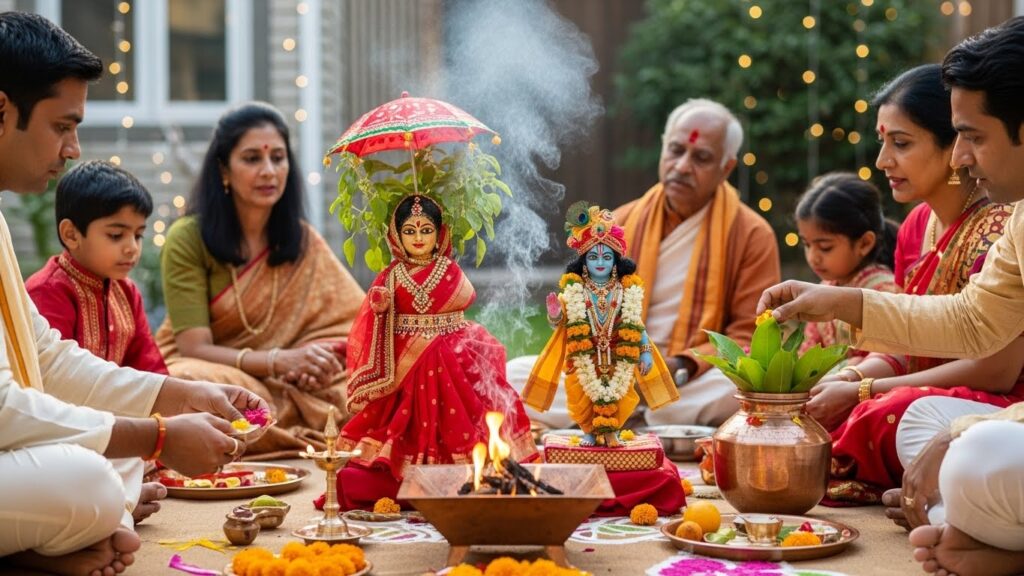
Families begin preparing days in advance by cleaning the home thoroughly, purchasing or preparing new clothes for the Tulsi plant (small sarees or ornaments), gathering wedding supplies (flowers, sweets, fruits, puja materials), and inviting relatives to witness the auspicious ceremony. The Tulsi plant is adorned like a bride with new decorations, and a mandap (ceremonial canopy) is created around it using bamboo sticks or sugarcane stalks, decorated with flowers, mango leaves, and colorful fabrics.
Essential Puja Samagri (Materials Required)
The ceremony requires comprehensive materials: Shaligram stone (representing Vishnu), decorated Tulsi plant, mandap decorations, sacred thread (for ritual tying), kumkum and turmeric, rice grains, flowers (especially marigolds and roses), fruits and sweets, betel leaves and nuts, coconut, ghee lamps and incense, camphor, traditional wedding items (mangalsutra, toe rings, bangles for the Tulsi), wedding invitation cards (some families create formal invitations), prasadam for distribution, and new clothes or ornaments for decorating the Tulsi plant.
The Ceremony Sequence
Step 1 – Ganesh Puja: The ceremony begins with invoking Lord Ganesha to remove obstacles and ensure the wedding’s auspicious completion.
Step 2 – Kalash Sthapana: A sacred pot (kalash) filled with water, coconut, mango leaves, and sacred thread is established, invoking divine presence.
Step 3 – Tulsi and Shaligram Preparation: The Tulsi plant is ceremonially bathed, decorated with new ornaments and clothes, and adorned with flowers and kumkum. The Shaligram stone is similarly bathed, decorated, and placed in an honored position as the groom.
Step 4 – Wedding Rituals: Following traditional Hindu marriage customs, the ceremony includes kanyadaan (giving away the bride, performed by offering Tulsi to Vishnu), mangal phera (circumambulation around sacred fire or the Tulsi plant), applying sindoor (vermillion mark), tying the mangalsutra (sacred wedding necklace around the Tulsi plant), and exchanging garlands between the Tulsi and Shaligram.
Step 5 – Mantras and Prayers: Throughout the ceremony, specific Vedic mantras are chanted, including the Tulsi Vivah mantra and prayers invoking blessings for the divine couple. Traditional wedding songs and bhajans celebrating Vishnu and Tulsi are sung by assembled family members.
Step 6 – Arati and Prasadam: The ceremony concludes with elaborate arati performed before the married couple, followed by distribution of prasadam (sanctified food) to all attendees.
Step 7 – Community Celebration: Many communities organize collective Tulsi Vivah ceremonies in temples or public spaces, creating grand celebrations with multiple Tulsi plants married simultaneously, complete with wedding processions, music, dance, and communal feasting.
Tulsi Vivah 2025: Date, Muhurat, and Timing
For devotees planning their 2025 Tulsi Vivah celebrations, understanding the precise dates and auspicious timings ensures proper observance of this sacred ceremony.
Tulsi Vivah 2025 Date
Tulsi Vivah in 2025 is observed on Sunday, November 2nd, coinciding with Prabodhini Ekadashi (also called Devotthan Ekadashi) during the Kartik month. This date marks the awakening of Lord Vishnu from his four-month cosmic sleep (Yoga Nidra) during Chaturmas, making it the most auspicious timing for the divine marriage.
Muhurat Timing
The most auspicious time window for conducting Tulsi Vivah in 2025:
- Morning Muhurat: 6:30 AM to 8:45 AM
- Afternoon Muhurat: 12:15 PM to 2:30 PM
- Pradosh Muhurat (Most auspicious): 5:30 PM to 7:45 PM
The evening pradosh period is traditionally considered most auspicious for marriage ceremonies, including the divine Tulsi Vivah. However, all three windows are acceptable, with families choosing based on convenience and local traditions.
Ekadashi Tithi Details
The Prabodhini Ekadashi Tithi begins at 6:46 PM on November 1st and ends at 8:32 PM on November 2nd, providing a full day for ceremonial observances.
Beginning of the Wedding Season: Social Significance
Tulsi Vivah holds immense practical significance beyond its spiritual dimensions, as it marks the commencement of the auspicious Hindu wedding season. This social function connects the divine marriage to human celebrations in meaningful ways.
The Chaturmas Period and Its Conclusion
Chaturmas, the four-month period from Ashad Shukla Ekadashi (June-July) to Kartik Shukla Ekadashi (October-November), is considered inauspicious for major celebrations including weddings, thread ceremonies, housewarming, and other significant life-cycle rituals. This period coincides with the Indian monsoon season when travel was historically difficult and agricultural activities consumed community attention. Hindu tradition holds that Lord Vishnu enters Yoga Nidra (cosmic sleep) during Chaturmas, making it inappropriate for auspicious ceremonies requiring divine blessings.
Awakening of Lord Vishnu
Prabodhini Ekadashi marks Vishnu’s awakening from his cosmic slumber, restored to full consciousness and ready to bless devotees’ endeavors. The divine marriage of Tulsi and Vishnu on this day symbolically demonstrates that the Lord is fully awake and participating in worldly affairs again. Following this divine wedding, human marriages and other celebrations can proceed with confidence that divine blessings are available.
Social and Economic Impact
The opening of the wedding season after Tulsi Vivah triggers massive social and economic activity across India. Families begin finalizing marriage arrangements, booking venues, ordering invitations, and scheduling ceremonies. The wedding industry—including venues, caterers, decorators, photographers, and clothing merchants—experiences its busiest period. This tradition demonstrates how religious calendars structure social life and economic cycles, creating rhythms that have organized Hindu civilization for millennia.
Regional Variations and Community Celebrations
While the core significance remains consistent, Tulsi Vivah manifests through diverse regional expressions across India’s cultural landscape, each adding unique elements while maintaining essential spiritual content.
Northern India
In Uttar Pradesh, Bihar, and Madhya Pradesh, elaborate community celebrations include decorated Tulsi platforms in public spaces, collective wedding ceremonies with dozens of Tulsi plants married simultaneously, traditional folk songs celebrating the divine union, and grand feasts distributed as prasadam.
Western India
Maharashtra and Gujarat observe Tulsi Vivah with characteristic regional devotion, incorporating local traditions including specific regional songs, distinctive decoration styles using local materials, and preparation of regional sweets like puran poli, shrikhand, and various traditional delicacies.
Southern India
In Karnataka, Andhra Pradesh, and Tamil Nadu, the ceremony often includes additional rituals specific to regional traditions, with Tulsi worship integrated into broader Kartik month observances and distinct musical traditions accompanying the ceremonies.
Temple Celebrations
Major temples organize grand Tulsi Vivah events attracting thousands of devotees, featuring elaborate decorations transforming temple premises into wedding venues, continuous bhajan and kirtan programs, distribution of massive quantities of prasadam, and cultural programs celebrating the divine marriage through dance and drama.
Contemporary Relevance: Ecology, Devotion, and Culture
In 2025, Tulsi Vivah’s significance extends beyond traditional religious observance to address contemporary concerns about ecology, community cohesion, and cultural continuity.
Environmental Awareness
The ceremony’s emphasis on reverencing a plant offers powerful environmental messaging. By treating Tulsi as a manifestation of the divine feminine worthy of marriage to the Supreme Deity, Hindu tradition implicitly teaches that botanical life deserves profound respect and protection. Environmental activists within Hindu communities increasingly emphasize Tulsi Vivah as demonstrating traditional ecological consciousness, using the ceremony to promote tree planting, organic gardening, and biodiversity conservation.
Community Bonding
Tulsi Vivah celebrations create opportunities for strengthening social ties within Hindu communities. Families gather, neighbors participate together, and collective ceremonies in temples or public spaces foster community identity and cooperation. These social dimensions prove particularly valuable for diaspora communities seeking to maintain cultural connections across generations.
Youth Engagement
Many organizations now structure Tulsi Vivah celebrations to engage younger generations who might feel disconnected from traditional practices. Educational components explaining the mythology, scientific discussions about Tulsi’s medicinal properties, cultural programs, and social media documentation make the tradition accessible and relevant to contemporary youth while transmitting essential cultural knowledge.
Frequently Asked Questions About Tulsi Vivah
Why do Hindus marry Tulsi plant to Vishnu?
Tulsi Vivah commemorates the transformation of the devoted Vrinda into the sacred Tulsi plant after she was blessed by Lord Vishnu following her husband Jalandhara’s death. Vishnu promised to marry Vrinda annually in her Tulsi form to honor her eternal devotion. The ceremony celebrates this divine union, demonstrates the power of pure devotion, marks the end of Chaturmas, and inaugurates the Hindu wedding season. It embodies theological principles about divine immanence in nature and the sacred relationship between deity and devotee.
What is the story behind Tulsi Vivah?
The story originates with Vrinda, a devoted wife whose pativrata dharma made her demon husband Jalandhara invincible. To restore cosmic balance, Vishnu disguised himself as Jalandhara, breaking Vrinda’s faith when she embraced him. Though this enabled Jalandhara’s defeat, Vrinda cursed Vishnu to become a stone (manifesting as Shaligram). Vishnu then blessed her with immortality as the sacred Tulsi plant and promised to marry her annually, transforming tragedy into eternal divine union. This narrative teaches about devotion’s power, divine grace, and redemptive transformation.
When is Tulsi Vivah in 2025 and what is the muhurat?
Tulsi Vivah in 2025 falls on Sunday, November 2nd, coinciding with Prabodhini Ekadashi. The most auspicious muhurats are: Morning (6:30 AM to 8:45 AM), Afternoon (12:15 PM to 2:30 PM), and Pradosh period (5:30 PM to 7:45 PM)—the evening timing being most traditional for wedding ceremonies. The Ekadashi Tithi begins at 6:46 PM on November 1st and ends at 8:32 PM on November 2nd, providing a full day for ceremonial observances.
How do you perform Tulsi Vivah at home?
Begin by decorating the Tulsi plant with new clothes and ornaments like a bride, creating a mandap around it. Prepare a Shaligram stone as the groom. Start with Ganesh puja, establish a kalash, and ceremonially bathe both Tulsi and Shaligram. Perform traditional wedding rituals including kanyadaan, circumambulation, applying sindoor, tying mangalsutra around the Tulsi, and exchanging garlands. Chant specific Vedic mantras and Tulsi Vivah prayers throughout. Conclude with arati and distribute prasadam to all attendees. Many families invite relatives to witness this auspicious divine marriage.
What is Shaligram and why is it used in Tulsi Vivah?
Shaligram is a sacred black stone containing fossilized ammonite shells, naturally formed in Nepal’s Gandaki River. Hindu theology recognizes it as a self-manifested form of Lord Vishnu, created when Vrinda cursed Vishnu to become stone. Shaligrams represent Vishnu without requiring elaborate installation rituals or mantra initiation. In Tulsi Vivah, the Shaligram serves as the groom, representing Vishnu in his promise to marry Tulsi annually. The stone’s natural origin, spiritual significance, and direct association with Vishnu make it the appropriate form for this divine wedding.
Why does the Hindu wedding season begin after Tulsi Vivah?
Tulsi Vivah occurs on Prabodhini Ekadashi, marking Lord Vishnu’s awakening from four-month Yoga Nidra during Chaturmas. This period (June-November) is considered inauspicious for major ceremonies including weddings, as the sleeping deity cannot bless devotees’ endeavors. The divine marriage on awakening day symbolically demonstrates Vishnu’s restored consciousness and readiness to bless human affairs. Following this divine wedding, human marriages can proceed with confidence that divine blessings are fully available, making Tulsi Vivah the gateway to the auspicious wedding season.
What is the significance of Tulsi plant in Hinduism?
Tulsi (Holy Basil) is considered the holiest among all plants in Hindu worship, understood as a manifestation of Goddess Lakshmi and Vrinda’s transformed essence. No Vishnu puja is complete without Tulsi leaves. The plant possesses remarkable medicinal properties recognized in Ayurveda—antimicrobial, immunomodulating, and stress-reducing effects. Traditional households maintain Tulsi with daily worship rituals including water offerings, lamp lighting, and circumambulation. The plant embodies the principle that divine consciousness manifests in botanical form, teaching reverence for all plant life as expressions of the sacred.
Can Tulsi Vivah be performed on any other day besides Prabodhini Ekadashi?
While Prabodhini Ekadashi (Kartik Shukla Ekadashi) is the most traditional and auspicious day for Tulsi Vivah, some communities observe the ceremony throughout the Kartik month or specifically on Kartik Purnima (full moon day). The essential requirement is that the ceremony occur after Chaturmas ends with Prabodhini Ekadashi. Individual families or communities unable to perform the ceremony on the primary date may conduct it on other auspicious days during this period, though Prabodhini Ekadashi carries maximum spiritual efficacy and traditional authenticity.
About the Author
Anjali Deshmukh – PhD in Vedic Studies and Ancient Indian History
Anjali Deshmukh is a distinguished scholar specializing in ancient Indian history, Vedic traditions, and Hindu cultural practices. With over 15 years of research experience focused on decolonizing historical narratives, he has published extensively on temple architecture, Hindu philosophy, botanical symbolism in Hindu worship, and the continuity of Sanatana Dharma traditions. His work bridges academic rigor with accessible presentation, making complex historical, mythological, and philosophical concepts understandable to contemporary audiences seeking authentic knowledge about Hindu civilization and its environmental wisdom.